

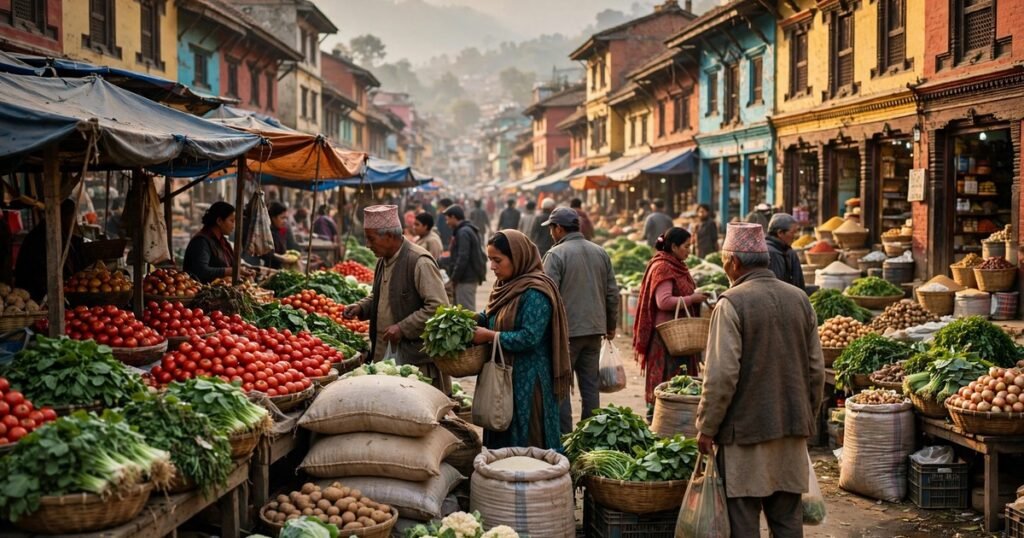
Cost of living in Nepal is the question behind almost every household budget in the country: how much does it actually take to live, month after month, and why does that amount keep moving? The short answer is that prices are rising faster than they were a year ago. Nepal Rastra Bank‘s latest figures put year-on-year consumer price inflation at 6.37 percent in mid-October 2026, up from just 1.47 percent in the same month a year earlier. Food prices rose even faster, at 8.04 percent.
This article breaks down the cost of living in Nepal category by category — housing, food, transport, electricity, education, healthcare and communication — explains what drives each cost, and shows what a typical paycheck actually covers. It does not invent prices: where no official or published source gives a figure, it explains the drivers instead.
Table of Contents
- What the Cost of Living in Nepal Actually Means
- How the Cost of Living in Nepal Is Measured
- Housing and Rent: The Biggest Slice of the Cost of Living in Nepal
- Food and Groceries: Where the Cost of Living in Nepal Bites Hardest
- Transport: Why the Cost of Living in Nepal Moves With Fuel Prices
- Electricity, Water and Cooking Gas
- Education and Healthcare
- Communication: Phones, Data and the Internet
- What a Paycheck Covers: The Cost of Living in Nepal Against the Minimum Wage
- How to Read Your Own Cost of Living in Nepal
- Frequently Asked Questions
Table of Contents
What the Cost of Living in Nepal Actually Means
The cost of living in Nepal is the total amount a household needs to spend to keep up a basic, ordinary life: a roof, food, a way to get to work, light and water, school fees, medicine, and a phone. It is not a single number, because a family in Kathmandu, a farmer in the Tarai, and a student in Pokhara buy different things at different prices.
What the phrase really measures is the price of a typical basket of goods and services, and how that price changes over time. When that basket gets more expensive faster than incomes, living standards fall even if nobody’s salary has been cut. That is exactly what the current inflation figures describe: prices up 6.37 percent in a year, while the legal minimum wage has not moved since July 2025.
How the Cost of Living in Nepal Is Measured
The cost of living in Nepal is tracked through the Consumer Price Index, or CPI, compiled by Nepal Rastra Bank. The index follows the prices of 525 items across 87 market centres, with 2023/24 as its base year. Every month, price collectors record what the same basket costs, and the change from a year earlier is the inflation rate you see in the news. The latest reading, for mid-October 2026, shows overall inflation of 6.37 percent, food and beverage inflation of 8.04 percent, and non-food and services inflation of 5.46 percent. The average for the first three months of the current fiscal year stands at 6.22 percent, against 1.67 percent in the same period last year.
The national average hides real differences. In mid-October 2026, Madhesh Province recorded the highest provincial inflation at 7.37 percent. A month earlier, in mid-September, inflation in the Kathmandu Valley was 5.28 percent, while the Tarai was 6.89 percent, the Hill region 6.41 percent and the Mountain region 5.69 percent. Wholesale prices — what traders pay before goods reach the shops — rose 7.29 percent in mid-October, which usually reaches consumers a little later. For the full picture of how these numbers are built, see our explainer on inflation in Nepal.
Housing and Rent: The Biggest Slice of the Cost of Living in Nepal
For most urban households, housing is the largest single cost, and it is also the hardest to pin down with one number. There is no official rent index for Nepal, and rents vary enormously by neighbourhood, floor, and whether water and parking are included. What can be said with confidence is what drives the price.
Location dominates. Rents are highest in central Kathmandu and Lalitpur, lower in the Valley’s outskirts, and lower still in smaller cities and district headquarters. A room near a university, a hospital or a bus park costs more than the same room a half-hour walk away. Newer buildings with lifts, backup power and reliable water charge more than older ones.
And demand is fed by migration: every year, hundreds of thousands of young Nepalis move to the cities for study and work, and remittance money flowing back from abroad supports families who rent or build in town. None of this means every rent is high — shared rooms, family houses and older buildings keep costs down for many — but it explains why housing is the first thing that strains a household budget, and why the cost of living in Nepal feels so different from one family to the next.
If you are budgeting, treat rent as the fixed cost everything else must fit around. A common rule of thumb used by household-budget advisers is that housing should take no more than about a third of income; in Kathmandu, many families spend more than that, which squeezes food and transport. For a city-by-city look at the trade-offs people actually make, read our companion piece on the cost of living in Nepal’s cities.
Food and Groceries: Where the Cost of Living in Nepal Bites Hardest
Food is where the rising cost of living in Nepal is felt most directly, because it is bought every day and cannot be postponed. Food and beverage inflation reached 8.04 percent in mid-October 2026, and in mid-September the sharpest rises were in ghee and oil, up 16.68 percent in a year, fruit up 15.99 percent, and sugar up 12.14 percent. Cooking oil, in particular, has become the symbol of food-price pressure, because Nepal imports almost all of it.
Several forces push food prices up at once. Nepal imports a large share of its food — rice, lentils, vegetables and edible oil cross the open border from India, so Indian prices and the exchange rate pass straight through to Nepali shops. Transport costs add another layer: every truck journey from the border to a hill market adds to the price on the shelf. Seasonal supply matters too — vegetable prices swing with the harvest — and the 13 percent value-added tax applies to processed and packaged foods, though basic staples are exempt. Read our explainer on VAT in Nepal for how the tax works.
The practical result is that a household’s food bill is the least flexible part of its budget. Families cope by shifting to cheaper staples, buying in bulk at wholesale markets, cooking at home instead of eating out, and growing what they can. None of these are new strategies — they are how Nepali households have always managed — but when food inflation runs at 8 percent, the adjustments get harder, and the poorest households feel it first, because food takes the biggest share of their spending.

Transport: Why the Cost of Living in Nepal Moves With Fuel Prices
Transport inflation was 12.97 percent in mid-October 2026 — the highest of any major category — and it matters twice over: it raises the cost of getting to work, and it raises the price of everything that travels by road. Nepal imports all of its petroleum through Nepal Oil Corporation, which revises retail fuel prices roughly every fortnight based on the rates sent by its sole supplier, Indian Oil Corporation. When international prices rise, the effect reaches Nepali pumps within weeks, and public transport fares and freight charges usually follow.
For most people, the daily transport cost is a bus or microbus fare, a scooter’s petrol, or a taxi on a rainy day. Fares in the Kathmandu Valley are set by the government and revised when fuel prices move, so a fuel rise eventually becomes a fare rise. Outside the Valley, the same logic applies to the buses that connect district headquarters and villages. Long-distance travel is a separate, lumpy cost — a family trip for Dashain or a visit home can cost as much as a week’s groceries — and it is one of the first things households cut when money is tight.
Electricity, Water and Cooking Gas
Electricity is one of the more predictable parts of the cost of living in Nepal, because the tariff is published and fixed. The Nepal Electricity Authority charges domestic consumers on a rising-block tariff: Rs 4.00 per unit for the first 20 units, Rs 6.50 for 21–30 units, Rs 8.00 for 31–50 units, Rs 9.50 for 51–100 and 101–250 units, and Rs 11.00 above 250 units. Households using 20 units or fewer pay nothing for those units under the 5-ampere lifeline, and a 5 percent VAT applies above 50 units. Paying within seven days earns a 2 percent rebate. Our full explainer on the electricity tariff in Nepal works through the bill step by step.
Cooking gas is less predictable. A cylinder of LPG cost Rs 2,060 in October 2026, according to Nepal Oil Corporation, and the corporation has said it loses money on every cylinder it sells, which is why prices are reviewed so often. Water is usually the smallest utility bill for households connected to a municipal supply, but many families in the Valley buy tanker water or bottled water as well, and that cost is rarely counted in official figures. Together, utilities are a modest share of most budgets — but a power cut that forces a family to run a generator, or a dry tap that forces a tanker order, can push the month’s bill up sharply.
Education and Healthcare
Education and healthcare are the two costs that can turn a manageable budget into a difficult one, because both can jump suddenly. School fees vary widely: community schools charge little, while private schools in the cities charge monthly fees, plus admission, books, uniform and transport. Higher education adds its own costs — a student in Kathmandu pays rent and food on top of tuition, which is why so many families support a child studying away from home.
Healthcare works the same way. A routine visit to a health post costs little, but a hospital admission, a course of medicine or a diagnostic test can cost a month’s income at once. The government’s health insurance scheme charges a premium of Rs 3,500 a year for a family of five, covering treatment up to Rs 100,000, and it now covers around a fifth of the population — see our explainer on health insurance in Nepal. Even with insurance, families often pay for medicines and tests out of pocket. The honest way to budget for both education and health is to treat them as irregular but certain costs: they will come, even if the month is unknowable.
Communication: Phones, Data and the Internet
Communication is the newest essential in the cost of living in Nepal, and one of the cheapest relative to its importance. Almost every adult now has a mobile phone, and mobile data is how most Nepalis get online.
Prices are set by competition between the telecom operators and regulated by the Nepal Telecommunications Authority, and data packs have become steadily cheaper per gigabyte even as usage has grown. For many households, the phone bill — a recharge, a data pack, sometimes a home broadband connection — is a small, fixed monthly cost, and it is also the tool that makes other costs manageable: mobile banking, QR payments and online shopping all run through it. That is why the phone is usually the last thing a household gives up when the budget tightens.
What a Paycheck Covers: The Cost of Living in Nepal Against the Minimum Wage
The clearest way to judge the cost of living in Nepal is to set it against what people actually earn. The legal minimum wage is Rs 19,550 a month, in force since 17 July 2025, and it has not changed since. At current prices, that wage must cover rent, food, transport, electricity, cooking gas, school costs and a phone — and for many workers, it does not stretch far enough, which is why second incomes, overtime and remittances matter so much.
Remittances are the quiet support underneath millions of household budgets. In the first three months of the current fiscal year, Nepalis working abroad sent home Rs 703.7 billion, up 27.2 percent on a year earlier, and in the full previous fiscal year remittances reached Rs 2.36 trillion. For families that receive them, remittances pay school fees, build houses and cover the gap when prices rise. For families that do not, the rising cost of living in Nepal is felt in full.
The country’s foreign exchange reserves, at Rs 4.16 trillion in mid-October 2026, cover nearly 20 months of imports — a cushion for the economy as a whole, but not one that reaches a household’s kitchen directly. For the jobs side of this picture, see our explainer on youth unemployment in Nepal.

How to Read Your Own Cost of Living in Nepal
National averages are useful, but your own cost of living is personal. A few habits make it easier to see clearly. First, separate fixed costs from flexible ones: rent, school fees and the phone bill barely move month to month, while food, transport and eating out can be adjusted. Second, track one month honestly — write down every rupee for thirty days, and the real shares will surprise you.
Third, compare prices, not just totals: the same basket costs more in central Kathmandu than in a district town, and a wholesale market visit can cut the weekly food bill. Fourth, remember that inflation is a rate of change, not a price level: 6.37 percent inflation means the basket costs 6.37 percent more than a year ago, not that everything is expensive in absolute terms. And finally, plan for the lumpy costs — Dashain, admissions, a hospital visit — by setting a little aside when months are good, because those are the costs that break a budget when they arrive unannounced.
Frequently Asked Questions
What is the cost of living in Nepal right now?
The cost of living in Nepal is rising: consumer price inflation was 6.37 percent year-on-year in mid-October 2026, with food prices up 8.04 percent and transport up 12.97 percent, according to Nepal Rastra Bank. There is no single official figure for the total monthly cost, because it varies by city, family size and lifestyle.
Is the cost of living in Nepal high compared to incomes?
For many workers it is. The minimum wage is Rs 19,550 a month, unchanged since July 2025, while prices have risen 6.37 percent in a year. Housing and food take the largest shares of most household budgets, and remittances help millions of families bridge the gap.
Which city in Nepal is the most expensive to live in?
Kathmandu is generally the most expensive, especially for rent, followed by Pokhara and other major cities. Smaller towns and rural areas are cheaper, though some goods cost more there because of transport. Our piece on the cost of living in Nepal’s cities compares Kathmandu, Pokhara and Butwal through the lives of three people.
Why is food inflation higher than overall inflation in Nepal?
Food and beverage inflation was 8.04 percent in mid-October 2026, against 6.37 percent overall, because Nepal imports much of its food and cooking oil, so international prices and transport costs pass through quickly. In mid-September, ghee and oil alone were up 16.68 percent in a year.
How much is the minimum wage in Nepal?
The minimum wage is Rs 19,550 per month, in force since 17 July 2025 under the Labour Act 2074. It applies to workers in formal employment; many workers, especially in informal jobs, earn less.
What is the cheapest way to manage the cost of living in Nepal?
Cook at home, buy staples in bulk from wholesale markets, use public transport, pay the electricity bill within seven days for the 2 percent rebate, and keep the first 20 units of electricity use in mind — households using 20 units or fewer pay nothing for them. The biggest savings usually come from housing: sharing a flat or living slightly outside the city centre cuts the largest single cost.
Sources: Nepal Rastra Bank, Current Macroeconomic and Financial Situation (based on three months of data of 2026/27, released 19 November 2026) and Annual Report FY 2025/26 (released 20 November 2026); Nepal Rastra Bank, Current Macroeconomic and Financial Situation (based on two months of data of 2026/27, October 2026); Nepal Electricity Authority domestic consumer tariff (Electricity Regulatory Commission approved); Nepal Oil Corporation press release, 15 October 2026; Government of Nepal, Labour Act 2074 (minimum wage Rs 19,550/month from 17 July 2025); Inland Revenue Department, VAT Act 2052 (13 percent standard rate). Outbound link: Nepal Rastra Bank.