

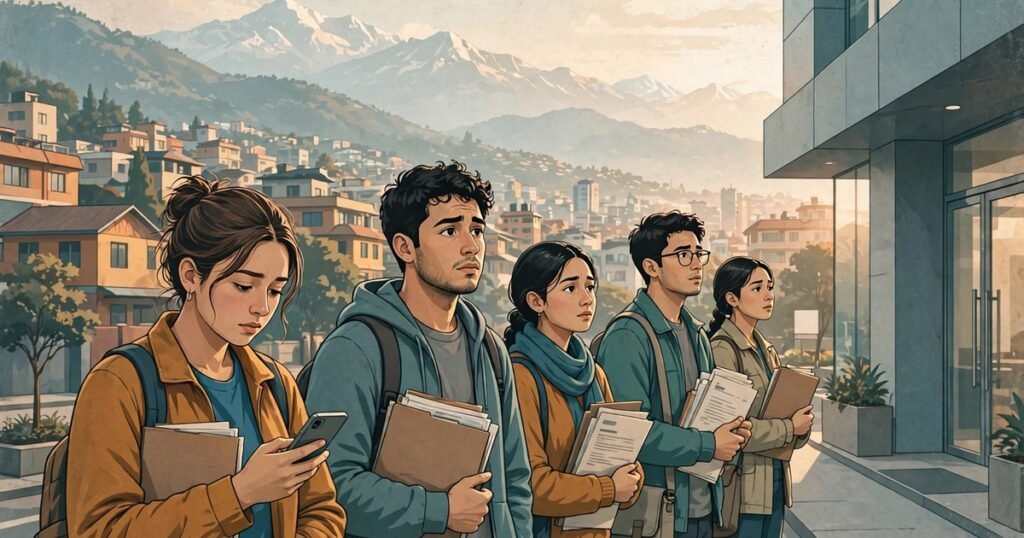
Youth unemployment Nepal is the country’s quiet emergency: about one in five young Nepalis who want work cannot find it, and the problem has outlasted every government, every budget, and every employment programme of the past decade. This guide explains what the numbers actually say, who is hit hardest, why jobs are so scarce, and what could realistically change.
Table of Contents
- Youth Unemployment Nepal: The Numbers
- Youth Unemployment Nepal: Who Is Hit Hardest
- Youth Unemployment Nepal: Why the Jobs Aren’t There
- Youth Unemployment Nepal: The Migration Escape Valve
- Youth Unemployment Nepal: What the Government Is Trying
- Youth Unemployment Nepal: What Could Actually Work
- Frequently Asked Questions
Youth Unemployment Nepal: The Numbers
The most reliable figures on youth unemployment Nepal come from the Nepal Labour Force Survey III, carried out by the Central Bureau of Statistics (CBS) in 2017/18. It is the latest full labour force survey Nepal has conducted, and it remains the benchmark every discussion of jobs in Nepal starts from.
The survey found that 11.4% of Nepal’s labour force was unemployed — about 908,000 people out of a working-age population of 20.7 million. But the headline hides the real story. Among young people aged 15 to 24, the unemployment rate was 21.4% — nearly double the national average. For the 25–34 age group it was 12.7%. In other words, the younger you are in Nepal, the harder it is to find work.
The numbers look different depending on the method used, and that is worth understanding rather than ignoring. The World Bank’s modelled estimates, built from the same survey data with international definitions, put youth unemployment at about 19.6% in 2018 and roughly 20.6% in 2025. The gap between the two figures comes from definitions — who counts as “seeking work” and who counts as “employed” — not from disagreement about the basic picture. By either measure, around one in five young Nepalis in the labour force is unemployed, and that share has barely moved in years.
Scale matters too. About 500,000 young people enter Nepal’s job market every year, according to the United Nations Development Programme, and almost one million workers in total are unemployed. Young people aged 15 to 34 make up 69.1% of all the unemployed. The largest single group of job seekers — 38.1% of them — is aged just 15 to 24.
There is one more number that changes how the problem looks: the share of young people who are not in employment, education, or training at all. In a 2013 school-to-work survey by the International Labour Organization, 11.9% of young Nepalis were in this “NEET” group — neither working nor studying. Young women were far more likely to be in it than young men, at 17.4% against 7.4%. Unemployment alone does not capture the young people who have stopped looking altogether.
Youth Unemployment Nepal: Who Is Hit Hardest
Youth unemployment Nepal does not fall evenly. Where you live, whether you are a man or a woman, and what you studied all change your odds.
Young women face the steepest climb. In 2017, youth unemployment among young women was 23.9%, against 19.7% for young men, according to ILO data based on national estimates. The gap starts earlier: the female labour force participation rate is just 26.3%, about half the male rate of 53.8%. And when women do work, they are paid on average Rs 0.70 for every rupee a man earns for work of equal value, and 90.5% of them are in informal employment, against 81.1% of men. For many young women, the barrier is not only finding a job — it is being allowed into the labour market at all.
Geography matters as well. The 2017/18 survey found youth unemployment slightly higher in urban areas (21.8%) than in rural areas (20.4%). That surprises people who assume cities mean jobs. In practice, cities concentrate the job seekers — graduates, school-leavers, and migrants from the hills — while the work itself is often informal, insecure, and badly paid. Rural unemployment looks lower partly because rural work, however poor, is easier to count as employment: family farming absorbs people who would be openly unemployed in a city.
Education does not protect you the way it should. The survey found the highest unemployment rates among the young and the educated, and the ILO’s school-to-work survey found unemployment highest among those with more schooling. A degree in Nepal is no guarantee of a job — a mismatch between what schools teach and what employers need is one of the most repeated findings in every study of the problem. Graduates queue for a small number of formal jobs while employers complain they cannot find the practical skills they need.

Youth Unemployment Nepal: Why the Jobs Aren’t There
Youth unemployment Nepal is not caused by lazy young people. It is caused by an economy that creates too few formal jobs, and by a labour market in which most work is informal, insecure, and poorly paid.
The economy is not creating enough jobs. Nepal’s economy is dominated by services (about 62% of GDP) and agriculture (about 25.6%), with industry at only around 12.4%, according to national accounts for fiscal year 2024/25. Industry — the sector that historically absorbs young workers in large numbers — is small. The private sector is dominated by micro and small enterprises, most of them unregistered: the Economic Census 2018 found that 49.9% of business establishments were operating without registration with any government authority. Small, informal firms rarely hire formally, train staff, or grow into big employers.
Most “jobs” are not jobs in the formal sense. The 2017/18 survey found that 84.6% of employed Nepalis were in informal employment, and the ILO reported in December 2025 that the share had risen above 86%. Only about 15% of workers have a formal job with a contract, social security, and legal protection. For a young person entering the workforce, the realistic choice is often not between a good job and no job — it is between informal work with no security and no work at all. And informal work pays badly: 41.9% of informal wage workers earned below the minimum-wage benchmark, against 6.9% of formal wage workers.
The minimum wage is widely ignored. The government raised the minimum monthly wage to Rs 19,550 from 17 July 2025 — Rs 12,170 in basic salary plus Rs 7,380 in dearness allowance, under the Labour Act 2074. But the General Federation of Nepalese Trade Unions found in its Labour Audit 2024 that 29% of firms were not paying even the previous minimum of Rs 17,300 a month. A wage floor that a third of employers ignore does little for a young worker’s bargaining power.
Skills and schooling do not match the market. Nepal’s education system produces graduates in large numbers, but employers consistently report shortages of practical, technical, and digital skills. Vocational training reaches only a small share of young people. The result is a paradox visible in every jobs discussion in Nepal: employers say they cannot find skilled workers, while skilled young people say they cannot find work.

Youth Unemployment Nepal: The Migration Escape Valve
When jobs are not available at home, young Nepalis leave — and youth unemployment Nepal is the main reason why. The Department of Foreign Employment issued a record 839,266 labour permits in fiscal year 2024/25. The 2021 census counted 2,190,592 Nepalis as absent from their households, most of them working abroad. More than half a million young people leave the country every year, according to the UNDP.
Migration is also a study story, not just a labour story. Between fiscal year 2018/19 and mid-2024/25, more than 543,833 Nepali students obtained No Objection Certificates to study abroad, spending about Rs 493.09 billion on foreign education, according to the Ministry of Education, Science and Technology and Nepal Rastra Bank data. Many of those students never return.
Read our explainer on Nepal’s labour migration for the full picture of how the permit system, the risks, and the reforms work — and our piece on Bidesh Syndrome for why staying in Nepal feels riskier than leaving for so many young people.
This outflow has a cost that rarely appears in the unemployment figures. Remittance now brings in more than Rs 2.3 trillion a year — about a quarter of GDP — and it keeps millions of households afloat. But it also drains the country of its most energetic workers, and it masks the failure to create jobs at home. A country that exports its young people is not solving youth unemployment; it is exporting it.
Youth Unemployment Nepal: What the Government Is Trying
The government is not short of programmes for youth unemployment Nepal. The question is whether they reach enough young people, and whether they create lasting work.
The Prime Minister Employment Programme (PMEP) is the flagship. Launched on 13 February 2019 under the Employment Rights Act 2075, it guarantees a minimum of 100 days of employment a year to unemployed citizens aged 18 to 59, with a subsistence allowance of 50% of the minimum wage for 100 days if the government cannot provide the work. The fiscal year 2025/26 budget expanded the programme to reach 200,000 young people. In practice, the programme has been criticised for short-term, low-skill work — road maintenance and community projects — that ends when the 100 days end, and for spending that has often been slow to reach local levels.
Loans and startups. The fiscal year 2025/26 budget introduced collateral-free loans of Rs 200,000 to Rs 2 million at 3% annual interest for educated young people wanting to start a business, alongside Rs 730 million for startup promotion. The fiscal year 2083/84 policy and programme goes further, proposing a “Startup Nepal” digital platform with one-day company registration, tax facilitation, and seed funding, plus a 50% tax exemption on income from IT service exports. These are real steps toward self-employment — but a loan is only useful if a young person has a business idea, a market, and the skills to run it.
The budget’s growth bet. The fiscal year 2083/84 budget totals Rs 2.124 trillion and targets 7% economic growth, with productive employment, private-sector-led growth, and digital transformation at its centre. The finance minister has said the budget is designed to end the compulsion for young Nepalis to leave the country to fulfil their ambitions. Whether that happens depends on implementation — budgets in Nepal have a long record of ambitious announcements and weak delivery, with capital spending chronically under-spent.
The constitutional promise. The Constitution of Nepal guarantees the right to employment as a fundamental right. That promise is the legal basis for the PMEP and the Employment Rights Act — and it is also a reminder that the state has accepted a duty to act on jobs, not merely to hope the market provides them.
Youth Unemployment Nepal: What Could Actually Work
No single policy will fix youth unemployment Nepal. But the evidence from Nepal and from other countries points to a few things that would make a real difference.
- Grow the formal private sector. The single biggest lever is more formal firms that hire formally. That means simpler registration, reliable electricity, access to credit, and predictable rules — the unglamorous plumbing of a business environment. Every percentage point of industry’s share of GDP matters, because industry and modern services are where formal youth jobs come from.
- Fix the skills mismatch. Technical and vocational training needs to reach far more young people, and it needs to be tied to what employers actually need — digital skills, construction trades, hospitality, health care, and the green economy. Short, practical courses with work placements beat long, theory-heavy programmes that end in a certificate no employer asks for.
- Make informal work safer while formalising it. With more than 86% of workers informal, waiting for formalisation alone is not a plan. Extending social security to informal workers — the Social Security Fund’s voluntary scheme for the self-employed and informal workers has enrolled only a few thousand people so far — would make the work young people actually do less precarious. Read our explainer on Nepal’s social security fund for how the system works.
- Support young entrepreneurs properly. Loans help, but only alongside mentoring, market access, and simple compliance. The “Startup Nepal” one-day registration idea is a good start; the test will be whether a young person in Butwal or Dhangadhi can actually register, borrow, and operate a business without months of paperwork.
- Keep young women in the workforce. Childcare, safe transport, and enforcement of equal-pay rules would raise female participation from its current 26.3% — and every point of participation is hundreds of thousands of workers added to the economy.
- Measure it properly. Nepal has not run a full labour force survey since 2017/18. The country is debating a problem it last measured in detail eight years ago. A new labour force survey is overdue, and without it, policy is guesswork.
Youth unemployment Nepal is not a mystery. The numbers are clear, the causes are documented, and the fixes are known. What has been missing is the sustained, boring work of building an economy that hires its young people — not for 100 days, but for a career.
Frequently Asked Questions
What is the youth unemployment rate in Nepal?
About 21.4% of young people aged 15 to 24 who are in the labour force were unemployed, according to the Nepal Labour Force Survey 2017/18 by the Central Bureau of Statistics. World Bank modelled estimates put the figure at roughly 20.6% in 2025. The two figures use different definitions, but both point to about one in five young workers without a job.
How many young Nepalis are unemployed?
About 908,000 people in total were unemployed at the time of the 2017/18 survey, and 69.1% of all unemployed people were aged 15 to 34. About 500,000 young people enter the job market every year, and the largest single group of job seekers — 38.1% — is aged 15 to 24.
Why is youth unemployment so high in Nepal?
The main causes are too few formal jobs, a small industrial sector, a mismatch between education and employer needs, and a labour market in which 84.6% of work is informal. Most young people end up choosing between insecure informal work and no work at all.
Do educated young people in Nepal face unemployment too?
Yes. Unemployment is highest among the young and the educated, because the formal jobs graduates expect are few, and the skills schools teach often do not match what employers need. That is why so many graduates look abroad.
What is the government doing about youth unemployment in Nepal?
The main programmes are the Prime Minister Employment Programme, which guarantees 100 days of work a year to unemployed citizens aged 18 to 59, collateral-free loans of Rs 200,000 to Rs 2 million at 3% interest for educated youth, and startup support including the proposed “Startup Nepal” platform. The fiscal year 2083/84 budget targets 7% growth with employment at its centre.
What is the minimum wage in Nepal?
Rs 19,550 a month from 17 July 2025, made up of Rs 12,170 basic salary and Rs 7,380 dearness allowance, under the Labour Act 2074. However, a 2024 trade union audit found 29% of firms were not paying even the previous minimum of Rs 17,300.
Sources
- Central Bureau of Statistics, Nepal Labour Force Survey III, 2017/18 — unemployment 11.4%; youth 15–24 unemployment 21.4% (urban 21.8%, rural 20.4%); 25–34 unemployment 12.7%; informal employment 84.6%.
- World Bank, World Development Indicators — youth unemployment (modelled ILO estimate), Nepal, ~19.6% (2018), ~20.6% (2025).
- International Labour Organization, School-to-Work Transition Survey, Nepal, 2013 — NEET rate 11.9% (young women 17.4%, young men 7.4%).
- ILOSTAT — youth unemployment by sex, Nepal, 2017: young women 23.9%, young men 19.7%.
- UNDP, SDG Insights: Nepal — ~500,000 youth entering the job market yearly; 69.1% of unemployed aged 15–34; female labour force participation 26.3% vs male 53.8%; women paid Rs 0.70 per rupee earned by men.
- International Labour Organization, December 2025 — over 86% of Nepal’s workers in informal employment; 41.9% of informal wage workers below the minimum-wage benchmark.
- Department of Foreign Employment — 839,266 labour permits issued in FY 2024/25 (record).
- National Statistics Office, National Population and Housing Census 2021 — 2,190,592 absent population.
- Ministry of Education, Science and Technology / Nepal Rastra Bank — 543,833 No Objection Certificates FY 2018/19 to mid-2024/25; Rs 493.09 billion spent on foreign education.
- Ministry of Labour, Employment and Social Security — minimum wage Rs 19,550/month from 17 July 2025 (Labour Act 2074, Sections 106–107).
- General Federation of Nepalese Trade Unions, Labour Audit 2024 — 29% of firms not paying the minimum wage.
- Employment Rights Act 2075; Prime Minister Employment Programme, launched 13 February 2019 — 100 days of employment for ages 18–59; subsistence allowance 50% of minimum wage.
- Ministry of Finance, Budget FY 2025/26 — PMEP expanded to 200,000 youths; collateral-free loans Rs 200,000–2 million at 3%; Rs 730 million for startups.
- Government of Nepal, Policy and Programme FY 2083/84; Citizen Budget FY 2083/84 — Rs 2.124 trillion; 7% growth target; “Startup Nepal” platform; 50% tax exemption on IT service exports.
- Constitution of Nepal 2015 — right to employment as a fundamental right.
- Economic Census 2018 — 49.9% of business establishments unregistered.