


VAT Nepal explained simply: it is the 13% tax added to the price of most goods and services you buy, collected a little at a time by every business along the way, and paid in the end by you, the final customer. Every time you eat at a restaurant, buy a phone, or pay a hotel bill, a line on the receipt usually shows 13% VAT. This guide explains, in plain language, what that line means, who has to charge it, what escapes it, and where the money goes.
Table of Contents
- VAT Nepal Explained: What It Is
- VAT Nepal Explained: The 13% Rate and a Short History
- VAT Nepal Explained: Who Has to Register
- VAT Nepal Explained: What Is Exempt and What Is Zero-Rated
- VAT Nepal Explained: How the Tax Reaches the Government
- VAT Nepal Explained: Why It Matters to You
- Frequently Asked Questions
- Sources
Table of Contents
VAT Nepal Explained: What It Is
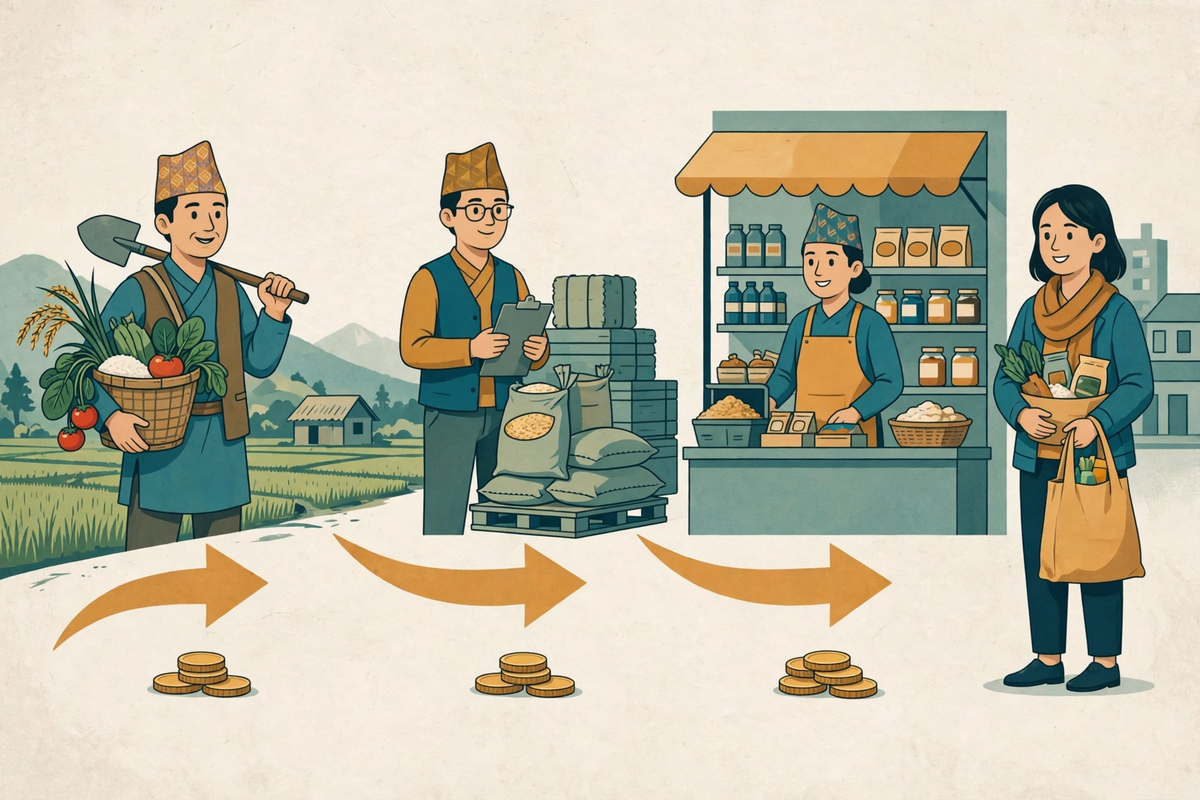
VAT — value added tax — is an indirect tax on consumption. “Indirect” means the government does not collect it from you directly. Instead, businesses charge it on their sales and pass it on to the tax office. “Value added” is the key idea: at each step of making and selling something, a business adds value, and the tax applies only to that added value, not to the full price over and over again.
Here is how it works with a simple example. A shopkeeper buys 100 notebooks from a wholesaler for Rs 100,000, plus 13% VAT — Rs 13,000. That Rs 13,000 is called input tax: tax the shopkeeper paid on purchases. She then sells the notebooks for Rs 150,000, plus 13% VAT — Rs 19,500. That is output tax: tax she collected from her customers.
At the end of the month she does not hand over the full Rs 19,500. She subtracts the Rs 13,000 she already paid, and sends the difference — Rs 6,500 — to the government. That Rs 6,500 is exactly 13% of the Rs 50,000 of value she added. The wholesaler did the same before her, and the customer at the end of the chain cannot deduct anything, so the final buyer carries the whole tax. That is why VAT is called a tax on the consumer, even though businesses do the paperwork.
VAT Nepal explained this way also shows why the system needs invoices. Every business in the chain must issue a proper tax invoice showing the VAT separately, because the next business needs that invoice to claim its input credit. Without the paper trail, the chain breaks — which is why the Inland Revenue Department insists on VAT invoices and electronic billing.
VAT Nepal Explained: The 13% Rate and a Short History
Nepal has a single standard VAT rate: 13%. It applies to almost every taxable good and service, from a bottle of shampoo to a hotel room. There are no multiple rates for different goods, as some countries have — just 13%, a zero rate for exports, and exemptions for a list of basic goods and services.
The tax is governed by the Value Added Tax Act, 2052 (1996), and the VAT Rules, 2053. VAT began in Nepal on 16 November 1997, replacing the old sales tax. The 13% rate has remained unchanged since it was introduced — every annual Finance Act since then has left it alone, even while thresholds, exemptions and penalties have been adjusted. That stability is part of why VAT has become the backbone of Nepal’s tax system: businesses and consumers both know what to expect.
Two things are worth keeping straight. First, VAT is an indirect tax on spending. Income tax, by contrast, is a direct tax on what you earn — our guide to Nepal’s income tax slabs for 2026/27 explains that side of the system. Second, VAT is charged on imports as well as on goods made in Nepal. When goods cross the border, customs collects the VAT before they enter the market, and the Inland Revenue Department (IRD), under the Ministry of Finance, administers the system inside the country.
VAT Nepal Explained: Who Has to Register
Not every business charges VAT. A business must register for VAT — and start charging 13% on its sales — once its annual turnover crosses a threshold set by law. For a business that sells goods, the threshold is annual turnover above Rs 50 lakh (Rs 5 million). For services, or a mix of goods and services, the threshold is Rs 30 lakh (Rs 3 million). The services threshold was raised from Rs 20 lakh to Rs 30 lakh by the Finance Act 2081, so older guides that still say Rs 20 lakh are out of date. A business that crosses the threshold must register within 30 days.
Some businesses must register regardless of turnover. Importers of taxable goods, for example, register from their first import. Certain specified sectors — such as producers of some excisable goods — must also register from the first sale. And foreign companies that sell digital services to Nepali consumers, such as streaming or software subscriptions, must register for VAT in Nepal and charge 13% on those sales. The separate 2% digital service tax on the income of non-resident digital providers is a different, direct tax — it is not VAT.
Businesses below the threshold do not have to register, but they may choose to register voluntarily. Why would a small business volunteer for tax? Because registration lets it claim back the VAT it pays on its own purchases. A small manufacturer that buys raw materials with VAT on them can only recover that VAT if it is registered. Voluntary registration is a business decision, not a legal duty.
VAT Nepal Explained: What Is Exempt and What Is Zero-Rated
VAT Nepal explained honestly has to admit that not everything carries the 13%. The law divides goods and services into three groups: taxable at 13%, zero-rated at 0%, and exempt — no VAT at all. The distinction matters, and people often mix up the last two.
Exempt goods and services are listed in Schedule 1 of the VAT Act. They are outside the VAT system altogether, and a business that sells only exempt goods does not need to register for VAT.
The list is deliberately built around daily life: basic agricultural products such as paddy, rice, wheat, maize, millet, pulses, fresh vegetables and fruits; goods of basic needs such as piped water, fuel wood, coal and salt; medicines and medical services; education; books, newspapers and printed materials; financial and insurance services; the purchase and renting of land and buildings; and personal services such as those of writers, translators and entertainers. That is why the rice and vegetables you buy loose in the market carry no VAT, while the same items served in a restaurant do — the exemption covers the raw product, not the cooked meal.
Zero-rated goods and services, listed in Schedule 2, are taxed at 0% — which sounds the same as exempt, but works differently. A business selling zero-rated goods is inside the VAT system: it must register, issue VAT invoices, and — crucially — it can claim back the VAT it paid on its purchases. The main zero-rated category is exports: goods and services sold outside Nepal, and services supplied to people outside Nepal, carry 0% VAT so that Nepali exports are not burdened by domestic tax before they compete abroad. Goods imported by diplomatic missions are also zero-rated. The rule of thumb is simple: exemption protects basic needs at home, zero-rating protects exports abroad.

VAT Nepal Explained: How the Tax Reaches the Government
Once a business is registered, its main monthly job is the VAT return. Returns are filed online through the Inland Revenue Department’s portal at ird.gov.np, and the deadline is the 25th day of the following Nepali month. A return for Shrawan, for example, is due by 25 Bhadra. In the return the business reports its total sales, the output VAT it collected, and the input VAT it paid on purchases; it pays the difference. If it paid more input VAT than it collected — common for exporters, whose sales are zero-rated — it can carry the credit forward or claim a refund.
VAT is also collected at the border. The Department of Customs charges 13% VAT on the value of imported goods, so a large share of the country’s VAT is collected before goods ever reach a shop shelf. Together, the customs point and the monthly return are the two doors through which VAT enters the treasury.
Where does it go after that? VAT is a divisible revenue, shared between the three tiers of government under the Intergovernmental Fiscal Arrangement Act, 2074. Of the VAT and excise collected on domestic products, 70% stays with the federal government, 15% goes to the provinces and 15% to local levels. Our guide to how local governments spend your tax money follows that 15% share to the 753 municipalities and rural municipalities. The money then pays for the things the budget promises — salaries, schools, hospitals, roads and debt payments — which is why VAT, a tax most people never think about, ends up funding a large part of what the state does.
VAT Nepal Explained: Why It Matters to You
VAT is the single largest source of government revenue in Nepal. The Economic Survey for fiscal year 2082/83 reports that VAT made up 68.2% of all divisible revenue shared between the three tiers of government in FY 2081/82, far ahead of excise duty at 24.4%. In the first seven months of FY 2082/83, VAT collection reached Rs 196.44 billion, up 7.58% from the same period a year earlier, according to the Ministry of Finance’s revenue data. Total revenue from all three tiers of government was Rs 1.281 trillion in FY 2081/82, up 11.4% on the year before.
For an ordinary person, VAT matters in three practical ways. First, it is in almost every price you pay, so the 13% line on a bill is not a shop’s surcharge — it is a tax, and the shop is only collecting it. Second, the invoice matters: a proper VAT invoice, showing the seller’s PAN and the VAT amount separately, is your proof that the tax was charged correctly, and it is the document a registered buyer needs to claim input credit.
Third, VAT is regressive in a way worth knowing about: because everyone pays the same 13% on a purchase, the tax takes a bigger share of a poor person’s income than a rich person’s. That is exactly why the exemption list exists — keeping rice, vegetables, medicines, education and drinking water out of VAT is the system’s main way of softening that effect.
VAT Nepal explained in one line is this: a 13% tax, charged at every stage of making and selling, paid in the end by the consumer, and big enough to fund more of the state than any other single tax. Knowing how it works will not make the bill smaller — but it will tell you what you are paying for, and where to look when the numbers on the receipt do not add up.
Frequently Asked Questions
What is VAT in Nepal?
VAT Nepal explained simply is a 13% consumption tax on most goods and services, governed by the Value Added Tax Act, 2052. Businesses charge it on sales, deduct the VAT they paid on purchases, and send the difference to the Inland Revenue Department. The final consumer bears the cost.
What is the VAT rate in Nepal?
The standard VAT rate in Nepal is 13%, unchanged since VAT was introduced on 16 November 1997. Exports are zero-rated at 0%, and basic goods and services listed in Schedule 1 of the VAT Act are exempt.
Who has to register for VAT in Nepal?
A business selling goods must register once annual turnover exceeds Rs 50 lakh; for services or mixed supplies the threshold is Rs 30 lakh. Importers and some specified sectors must register from the first transaction, and registration is required within 30 days of crossing the threshold.
What is exempt from VAT in Nepal?
Basic agricultural products (rice, wheat, maize, pulses, fresh vegetables and fruits), goods of basic needs (piped water, fuel wood, salt), medicines and medical services, education, books and newspapers, financial and insurance services, and the purchase or renting of land and buildings are exempt under Schedule 1 of the VAT Act.
What is the difference between zero-rated and exempt?
Zero-rated sales (mainly exports) are charged VAT at 0% and the seller can claim back input VAT. Exempt sales carry no VAT at all and the seller cannot claim back input VAT on related purchases.
When is the VAT return due in Nepal?
VAT returns are filed monthly, online through the Inland Revenue Department’s portal, by the 25th day of the following Nepali month.
How much VAT does Nepal collect?
VAT is Nepal’s largest single source of revenue. In the first seven months of FY 2082/83, VAT collection was Rs 196.44 billion, up 7.58% year on year, and VAT made up 68.2% of the divisible revenue shared between federal, provincial and local governments in FY 2081/82.
Sources
- Value Added Tax Act, 2052 (1996) and Value Added Tax Rules, 2053 — Schedules 1 and 2; Nepal Law Commission / Inland Revenue Department — ird.gov.np
- Ministry of Finance, Economic Survey 2082/83 (presented 27 May 2026) — revenue collection Rs 1.281 trillion in FY 2081/82; VAT 68.2% of divisible revenue
- Ministry of Finance, Revenue Management Information System, first seven months of FY 2082/83 — VAT collection Rs 196.44 billion, up 7.58% year on year
- Finance Act 2081 — services VAT registration threshold raised from Rs 20 lakh to Rs 30 lakh
- Intergovernmental Fiscal Arrangement Act, 2074 — VAT and excise sharing 70% federal, 15% province, 15% local
- Inland Revenue Department, VAT registration and return-filing guidance — ird.gov.np