


Inflation Nepal explained simply: inflation is the rate at which the general level of prices rises, so the same amount of money buys a little less than it did before. When Nepal Rastra Bank reported year-on-year consumer price inflation of 6.34 percent in mid-September 2026, it meant that a basket of goods and services costing Rs 100 a year earlier cost about Rs 106.34. That number shapes household budgets, business costs, and government policy.
This article explains what inflation is, how Nepal measures it, why prices have been rising through 2026, and what the number means for your money — using figures from Nepal Rastra Bank’s own monthly reports.
Table of Contents
- Inflation Nepal Explained: What the Number Actually Means
- Inflation Nepal Explained: How the CPI Basket Works
- Inflation Nepal Explained: Why Prices Are Rising Now
- Inflation Nepal Explained: Who Feels It Most
- How Nepal Rastra Bank Responds to Inflation
- Inflation Nepal Explained: What It Means for Your Money
- Frequently Asked Questions
Inflation Nepal Explained: What the Number Actually Means
Inflation is not the price of one thing going up. It is the average rise in prices across the whole economy — what happened to the typical household’s spending overall, even if some individual prices fell.
Two versions of the number matter, and confusing them causes most of the misunderstanding. The year-on-year rate compares prices this month with the same month last year — the 6.34 percent figure from mid-September 2026 is a year-on-year rate. The annual average rate averages inflation over the whole fiscal year: for 2025/26 it was 3.08 percent, down from 4.06 percent the year before. So the year as a whole was calm, even though prices accelerated sharply in its final months. A low annual average can hide a fast rise at the end of the year — the average tells you how the year felt, while the year-on-year rate tells you where prices are heading right now.
Inflation Nepal Explained: How the CPI Basket Works
Nepal measures inflation with the Consumer Price Index (CPI), compiled by Nepal Rastra Bank since 1973/74 and rebased most recently in 2024, when the base year moved from 2014/15 to 2023/24.
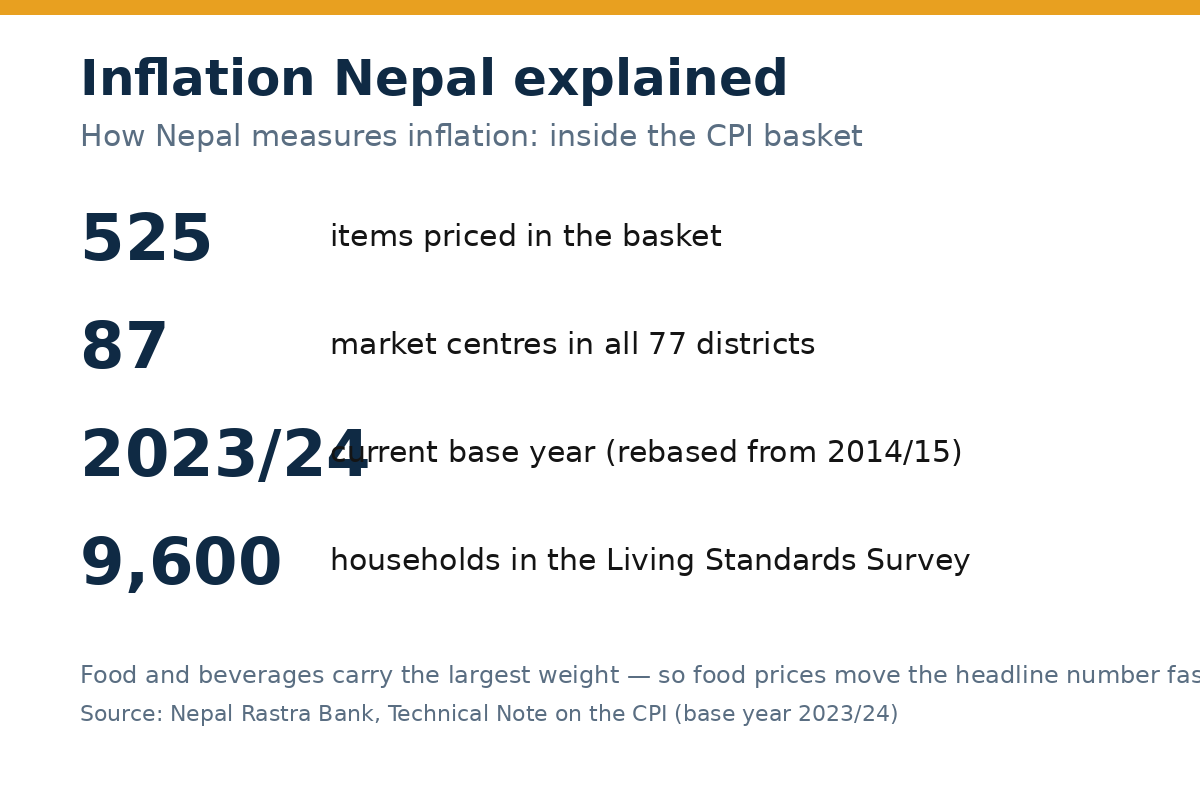
The method is straightforward. The central bank tracks the prices of a fixed basket of goods and services that a typical household buys — 525 items grouped into 249 commodities, from rice and cooking oil to rent, school fees, and bus fares. Prices are collected from 87 market centres across all 77 districts. The weights — how much each item counts — come from the Nepal Living Standards Survey IV, conducted by the National Statistics Office in 2022/23 among 9,600 households. Food and beverages carry the largest single weight, which is why a bad harvest or a jump in cooking-oil prices moves the headline number so fast.
Prices are collected weekly for perishable items such as vegetables, monthly for most goods, and quarterly for services. Each month, Nepal Rastra Bank compares the cost of the basket with the same month a year earlier and publishes the result in its Current Macroeconomic and Financial Situation report — the source for every figure in this article. A second index, the Wholesale Price Index, tracks prices at the wholesale level and often moves first: wholesale inflation stood at 8.08 percent in mid-September 2026, up from 2.10 percent a year earlier, suggesting retail price pressure may continue.
Inflation Nepal Explained: Why Prices Are Rising Now
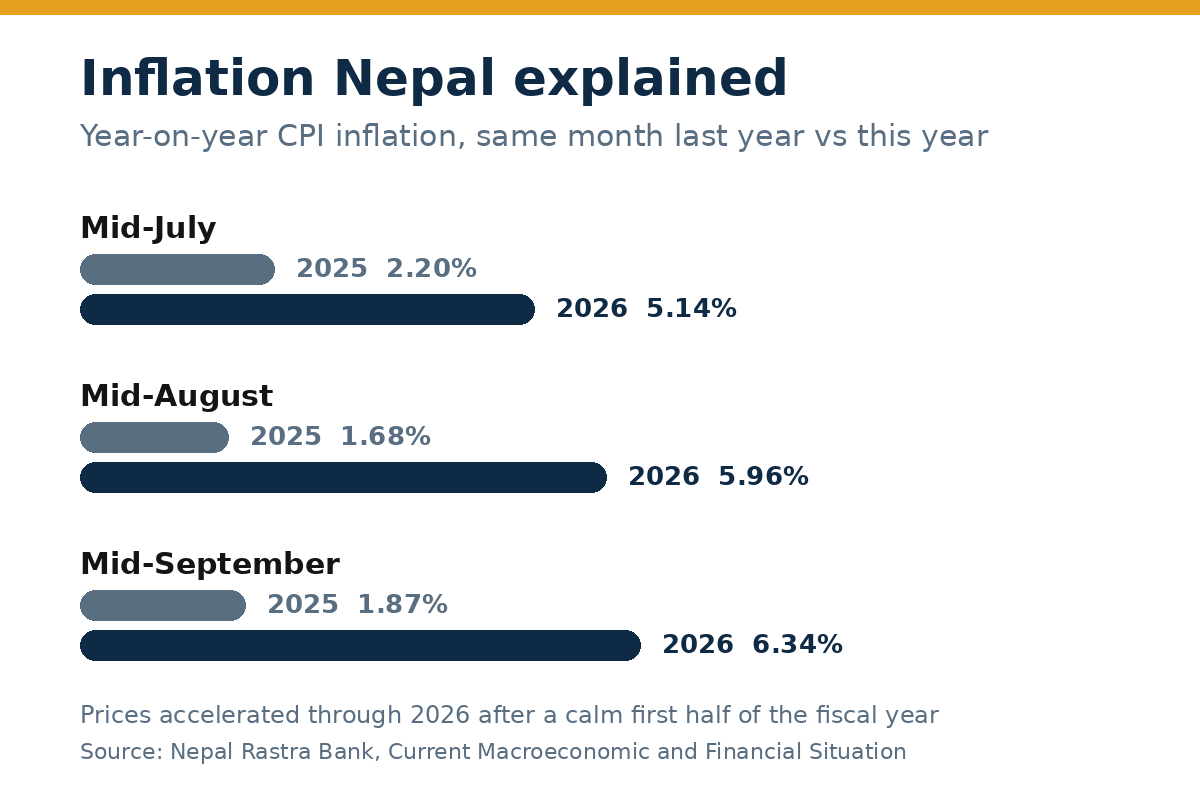
Inflation was low for most of fiscal year 2025/26 — 1.68 percent in mid-August 2025 and 2.20 percent in mid-July 2025 — then climbed month by month: 5.14 percent in mid-July 2026, 5.96 percent in mid-August, and 6.34 percent in mid-September.
Food is doing most of the pushing. Food and beverage prices rose 7.54 percent year-on-year in mid-September 2026, while non-food items and services rose 5.69 percent. Within food, the sharpest rises were in ghee and oil, up 16.68 percent, fruits, up 15.99 percent, and sugar, up 12.14 percent. Nepal Rastra Bank linked the rise to higher food prices and supply disruptions caused by floods and landslides, which damaged crops and cut transport links.
Transport is the other big driver. Transport prices rose 12.77 percent year-on-year in mid-September 2026, the highest increase of any non-food category. Because Nepal imports almost all of its fuel and much of its food, global prices feed into domestic prices quickly — and because the Nepali rupee is pegged to the Indian rupee, inflation in India passes through too. India’s year-on-year consumer inflation was 4.45 percent in July 2026, below Nepal’s 5.14 percent that month.
The outlook is cautious: the budget for fiscal year 2026/27 assumes inflation stays within 6 percent, and Nepal Rastra Bank expects an average of about 5.5 percent for the year.
Inflation Nepal Explained: Who Feels It Most
Inflation does not hit everyone equally. In mid-September 2026, prices rose 6.78 percent year-on-year in rural areas, compared with 6.19 percent in urban areas. Rural households spend a larger share of their income on food, so food price rises hurt them more. The provinces differ too: in mid-July 2026, Madhesh recorded the highest year-on-year inflation of any province, at 5.94 percent.
The people who feel inflation most are those whose incomes do not rise with prices: daily-wage workers, pensioners on fixed incomes, and households that spend most of their budget on food and transport. A worker whose pay rises 5 percent while prices rise 6.34 percent is, in real terms, worse off — which is why inflation is not just a statistic, but a measure of how much living standards are being squeezed.
How Nepal Rastra Bank Responds to Inflation
Nepal Rastra Bank’s job is to keep inflation under control while supporting economic growth, and inflation Nepal explained through the central bank’s lens comes down to one main tool: the interest rate. When inflation rises, the central bank can raise rates, which makes borrowing more expensive and cools spending. To understand how that works in practice, read our explainer on how Nepal Rastra Bank sets interest rates.
The central bank also uses open market operations — buying and selling securities to manage the amount of money in the banking system — and it manages the foreign exchange reserves behind the rupee’s peg to the Indian rupee. The peg keeps imported inflation from India in check, but it also means Nepal cannot fully escape price rises in its largest trading partner. The government has a role as well: the budget targets inflation within 6 percent, and food supply management and transport infrastructure can ease the floods, fuel costs, and broken supply chains that push prices up.
Inflation Nepal Explained: What It Means for Your Money
Inflation changes the value of everything you hold and owe. Savings earn interest, but if inflation is higher than the interest rate, the real value of those savings falls — a fixed deposit paying 5 percent while inflation runs at 6.34 percent loses purchasing power. Loans work the other way: inflation makes fixed repayments cheaper in real terms, which is one reason borrowers welcome moderate inflation while savers do not.
For households, the practical response is to track where the money actually goes: when food and transport — the two categories rising fastest in 2026 — take up a bigger share of the budget, the squeeze shows up before any official statistic does. Keeping an emergency buffer, comparing prices, and avoiding unnecessary borrowing when interest rates are high are the basic defences.
Moderate inflation is normal: prices that rise a little each year encourage spending and investment, while falling prices — deflation — can freeze an economy as people delay purchases. The danger is when inflation runs well above target for a long time, because it erodes wages, savings, and trust in money itself. Nepal’s 3.08 percent annual average for 2025/26 sits in the moderate range; the question is whether the 6.34 percent reading of mid-September 2026 is a temporary spike or the start of a longer climb. For the broader picture, see our guide to reading Nepal’s GDP.
Frequently Asked Questions
What is the current inflation rate in Nepal?
Inflation Nepal explained in one line: year-on-year consumer price inflation stood at 6.34 percent in mid-September 2026, according to Nepal Rastra Bank, up from 1.87 percent a year earlier. The annual average for fiscal year 2025/26 was 3.08 percent.
How is inflation measured in Nepal?
Inflation is measured with the Consumer Price Index, compiled by Nepal Rastra Bank. It tracks 525 items in a fixed basket, priced at 87 market centres in all 77 districts, weighted by the National Statistics Office’s Living Standards Survey.
Why is inflation rising in Nepal in 2026?
Inflation Nepal explained for 2026 comes down to two drivers: food and transport. Food and beverage prices rose 7.54 percent year-on-year in mid-September 2026, transport rose 12.77 percent, and floods and landslides disrupted supplies. Wholesale prices, up 8.08 percent, point to continued pressure.
Does inflation affect rural and urban Nepal differently?
Yes. In mid-September 2026, rural inflation was 6.78 percent against 6.19 percent in urban areas, because rural households spend a larger share of their income on food.
What can Nepal Rastra Bank do about inflation?
It can raise interest rates to cool spending, manage money supply through open market operations, and protect the exchange rate. The government can also ease supply problems in food and transport that push prices up.
Sources: Nepal Rastra Bank, Current Macroeconomic and Financial Situation reports (annual data, mid-July 2026; monthly data to mid-September 2026) — see nrb.org.np; Nepal Rastra Bank, Technical Note on the Consumer Price Index (base year 2023/24). Year-on-year rates compare each month with the same month a year earlier.