

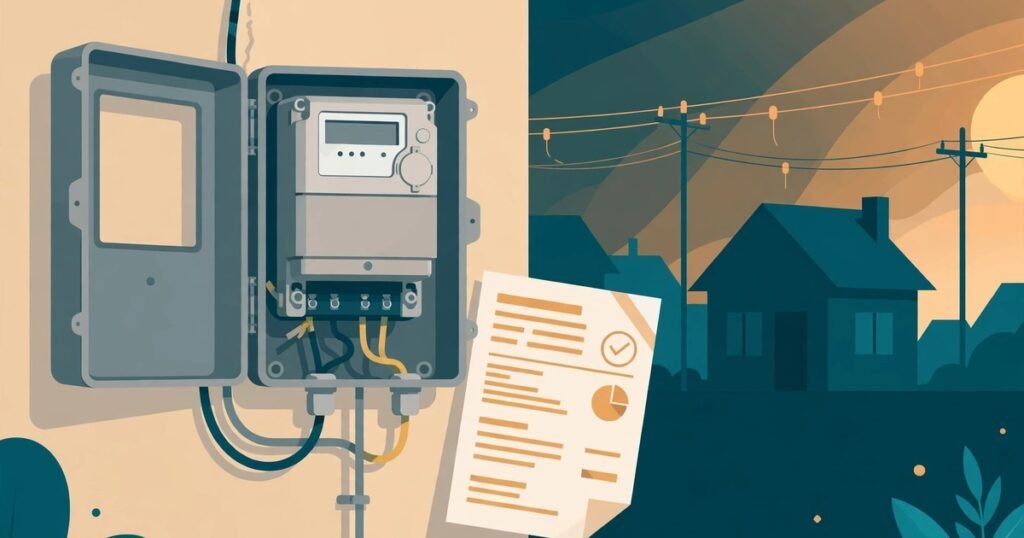
Nepal electricity tariff explained in plain language: your monthly bill is not one flat rate per unit. It is built slab by slab — the first units are cheap, later units cost more — plus one monthly minimum charge that depends on the size of your meter. Once you understand the six slabs, you can check any NEA bill in about a minute, and you can see exactly why a geyser or a room heater pushes the total up so fast.
On this page
- Nepal electricity tariff explained: the six slabs
- Nepal electricity tariff explained: the minimum charge
- Nepal electricity tariff explained: three worked examples
- Nepal electricity tariff explained: VAT, rebate and late fees
- Nepal electricity tariff explained: who sets the rates
- Nepal electricity tariff explained: how to lower your bill
- Frequently asked questions
Table of Contents
Nepal electricity tariff explained: the six slabs
The Nepal Electricity Authority (NEA) bills domestic customers on a progressive, or slab, system. Each block of units you use in a month is charged at its own rate. Only the units inside a block pay that block’s rate — so crossing into a higher slab does not make your earlier units more expensive. That is the single most misunderstood part of the bill, and the rest of this Nepal electricity tariff explained guide takes each piece in turn.
The domestic single-phase tariff (230 V), approved by the Electricity Regulatory Commission, has six blocks:
| Monthly units | Energy charge per unit |
|---|---|
| 0–20 units | Rs 0 (5A) / Rs 4.00 (15A) / Rs 5.00 (30A) / Rs 6.00 (60A) |
| 21–30 units | Rs 6.50 |
| 31–50 units | Rs 8.00 |
| 51–100 units | Rs 9.50 |
| 101–250 units | Rs 9.50 |
| Above 250 units | Rs 11.00 |
Two things stand out. First, the 51–100 and 101–250 blocks share the same Rs 9.50 rate, so the jump most households feel is at 51 units, not at 101. Second, every unit above 250 costs Rs 11.00 — the most expensive block — which is why heavy loads in winter, such as geysers and room heaters, show up so sharply on the bill.
There is one special rule for the smallest meters. On a 5-ampere connection, the first 20 units are free if your total monthly use stays at 20 units or below. If you use more than 20 units, those first 20 units are charged at Rs 3.00 each instead. Around 1.9 million households are on 5-ampere connections, so this lifeline block matters to a large share of NEA’s customers.
The rates above are the energy charge only. They have not changed with the FY 2083/84 (2026/27) budget — what changed in that budget was the tax on electricity, not the tariff itself. We cover that below.
Nepal electricity tariff explained: the minimum charge
On top of the energy charge, every bill carries one monthly minimum charge. It is not added per slab: NEA picks a single figure from the row that matches your total monthly consumption and your meter size (5, 15, 30 or 60 ampere). A bigger meter means a bigger minimum charge, even if you use the same number of units.
| Monthly units | 5A meter | 15A meter | 30A meter | 60A meter |
|---|---|---|---|---|
| 0–20 units | Rs 30 | Rs 50 | Rs 75 | Rs 125 |
| 21–30 units | Rs 50 | Rs 75 | Rs 100 | Rs 125 |
| 31–50 units | Rs 50 | Rs 75 | Rs 100 | Rs 125 |
| 51–100 units | Rs 75 | Rs 100 | Rs 125 | Rs 150 |
| 101–250 units | Rs 100 | Rs 125 | Rs 150 | Rs 200 |
| Above 250 units | Rs 150 | Rs 175 | Rs 200 | Rs 250 |
So a household on a 15-ampere meter that uses 45 units pays a Rs 75 minimum charge, while a neighbour on a 60-ampere meter using the same 45 units pays Rs 125. Understanding the minimum charge is half of getting the Nepal electricity tariff explained properly — the other half is the slabs. The minimum charge is why a bill is never zero, even in a month when almost no electricity was used: a 5-ampere household that uses 18 units pays no energy charge at all, but still pays the Rs 30 minimum.
Three-phase domestic connections work differently. They carry a much larger minimum charge — Rs 1,100 a month for up to 10 kVA, or Rs 1,800 above 10 kVA — and the energy rate changes with the season: Rs 10.50 per unit in the wet season (Asar to Kartik) and Rs 11.50 per unit in the dry season (Mangsir to Jestha). Three-phase supply is common in larger houses, commercial buildings and small factories rather than ordinary flats.
Nepal electricity tariff explained: three worked examples
The best way to check your bill is to work it out slab by slab. Here are three examples that put the Nepal electricity tariff explained above into numbers, all before VAT and before any rebate or late fee.
Example 1 — a small household, 5-ampere meter, 18 units. The first 20 units are free on a 5-ampere connection, so the energy charge is Rs 0. The minimum charge for the 0–20 band is Rs 30. Total: Rs 30.
Example 2 — a typical flat, 15-ampere meter, 45 units. Energy charge: 20 units × Rs 4.00 = Rs 80, plus 10 units × Rs 6.50 = Rs 65, plus 15 units × Rs 8.00 = Rs 120. That is Rs 265 of energy. The minimum charge for the 31–50 band on a 15-ampere meter is Rs 75. Total: Rs 340. Because 45 units is below the 50-unit threshold, no VAT applies to this bill.
Example 3 — a larger household, 15-ampere meter, 120 units. Energy charge: 20 × Rs 4.00 = Rs 80, plus 10 × Rs 6.50 = Rs 65, plus 20 × Rs 8.00 = Rs 160, plus 50 × Rs 9.50 = Rs 475, plus 20 × Rs 9.50 = Rs 190. That is Rs 970 of energy. The minimum charge for the 101–250 band on a 15-ampere meter is Rs 125. Subtotal: Rs 1,095, before VAT and before the early-payment rebate. Notice that the bill is not 120 × Rs 9.50 — the first 50 units were charged at the cheaper rates, which is why the average works out to about Rs 9.13 per unit rather than Rs 9.50.
Averaged across households, Nepal’s residential electricity price is about Rs 5.79 per unit, according to price data collected in March 2026 — a useful benchmark, but your own average will be higher or lower depending on which slabs your usage reaches.
Nepal electricity tariff explained: VAT, rebate and late fees
Three more lines can appear on your bill, and together they explain most of the surprises.
The 5% VAT. From Shrawan 1, 2083, the FY 2083/84 budget introduced 5% value added tax on household electricity. The first 50 units a month remain exempt; the tax applies to the taxable electricity value above 50 units. So a household using 45 units pays no VAT, while a household using 120 units pays VAT on the part of the bill above the 50-unit threshold. The tariff itself did not change — only the tax did. That is the short version of the tax side of the Nepal electricity tariff explained here. As of late September 2026, the tax was still in force, although the energy and finance ministers had agreed in principle to remove it, so it is worth checking the VAT line on your latest bill rather than assuming it is gone. For more on how VAT works in Nepal generally, see our explainer on VAT in Nepal.
The 2% early-payment rebate. NEA gives a 2% rebate on the bill if you pay within 7 days of the meter reading. On a Rs 1,000 bill that is Rs 20 back — small, but it comes every month, and it is the easiest discount in the whole system. You can pay through NEA’s own billing portal, its app, or wallets and banking apps such as eSewa, Khalti and ConnectIPS.
Late-payment surcharges. The Tariff Collection Regulations, 2078 set a staged penalty. No fine is charged if you pay between the 8th and 15th day after the meter reading. From the 16th to the 30th day, a 5% surcharge applies; from the 31st to the 40th day, 10%; and from the 41st to the 60th day, 25%. After 60 days of non-payment, NEA can disconnect the line without prior notice. If a line is cut, the service charges are Rs 250 for cutting it and Rs 500 for reconnecting it.
Nepal electricity tariff explained: who sets the rates
NEA does not set its own retail prices. Under the Electricity Regulatory Commission Act, retail tariff revisions go through the Electricity Regulatory Commission (ERC), which approves the schedule NEA publishes. That approval step is the reason the Nepal electricity tariff explained on this page can stay stable while budgets change: a new budget can change the tax on your bill without changing the tariff at all.
To check your own bill, you need three numbers from it: your NEA office, your SC number and your consumer ID. With those, you can look the bill up on NEA’s billing portal (linked from nea.org.np) and compare each line with the tariff table above. If a figure does not match, the first step is to check whether the meter reading itself is right — the units billed are simply the current reading minus the previous reading — and then to ask your local NEA distribution centre. The ERC is the regulator to approach if a dispute with NEA is not resolved.
One more check worth doing: the meter size printed on your bill. If you are on a 30- or 60-ampere meter but your usage never leaves the lower slabs, you are paying a higher minimum charge every month for capacity you do not use. Asking NEA to review the connection size is a legitimate way to cut a fixed cost.
Nepal electricity tariff explained: how to lower your bill
Because the tariff is progressive, the cheapest unit you can save is always the most expensive one you are currently using. A household at 260 units saves Rs 11.00 for every unit it cuts; a household at 40 units saves Rs 8.00. That is the practical payoff of having the Nepal electricity tariff explained slab by slab, and it shapes what actually works:
- Shift heavy use, don’t just cut it. Geysers, room heaters, irons and washing machines are the loads that push a household past 250 units. Heating water once, at a lower thermostat setting, and using a heater only in the room you are sitting in, moves real units out of the Rs 11.00 block.
- Pay within 7 days. The 2% rebate is automatic and needs no application — it is the only saving on this list that takes no effort at all.
- Check the meter size. If your bill shows a 30- or 60-ampere meter and your monthly use is under 100 units, ask NEA whether a smaller connection fits. The minimum charge drops with the meter size.
- Watch the 50-unit line. The VAT exemption ends at 50 units, so a household hovering just above it pays tax on the excess. Small savings that keep you under 50 units are worth more than the same savings made at 200 units.
- Read the bill, not just the total. Compare the units, the slab split and the minimum charge against the tables above. Meter-reading errors and wrong meter sizes are both fixable, but only if someone notices them.
Electricity in Nepal is cheap by regional standards, and the slab system is designed so that the lightest users pay the least. The bill only starts to bite when usage climbs into the top blocks — which is exactly when it pays to know how the tariff works. Knowing the Nepal electricity tariff explained in this way also helps you spot errors: a wrong meter size or a misread meter is fixable, but only if someone notices it. For the wider picture of how the government raises and spends money, see our plain-language guide to Nepal’s budget for 2026/27.
Frequently asked questions
What is the Nepal electricity tariff for a normal household?
The Nepal electricity tariff explained above is a six-slab progressive system: Rs 4.00–6.00 per unit for the first 20 units (depending on meter size), Rs 6.50 for units 21–30, Rs 8.00 for units 31–50, Rs 9.50 for units 51–250, and Rs 11.00 above 250 units, plus one monthly minimum charge based on total use and meter size.
How is my NEA bill calculated?
The Nepal electricity tariff explained as a calculation: your meter reading gives the units used (current reading minus previous reading). NEA charges each block of units at its own slab rate, adds one minimum charge for your meter size and usage band, then applies 5% VAT on the taxable value above 50 units, subtracts the 2% rebate if you pay within 7 days, and adds any late surcharge if you pay late.
Is there VAT on electricity in Nepal?
Yes, since Shrawan 1, 2083 (FY 2083/84). Household electricity up to 50 units a month is exempt; 5% VAT applies to the taxable value above 50 units. The tariff rates themselves did not change.
What is the minimum electricity bill in Nepal?
For a 5-ampere household using 20 units or less, the energy charge is free and the bill is just the Rs 30 minimum charge. On larger meters the minimum bill is higher: Rs 50 on a 15-ampere meter, Rs 75 on 30 ampere, and Rs 125 on 60 ampere, for the lowest usage band.
How do I get the 2% rebate on my electricity bill?
Pay within 7 days of the meter reading, including the reading day. The rebate applies to the bill amount and is shown as a deduction on the bill.
What happens if I pay my electricity bill late?
No fine is charged for payment between the 8th and 15th day after the meter reading. After that, surcharges of 5% (16–30 days), 10% (31–40 days) and 25% (41–60 days) apply, and NEA can disconnect the line after 60 days of non-payment.
Sources: Nepal Electricity Authority, consumer tariff rates (nea.org.np/pages/consumer-tariff-rates); Electricity Regulatory Commission tariff determinations; Inland Revenue Department, Electricity Service VAT Collection Guidelines 2083; NEA Tariff Collection Regulations, 2078; Nepal Rastra Bank and GlobalPetrolPrices household electricity price data, March 2026.