


How Nepal parliament works is simpler than it looks on the news: two houses, 334 members between them, and a set of rules written into Part 8 of the Constitution of Nepal 2015 that decide who can make laws, who can question ministers, and who can bring a government down. Parliament is where the budget is passed, where the Prime Minister must prove they still have support, and where every bill has to survive debate before it becomes law. This guide explains how Nepal parliament works in plain language: the two houses, who sits in each, how sessions and committees run, how laws and the budget pass, and how Parliament keeps the government in check — including the Parliament elected in March 2026.
Table of Contents
- How Nepal Parliament Works: The Two Houses at a Glance
- How Nepal Parliament Works: The House of Representatives
- How Nepal Parliament Works: The National Assembly
- How Nepal Parliament Works: Sessions, Quorum, and Who Runs the Show
- How Nepal Parliament Works: Committees — Where the Real Work Happens
- How Nepal Parliament Works: Making Laws and Passing the Budget
- How Nepal Parliament Works: Keeping the Government in Check
- How Nepal Parliament Works: The Parliament Elected in 2026
- Frequently Asked Questions
Table of Contents
How Nepal Parliament Works: The Two Houses at a Glance
The foundation of how Nepal parliament works is Part 8 of the Constitution of Nepal 2015, Articles 83 to 108. The Federal Parliament has two houses: the House of Representatives (Pratinidhi Sabha), the lower house, and the National Assembly (Rastriya Sabha), the upper house. The President of Nepal is the head of Parliament and summons its sessions, addresses it, and gives assent to bills after both houses have passed them.
| House | Members | How chosen | Term |
|---|---|---|---|
| House of Representatives | 275 | Directly elected by voters | 5 years, unless dissolved early |
| National Assembly | 59 | 56 elected indirectly, 3 nominated | 6 years, staggered |
| Total | 334 |
The two houses are not equal. The House of Representatives is the more powerful house: it forms the government, it alone can introduce a Money Bill, and it can ultimately pass a bill even if the National Assembly disagrees. The National Assembly is a revising and reviewing house. It debates bills a second time, suggests changes, and represents the provinces — but it cannot veto an ordinary bill forever. Understanding that imbalance is the key to understanding how Nepal parliament works.
One rule applies to Parliament as a whole: at least one-third of the total members of the Federal Parliament must be women. The Constitution builds this in through the election rules for both houses, so the one-third rule is a floor, not a target.
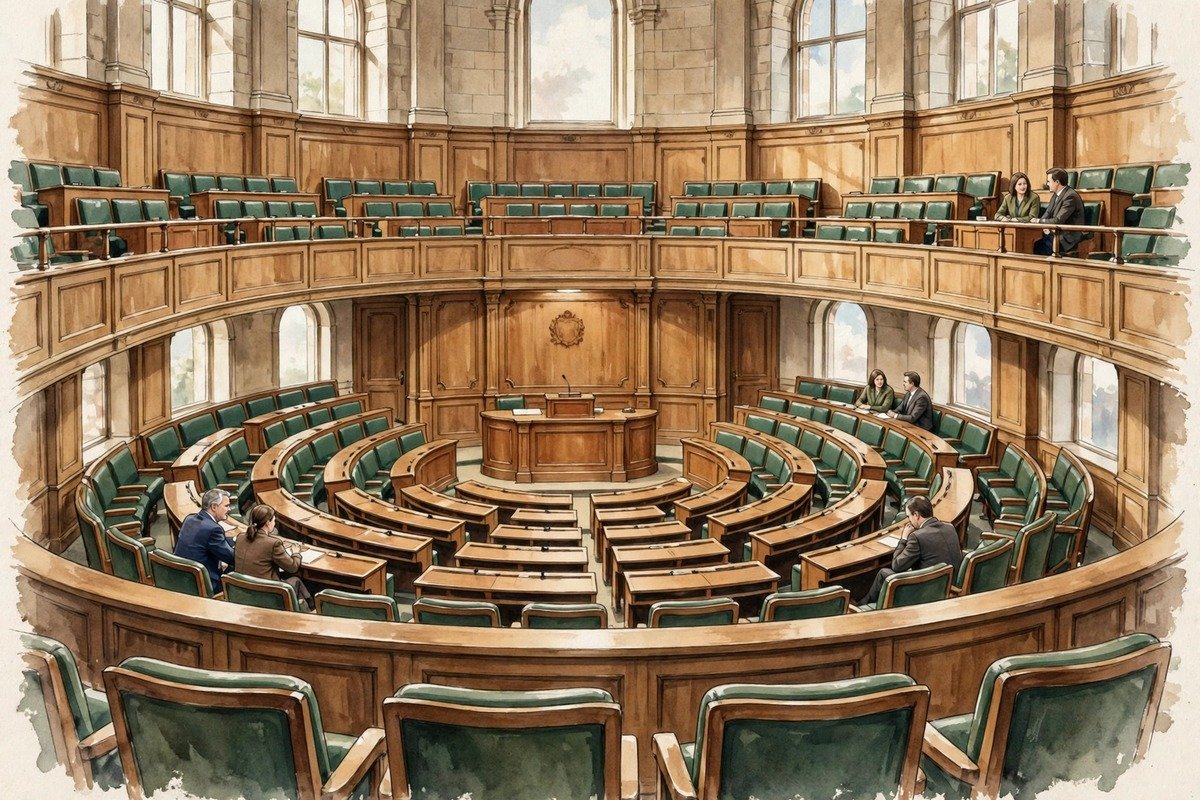
How Nepal Parliament Works: The House of Representatives
How Nepal parliament works starts, for most citizens, with the House of Representatives — because this is the house you vote for. Its 275 members are elected through a mixed system: 165 members win single-member constituencies under first-past-the-post (FPTP), and 110 members come from party lists under proportional representation (PR), with the whole country counting as one constituency for the PR vote. Every voter casts two ballots on election day — one for a person, one for a party. The full chain, from registering to vote to forming a government, is explained in our guide to how elections work in Nepal.
To stand for the House, a candidate must be a Nepali citizen, at least 25 years old, and not disqualified under the Constitution — for example, by holding an office of profit, being of unsound mind, or being convicted of a criminal offence involving moral turpitude. Members serve a five-year term from the date of the first meeting, unless the House is dissolved early. The House can be dissolved by the President on the recommendation of the Council of Ministers, and a general election must then be held within six months. That is what happened in September 2025, when the House elected in 2022 was dissolved and a fresh election was held on 5 March 2026.
The House of Representatives is the house that matters most for forming a government. The Prime Minister is appointed from among its members, and the Council of Ministers is formed from members of the Federal Parliament. A person who is not a member of Parliament can be appointed a minister, but must become a member within six months. Because the government is drawn from the House, the House can also remove it — which is why the confidence vote, explained below, is the most important power Parliament holds.
The House is led by a Speaker and a Deputy Speaker, elected by the members within 15 days of the first meeting. The two must come from different political parties, and one of them must be a woman. The Speaker runs the proceedings, decides whether a bill is a Money Bill, and certifies bills before they go to the President. The current Speaker is Dol Prasad Aryal, elected on 5 April 2026, and the Deputy Speaker is Ruby Kumari Thakur, elected on 10 April 2026.
How Nepal Parliament Works: The National Assembly
How Nepal parliament works in the National Assembly is very different, because you do not vote for it directly. Of its 59 members, 56 are elected by an electoral college in each province and three are nominated by the President on the recommendation of the government. Each of the seven provinces elects eight members, regardless of population. The electoral college is made up of the members of the provincial assembly and the chairs, vice-chairs, mayors and deputy mayors of the local governments in that province — a provincial assembly member’s vote carries a weight of 48, and a local chief or deputy chief’s vote carries a weight of 18.
Each province’s eight members must include at least three women, one Dalit, and one person with a disability or from a minority community. Of the three nominated members, at least one must be a woman. A candidate for the National Assembly must be at least 35 years old.
The National Assembly is a permanent house: it is never dissolved as a whole. Instead, members serve six-year terms, and one-third of the members retire every two years, so the house is renewed in stages. The most recent National Assembly election was held on 25 January 2026, when 18 seats were filled. The next renewal is due in 2028. Because only a third of the house changes at a time, the National Assembly’s political balance can look very different from the House of Representatives — and often does.
The National Assembly is led by a Chairperson and a Vice-Chairperson, and as with the Speaker and Deputy Speaker, one of the two must be a woman. The current Chairperson is Narayan Prasad Dahal, in office since 12 March 2024, and the Vice-Chairperson is Lila Kumari Bhandari, who took office on 7 April 2026.
How Nepal Parliament Works: Sessions, Quorum, and Who Runs the Show
Parliament does not sit all year round. It meets in sessions, and how Nepal parliament works depends on who can call a session and how many members must be present for business to count.
The President summons sessions of the Federal Parliament. The first session after a House election must be called within 30 days of the declaration of the final results, and the gap between two consecutive sessions must not exceed six months. The President may also prorogue — formally end — a session. If the House is not in session and one-fourth of its members write to the President asking for a session, the President must call one. The President also addresses a joint sitting of both houses at the start of the first session after an election, and may address Parliament at other times.
For a meeting to take decisions, a quorum is required: at least one-fourth of the total members of the house concerned must be present. In the House of Representatives that means 69 members; in the National Assembly, 15. If the quorum is not met, the meeting cannot decide anything and is adjourned.
Day-to-day business is run by the Federal Parliament Secretariat, headed by a Secretary General. The Secretariat registers bills, publishes the daily business list, keeps the official record of debates, and supports the committees. The two houses have their own rules of procedure, which set out how questions are asked, how debates are timed, and how voting is conducted. Most decisions are taken by a majority of the members present and voting, but some — notably constitutional amendments — need a special majority, explained below.
Parliament’s meeting place has also been part of its story. For years the House met at the International Convention Centre in New Baneshwor, Kathmandu. A new Parliament building at Singha Durbar has been under construction to become its permanent home.
How Nepal Parliament Works: Committees — Where the Real Work Happens
Much of how Nepal parliament works happens away from the main chamber, in committees. Article 97 of the Constitution allows each house to form thematic committees, and the two houses can also form joint committees. There are 16 committees in total: ten under the House of Representatives, four under the National Assembly, and two joint committees. Most committees have around 25 members, and their chairs are divided among the parties roughly in proportion to their strength in the House.
The ten thematic committees of the House of Representatives are: Finance Committee; International Relations and Tourism Committee; Industry, Commerce, Labour and Consumer Welfare Committee; Law, Justice and Human Rights Committee; Agriculture, Cooperatives and Natural Resources Committee; Women and Social Affairs Committee; State Affairs and Good Governance Committee; Infrastructure Development Committee; Education, Health and Information Technology Committee; Public Accounts Committee.
The four thematic committees of the National Assembly are the Sustainable Development and Good Governance Committee, the Legislation Management Committee, the Delegated Legislation and Government Assurances Committee, and the National Concerns and Coordination Committee. The two joint committees are the Parliamentary Hearing Committee — which holds public hearings for nominees to constitutional bodies and the judiciary before they are appointed — and the Committee for Monitoring and Evaluation of the Implementation of the Directive Principles, Policies and Obligations of the State.
Committees do three things the full house cannot do well. First, they examine bills clause by clause, hearing from experts, officials and affected groups, and propose amendments. Second, they scrutinise the government: they can summon ministers and senior officials, demand documents, and question spending. Third, they investigate. The Public Accounts Committee is the best known of these — it examines the Auditor General’s reports on how public money was spent, and by convention it is chaired by a member of the main opposition party, so that the government is not marking its own homework. Committee meetings are generally open, and their reports are tabled in the house, where they can force a debate the government would rather avoid.

How Nepal Parliament Works: Making Laws and Passing the Budget
The most visible part of how Nepal parliament works is law-making. A bill can be introduced in either house — except a Money Bill, which must start in the House of Representatives, and bills concerning the security forces, which can only be introduced as Government Bills. Once a bill is registered with the Parliament Secretariat, it goes through a general discussion on its principles, then a clause-by-clause examination — usually in the relevant committee — and then a vote. A bill passed by one house is sent to the other house, which repeats the process. The full seven-step route is explained in our guide to how a bill becomes law in Nepal.
The Constitution sets deadlines for the second house. The National Assembly must return a Money Bill within 15 days, with suggestions if it has any; the House of Representatives may accept those suggestions or not, and if the Assembly does not return the bill within 15 days, the House can send it to the President anyway. For an ordinary bill, the National Assembly has two months. If the two houses disagree, the bill can go to a joint sitting, where a majority of the members present decides. A constitutional amendment is the one exception to that rule: it must be passed by a two-thirds majority of the total membership of each house separately, so neither house can be overruled on the Constitution itself.
The budget follows the same money-bill route, with a fixed date: the Finance Minister presents the annual estimates of revenue and expenditure to a joint sitting of Parliament on 15 Jestha (late May) each year. The estimates are then debated and voted on as an Appropriation Bill, which authorises the government to spend from the Federal Consolidated Fund. Without that authorisation, the government cannot legally spend. That is why the budget session is the most consequential sitting of the year — and why a government that loses a budget vote is, in practice, a government that has lost the confidence of the House.
How Nepal Parliament Works: Keeping the Government in Check
Making laws is only half of how Nepal parliament works. The other half is holding the government to account, and Parliament has several tools for it.
The most direct is the vote of confidence. A Prime Minister appointed after an election must win a vote of confidence in the House of Representatives within 30 days of appointment. A no-confidence motion can be tabled with the support of one-fourth of the House’s members, and if it passes by a majority, the Prime Minister must resign. Because ministers are drawn from Parliament and are collectively responsible to it, losing the confidence of the House means losing office.
The daily tools are quieter but constant. Members can ask oral and written questions to ministers, raise matters of urgent public importance, move resolutions, and demand statements from the government. Ministers are expected to answer in the house, on the record. The zero hour and question hour — the first part of a sitting day — are where ministers are most often caught unprepared.
Then there is the power of the purse. Parliament approves the budget, and the Public Accounts Committee and the Auditor General examine how the money was actually spent. The Auditor General’s annual report, tabled in Parliament, is the starting point for the committee’s investigations into irregular spending, and its findings regularly make the news. Parliament also has to approve treaties, and it can approve or reject a state of emergency: the President may declare an emergency on the government’s recommendation, but it must be approved by a two-thirds majority of the House of Representatives within three months, or it lapses.
How Nepal Parliament Works: The Parliament Elected in 2026
How Nepal parliament works today is shaped by an election that broke a long pattern. The House of Representatives elected in 2022 was dissolved on 12 September 2025, after the Gen Z protests of 8–9 September 2025 brought down the coalition government of Prime Minister KP Sharma Oli. Former Chief Justice Sushila Karki was appointed interim Prime Minister the same day, and fresh elections were called for 5 March 2026. About 60 percent of registered voters turned out.
The result was a single-party majority — something Nepal had not seen in decades of coalition government. The Rastriya Swatantra Party (RSP) won 182 of the 275 seats, giving the government bloc 183 seats against 92 in opposition. The Nepali Congress won 38 seats, CPN (UML) 25, the Nepal Communist Party 17, the Samajbadi Party 7, and the Rastriya Prajatantra Party 5. RSP leader Balen Shah became Prime Minister on 27 March 2026, and the new House held its first session on 2 April 2026.
The National Assembly, with its staggered terms, changed more slowly: its party balance still reflects elections from 2022, 2024 and January 2026, and no single party holds a majority there. That split between the two houses is normal in Nepal’s system, and it is exactly why the National Assembly’s power to delay and suggest changes to bills matters — the government may command the lower house, but it still has to carry the upper house’s scrutiny.
The current office-holders are President Ram Chandra Paudel (in office since 13 March 2023), Prime Minister Balen Shah, Speaker Dol Prasad Aryal, Deputy Speaker Ruby Kumari Thakur, National Assembly Chairperson Narayan Prasad Dahal, Vice-Chairperson Lila Kumari Bhandari, and Leader of the Opposition Bhishma Raj Angdembe of the Nepali Congress. The next general election is not due until 2031, unless the House is dissolved early.
Frequently Asked Questions
Q: How many members are in Nepal’s Parliament?
A: How Nepal parliament works starts with 334 members in total: 275 in the House of Representatives and 59 in the National Assembly. At least one-third of the total membership must be women.
Q: Is the National Assembly elected by voters?
A: No. Voters elect only the House of Representatives. Fifty-six National Assembly members are chosen by an electoral college of provincial assembly members and local chiefs and deputy chiefs, and three are nominated by the President on the government’s recommendation.
Q: How long does a member of the House of Representatives serve?
A: Five years from the date of the first meeting, unless the House is dissolved early. National Assembly members serve six years, with one-third retiring every two years, so the upper house is never fully dissolved.
Q: Who is the Speaker of Nepal’s Parliament in 2026?
A: Dol Prasad Aryal of the Rastriya Swatantra Party, elected Speaker of the House of Representatives on 5 April 2026. The Deputy Speaker is Ruby Kumari Thakur. The National Assembly is chaired by Narayan Prasad Dahal.
Q: Can the National Assembly block a bill?
A: It can delay it and suggest changes, but it cannot block an ordinary bill forever. It must return a Money Bill within 15 days and an ordinary bill within two months, after which the House of Representatives can send the bill to the President. A constitutional amendment is different: it needs a two-thirds majority in each house.
Q: What is the quorum for Parliament to take decisions?
A: One-fourth of the total members of the house concerned must be present — 69 members in the House of Representatives and 15 in the National Assembly. Without a quorum, no question or resolution can be put to a vote.