

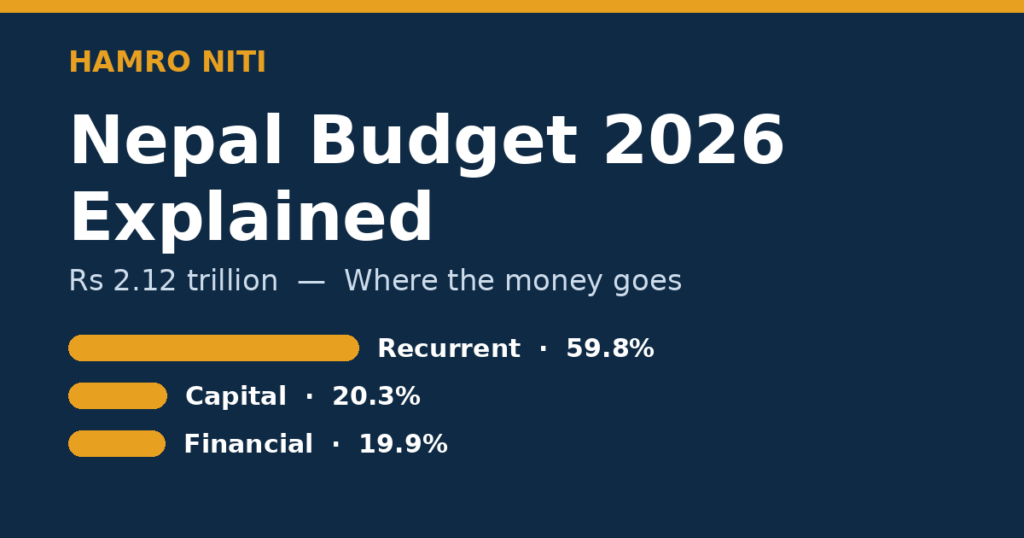
Nepal budget 2026 explained in one line: the government plans to spend Rs 2.12 trillion in the fiscal year that began on 16 July 2026 — the biggest budget in Nepal’s history, about a quarter bigger than what it actually spent the year before.
Table of Contents
Finance Minister Dr Swarnim Wagle presented it to Parliament on 29 May 2026, aiming for 7% growth and inflation within 6%. Below, in plain language: the money, where it goes, how it is paid for, and what it means for you.
The big number, in one table
A budget is the government’s one-year plan for how much it will spend and where the money comes from. Here is the 2026/27 plan next to the one before it.
| FY 2082/83 (2025/26) announced | FY 2083/84 (2026/27) | |
|---|---|---|
| Total budget | Rs 1,964.11 billion | Rs 2,124.34 billion |
| Recurrent (day-to-day) | Rs 1,180.98 billion | Rs 1,270.58 billion |
| Capital (building things) | Rs 407.89 billion | Rs 431.10 billion |
| Financial management | Rs 375.24 billion | Rs 422.64 billion |
Two things matter. First, the new total is 25.2% higher than the revised estimate for last year — Rs 1,688.32 billion, after a 14.04% mid-year cut. Second, it is about one-third of Nepal’s economy: GDP was expected to reach roughly Rs 6,609 billion by mid-July 2026.
Nepal budget 2026 explained: where the money goes
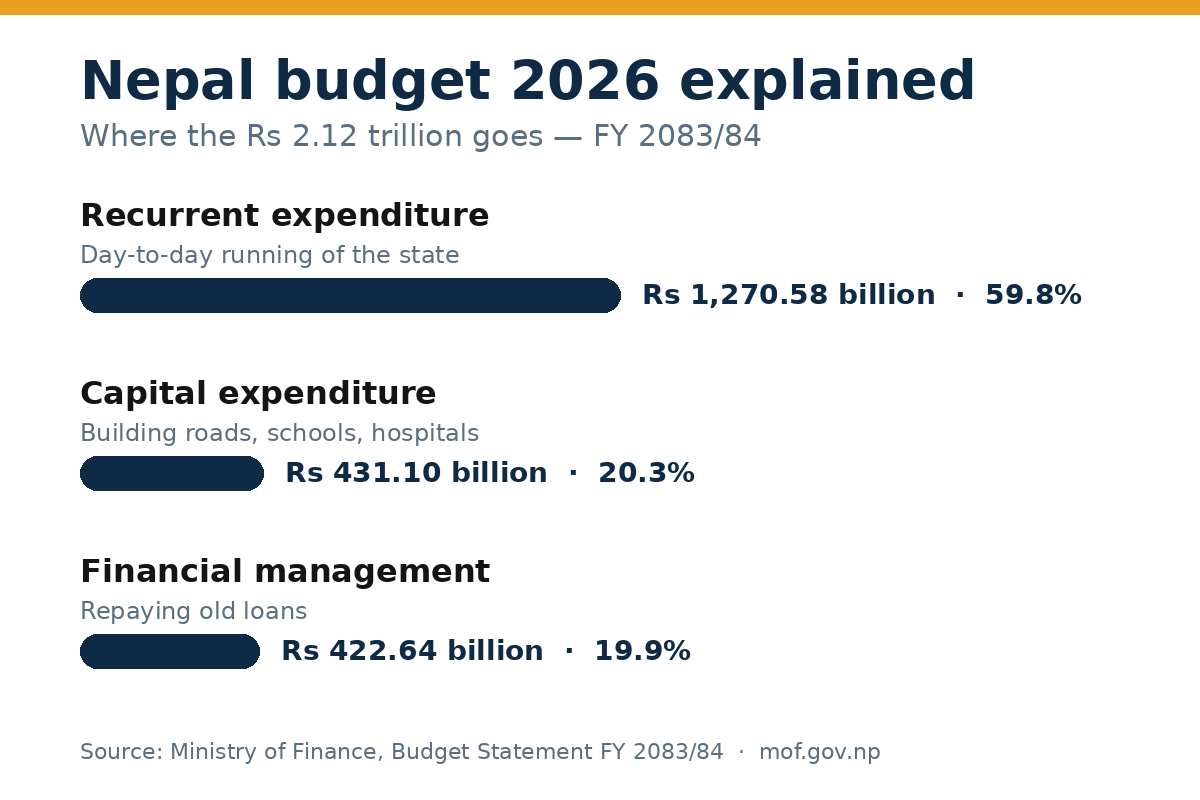
Nepal budget 2026 explained divides the Rs 2,124.34 billion into three buckets.
Recurrent expenditure — Rs 1,270.58 billion, or 59.8%. The cost of keeping the state running: salaries and pensions, ministries, hospitals and schools, and interest on old loans. The biggest slice — and it builds nothing new.
Capital expenditure — Rs 431.10 billion, or 20.3%. Money for building things: roads, bridges, schools, hospitals, irrigation and hydropower. The smallest bucket, and the hardest to spend: Nepal has a long record of announcing capital projects and failing to finish them on time. The budget speech promised “mission mode” delivery — projects finished on time and on cost, focused on a few large priorities instead of many small ones.
Financial management — Rs 422.64 billion, or 19.9%. Repaying old loans and lending onwards: Rs 245.89 billion repays the principal of domestic loans taken in earlier years — about one rupee in five of this budget pays for past borrowing, not anything new.
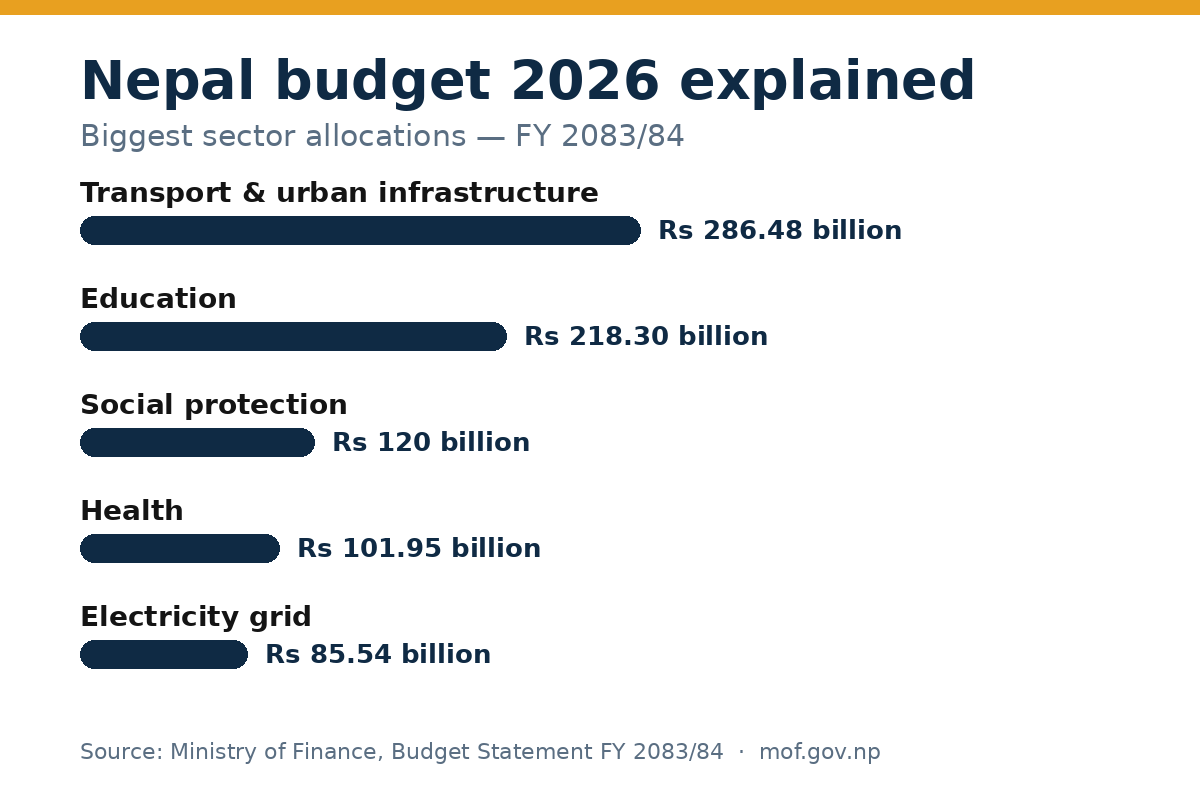
Biggest sector allocations: transport and urban infrastructure Rs 286.48 billion, education Rs 218.30 billion, social protection Rs 120 billion, health Rs 101.95 billion, electricity grid Rs 85.54 billion — plus Rs 70 billion ring-fenced for transmission lines.
Nepal budget 2026 explained: how the government pays for it
The government does not have Rs 2.12 trillion in a vault. Nepal budget 2026 explained is also a story about how the money is raised.
| Source | Amount |
|---|---|
| Revenue | Rs 1,405.31 billion |
| Foreign grants | Rs 61.74 billion |
| Foreign loans | Rs 247.28 billion |
| Domestic borrowing | Rs 410.00 billion |
| Total | Rs 2,124.34 billion |
The gap between spending and collection is the deficit: Rs 657.29 billion — roughly one rupee in every three the government spends. It is covered by borrowing: Rs 247.28 billion from abroad and Rs 410 billion from inside Nepal. Because Rs 245.89 billion of old domestic loans is repaid at the same time, net new domestic borrowing is Rs 164.11 billion.
That matters to everyone. Heavy domestic borrowing means the government competes with businesses and households for the same pool of money — one reason interest rates matter so much. And the revenue target is a big jump, so whether it is collected is one of the first things to watch.
Nepal budget 2026 explained: what changes for you
Nepal budget 2026 explained matters most where it touches your pocket.
Your taxes. The income tax exemption limit doubles to Rs 1 million a year, and the top marginal rate is cut by 10 percentage points. Our article on Nepal income tax slabs 2026 explains what that means for your pay. On customs, the 11-tier duty system becomes 7 tiers, duties fall on 273 categories of raw materials, excise duty is removed on 360 product categories, and scattered border taxes merge into a single “green levy”.
Government salaries. Starting salaries rise 10%, plus a new 10% monthly performance allowance — a net rise of roughly 21% in take-home pay. Minimum remuneration rises to around Rs 40,000 a month, beyond Rs 100,000 at the top. It is the first rise in four years, during which consumer prices rose 17.3%.
Health. From a Rs 101.95 billion health budget, Rs 15 billion restructures health insurance into a single-payer model, aiming to cover 90% of citizens within three years. Nurses’ night duty allowances double, and transport stipends for female community health volunteers rise 50%.
Social protection. From a Rs 120 billion social protection budget, the monthly child nutrition stipend for vulnerable Dalit families in 25 high-poverty districts doubles to Rs 1,000. The budget targets inflation of no more than 6%.
The big bets: energy, AI and roads
Nepal budget 2026 explained is not only about the headline numbers — the budget also places a few large bets.
Energy. The state plans to add 1,040 MW — 670 hydro and 370 solar — taking capacity to 5,535 MW. The Nepal Electricity Authority splits into three companies for generation, transmission and distribution. The 1,200 MW Budhigandaki project moves into construction, and private firms may trade and export electricity for the first time.
Technology. Nepal’s first Sovereign AI Computing Center will be built in Kathmandu on domestic hydropower, with fellowships for 15 Nepali AI researchers to return. IT exporters get a 50% income tax exemption and tax-free sweat equity. The stock exchange is to be restructured, and part of Nepal Telecom will be sold by mid-January 2027, keeping a controlling 66% state stake.
Roads and regions. Transport and urban infrastructure is the largest single sector, at Rs 286.48 billion: Rs 37.46 billion to widen the 1,028-km East-West Highway to four lanes, Rs 17.64 billion to the Kathmandu–Tarai Fast Track, and the Nagdhunga tunnel opens in July 2026.
Nepal budget 2026 explained: money for provinces and local governments
Nepal is federal, so much of the budget leaves Kathmandu. Equalisation grants — unconditional money for provinces and local governments — are Rs 61.50 billion to provinces and Rs 90.20 billion to local governments. Conditional grants, tied to federal programmes, add Rs 39.72 billion and Rs 206.8 billion. A further Rs 175 billion flows through revenue sharing.
That is the federal chapter of Nepal budget 2026 explained: more than Rs 600 billion reaches provinces and local governments through revenue sharing and transfers. Equalisation grants are yours to spend as you choose; conditional grants arrive with instructions attached. To judge whether your local government spends its share well, start with the equalisation grant — our guide to checking government spending starts there too.
Nepal budget 2026 explained: what to watch
A budget is a promise, not a result. Three things will decide whether this one delivers.
Can the government actually spend the capital budget? The plan is 25.2% bigger than what was actually spent last year, itself cut 14% at the mid-year review. Watch the review, usually in February, for the first honest signal.
Can it collect the revenue? The plan assumes Rs 1,405.31 billion. If collections fall short, the deficit — and borrowing — grows.
Will the big bets happen? Splitting the electricity authority, building an AI centre, restructuring the stock exchange and completing the Fast Track are multi-year jobs. The budget announces them; the test is whether the laws, money and people follow.
Presented on 29 May 2026, it runs from 16 July 2026; the full statement is at mof.gov.np.
Frequently asked questions
What is the Nepal budget 2026 explained in one sentence?
Rs 2,124.34 billion in fiscal year 2083/84: Rs 1,270.58 billion on running the state, Rs 431.10 billion on building things, Rs 422.64 billion on financial management — from Rs 1,405.31 billion in revenue, Rs 61.74 billion in grants and Rs 657.29 billion in borrowing.
When was the budget presented, and when does it start?
Finance Minister Dr Swarnim Wagle presented it to a joint session of Parliament on 29 May 2026 (15 Jestha 2083); the fiscal year began on 16 July 2026.
How big is the budget compared with last year?
The largest in Nepal’s history: 25.2% above the revised estimate of Rs 1,688.32 billion for 2082/83, whose announced budget was Rs 1,964.11 billion.
Where does the money come from?
Revenue Rs 1,405.31 billion, foreign grants Rs 61.74 billion, foreign loans Rs 247.28 billion, domestic borrowing Rs 410 billion — a deficit of Rs 657.29 billion.
What does the budget mean for my taxes?
The income tax exemption doubles to Rs 1 million a year and the top rate falls 10 points — see our Nepal income tax slabs 2026 explainer for what it means for your pay.
Where can I read the budget myself?
The Ministry of Finance publishes the full statement at mof.gov.np; the Institute of Chartered Accountants of Nepal publishes plain-language highlights.
Sources and verification — checked 13 November 2026: Ministry of Finance, Government of Nepal — Budget Statement for the Financial Year 2083/84, presented by Finance Minister Dr Swarnim Wagle on 29 May 2026 (mof.gov.np). The Rising Nepal, 30 May 2026. Nepal News, 29 May 2026. Institute of Chartered Accountants of Nepal — Highlights of Federal Budget FY 2083/84. This article is general information, not financial advice.