

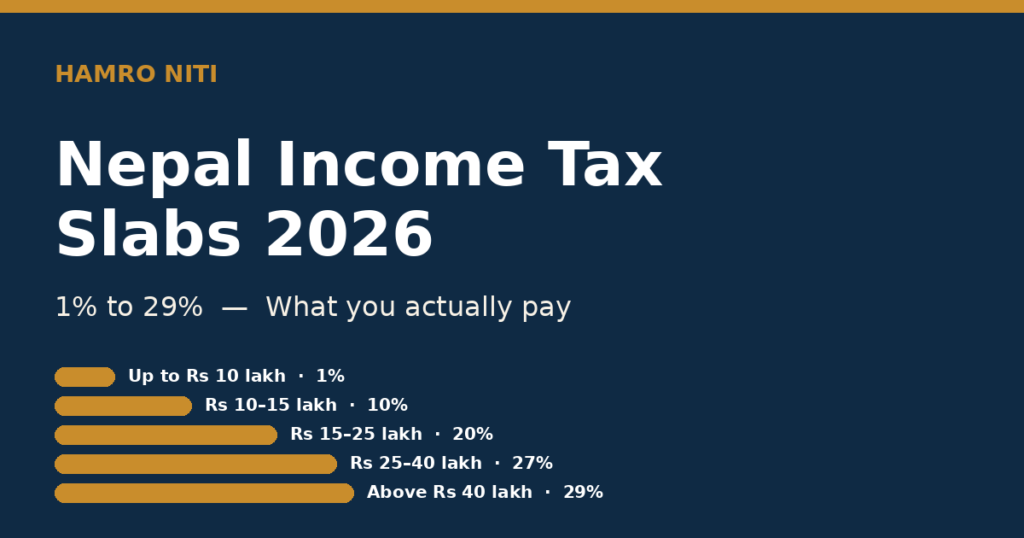
Nepal income tax slabs 2026 changed more than any year in recent memory. If you are a salaried employee, a freelancer, or a small business owner, the amount taken from your pay this fiscal year is probably different from last year.
The change comes from the Finance Act 2083, after the budget for fiscal year 2083/84, presented on 15 Jestha 2083 (29 May 2026) by Finance Minister Dr. Swarnim Wagle. The rates apply from 1 Shrawan 2083 — about 17 July 2026. This is a guide, not tax advice: confirm your position with the Inland Revenue Department (IRD) before you file.
Table of Contents
Nepal income tax slabs 2026: the full table
Nepal income tax slabs 2026 use five bands for a resident individual. The rates are progressive: each rate applies only to the slice of income inside that band.
| Income band | Rate | Tax on band |
|---|---|---|
| Up to 1,000,000 | 1% Social Security Tax | Rs 10,000 |
| 1,000,001–1,500,000 | 10% | Rs 50,000 |
| 1,500,001–2,500,000 | 20% | Rs 200,000 |
| 2,500,001–4,000,000 | 27% | Rs 405,000 |
| Above 4,000,000 | 29% | No upper limit |
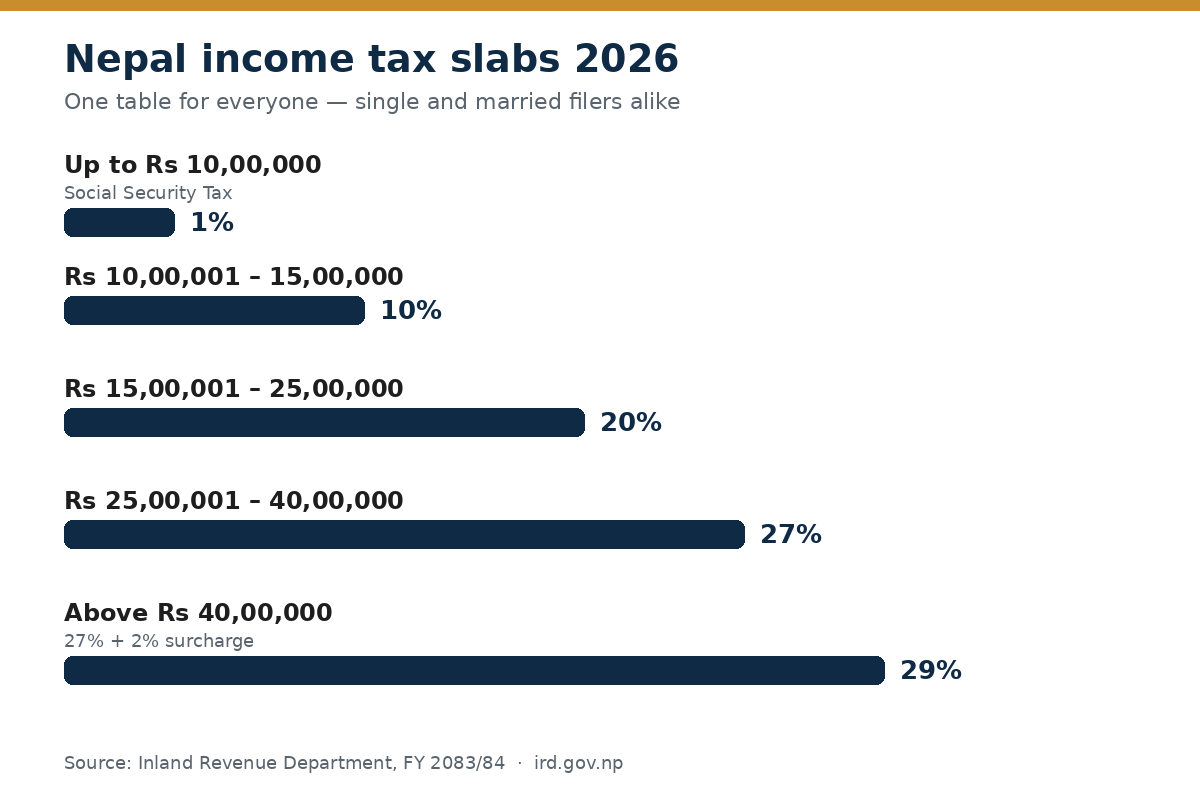
The 29% top rate is the 27% rate plus a 2 percentage point surcharge above Rs 40 lakh. The IRD published this schedule for fiscal year 2083/84 on 22 Shrawan 2083, and the same table appears in the Finance Act 2083. There is now one table for everyone: the separate single and married tables have been merged. Taxable income is what is left after deductions — retirement contributions, insurance premiums, and the items listed below — not your gross salary.
How Nepal income tax slabs 2026 work in practice
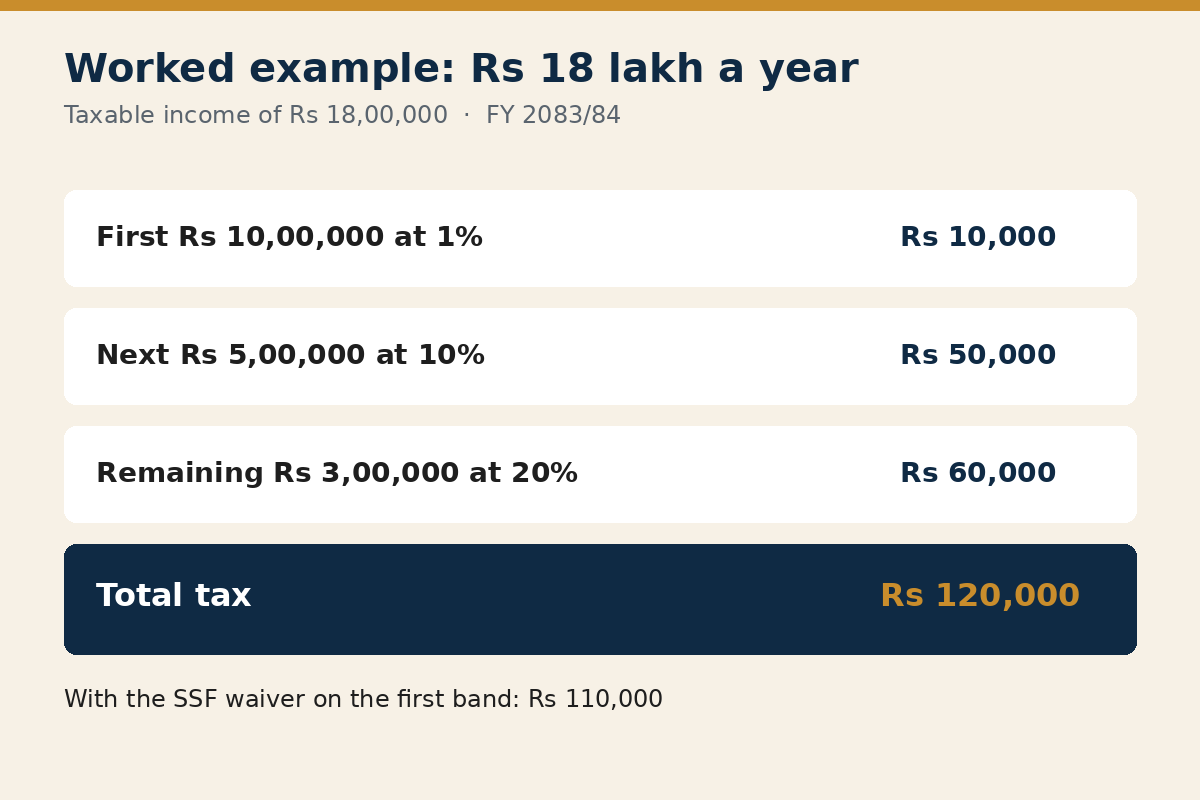
Nepal income tax slabs 2026 are easiest with an example. Take Rs 18 lakh of taxable income, for someone who does not contribute to the Social Security Fund (SSF): Rs 10,00,000 at 1% is Rs 10,000; the next Rs 5,00,000 at 10% is Rs 50,000; the remaining Rs 3,00,000 at 20% is Rs 60,000. Total tax: Rs 120,000. If the same person contributes to the SSF, the 1% on the first band is waived, so the total falls to Rs 110,000.
On Rs 60 lakh, the tax is Rs 12,45,000 — the figure in the IRD’s own table: Rs 665,000 on the first Rs 40 lakh, plus 29% on the remaining Rs 20 lakh. A salary of Rs 50,000 a month is Rs 6 lakh a year, taxed at Rs 6,000 a year, or zero for an SSF contributor. Do not apply your top rate to your whole income: if you earn Rs 18 lakh, you pay 20% only on the Rs 3 lakh inside the 20% band. Your employer usually handles this through tax deducted at source (TDS), deducting a twelfth of your estimated annual tax each month.
Nepal income tax slabs 2026 vs last year: what changed
Nepal income tax slabs 2026 replaced a six-band system with five bands. Last year, a single filer paid 1% on the first Rs 5 lakh, then 10% to Rs 7 lakh, 20% to Rs 10 lakh, 30% to Rs 20 lakh, 36% to Rs 50 lakh, and 39% above Rs 50 lakh. A married filer started with a Rs 6 lakh first band before joining the same higher bands.
| Item | Last year | Now |
|---|---|---|
| First 1% band single | Up to Rs 5,00,000 | Up to Rs 10,00,000 |
| First 1% band married | Up to Rs 6,00,000 | Up to Rs 10,00,000 (merged) |
| Number of bands | Six (1/10/20/30/36/39%) | Five (1/10/20/27/29%) |
| Top marginal rate | 39%, above Rs 50,00,000 | 29%, above Rs 40,00,000 |
The 1% band doubled, the top rate fell ten points, and the tables merged. The saving is largest in the middle: the Rs 18 lakh earner above paid Rs 120,000, against Rs 325,000 last year — about Rs 205,000 less, almost all of it from the first Rs 10 lakh now sitting in the 1% band.
The first Rs 10 lakh is not tax-free
Under Nepal income tax slabs 2026, income up to Rs 10 lakh is not tax-free. It carries a 1% charge, a Social Security Tax (SST), not ordinary income tax. The budget speech described income up to Rs 10 lakh as exempt from personal income tax, but that headline needs a careful reading.
The 1% SST is waived for people who contribute to the Social Security Fund or an approved retirement or pension fund, and it does not apply to pension income or to a taxpayer registered as a sole proprietorship. For those people, the first Rs 10 lakh is effectively taxed at 0%. For everyone else, it is 1%: a person earning exactly Rs 10 lakh a year pays Rs 10,000, or about Rs 833 a month. What changed is how much income sits in that low band, not whether the band is taxed.
Nepal income tax slabs 2026: deductions that lower your bill
Nepal income tax slabs 2026 are applied after deductions, so what you can deduct matters as much as the rates. The limits below are from the IRD’s published schedule for fiscal year 2083/84: retirement fund contributions (Provident Fund, Citizen Investment Trust, and SSF combined) up to the lower of one-third of assessable income or Rs 500,000; life insurance premiums up to Rs 40,000; health insurance up to Rs 20,000; insurance on a private building you own up to Rs 10,000; children’s education fees up to 25% of the fees, capped at Rs 25,000; remote area allowance of Rs 10,000–50,000 by area; and a tax credit of 15% of approved medical expenses, up to Rs 750.
A resident woman whose only income is salary receives a 10% rebate on her tax. Keep your premium receipts and give them to your employer before filing: TDS often misses personal policies held outside work. For example, Rs 13 lakh of gross income minus Rs 1 lakh in retirement contributions and Rs 40,000 in life insurance leaves Rs 11.6 lakh taxable, taxed at Rs 26,000 — Rs 16,000 with the SST waiver.
Freelancers, small businesses, and companies
Not everyone is taxed through the personal slab table. Freelancers earning in foreign currency pay a flat 5% final withholding tax, deducted by their bank when the money arrives through a Nepali bank account. It is a full and final settlement if total annual freelance income stays below Rs 40 lakh, and your PAN must be linked to the account for it to be credited correctly. Cash or informal receipts do not qualify.
Small businesses with turnover below Rs 30 lakh and profit below Rs 3 lakh, not VAT-registered and not claiming tax credits, may use presumptive tax — a fixed annual amount instead of a full return. The standard corporate rate is 25%; banks, insurers, and telecom companies pay 30%.
Nepal income tax slabs 2026: what to do next
Under Nepal income tax slabs 2026, first find your taxable income, not your gross salary: annual pay plus bonuses and other taxable income, minus the deductions you can claim. Second, apply the table above to that figure, band by band. Third, compare the result with what your employer deducts each month — a gap usually means a deduction your employer does not know about, or a change in pay during the year.
A PAN is mandatory for filing, and returns are filed online through the IRD Taxpayer Portal at taxpayerportal.ird.gov.np. The table above is for fiscal year 2083/84 only. For more context on public money in Nepal, see Hamro Niti at https://hamroniti.com/.
Frequently asked questions
What are the Nepal income tax slabs 2026? Nepal income tax slabs 2026 are 1% to Rs 10 lakh, 10% to Rs 15 lakh, 20% to Rs 25 lakh, 27% to Rs 40 lakh, and 29% above Rs 40 lakh. The 1% is Social Security Tax, waived for SSF and approved pension contributors.
Is income up to Rs 10 lakh tax-free in Nepal in 2026? No. It carries a 1% Social Security Tax, so a person earning exactly Rs 10 lakh pays Rs 10,000 — unless they contribute to the Social Security Fund or an approved pension fund, in which case the 1% is waived.
Are single and married people taxed differently in 2026/27? No. The Finance Act 2083 merged the separate single and married tables into one unified table, with the same bands and rates for both.
How much tax do I pay on Rs 18 lakh a year? On Rs 18 lakh, the tax is Rs 120,000 — Rs 110,000 with the SSF waiver — and deductions would lower it further.
Where do I file my return? Through the IRD Taxpayer Portal at taxpayerportal.ird.gov.np, using your PAN. Check ird.gov.np for the deadline and forms.