

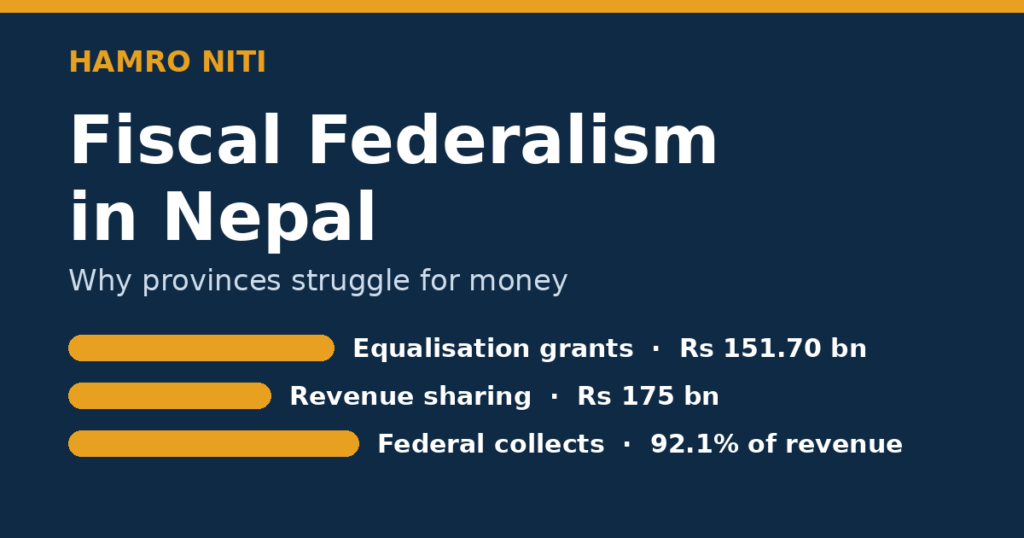
Fiscal federalism Nepal is the system that decides who collects the country’s money and who gets to spend it. Since the Constitution of 2015 created three tiers of government — federal, provincial and local — that question has shaped almost every argument about how Nepal is run. The idea is simple: the level closest to people should have the money to serve them. The reality is that most of the money still sits in Kathmandu.
Table of Contents
Fiscal federalism Nepal: what it actually means
Fiscal federalism Nepal means dividing financial power between the three tiers of government. The Constitution gives each tier its own responsibilities: the federal government handles defence, foreign affairs and national highways; provinces run provincial roads and agriculture extension; local governments handle basic education, basic health, drinking water and local roads. But each tier needs the money to pay for them.
The rules sit in three places: the Constitution (Articles 56–60 and 250–252), which sets out who can tax what and creates the National Natural Resources and Fiscal Commission — the NNRFC — to recommend how money is shared; the Intergovernmental Fiscal Arrangement Act, 2074 (2017), which turns those principles into working rules; and the federal budget, which decides the actual amounts each year. Nepal has 7 provinces and 753 local levels, each with an elected assembly and a budget of its own. But having the right to spend is not the same as having the money — and that gap is the central tension of fiscal federalism Nepal.
Fiscal federalism Nepal: who collects the money
The biggest taxes in Nepal belong to the federal government. Customs duty, value-added tax (VAT), excise duty, corporate income tax and personal income tax are all collected in Kathmandu. That is by design: taxes on trade and consumption work best when collected once, nationally, rather than at every provincial border.
The result is a lopsided system. The Economic Survey for fiscal year 2082/83 records total revenue of Rs 1.281 trillion collected by all three tiers in 2081/82 — and the federal government collected 92.1% of it. Provincial and local governments together collected just 7.9%.
Provinces levy smaller taxes such as vehicle tax, and local governments collect property tax, business tax and land revenue — but a rural municipality cannot fund a hospital from property tax alone. So the system depends on money flowing back down from the centre, through revenue sharing and grants.
Fiscal federalism Nepal: the four grants that move money down
Federal money flows down mainly as grants. There are four kinds, and the difference between them matters.
Equalisation grants — the free money. These are unconditional: a province or local government can spend them on whatever it chooses. The NNRFC recommends the amount each year from a formula weighing population, human development, price levels, area, infrastructure and local revenue capacity. For FY 2083/84 it recommended Rs 151.70 billion — Rs 61.50 billion to provinces and Rs 90.20 billion to local levels — split into a minimum grant, a formula-based share and a performance top-up of up to 4%.
Conditional grants — money with instructions. These fund federal programmes, and the receiving government must spend them as directed. In the FY 2083/84 budget they were Rs 39.72 billion to provinces and Rs 206.8 billion to local governments — local governments get far more in conditional grants than in equalisation grants. That is the heart of the complaint from local leaders: most of the money that reaches them arrives with Kathmandu’s instructions attached.
Complementary grants — cost-sharing for big projects. The federal share depends on how poor the province is: Karnali gets 70% from the centre; Sudurpashchim 65%; Madhesh 60%; Koshi, Gandaki and Lumbini 50% each; Bagmati, the richest province, 40%.
Special grants — for emergencies and special needs such as floods and earthquakes.
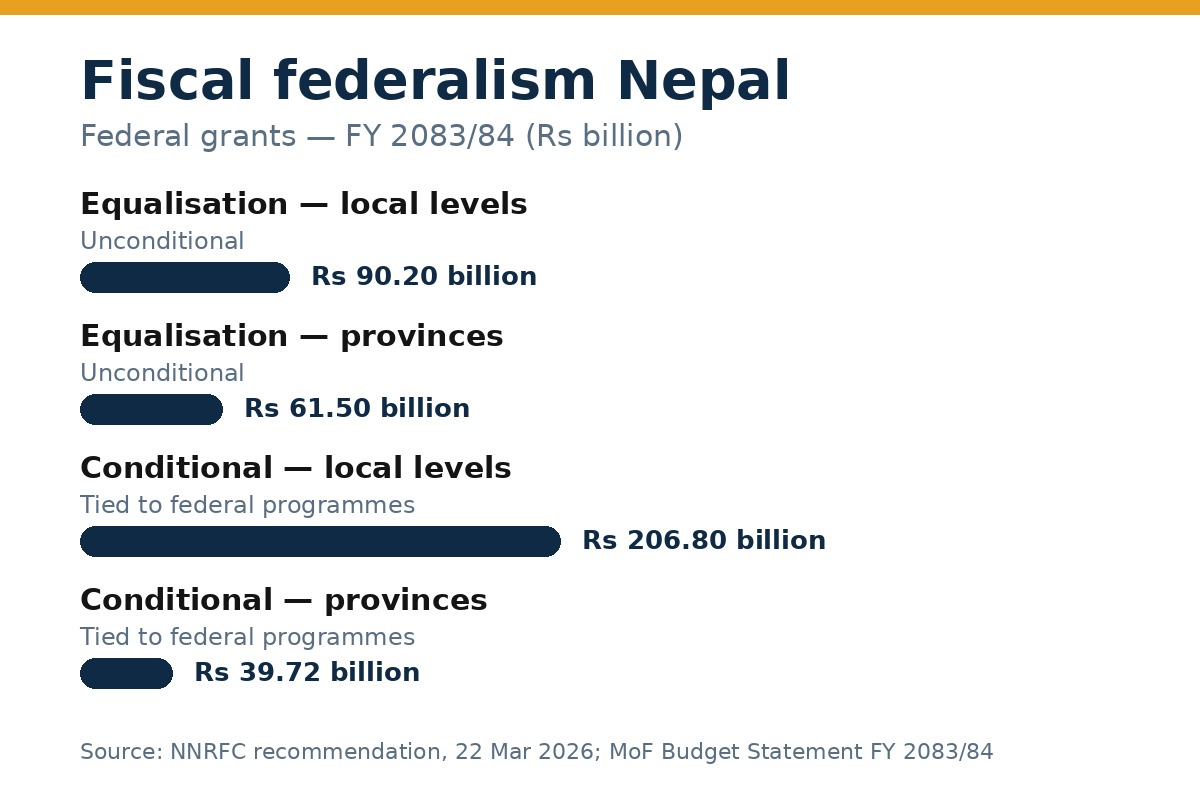
| Grant type — FY 2083/84 | To provinces | To local levels |
|---|---|---|
| Equalisation (unconditional) | Rs 61.50 billion | Rs 90.20 billion |
| Conditional (tied to federal programmes) | Rs 39.72 billion | Rs 206.80 billion |
| Complementary and special | Decided case by case | Decided case by case |
Add revenue sharing of about Rs 175 billion, and more than Rs 600 billion reaches provinces and local governments each year — still not enough, in the view of most provincial governments.
Fiscal federalism Nepal: revenue sharing, the 70-15-15 split
Grants are only half the transfer system. The other half of fiscal federalism Nepal is revenue sharing: a fixed share of certain taxes, divided automatically.
Under Section 6 of the Intergovernmental Fiscal Arrangement Act, VAT and domestic excise duty from Nepali products go into a Federal Divisible Fund, split 70% to the federal government, 15% to the provinces and 15% to the local levels. Royalties from natural resources — mountaineering, electricity, forests, mines and minerals — are split 50% federal, 25% provincial and 25% local.
In fiscal year 2081/82, divisible revenue reached Rs 501.10 billion, up 12.2% on the year before — VAT made up 68.2% of it, excise duty 24.4%.
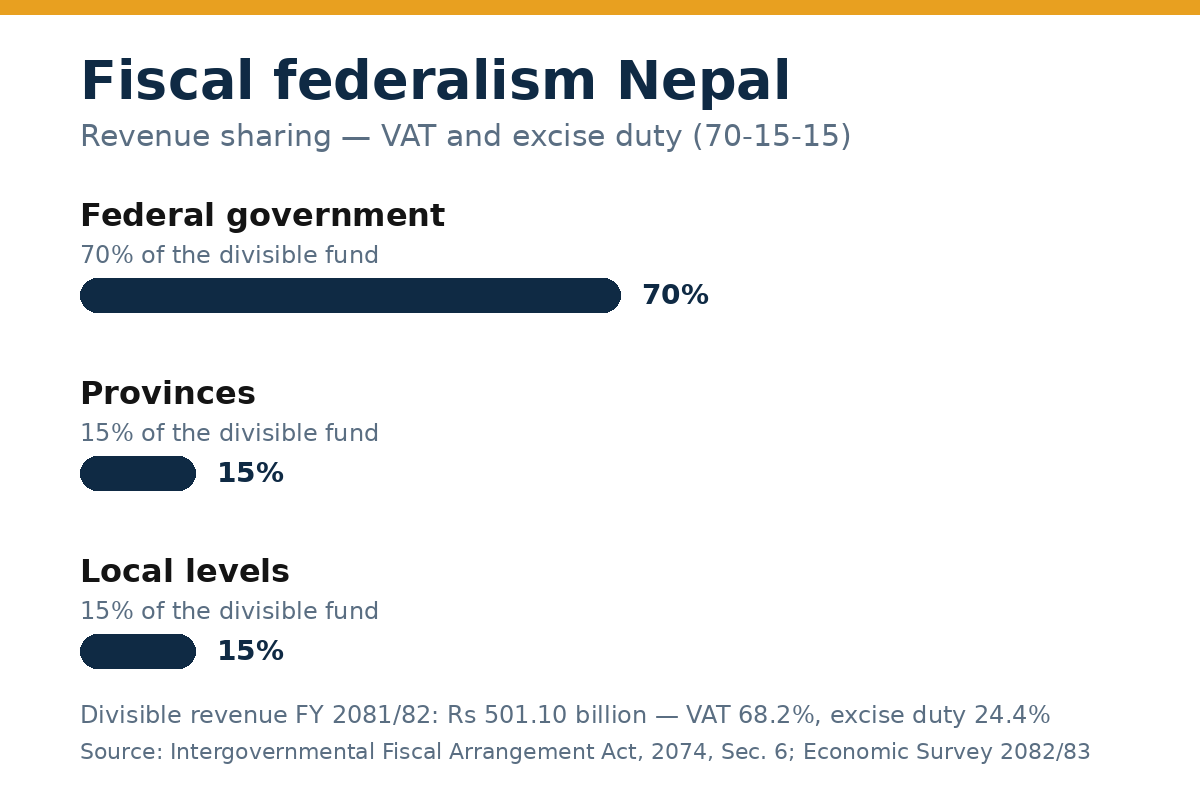
Revenue sharing is the fairest part of fiscal federalism Nepal because it is automatic — nobody in Kathmandu decides each year whether a province deserves its share. But it is small next to the grants, and it rises and falls with tax collection.
Fiscal federalism Nepal: why provinces struggle
If more than Rs 600 billion flows down every year, why do provinces still say they are broke? Four reasons.
First, they collect almost nothing themselves. With 92.1% of revenue collected federally, a province’s own income covers only a small part of its budget — in fiscal year 2082/83, Karnali depended on federal grants for nearly 49% of its budget, while only Bagmati and Madhesh kept that figure below 28%.
Second, the money that does arrive is increasingly conditional. Conditional grants to local governments rose from Rs 208 billion in 2024/25 to Rs 211.45 billion in 2025/26, while equalisation grants grew far more slowly. The NNRFC’s acting chairman has said equalisation grants should grow and conditional grants should shrink. When most of your budget is someone else’s programme, you are an implementer, not a government.
Third, capacity is thin. Provinces and local governments struggle to recruit and keep the accountants, engineers, planners and auditors a government needs. In 2025, 39 local levels missed the legal deadline of Asar 10 (24 June) to pass their annual budget for 2082/83.
Fourth, borrowing is tightly capped. Provinces and local governments may borrow only up to 12% of their own internal income, against 5.5% of GDP for the federal government. With so little own income, the local limit is small in practice.
None of this means federalism has failed. Before 2015, local bodies were run by appointed officials; today, 753 local governments and 7 provinces are elected and accountable. The structure exists — the money and staff to match it do not.
What would make fiscal federalism Nepal work better
The fixes are well known — the NNRFC has proposed most of them.
Grow the equalisation grant, and shrink the conditional share. Unconditional money lets a local government fix its own priorities instead of implementing a programme designed in Kathmandu.
Give provinces and local governments a bigger tax base. The taxes they control — property, vehicles, local business — can be administered better, so a municipality that collects its own property tax properly depends less on transfers.
Pay for performance. The equalisation grant already includes a top-up of up to 4% for good performers; extending that logic would push the transfer system in the right direction.
Build capacity, not just budgets. Money without staff is unspent money — training accountants, engineers and planners decides whether a grant becomes a road or a line in a report.
Fiscal federalism was never going to be finished in a decade. The Constitution drew the map; the hard work is making the money follow it.
Our explainer on the Nepal budget 2026 shows where the Rs 600 billion-plus in transfers sits inside the Ministry of Finance‘s federal budget, and our guide to Nepal income tax slabs 2026 explains the biggest tax that stays in Kathmandu. How the government borrows is covered in our piece on interest rates in Nepal.
Frequently asked questions
What is fiscal federalism Nepal in simple terms?
Fiscal federalism Nepal is the system for sharing money between Nepal’s three tiers of government — federal, provincial and local — so each level can fund its constitutional responsibilities.
How many provinces and local governments does Nepal have?
Seven provinces and 753 local levels, created under the Constitution of 2015.
What is an equalisation grant?
An unconditional transfer from the federal government to provinces and local governments, recommended each year by the NNRFC. For FY 2083/84: Rs 151.70 billion in total — Rs 61.50 billion to provinces, Rs 90.20 billion to local levels.
How is VAT shared between the three tiers of government?
VAT and domestic excise duty go into a Federal Divisible Fund, split 70% federal, 15% provincial and 15% local. Royalties from natural resources are split 50-25-25.
Why do provinces say they have no money?
Because the federal government collects 92.1% of all revenue, most transfers arrive as conditional grants tied to federal programmes, and provinces have limited staff and borrowing room to act on their own.