

Nepal interest rate explained in one line: Nepal Rastra Bank (NRB) does not set the rate on your home loan, but it sets the range inside which every bank in Nepal has to price one. Understand that range, and you understand why your EMI fell, why your fixed deposit now pays so little, and why your loan rate does not move the day NRB announces a change.
NRB announced its monetary policy for fiscal year 2083/84 (2026/27) on Tuesday 7 July 2026. Governor Biswo Nath Poudel kept all the headline rates unchanged, calling the stance cautiously flexible: support growth, keep inflation in check, and keep borrowing cheap. The targets are growth of about 7%, inflation within 5.5%, private-sector credit growth of about 11%, and reserves enough to cover at least seven months of imports. This is a guide, not financial advice: the rate any bank offers you depends on its own costs and on your profile.
Table of Contents
Nepal interest rate explained: the corridor in plain language
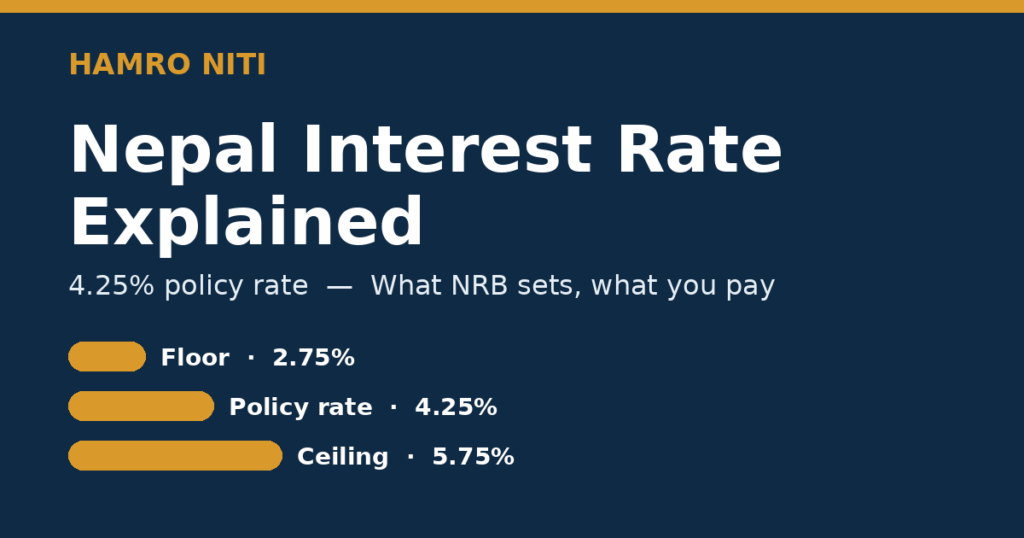
Nepal interest rate explained starts with the interest rate corridor, the system NRB has used since 2017. It has three rates, and together they form a band that the rate banks charge each other overnight is supposed to stay inside.
| Rate | Level | What it means |
|---|---|---|
| Standing deposit facility (floor) | 2.75% | Banks can always park surplus cash with NRB and earn this |
| Policy rate (middle) | 4.25% | The headline rate; NRB’s main signal about the cost of money |
| Bank rate / standing liquidity facility (ceiling) | 5.75% | Banks short of cash can always borrow from NRB at this rate |
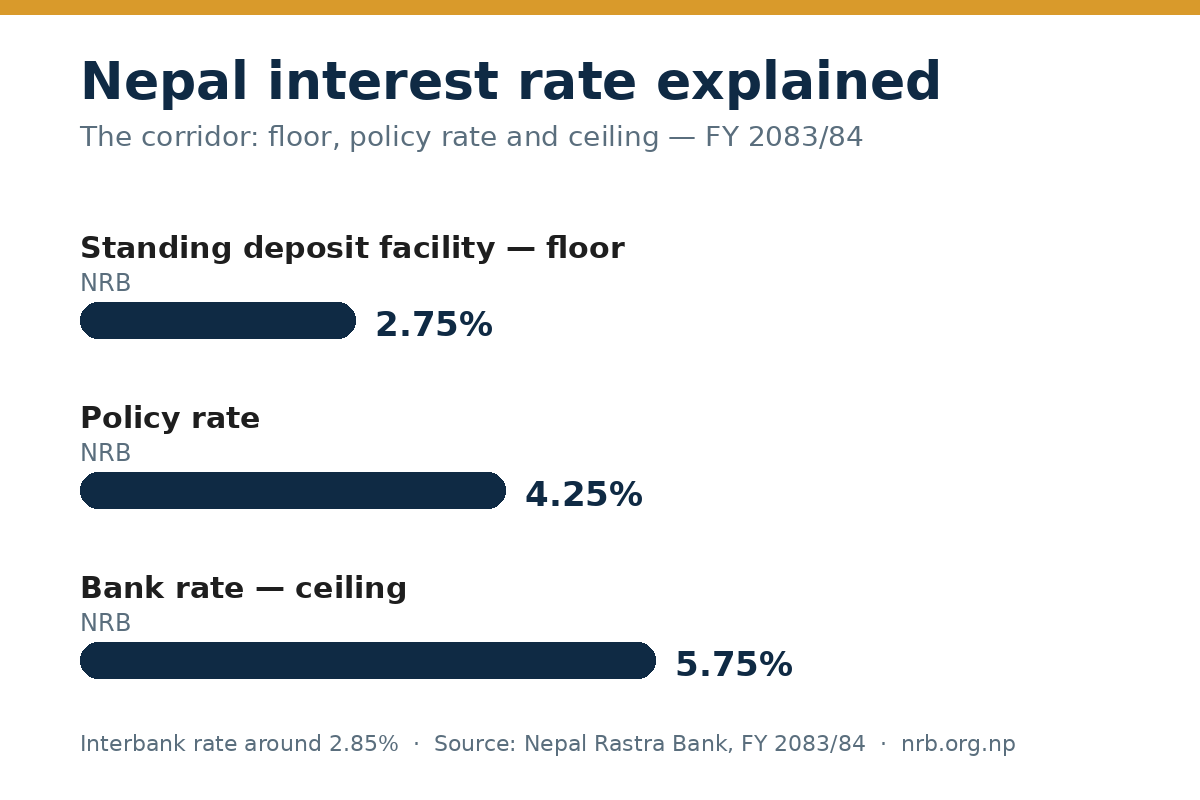
No bank will lend to another bank for less than 2.75% when NRB will pay that much, or pay more than 5.75% to borrow overnight when NRB will lend at that rate. The policy rate, at 4.25%, sits in the middle: the headline number, not the rate anything actually costs.
Right now the interbank rate is near the floor, at around 2.85% when the policy was announced: banks have far more money than they can lend. NRB’s data for fiscal year 2025/26 shows the same picture — deposits grew 13.9% to Rs 8,276.93 billion, while private-sector credit grew only 6.5%.
Nepal interest rate explained: who actually sets your loan rate
Nepal interest rate explained has a second step, because NRB’s corridor is only the start of the chain. Your loan rate is set by your bank, and it is built in two parts: a base rate, plus a premium.
The base rate is each bank’s own calculation of its cost of money: what it pays depositors, what it must keep aside as reserves, and what it costs to run the bank. In mid-July 2026 the average base rate of commercial banks was 4.83%, down from 6.02% a year earlier. Development banks averaged 6.58% and finance companies 7.09%.
The premium is what the bank adds on top, based on the loan type, size, tenure, collateral, and your repayment history. Most loans in Nepal are floating-rate, so when the base rate moves, your EMI can move with it.
Nepal interest rate explained: what changed, from 7% to 4.25%
Nepal interest rate explained is also a story about how far rates have fallen. In mid-2023 NRB’s policy rate was 7%, with a corridor running from 5.5% to 7.5%. By mid-2026 it was 4.25%, with the corridor narrowed to 2.75% to 5.75%. The cuts came in steps: 5.5% by mid-2024, 5% by mid-2025, 4.5% in the July 2025 policy, and 4.25% in its first review. The July 2026 policy held it there.
The fall pulled everything else down: the average base rate fell from 10.03% in mid-July 2023 to 4.83% in mid-July 2026, and the 91-day Treasury bill was 2.32% in mid-July 2026.
Why did NRB cut? The economy was not using the money it already had: private-sector credit grew only 6.5% in fiscal year 2025/26, and banks held more than Rs 1.4 trillion of excess liquidity. Inflation was contained at 3.08% on an annual average basis, down from 4.06% the year before.
Nepal interest rate explained: a Rs 50 lakh loan, worked out
Nepal interest rate explained is clearest with real numbers. Take a Rs 50 lakh home loan over 20 years, at the average commercial bank lending rate. At 6.55% — the average in mid-July 2026 — the EMI is about Rs 37,426 a month, and you pay about Rs 39.8 lakh in interest over 20 years, on top of the Rs 50 lakh you borrowed.
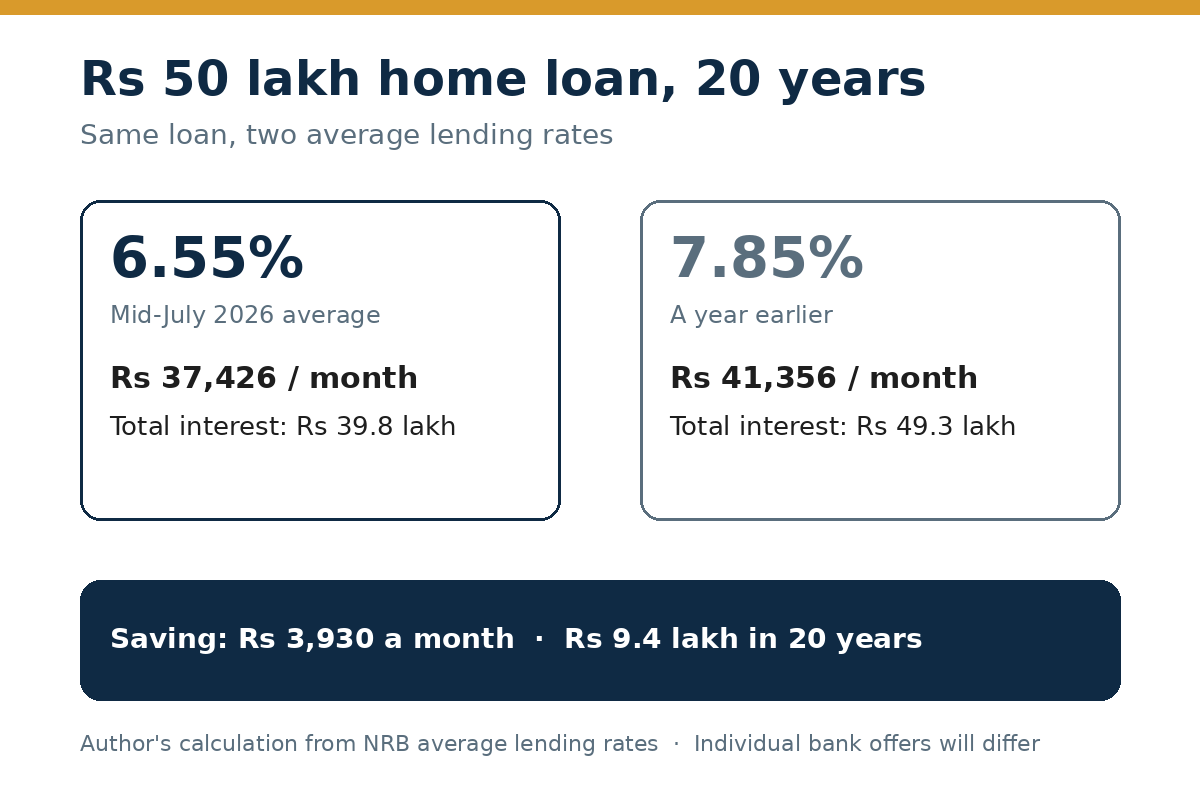
At 7.85% — the average a year earlier — the same loan cost about Rs 41,356 a month, or about Rs 49.3 lakh in interest: a difference of about Rs 3,930 a month, and about Rs 9.4 lakh in total. The same maths works in reverse: a rise of one percentage point adds roughly Rs 3,000 a month to the EMI.
Remember three things. First, this uses the average rate, not any bank’s actual offer: ask for your rate in writing. Second, it assumes the rate stays fixed for 20 years, which it will not. Third, the interest figure excludes service charges, insurance, and the down payment, which is the part of the property’s value the bank will not finance.
Nepal interest rate explained: what it means for savers
Nepal interest rate explained is bad news for savers at the moment. A saver who put Rs 10 lakh in a one-year fixed deposit at the average commercial bank rate of 3.21% would earn about Rs 32,100 in a year, before tax. That is the lowest average deposit rate in the central bank’s monthly series.
Prices were also rising faster than the deposit rate. Year-on-year inflation was 5.14% in mid-July 2026, so a deposit paying 3.21% was losing about 1.9 percentage points of purchasing power a year at that moment. On an annual average basis inflation was 3.08%, so the real return was slightly positive.
That is why fixed deposits have lost their pull: they were 56.4% of all deposits two years ago and 35.3% by mid-July 2026, while saving deposits had risen to 47.0%. For a saver, the question is the rate your own bank is actually paying, after tax — and whether it beats inflation. If it does not, the deposit is safe, but it is not growing in real terms.
Nepal interest rate explained: why your rate moves slowly, and what to check before you borrow
Nepal interest rate explained has one last twist: the rate NRB announces and the rate you pay do not move together. The policy rate moves first. The interbank rate follows within a week or so. Treasury bill yields follow within weeks. Deposit rates take roughly a quarter to reprice, because banks only change them when they need new deposits. Lending rates take longer still — two quarters or more — because most existing loans reprice only when the bank’s base rate is reset.
That lag cuts both ways: borrowers wait months for the benefit of a cut, and get a few months of grace after a rise. Before you borrow, ask what base rate and premium the bank is charging, whether the rate is floating, what the total cost is, and whether you could still afford the EMI if the rate rose by one or two points.
For more on what your pay looks like after tax, see our explainer on Nepal income tax slabs 2026 at https://hamroniti.com/nepal-income-tax-slabs-2026/, and for more context on public money in Nepal, see Hamro Niti at https://hamroniti.com/.
Frequently asked questions
What is the Nepal interest rate explained in one sentence? NRB sets a corridor — 2.75% at the bottom, 4.25% in the middle, 5.75% at the top — and banks price your loan as their base rate plus a premium.
What is NRB’s policy rate now? The policy rate is 4.25%, unchanged in the monetary policy for fiscal year 2083/84 announced on 7 July 2026. The standing deposit facility is 2.75% and the bank rate is 5.75%.
Why is my home loan rate not 4.25%? Because 4.25% is NRB’s policy rate, not a lending rate. Your bank lends at its base rate — 4.83% on average in mid-July 2026 — plus a premium, for an average lending rate of 6.55%.
How much is the EMI on a Rs 50 lakh loan? At 6.55% over 20 years, about Rs 37,426 a month; at 7.85%, the average a year earlier, about Rs 41,356 a month. Your bank’s offer will differ.
Are deposit rates in Nepal below inflation? At mid-July 2026, yes year-on-year: the average deposit rate was 3.21% while inflation was 5.14%. On an annual average basis inflation was 3.08%, so the real return was slightly positive.
Where can I check the current rates? At nrb.org.np, in NRB’s monetary policy and monthly Current Macroeconomic and Financial Situation report, and in each bank’s own published rate sheet.