

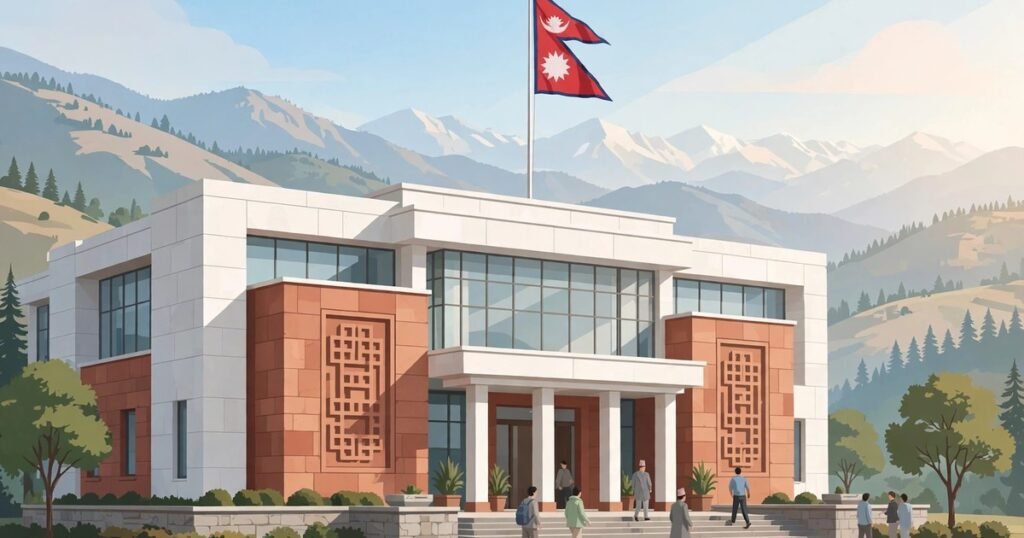
Nepal provincial government explained in one sentence: it is the middle layer of Nepal’s federal system — seven elected governments that run hospitals, roads, schools and farms in their own province, under powers written into the Constitution of 2015.
Most Nepalis deal with their province far less often than with their municipality or with Kathmandu, so the provincial layer can feel distant and unclear. Yet provinces decide real things: which provincial hospital gets a new building, which road gets blacktopped, how much vehicle tax you pay, and who runs the province’s schools and universities. This is Nepal provincial government explained for anyone who wants to know who does what — and who to hold to account.
Table of Contents
- Nepal Provincial Government Explained: The Seven Provinces at a Glance
- Nepal Provincial Government Explained: How It Is Formed
- Nepal Provincial Government Explained: Its Powers
- Nepal Provincial Government Explained: The Services It Runs
- Nepal Provincial Government Explained: Where the Money Comes From
- Nepal Provincial Government Explained: What Still Isn’t Working
- Nepal Provincial Government Explained: How to Check Its Work
- Frequently Asked Questions
- Sources
Table of Contents
Nepal Provincial Government Explained: The Seven Provinces at a Glance
The Constitution of 2015 turned Nepal from a unitary state into a federal democratic republic with three levels of government: the federation in Kathmandu, seven provinces, and 753 local governments. Article 56 sets out that structure, and Schedule 4 lists the seven provinces and the districts inside each one.
Each province chose its own name and capital by a two-thirds vote of its provincial assembly. The seven provinces, their capitals, and their chief ministers as of November 2026 are:
| Province | Capital | Districts | Population (2021 census) | Assembly seats | Chief minister (Nov 2026) |
|---|---|---|---|---|---|
| Koshi | Biratnagar | 14 | 4,961,412 | 93 | Hikmat Kumar Karki (since 9 May 2024) |
| Madhesh | Janakpurdham | 8 | 6,114,600 | 107 | Saroj Kumar Yadav (since 22 Nov 2026) |
| Bagmati | Hetauda | 13 | 6,116,866 | 110 | Kiran Thapa Magar (since 21 Aug 2026) |
| Gandaki | Pokhara | 11 | 2,466,427 | 60 | Surendra Raj Pandey (since 29 May 2024) |
| Lumbini | Deukhuri | 12 | 5,122,078 | 87 | Chet Narayan Acharya (since 24 Jul 2024) |
| Karnali | Birendranagar | 10 | 1,688,412 | 40 | Mangal Bahadur Shahi (since 29 Jul 2026) |
| Sudurpashchim | Godawari | 9 | 2,694,783 | 53 | Khagaraj Bhatta (since 14 Aug 2026) |
Bagmati is the most populous province, with 6,116,866 people in the 2021 census, just ahead of Madhesh with 6,114,600. Karnali is the largest by area but has the fewest people, at 1,688,412. Together the seven provinces cover all 77 districts and all 29,164,578 people counted in the census.
Chief ministers change when the politics of a provincial assembly shifts, so the names above are a snapshot, not a permanent list. Madhesh is the freshest example: Saroj Kumar Yadav was appointed chief minister on 21 November 2026 and took the oath the next day, after no party could put together a majority coalition. A Nepal provincial government explained properly has to include that instability, because it shapes everything else the province does. That table is the short version; the rest of this Nepal provincial government explained guide fills in how each part works.
Nepal Provincial Government Explained: How It Is Formed
A Nepal provincial government has three parts: a ceremonial head, an elected head, and an elected assembly. A Nepal provincial government explained through its formation shows why chief ministers change so often — and why that matters for everything the province tries to do.
The Province Chief (Governor). Each province has a Province Chief, appointed by the President on the recommendation of the federal government, for a five-year term. The Province Chief is the ceremonial head of the province. The Chief administers the oath of office to the chief minister and the ministers, summons and ends sessions of the provincial assembly, and gives assent to provincial laws. The Chief does not run the government day to day.
The Chief Minister. The chief minister is the real head of a Nepal provincial government. Article 168 of the Constitution sets out how one is chosen, in a clear order. First, the leader of the party with a majority in the provincial assembly is appointed. If no party has a majority, a member who can show the support of two or more parties is appointed. If that fails too, the leader of the largest party in the assembly is appointed — which is how Saroj Kumar Yadav became Madhesh chief minister in November 2026. Whoever is appointed must win a vote of confidence in the assembly within 30 days.
The chief minister picks a council of ministers, and together they run the province’s administration, prepare its budget, and carry out its laws. If the assembly passes a vote of no confidence, the government falls and the process starts again.
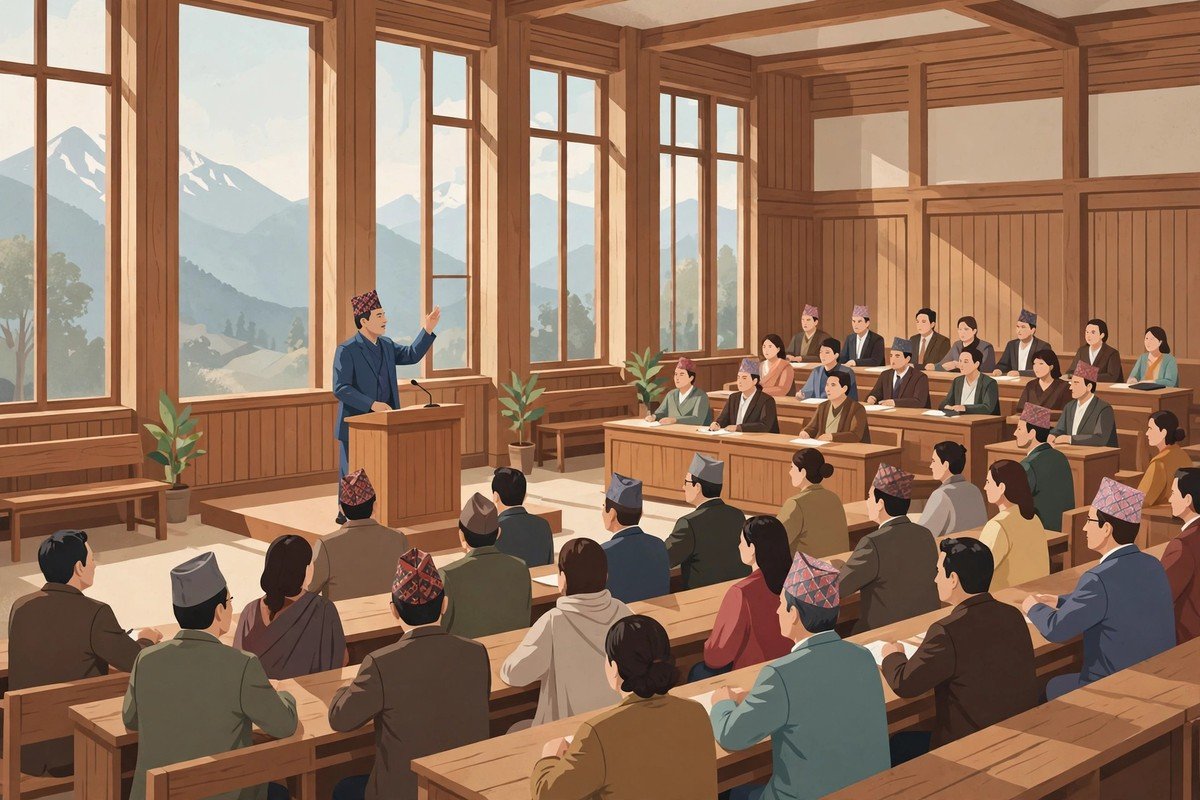
The Provincial Assembly. Each province has a single-chamber assembly, elected for five years unless dissolved earlier. Across all seven provinces there are 550 seats: 330 elected directly by first-past-the-post voting and 220 by proportional representation. At least one-third of each party’s members in the assembly must be women. The assembly makes provincial laws, approves the provincial budget, and holds the chief minister and ministers to account. It is the part of a Nepal provincial government explained least often, but it is where the province’s laws and budgets are actually decided. It elects its own Speaker and Deputy Speaker, and it must receive the province’s budget every year on Asar 1 (mid-June).
Provincial elections were first held in 2017, alongside the first federal elections under the new Constitution. The current assemblies were elected in November 2022, so the next provincial elections are due in 2027. When provincial elections are held on the same day as federal elections, each voter casts four ballots: two for the federal parliament and two for the provincial assembly.
Nepal Provincial Government Explained: Its Powers
The Constitution divides power between the three levels of government in Article 57 and Schedules 5 to 9. Schedule 5 lists the federation’s exclusive powers, Schedule 6 lists the provinces’ exclusive powers, Schedule 7 lists powers shared between the federation and the provinces, Schedule 8 lists the local levels’ powers, and Schedule 9 lists powers shared by all three levels. Nepal provincial government explained through Schedule 6 alone would be a list; what matters is which of those powers are real in practice, and which are still only on paper.
What only a province can do. Schedule 6 gives each Nepal provincial government 21 exclusive subjects. In plain language, the most important are:
- Provincial police administration and law and order
- The provincial civil service and other provincial government services
- Provincial universities, higher education, libraries and museums
- Health services
- Provincial highways, provincial railways and provincial aviation
- Provincial-level electricity, irrigation and water supply
- Agriculture and livestock development, and factories and industry inside the province
- Management of forests, water resources and ecology within the province
- Land management, land records and land revenue collection
- Exploration and management of mines
- Provincial statistics
- Cooperatives, and banks and financial institutions at the provincial level
- Radio, FM and television
- The provincial public service commission, which recruits provincial staff
- Protection and use of language, culture, script and religion
- Guthi (community trust) management
What provinces share with Kathmandu. Schedule 7 lists 25 concurrent subjects, where both the federal and provincial governments can make laws. These include criminal and civil procedure, the supply and price control of essential goods, jail management, inter-provincial forests, national parks and water use, and land policy. Where a federal law and a provincial law conflict on a concurrent subject, the federal law prevails. Schedule 9 adds subjects shared by all three levels, such as cooperatives, disaster management, and social security.
What stays with Kathmandu. The federation keeps defence and the military, foreign affairs, citizenship and passports, customs, VAT and income tax, the central bank and monetary policy, and national security. A province cannot set its own foreign policy, print money, or charge customs duty at the border. Understanding a Nepal provincial government explained in full means knowing this boundary: provinces are powerful on paper, but the biggest taxes and the biggest decisions about money still sit in Kathmandu. That overlap is also why a Nepal provincial government explained often turns into an argument about who is responsible when something goes wrong — the answer is frequently “more than one level”.
Nepal Provincial Government Explained: The Services It Runs
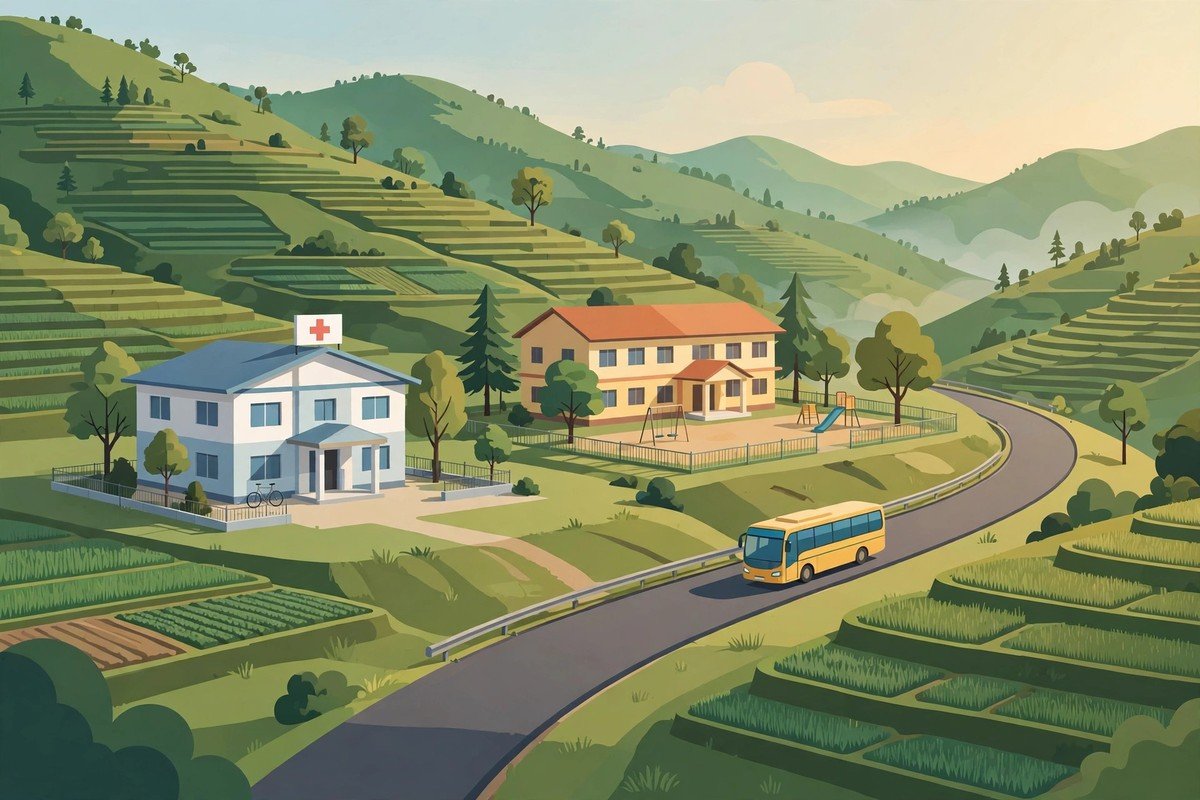
Powers on a list only matter if they turn into services people can use. Nepal provincial government explained in terms of services comes down to the things people notice: hospitals, schools, roads and farms. Here is what a Nepal provincial government actually runs, day to day.
Health. Provinces run provincial hospitals and have their own health directorates. If you are referred from a health post to a bigger hospital in your province, that hospital is most likely a provincial one. A Nepal provincial government explained through its hospitals is a story of the middle tier doing the heavy lifting: local governments run the health posts and basic hospitals, and the federal Ministry of Health and Population sets policy and runs national programmes — so health is a shared job, with the province in the middle. Our guide to Nepal’s public health system explains how the three levels divide this work.
Education. Provinces are responsible for higher education, including provincial universities, and for supporting secondary education. They also run libraries and museums. Basic schooling up to grade 8 sits mainly with local governments, and the federal government sets national education policy and runs the big public universities such as Tribhuvan University.
Roads and transport. Provinces build and maintain provincial highways and rural roads inside their borders, and they run vehicle registration and collect vehicle tax — the tax you pay when you renew your blue book. National highways remain a federal job, and your municipality looks after the streets inside town.
Agriculture, irrigation and water. Provinces run agricultural extension services, support farmers with seeds and training, manage provincial irrigation projects, and look after drinking water supply schemes. This matters most in provinces where most people still farm for a living, such as Madhesh, Lumbini and Karnali.
Forests and environment. Forests inside a province, outside national parks, are managed by the province together with community forest user groups. Provinces also handle provincial-level environmental protection.
What a province does not run. Provinces do not run the police in practice yet, even though the Constitution gives them that power — more on that below. They do not run courts, citizenship or passport offices, or the national army. And they do not run the 753 municipalities and rural municipalities, which are a separate level of government with their own elected leaders and budgets. Our guide to how local governments spend your tax money covers that third level.
Nepal Provincial Government Explained: Where the Money Comes From
A Nepal provincial government has three sources of money: taxes it collects itself, a share of national taxes, and grants from the federal government. Nepal provincial government explained through its money is a story of dependence — and that dependence shapes what provinces can actually deliver.
Its own taxes. Provinces collect vehicle tax, land and house registration fees, entertainment tax, advertisement tax, tourism tax, agricultural income tax, and service charges and fees. These are real revenues, but they are the smallest part of any Nepal provincial government explained by its budget. Bagmati collects the most, because Kathmandu’s vehicle registrations and property transactions sit inside it; Karnali collects the least.
A share of national taxes. Under the Intergovernmental Fiscal Arrangement Act, 2074, VAT and excise duty collected on domestic products go into a Federal Divisible Fund, split 70 percent to the federal government, 15 percent to the provinces and 15 percent to local levels. Royalties from natural resources such as hydropower, forests and mines are shared 50 percent federal, 25 percent province and 25 percent local.
Grants from Kathmandu. Article 60 of the Constitution provides for four kinds of federal grant: fiscal equalisation grants, which a province can spend as it chooses; conditional grants, tied to specific programmes; complementary (matching) grants, which require the province to add its own money; and special grants, for particular needs. The National Natural Resources and Fiscal Commission, a constitutional body, recommends the equalisation amounts each year from a formula based on population, area, development level and revenue capacity. For fiscal year 2083/84 it recommended Rs 61.50 billion in equalisation grants to the seven provinces. In total, the federal government allocated Rs 109.65 billion in grants to the provinces for fiscal year 2083/84 — Madhesh received the largest share at Rs 17.06 billion, followed by Karnali at Rs 17.21 billion, Koshi at Rs 16.47 billion, Sudurpashchim at Rs 16.01 billion, Bagmati at Rs 15.21 billion, Lumbini at Rs 14.42 billion and Gandaki at Rs 12.73 billion.
The budgets. For fiscal year 2083/84 (2026/27), the seven provinces tabled combined budgets of about Rs 291.96 billion:
| Province | Budget FY 2083/84 |
|---|---|
| Bagmati | Rs 66.93 billion |
| Madhesh | Rs 41.13 billion |
| Koshi | Rs 40.44 billion |
| Sudurpashchim | Rs 37.70 billion |
| Lumbini | Rs 37.38 billion |
| Karnali | Rs 35.39 billion |
| Gandaki | Rs 32.99 billion |
For scale, the federal budget for the same year is Rs 2,124.34 billion — so all seven provinces together spend roughly one-seventh of what Kathmandu spends. Bagmati has the largest provincial budget, and the highest projected per capita income of any province, at USD 2,644. Koshi posted the largest percentage increase, up 12.74 percent on the previous year.
The catch. Announced money and received money are not the same thing. The Fiscal Commission’s seventh annual report, presented to the President in October 2026, found that in fiscal year 2081/82 the federal government transferred only 91.76 percent of the equalisation grants it had allocated to provinces. This is why any Nepal provincial government explained honestly must start with the grants, not the taxes: when grants arrive late or short, provincial projects stall — and provinces have little of their own revenue to fall back on. That dependence on Kathmandu is the central fact of provincial finance, and it is why arguments about grants dominate every meeting between chief ministers and the prime minister. Our explainer on fiscal federalism in Nepal goes deeper into how the money flows between the three levels.
Nepal Provincial Government Explained: What Still Isn’t Working
Ten years after the Constitution promised federalism, provincial governments say they still cannot do the job they were given. Nepal provincial government explained ten years on is largely a story of that gap: in October 2026, the chief ministers of all seven provinces met in Biratnagar and issued the Koshi Declaration 2083, repeating demands they have made for years. Three problems dominate.
The police have not been handed over. The Constitution puts provincial police administration on the provinces’ exclusive list, but the adjustment of police personnel, infrastructure and records from the federal police has never been completed. The Koshi Declaration calls for the transfer to be finished, with a clear division of duties for criminal investigation, public security and traffic management. Until that happens, the Nepal Police — a federal force — does most day-to-day policing, and a chief minister has little direct control over law and order in their own province.
The civil service is incomplete. Provinces are supposed to have their own civil services, recruited through their own public service commissions. But the federal laws needed to make the system work have been slow, staffing is patchy, and provinces often rely on federal employees on deputation or on temporary hires. A Nepal provincial government explained honestly has to admit this: a government without its own staff cannot deliver its own programmes.
The money does not arrive in full. As the Fiscal Commission reported, equalisation grants are cut or delayed mid-year, and conditional grants come with strings that limit what a province can spend on its own priorities. The chief ministers’ declaration asks for equalisation grants to be transferred without cuts and for a fairer share of revenue from natural resources.
None of this means provinces do nothing. They pass laws, run hospitals and universities, build roads and present budgets every year. But the gap between what the Constitution promises and what provinces can actually deliver is the main story of federalism in Nepal — and it is why the same demands appear in declaration after declaration. The Auditor General’s 63rd report adds an accountability footnote: of Rs 755.17 billion in total outstanding financial irregularities across all levels of government, Rs 33.96 billion sits with provincial offices.
Nepal Provincial Government Explained: How to Check Its Work
Provinces spend public money, so citizens have the right — and the tools — to check them. A Nepal provincial government explained is only useful if you can check it, so here is how.
Read the budget. Every province must present its budget on Asar 1 (mid-June). The budget speech and the detailed estimates are public documents, usually published on the province’s own website and covered in the press. Compare what was promised with what was actually spent: the Financial Comptroller General Office publishes monthly spending data, and the Auditor General’s annual report names the offices that spent money wrongly.
Follow the assembly. Provincial assembly sessions are public, and their proceedings, questions and committee reports show what your elected members are actually doing. If your assembly member never speaks or never asks a question, that is on the record.
Use the right to information. The Constitution guarantees the right to information, and any citizen can file a request with a provincial office for documents such as contracts, attendance records and spending details. The National Information Commission can order disclosure if an office refuses.
Vote in provincial elections. The most direct check is the ballot box. Provincial assemblies are elected every five years, and the next elections are due in 2027. Knowing what your province is supposed to do — and what it has actually done — is the starting point for voting on its record rather than on party loyalty alone. Our guide to how elections work in Nepal explains the voting system, including the four ballots you cast when federal and provincial elections fall on the same day.
Frequently Asked Questions
These are the questions a Nepal provincial government explained guide gets asked most often.
What is a Nepal provincial government?
A Nepal provincial government is the elected government of one of Nepal’s seven provinces. It is led by a chief minister, has a council of ministers, and is accountable to a provincial assembly. It runs services such as provincial hospitals, provincial universities, provincial roads, agriculture and irrigation, under powers listed in Schedule 6 of the Constitution of 2015.
How many provinces does Nepal have?
Nepal has seven provinces: Koshi, Madhesh, Bagmati, Gandaki, Lumbini, Karnali and Sudurpashchim. They were created by the Constitution of 2015 and listed, with their districts, in Schedule 4. Each province chose its own name and capital by a two-thirds vote of its provincial assembly.
Who is the chief minister of my province?
As of November 2026: Koshi — Hikmat Kumar Karki; Madhesh — Saroj Kumar Yadav; Bagmati — Kiran Thapa Magar; Gandaki — Surendra Raj Pandey; Lumbini — Chet Narayan Acharya; Karnali — Mangal Bahadur Shahi; Sudurpashchim — Khagaraj Bhatta. Chief ministers change when assembly majorities shift, so check the current office-holder before relying on this list.
What is the difference between a Province Chief and a chief minister?
The Province Chief (Governor) is the ceremonial head of the province, appointed by the President on the federal government’s recommendation for five years. The chief minister is the elected head of government, chosen from the provincial assembly under Article 168, and runs the province day to day with a council of ministers.
Can a provincial government make its own laws?
Yes, on the 21 subjects in Schedule 6 of the Constitution, such as provincial police, provincial civil service, provincial universities, health services and provincial roads. Provinces can also make laws on the concurrent subjects in Schedules 7 and 9, but where a provincial law conflicts with a federal law on a concurrent subject, the federal law prevails.
Where does a provincial government get its money?
From three sources: its own taxes, mainly vehicle tax and land registration fees; a 15 percent share of VAT and domestic excise duty, plus 25 percent of natural-resource royalties; and four kinds of federal grants — fiscal equalisation, conditional, complementary and special. For fiscal year 2083/84 the federal government allocated Rs 109.65 billion in grants to the seven provinces, and the provinces’ combined budgets total about Rs 291.96 billion.
Why do provinces say they have no real power?
Because three things promised by the Constitution are still incomplete: the transfer of police administration to the provinces, a full provincial civil service, and the complete and timely transfer of fiscal grants. The chief ministers of all seven provinces repeated these demands in the Koshi Declaration of October 2026.
Sources
- Constitution of Nepal, 2015 — Articles 56, 57, 60, 163, 168 and 176; Schedules 4, 6, 7 and 9
- National Statistics Office, National Population and Housing Census 2021 — provincial populations
- Ministry of Finance, Government of Nepal — intergovernmental fiscal transfers and Budget Speech, fiscal year 2083/84
- National Natural Resources and Fiscal Commission — seventh annual report, presented to the President, October 2026
- The Himalayan Times — “All seven provinces table FY2083/84 budgets”, June 2026
- The Kathmandu Post — “Saroj Kumar Yadav takes oath as Madhesh chief minister”, 22 November 2026
- My Republica — “Incomplete transfer of funds to provincial and local levels affects budget implementation: Fiscal Commission”, November 2026
- Review Nepal / Nepal News — “Three Years, Same Demands: Provincial Powers Remain Unfulfilled” and the Koshi Declaration 2083, October 2026
- Office of the Auditor General — 63rd annual report, fiscal year 2024/25