

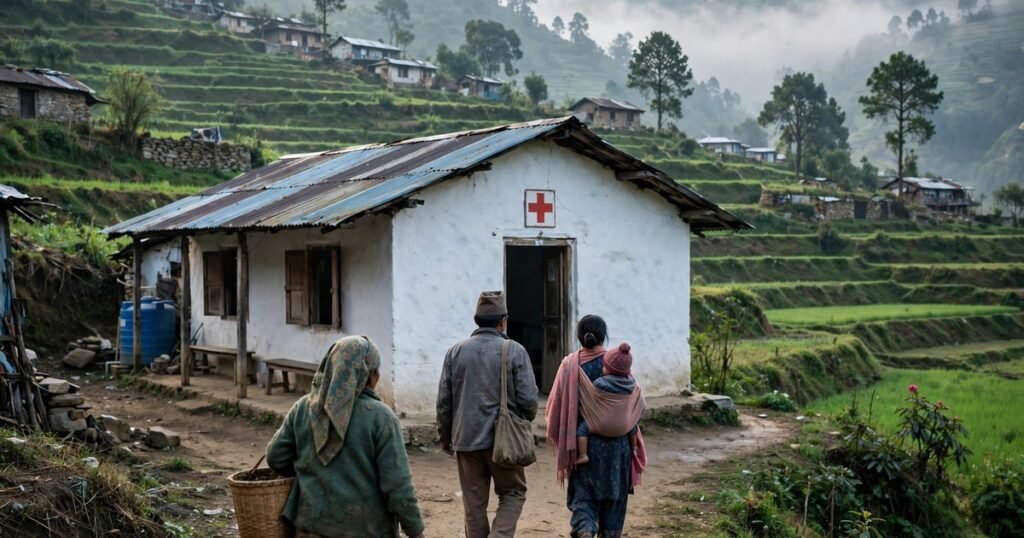
Nepal public health system explained in plain language: it is the network of government health posts, hospitals and volunteers that is supposed to give every Nepali free basic care — and the reason it often does not feel that way. The Constitution promises free basic health services to every citizen. In practice, whether you get care — and what it costs you — depends on where you live, which facility you reach, and whether the medicines are in stock that day. This is the Nepal public health system explained in full: how it is built, what is free, who pays for it, and where to go when you are sick.
Table of Contents
- Nepal public health system explained: who runs it
- Nepal public health system explained: the ladder from your ward to a central hospital
- Nepal public health system explained: what is free — and what is not
- Nepal public health system explained: who pays
- Nepal public health system explained: the people who keep it running
- What has improved — and what still fails
- How to use it: where to go when you are sick
- Frequently asked questions
- Sources
Table of Contents
Nepal public health system explained: who runs it
Nepal public health system explained from the top down starts with a promise written into the Constitution. Article 35 of the Constitution of Nepal, 2015, gives every citizen the right to free basic health services, and the Public Health Service Act, 2075 (2018) turns that promise into law. Section 3 of the Act says no citizen shall be deprived of health service, and it lists ten categories of care that must be free — from vaccination and childbirth to emergency treatment and mental health care.
Since federalism, the Nepal public health system is run by all three levels of government, not by Kathmandu alone. The federal Ministry of Health and Population sets policy and standards and runs national programmes through the Department of Health Services. Each of the seven provinces has a health directorate and runs provincial hospitals. And the 753 local governments — municipalities and rural municipalities — run the health posts, basic health service centres and basic hospitals in their own areas. That is why the quality of care can differ so much from one place to another. Nepal public health system explained in practice means your local government is now your first health provider.
The system is guided by the National Health Policy 2019 and the Nepal Health Sector Strategic Plan 2023–2030, which set the goal of universal health coverage — care for everyone, without financial hardship. The Health Financing Strategy 2023–2033 goes further, aiming for at least 10 percent of the government budget to go to health across all three levels. The target is clear. The gap between the target and the reality is what this article is about.
Nepal public health system explained: the ladder from your ward to a central hospital
Nepal public health system explained as a ladder: you are meant to start at the bottom and be referred upward only when you need more than the lower level can give.
At the bottom are the volunteers and outreach clinics in your own ward. Around 51,000 Female Community Health Volunteers (FCHVs) work in villages across the country, giving health advice, distributing vitamin A and family planning supplies, and referring sick people to the nearest facility. Behind them are about 12,500 primary health care outreach clinics and more than 16,000 immunisation clinics, which bring basic services to places a health post cannot easily reach.
The next step is the health post or basic health service centre — the small facility most Nepalis actually use. Then come the 181 primary health care centres (PHCCs), which have a doctor and a small laboratory, and then district hospitals, provincial hospitals, and finally the central and specialised hospitals in Kathmandu and the big cities, which handle surgery, cancer care, heart care and other specialist treatment.
Nepal public health system explained in numbers: according to the Ministry of Health and Population’s progress report, as of Falgun 2082 there were 8,976 government health institutions in the country: 420 hospitals, 181 primary health care centres, 3,603 health posts, 426 Ayurvedic dispensaries, and 4,346 sub-health posts and basic health service centres. On paper, that is a facility within reach of almost everyone.
Nepal public health system explained through its newest rung — the basic hospital. The plan is for every one of the 753 local levels to have its own 5- to 15-bed basic hospital, so that nobody has to travel to a district headquarters for a simple admission. The budget for fiscal year 2083/84 sets aside Rs 5.90 billion to finish 336 basic hospitals whose construction has already started, within three years. Until they are finished, the district hospital remains the nearest inpatient care for most rural Nepalis.
Nepal public health system explained: what is free — and what is not
Nepal public health system explained through what it gives for free starts with a long list, set out by law. The ten categories in the Public Health Service Act are: vaccination; motherhood, infant and child health, including family planning, abortion and reproductive health; communicable diseases; non-communicable diseases and physical disability; mental health; elderly citizens’ health; general emergency care; health promotion; Ayurveda and other accredited alternative systems; and any other service the government prescribes. The Act also requires every health institution to provide emergency treatment.
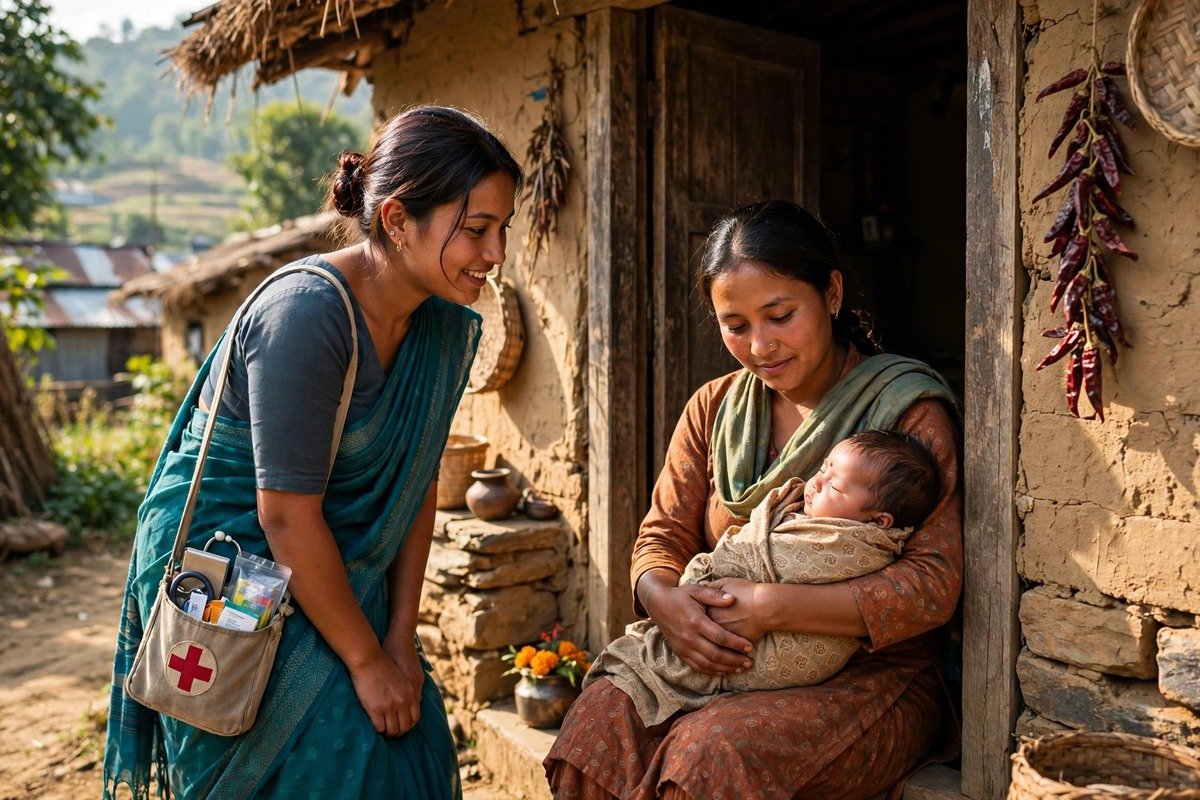
Of the ten free categories, Nepal public health system explained in daily life comes down to two that matter most. The first is medicines. The government provides 98 types of essential medicines free of cost from state-run health facilities — 57 types at health posts, and all 98 at primary health care centres and basic hospitals. The list covers common infections, blood pressure, diabetes, asthma, mental health and more, and it was expanded to 98 types in the budget of fiscal year 2022/23. The second is childbirth. Under the Aama Surakshya programme, running since 2005, delivery in a public health facility is free, and mothers who complete four antenatal check-ups receive a transport incentive — Rs 3,000 in mountain districts, Rs 2,000 in the hills, and Rs 1,000 in the Terai — plus Rs 400 for completing the four check-ups. Immunisation has been free since the National Immunisation Programme began in 1979.
Nepal public health system explained honestly also means saying what is not free: almost everything beyond that list. Specialist consultations, most diagnostic tests, surgery, and any medicine outside the 98 free types must be paid for — either from your pocket or through health insurance. And even the free services are not always available: health posts regularly run out of free medicines, and patients are then told to buy them from a private pharmacy. A 2025 news report found blood pressure and diabetes medicines out of stock at health facilities for months at a time, even though the law says they must be available around the clock. Free on paper is not the same as free in the building.
Nepal public health system explained: who pays
Nepal public health system explained through who pays for it comes down to three sources: the government budget, health insurance, and patients themselves. The balance between them is the system’s biggest problem.
Nepal public health system explained through the budget shows a government side that is growing but still small. The budget for fiscal year 2083/84 allocates Rs 101.95 billion to the health sector — about 4.8 percent of the total national budget of Rs 2,124.34 billion. Of that, Rs 96.44 billion goes to the Ministry of Health and Population itself, Rs 15 billion to the health insurance programme, and Rs 13.15 billion to social health security programmes, including treatment support for poor citizens, the Aama Surakshya programme and free medicines. That is well short of the Health Financing Strategy’s target of 10 percent of the budget, and well short of the World Health Organization’s recommendation that countries spend at least 5 percent of GDP on health.
The second source is health insurance. Under the national health insurance scheme, a family pays a premium of Rs 3,500 a year and can claim up to Rs 100,000 of treatment at empanelled hospitals, with extra members adding Rs 700 to the premium and Rs 20,000 to the ceiling. The budget aims to bring 90 percent of Nepalis under insurance within three years. Our full explainer on Nepal’s health insurance scheme (https://hamroniti.com/nepal-health-insurance-explained/) covers who is covered, what it pays for, and where it falls short — including the fact that only about one in five Nepalis is actively enrolled.
Nepal public health system explained through the patient’s wallet is the third source, and the one that matters most: their own pockets. According to the National Health Accounts, out-of-pocket spending was about 54.2 percent of all health spending in fiscal year 2019/20, and World Health Organization data puts it at about 59.4 percent in 2023, against 32.2 percent paid by government and compulsory schemes. In plain terms, for every Rs 100 spent on health care in Nepal, roughly Rs 55 to Rs 60 still comes straight out of a patient’s pocket — mostly for medicines bought at private pharmacies, tests, and treatment in private hospitals. That is why a serious illness can still push a family into debt, even though basic care is free by law.
Nepal public health system explained: the people who keep it running
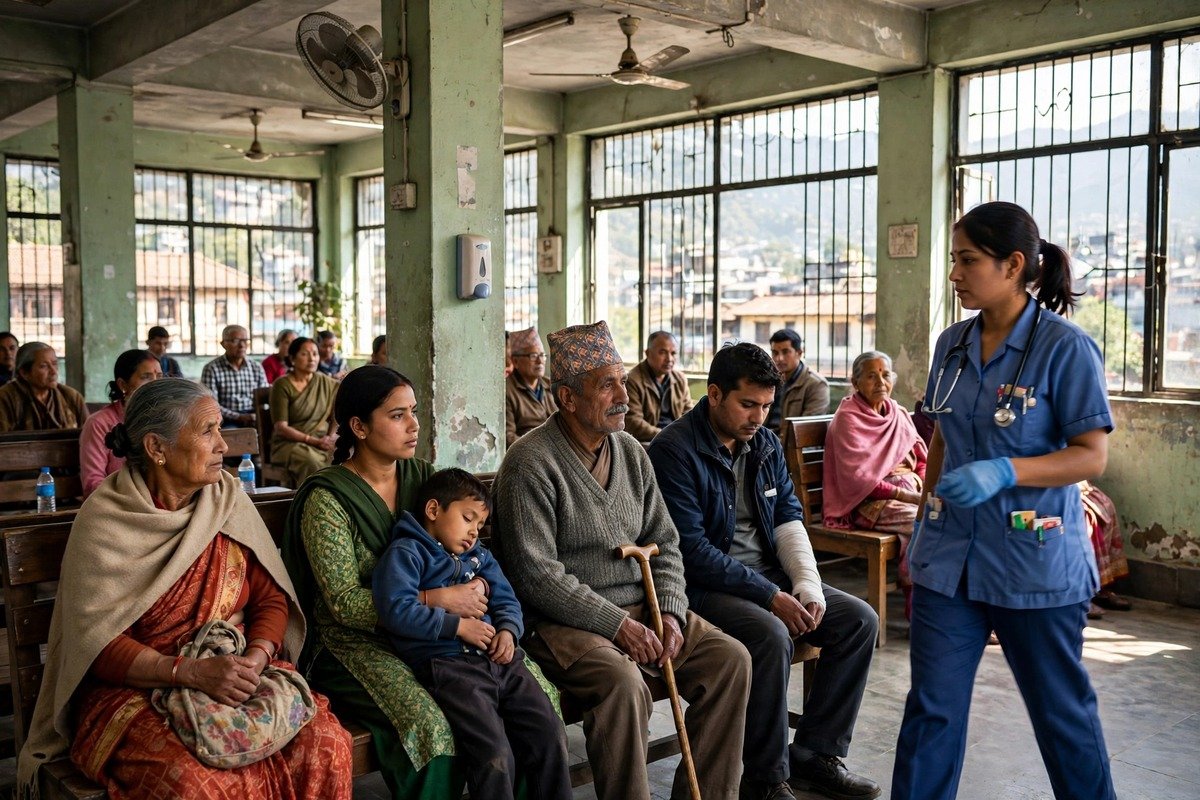
Nepal public health system explained through its people runs on people — and it does not have enough of them. As of Falgun 2082, about 104,756 health personnel were working in government services: 7,030 doctors, 28,650 nurses and auxiliary nurse midwives, 16,393 health assistants, and 51,386 Female Community Health Volunteers. That works out to 1.94 health workers per 1,000 people, against the World Health Organization’s benchmark of 4.45 per 1,000 needed for universal health coverage. Nepal has less than half the health workforce the WHO says it needs.
The shortage has a simple cause. The permanent staffing structure for government health services was fixed in 2048 BS, when Nepal’s population was about 18 million. The population has since grown to nearly 30 million, but the structure barely changed. The Ministry of Health and Population has recently approved 977 additional positions, but that is a small step against a gap measured in tens of thousands.
Nepal public health system explained through its volunteers is the exception to the shortage. The FCHVs — more than 51,000 women, most of them unpaid or paid a small allowance — are the backbone of community health in Nepal. They are the reason immunisation and vitamin A campaigns reach remote villages, and the reason many mothers first hear about antenatal care. Any honest account of the Nepal public health system has to start with them, because without them the ladder described above would have no bottom rung at all.
What has improved — and what still fails
Nepal public health system explained through results shows real gains, measured over decades. The maternal mortality ratio fell from 539 deaths per 100,000 live births in 1996 to 151 in 2022, according to the Nepal Demographic and Health Survey 2022. Institutional delivery rose from 19 percent in 2006 to 79 percent in 2022, and 94 percent of women now receive antenatal care from a skilled provider. Four in five children aged 12 to 23 months are fully vaccinated against the basic antigens. Neonatal mortality is 21 per 1,000 live births and under-five mortality 33 per 1,000. These are real gains, driven largely by the free services and the volunteer network described above.
Nepal public health system explained through what still fails is also measurable. More than half of all health spending still comes out of patients’ pockets. Free medicines are frequently out of stock. Health workers are less than half the number the WHO recommends. More than 1,800 health posts were operating without proper buildings in a 2017 report, and building conditions remain a complaint in many districts. Basic hospitals are still under construction in hundreds of local levels. And health insurance, the main tool for protecting families from medical bills, covers only about one in five Nepalis actively. The system is strongest at the things it does for free at the community level — vaccination, childbirth, basic medicines — and weakest at the things that cost money: specialist care, diagnostics, and hospital treatment.
How to use it: where to go when you are sick
Nepal public health system explained as a practical guide starts here: for most everyday problems — fever, cough, diarrhoea, a minor cut, a child’s vaccination — start at your nearest health post or basic health service centre. Consultation is free, and the medicines on the free list should be free too; if they are out of stock, ask the health worker to write a prescription and note what was unavailable. For pregnancy, register at the health post early: four antenatal check-ups, a delivery at a health facility, and the Aama Surakshya transport incentive all depend on it.
For anything that needs a doctor, a laboratory test or an admission, go to a primary health care centre or a basic hospital, and from there to the district hospital if you are referred. In an emergency, go straight to the nearest hospital — the law requires every health institution to provide emergency treatment. If you have a health insurance card, use it at an empanelled hospital and keep your receipts; the scheme pays the hospital directly up to your ceiling. And if a facility refuses a service the law says is free, or charges you for a medicine on the free list, you can raise it with your ward office or municipality — since federalism, they are the ones who run the facility, and they are the ones answerable for it.
Frequently asked questions
Is health care free in Nepal?
Nepal public health system explained in one answer: basic health services are free by law — the Constitution and the Public Health Service Act, 2075 guarantee them. That covers vaccination, childbirth, family planning, treatment for common communicable and non-communicable diseases, mental health care, elderly care and emergency treatment, plus 98 free essential medicines. Specialist care, most tests and medicines outside the free list are not free.
Which medicines are free at a health post?
Fifty-seven types of essential medicines are supposed to be available free at health posts, and all 98 types at primary health care centres and basic hospitals. They include antibiotics, blood pressure and diabetes medicines, asthma inhalers, and medicines for mental health. In practice, stock-outs are common, so availability varies by facility and by month.
What is a basic hospital?
A basic hospital is a small 5- to 15-bed hospital run by a local government, meant to give every municipality and rural municipality its own inpatient facility. The plan is one per local level — 753 in total — and 336 under construction are to be finished within three years under the fiscal year 2083/84 budget.
How does health insurance work in Nepal?
A family pays Rs 3,500 a year and can claim up to Rs 100,000 of treatment at empanelled hospitals. Extra family members add Rs 700 to the premium and Rs 20,000 to the ceiling, up to ten members. Poor households, senior citizens over 70, people with disabilities and several other groups get free or discounted enrolment. See our explainer on Nepal’s health insurance scheme (https://hamroniti.com/nepal-health-insurance-explained/) for the full details.
Who runs my local health post — the federal government or my municipality?
Your municipality or rural municipality. Since federalism, local governments run health posts, basic health service centres and basic hospitals, while provinces run provincial hospitals and the federal government sets policy and runs national programmes. Complaints about a health post go to the ward office or municipality first.
Why do I still have to pay so much if basic care is free?
Because the free package is narrow and the public system is thin. Medicines outside the 98 free types, diagnostic tests, specialist care and private hospital treatment all cost money, and about 55 to 60 percent of all health spending in Nepal still comes out of patients’ pockets. Health insurance is meant to close that gap, but only about one in five Nepalis is actively enrolled.
Sources
Constitution of Nepal, 2015, Article 35 (right to free basic health services); Public Health Service Act, 2075 (2018), Sections 3–4 (authenticated 18 September 2018); Ministry of Health and Population progress report, Falgun 2082, via Ratopati (8,976 government health institutions; 104,756 health personnel; 1.94 health workers per 1,000); Budget Speech, fiscal year 2083/84, Ministry of Finance (health sector Rs 101.95 billion; health insurance Rs 15 billion; 336 basic hospitals); Nepal Demographic and Health Survey 2022 (maternal mortality ratio 151; institutional delivery 79.4%; 80% of children fully vaccinated); World Health Organization, Nepal health system data 2023 (out-of-pocket spending 59.4% of current health expenditure); National Health Accounts, fiscal year 2019/20 (out-of-pocket spending 54.2%); Kathmandu Post, November 2023 and January 2026 (98 free essential medicines; list under revision); Health Insurance Board, via our health insurance explainer (Rs 3,500 premium, Rs 100,000 ceiling). For the homepage and more explainers, see Hamro Niti (https://hamroniti.com/).