
Nepal education system explained in plain language: it is a single ladder that runs from a nursery class in a village to a university degree in Kathmandu — and it is the ladder almost every Nepali family climbs, argues about, and pays for. More than 7 million children study in Nepal’s schools, and another 633,000 study in its universities. Yet only about 4 in 10 children who start school finish grade 12. This is the Nepal education system explained in full: how it is built, who runs it, what each exam means, what it costs, and where it works and where it fails.
Table of Contents
- Nepal education system explained: the big picture
- Nepal education system explained: early childhood and basic education
- Nepal education system explained: secondary school, the SEE, and grade 12
- Nepal education system explained: the fork after SEE — plus-two or CTEVT
- Nepal education system explained: universities and higher education
- Nepal education system explained: who pays for it
- Nepal education system explained: where it struggles
- What is changing
- Frequently asked questions
- Sources
Table of Contents
Nepal education system explained: the big picture
Nepal education system explained from the top starts with a promise in the Constitution. Article 31 of the Constitution of Nepal, 2015, gives every citizen the right to education, makes basic education free and compulsory, and promises free education up to the secondary level. It also gives every community the right to education in its own mother tongue. That promise is the reason nearly every child in Nepal now starts school: the net enrolment rate at the basic level reached 97.7 percent in academic session 2082.
The system has two main levels. Basic education covers grades 1 to 8, and secondary education covers grades 9 to 12. Before that comes early childhood education, and after grade 12 come university degrees and technical diplomas. The school year runs roughly from April to March, and children usually start grade 1 at age five.
Nepal education system explained through who runs it is a story of federalism. Since the 2015 Constitution, school education is mainly a local government job. The federal Ministry of Education, Science and Technology sets national policy, the curriculum, and the big exams. The seven provinces run provincial education offices and some universities. And the 753 local governments — municipalities and rural municipalities — run the schools in their own areas, hire and manage most school teachers, and run the grade 8 examination. That is why the quality of a school can differ so much from one municipality to the next: your local government is now your school manager.
The long-term plan for all of this is the School Education Sector Plan 2022–2032, a ten-year strategy that aims to improve access, quality, and equity together. The older framework, the Education Act of 1971, still governs much of the system’s day-to-day rules. The Curriculum Development Centre designs the national curriculum that every school follows.
Nepal education system explained: early childhood and basic education
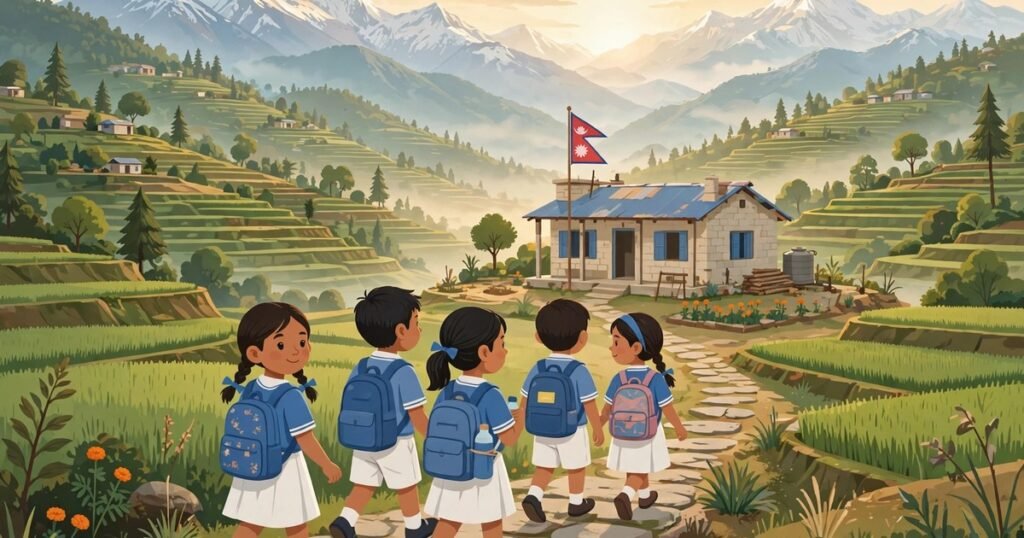
Nepal education system explained from a child’s first day starts before grade 1, in early childhood education. Children aged 3 to 5 attend nursery, lower kindergarten, and upper kindergarten classes, mostly attached to community schools. These early childhood centres are meant to prepare children for grade 1, and the share of grade 1 pupils who have had that experience has been rising steadily.
Basic education — grades 1 to 8 — is the foundation, and it is divided into two parts. The primary level is grades 1 to 5, and the lower secondary level is grades 6 to 8. The subjects are the same across the country: Nepali, English, mathematics, science, social studies, and health, with mother-tongue teaching in the early grades where the community asks for it. At the end of grade 8, students sit the Basic Level Examination, run by their local government.
Nepal education system explained in numbers shows a system that is very large and mostly public. In academic session 2082, there were 35,951 schools across the country and 7,040,825 students enrolled in grades 1 to 12 — 5,374,272 at the basic level and 1,666,553 at the secondary level. About 62 percent of students study in community schools, which are public schools run with government grants, and about 38 percent in institutional schools, which are private and self-funded. There were 272,456 teachers at the basic and secondary levels, of whom about 45 percent were women — though women make up about 55 percent of basic-level teachers and only about a fifth of secondary-level teachers.
Basic education is free by law, and the government provides free textbooks through Janak Education Materials Centre for community school students. But “free” still leaves costs: uniforms, stationery, transport, and in many private schools, fees. That is one reason the shift from community to institutional schools continues — families who can afford it often choose private schools, which are widely seen as better, even though community schools teach the majority of children.
Nepal education system explained: secondary school, the SEE, and grade 12
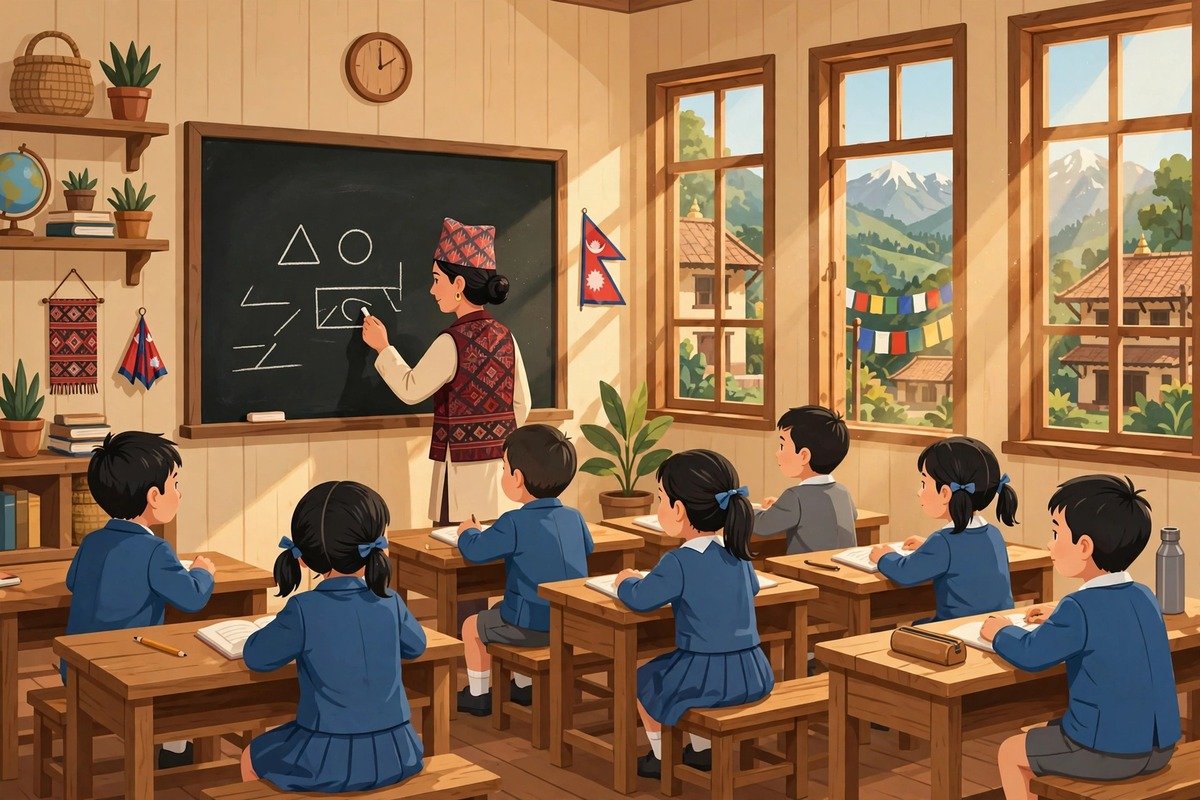
Nepal education system explained at the secondary level is where the system starts to sort students. Secondary education covers grades 9 to 12. Grades 9 and 10 end with the Secondary Education Examination — the SEE — and grades 11 and 12 end with the grade 12 examination. Both are run by the National Examinations Board.
The SEE, once called the School Leaving Certificate or SLC, is the exam every Nepali knows. It is the first national exam a student sits, and for decades it was called the “iron gate” because failing it closed the door to further study. Today it is graded on a letter scale, and students need a minimum GPA to move on. In the SEE of 2082, held in April 2026, 430,667 regular students appeared and 65.98 percent were graded — meaning about a third were not graded and had to try again. Our full explainer on the SEE (https://hamroniti.com/see-exam-nepal-explained/) covers the grading, the subjects, and what happens if you do not pass.
After the SEE, students choose a stream for grades 11 and 12 — science, management, humanities, or education — and the grade 12 examination at the end is the ticket to university. The grade 12 exam is also run by the National Examinations Board, and the certificate it gives is the School Leaver’s Certificate.
The numbers show how many students the system loses along the way. The student survival rate was 86.5 percent through grade 8, 66.9 percent through grade 10, and only 39.3 percent through grade 12. In other words, of every 100 children who start school, about 39 finish grade 12. The net enrolment rate tells the same story from the other side: 97.7 percent at the basic level, but only 51.2 percent at the secondary level. Getting children into school is largely solved. Keeping them there is not.
Nepal education system explained: the fork after SEE — plus-two or CTEVT
Nepal education system explained after the SEE splits into two paths, and this choice shapes a young person’s working life. The academic path is grades 11 and 12, then university. The technical path is run by the Council for Technical Education and Vocational Training, or CTEVT.
CTEVT was established on 23 February 1989 as the national body for technical and vocational education. It runs 49 diploma programmes and 33 pre-diploma courses through 1,169 affiliated schools and colleges across all seven provinces. The main diploma is a three-year course, taken after the SEE, in fields such as civil engineering, nursing, general medicine, agriculture, forestry, pharmacy, and computer engineering. The pre-diploma, or Technical School Leaving Certificate, takes 15 to 18 months and trains health assistants, lab technicians, junior agricultural technicians, plumbers, and electricians. Admission is through a centralised CTEVT entrance examination, and a diploma is treated as equivalent to grade 12 for university admission — so the technical path does not close the academic door.
The technical path matters because Nepal’s economy needs skilled workers and because many students do not want, or cannot afford, four more years of university. But CTEVT itself has problems: about half of its diploma seats go unfilled, and only about 58 percent of its diploma graduates find work, according to its own annual report. The skills are in demand; the link between training and jobs is still weak.
Nepal education system explained: universities and higher education
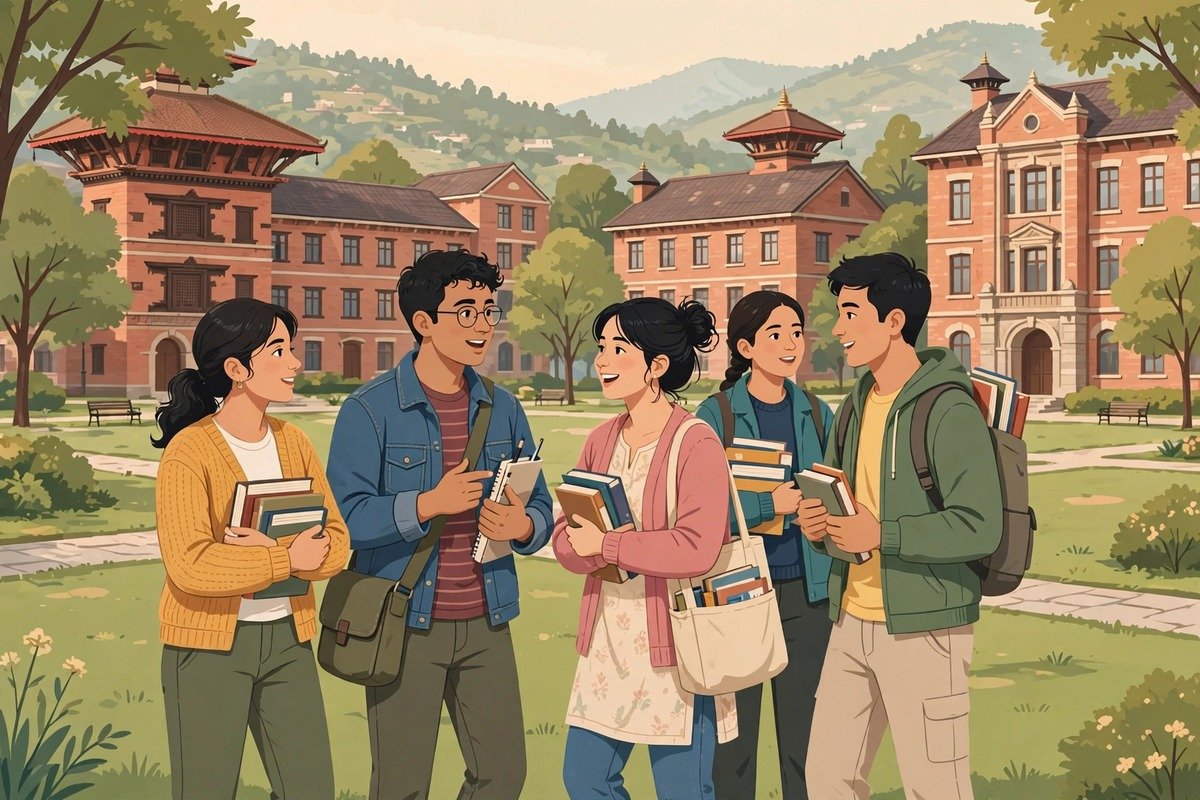
Nepal education system explained at the top is dominated by one giant. Tribhuvan University, founded in 1959, is Nepal’s oldest and largest university, and it enrols about 78 percent of all higher education students in the country. The rest are spread across Kathmandu University, Pokhara University, Purbanchal University, Far Western University, Mid-West University, and a handful of smaller and provincial universities, plus seven medical academies.
The University Grants Commission is the body that coordinates higher education, distributes government grants, and runs quality assurance. According to its EMIS report for 2023/24, there were 633,053 students enrolled across 1,432 campuses in 16 universities and seven medical academies. Tribhuvan University alone had 491,299 of them. Women made up 56.6 percent of all higher education students — more than men — and the gross enrolment ratio for ages 18 to 22 was about 22 percent, meaning roughly one in five young Nepalis reaches higher education.
A bachelor’s degree in Nepal typically takes four years, a master’s two, and a PhD several more. The biggest programmes are management, education, and humanities, which together take most students. Medical, engineering, and IT programmes are smaller and much more competitive, with entrance exams and quotas that the government has promised to review. Kathmandu University, founded in 1991, is the best-known private-sector-style university, while Tribhuvan’s 64 constituent campuses and more than 1,000 affiliated colleges carry the bulk of the country’s students.
The university system is also where Nepal’s brain drain is most visible. In fiscal year 2024/25, the government issued 543,833 no-objection certificates to students going abroad to study — a record. That is nearly as many as the entire higher education enrolment at home. Most go to Australia, Japan, the UK, Canada, and the United States, and many do not come back. Our explainer on youth unemployment (https://hamroniti.com/youth-unemployment-nepal/) looks at what happens to the graduates who stay.
Nepal education system explained: who pays for it
Nepal education system explained through money starts with the national budget. For fiscal year 2083/84, the government allocated Rs 218.30 billion to the education sector — about 10.28 percent of the total national budget of Rs 2,124.34 billion. That is a large sum, but it is still below the 20 percent of the budget that international guidance suggests, and below the 4 to 6 percent of GDP that UNESCO recommends countries spend on education.
Where the money goes is the more revealing part. About 69 percent of the education budget is transferred to local governments, because they now run the schools. About 69 percent of the budget goes on salaries and pensions. School education takes the biggest share, about 69.5 percent, while higher education gets about 11 percent and technical and vocational education about 2.6 percent. The budget also sets aside Rs 8.60 billion for scholarships, from school level to higher education, and Rs 4 billion for science, technology, and innovation.
For families, the cost depends on the path. Community schools are free, with free textbooks, though families still pay for uniforms and supplies. Institutional schools charge fees that vary widely, from a few thousand rupees a month in small towns to far more in Kathmandu’s well-known schools. At university, Tribhuvan University’s fees are low by international standards — a few thousand rupees a semester for most programmes — but medical and engineering programmes cost far more, and private colleges charge several times the public rate. Scholarships exist at every level, including targeted scholarships for girls, Dalits, students with disabilities, and students from remote districts, but the amounts are small and the competition is fierce.
Nepal education system explained: where it struggles
Nepal education system explained honestly has to say that access has improved far faster than quality. Almost every child starts school, and adult literacy reached 76.2 percent in the 2021 census, up from about 66 percent a decade earlier. But learning outcomes are weak. The National Assessment of Student Achievement found that only about one in three grade 8 students met the minimum competency in mathematics, and more than half of grade 5 students could not write a complete, grammatically correct paragraph in Nepali.
The problems start with teachers. There are too few of them in the right places, and many community schools operate without a full-time principal — more than 40 percent, according to the Flash Report. In small rural schools, a handful of teachers cover every subject for every grade. Teacher training exists, through the National Centre for Educational Development, but it reaches too few teachers too slowly.
The second problem is the gap between community and institutional schools. Community schools teach most children but get the worst results in the SEE, year after year. Institutional schools do better, but only families who can pay can send their children there. The result is a two-track system: one for those who can afford quality, one for those who cannot.
The third problem is what happens after school. The economy creates too few good jobs for graduates, so families invest in education and then watch their children leave — for foreign employment, or for study abroad. The 543,833 no-objection certificates issued in a single year are the clearest measure of that: the system educates, and then exports, its young people.
What is changing
Nepal education system explained as a work in progress has several changes under way. The School Education Sector Plan runs to 2032 and puts money behind teacher training, school infrastructure, and learning assessments. The budget for 2083/84 promises a national school mapping exercise and infrastructure audit, with Rs 1 billion set aside, plus teacher competency testing and an assessment of AI and education-technology readiness. The government has also announced it will encourage international-standard university campuses to operate in Nepal, and that the quotas on medical, nursing, and IT seats will be reviewed and increased.
Some of these promises have been made before. The test is whether the money follows the announcement — and whether the children who start school today are still in it at grade 12. The system has already proved it can get nearly every child through the school gate. The next decade will decide whether it can teach them well enough, and keep them long enough, for that to matter.
Frequently asked questions
How many years of school are there in Nepal?
Nepal education system explained as a timeline: 2 to 3 years of early childhood education, then 8 years of basic education (grades 1 to 8) and 4 years of secondary education (grades 9 to 12). A bachelor’s degree after that usually takes 4 years.
Is school free in Nepal?
Basic education, grades 1 to 8, is free and compulsory under the Constitution, and community school students get free textbooks. Secondary education is also meant to be free in public schools, but families still pay for uniforms, stationery, and transport, and private schools charge fees.
What is the SEE exam?
The SEE, or Secondary Education Examination, is the national exam at the end of grade 10, run by the National Examinations Board. It replaced the old SLC. Students need a minimum GPA to continue to grades 11 and 12. In 2082, 430,667 students appeared and 65.98 percent were graded.
What is the difference between plus-two and CTEVT?
Plus-two is the academic route — grades 11 and 12 in a stream such as science or management, leading to university. CTEVT is the technical route — a three-year diploma or a 15- to 18-month pre-diploma in a trade or profession, taken after the SEE. A CTEVT diploma counts as equivalent to grade 12 for university admission.
How many universities are there in Nepal?
There are 16 universities and seven medical academies, with 1,432 campuses between them, according to the University Grants Commission’s 2023/24 report. Tribhuvan University, founded in 1959, enrols about 78 percent of all higher education students.
How much does Nepal spend on education?
The budget for fiscal year 2083/84 allocates Rs 218.30 billion to the education sector, about 10.28 percent of the national budget. About 69 percent of it goes to local governments, which run the schools, and about 69 percent goes on salaries and pensions.
Sources
- Ministry of Education, Science and Technology — Annual Progress Report, fiscal year 2082/83 (schools 35,951; students 7,040,825; teachers 272,456; net enrolment 97.7% basic, 51.2% secondary; survival 86.5% / 66.9% / 39.3%)
- Centre for Education and Human Resource Development — Flash I Report 2081 (2024/25) (schools 35,447: 27,298 community, 8,149 institutional)
- National Statistics Office — National Population and Housing Census 2021 (literacy 76.2%)
- National Examinations Board — SEE 2082 results (430,667 appeared; 65.98% graded)
- University Grants Commission — EMIS Report on Higher Education 2023/24 (633,053 students; 1,432 campuses; 16 universities and 7 medical academies; Tribhuvan University 491,299 students, 77.61%)
- Council for Technical Education and Vocational Training — CTEVT Act 2045 (established 23 February 1989); CTEVT Annual Report 2025 (1,169 institutions; 49 diploma and 33 pre-diploma programmes; diploma seats about half filled; graduate employment about 58.2%)
- Ministry of Finance — Budget Speech, fiscal year 2083/84 (education Rs 218.30 billion; 10.28% of Rs 2,124.34 billion; 69.07% to local levels; Rs 8.60 billion scholarships; Rs 4 billion science, technology and innovation)
- Ministry of Education, Science and Technology — School Education Sector Plan 2022–2032
- Constitution of Nepal, 2015 — Article 31 (right to education; free and compulsory basic education)
- Ministry of Education — no-objection certificates, fiscal year 2024/25 (543,833 issued)
- National Assessment of Student Achievement — grade 8 mathematics competency, via The Himalayan Times. For the homepage and more explainers, see Hamro Niti (https://hamroniti.com/).