

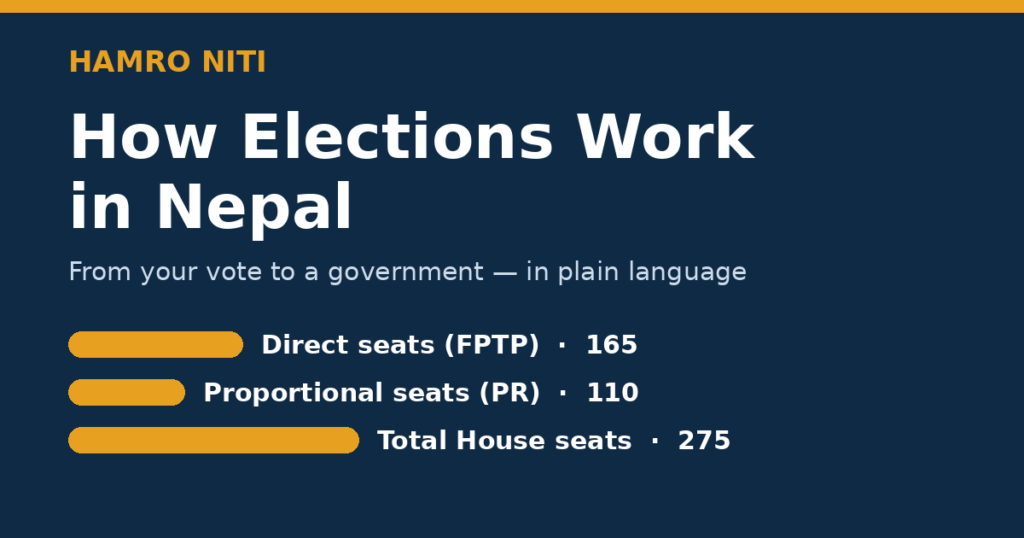
How elections work in Nepal is simpler than it looks on the news: you vote twice on the same day, your two votes do two different jobs, and the party that ends up with the most seats gets the first chance to form a government. The details matter, though — the system is designed so that no single party can easily win everything, which is why Nepal was governed by coalitions for a decade after the Constitution of 2015, until the election of March 2026 produced a single-party majority.
This article explains the whole chain, from registering to vote to the swearing-in of a prime minister, using the rules in the Constitution and the Election Commission’s own figures.
Table of Contents
- How Elections Work in Nepal: The Three Levels of Government
- How Elections Work in Nepal: The Two Ballots
- Who Runs the Election
- How Elections Work in Nepal: What Happens on Election Day
- How Elections Work in Nepal: Counting the Votes
- How Elections Work in Nepal: Forming a Government
- What It Means for You
- Frequently Asked Questions
Table of Contents
How Elections Work in Nepal: The Three Levels of Government
Nepal is a federal country, so elections happen at three levels. At the federal level, Parliament has two houses: the House of Representatives, with 275 members, and the National Assembly, with 59 members. Below that are seven provincial assemblies with 550 members between them, and 753 local governments — metropolitan cities, sub-metropolitan cities, municipalities, and rural municipalities — with 6,743 wards and 35,221 elected local representatives in total.
The House of Representatives is the house that matters most for forming a government, and it is the one this article focuses on. Its members serve a five-year term unless the House is dissolved early. Provincial assemblies also serve five-year terms. Local governments serve five-year terms as well, and their elections are held separately: the last local elections were held in May 2022.
The National Assembly works differently. You do not vote for it directly. Fifty-six of its 59 members are chosen by an electoral college of provincial assembly members and local chiefs and deputy chiefs, with each province electing eight members — including at least three women, one Dalit, and one person from a minority or differently abled group. The President nominates the remaining three. Members serve six-year terms, with one-third retiring every two years.
How Elections Work in Nepal: The Two Ballots
The heart of the system is the mixed electoral system for the House of Representatives. Every voter casts two ballots for the federal parliament — and, when provincial elections are held on the same day, two more for the provincial assembly, making four ballots in total.
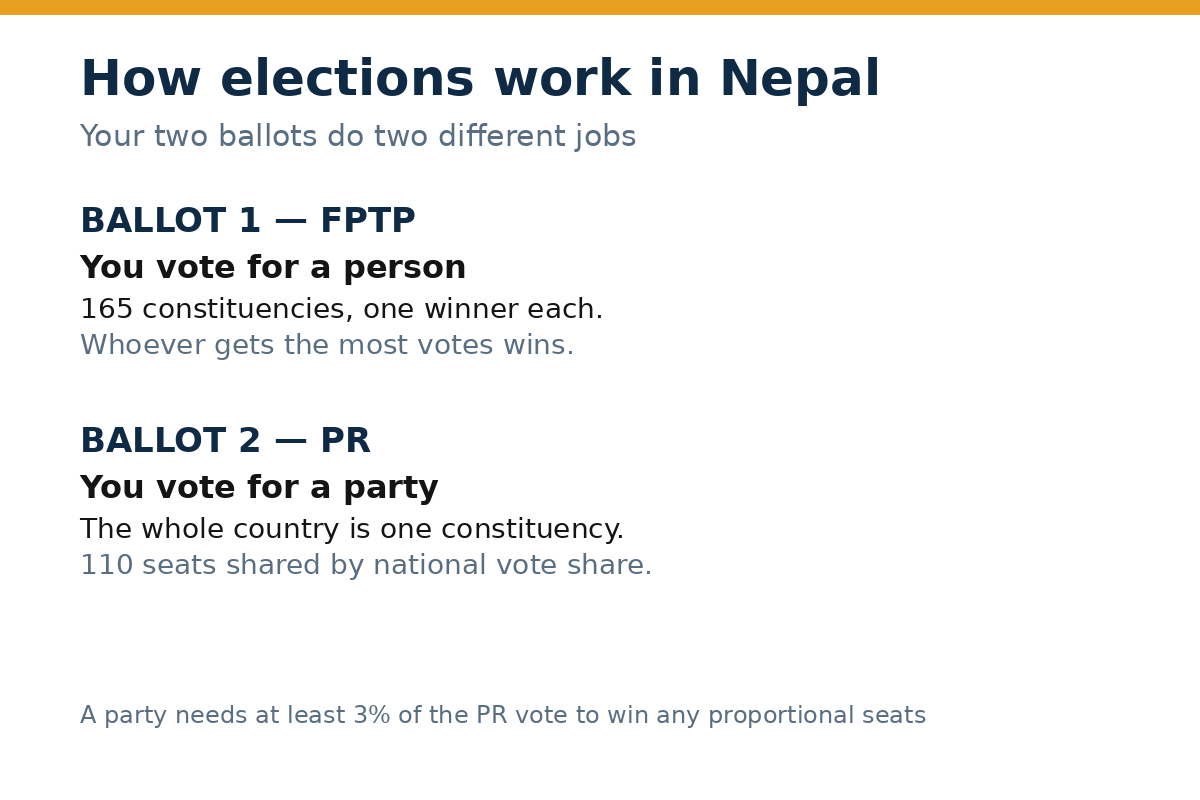
The first ballot is for a person: the First-Past-The-Post (FPTP) vote. Nepal is divided into 165 constituencies, and each one elects a single member. Whoever gets the most votes in that constituency wins — there is no second round and no minimum share required. A candidate can win with 30 percent of the vote if the rest is split among rivals.
The second ballot is for a party: the Proportional Representation (PR) vote. The whole country counts as one constituency for this ballot, and the 110 PR seats are shared out in proportion to each party’s national vote. A party must win at least 3 percent of the total valid PR votes to qualify for any PR seats at all — votes for parties below that line do not count toward seats. Parties must also win at least one FPTP seat to be recognised as a national party.
The PR seats are allocated using the Sainte-Laguë method, which divides each party’s votes by 1, then 3, then 5, and so on, handing out seats one at a time to the highest remaining quotient until all 110 seats are filled. Parties submit a closed list of candidates before the election, so voters choose the party, not the person, on this ballot. The Constitution also requires that at least one-third of each party’s total members in Parliament be women, and parties meet that quota mainly through their PR lists.
Provincial assemblies use the same mixed system: 330 of their 550 seats are FPTP and 220 are PR, with a lower threshold of 1.5 percent of the valid PR votes in that province.
Who Runs the Election
Elections are run by the Election Commission of Nepal, an independent constitutional body — and understanding who runs the vote is the first step in how elections work in Nepal. It has five commissioners, including a Chief Election Commissioner, appointed for a six-year term. The Commission registers voters and parties, sets the election timetable with the government, enforces the code of conduct, runs polling and counting, and declares the results. You can check your own registration on the Commission’s website at election.gov.np.
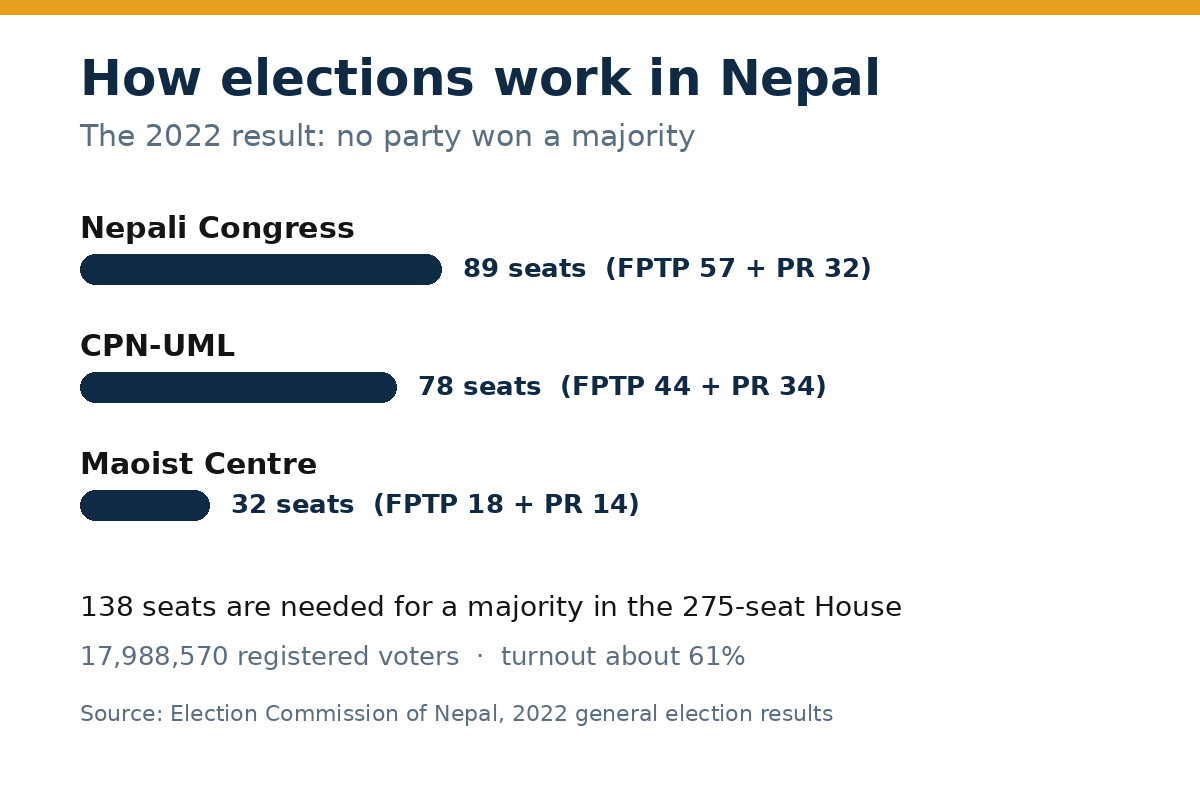
To vote, you must be a Nepali citizen aged 18 or older and registered on the voters’ list for the constituency where you live. In the general election of 20 November 2022, there were 17,988,570 registered voters, with 22,227 voting centres set up in 10,892 polling stations across the country. About 61 percent of registered voters turned out — down from 69 percent in 2017 — a decline the Commission and observers have both flagged as a concern.
One thing to know if you work abroad: Nepal does not yet have out-of-country voting. The roughly 2.6 million Nepalis working overseas, according to election observers, must be in Nepal on election day to cast a ballot.
To stand as a candidate for the House of Representatives you must be at least 25 years old; for the National Assembly, 35; and for a local position, 21. Candidates can stand for a party or as independents — independents can win FPTP seats, though they cannot win PR seats, which go only to parties.
How Elections Work in Nepal: What Happens on Election Day
Polling runs from 7 in the morning to 5 in the evening, and on the day itself how elections work in Nepal is deliberately low-tech. At your polling station, officials check your name against the voters’ list and your identity document, mark your finger with indelible ink, and hand you the ballot papers. You mark each one in private and drop it in the ballot box.
The two-ballot design means the same voter can split their support: vote for a popular local candidate from one party on the FPTP ballot, and for a different party on the PR ballot. That split is common, and it is one reason the final seat count rarely matches any single party’s vote share.
After polls close, ballot boxes are sealed and taken to counting centres, usually at the district headquarters. Counting starts with the FPTP ballots, constituency by constituency, and results trickle in over several days. The PR count is done nationally: the Election Commission adds up every party’s PR votes from all 165 constituencies, applies the 3 percent threshold, and runs the Sainte-Laguë calculation to divide the 110 seats.
How Elections Work in Nepal: Counting the Votes
The 2022 election shows how elections work in Nepal when the two halves combine. The Nepali Congress won 57 FPTP seats and 32 PR seats, for a total of 89 — the largest bloc, but only 32 percent of the 275-seat House. The CPN-UML won 44 FPTP seats and 34 PR seats, for 78. The Maoist Centre won 18 FPTP seats and 14 PR seats, for 32. The FPTP results alone were lopsided — the Congress led the UML by 13 seats — but the PR seats narrowed the gap, because the UML had won slightly more PR votes.
That balancing act is the point of the mixed system. FPTP rewards parties with strong local candidates; PR corrects the result toward each party’s national vote share. The 3 percent threshold keeps the correction from fragmenting into dozens of tiny parties: in 2022, about 12 percent of PR votes went to parties below the threshold and won no seats.
The final step is the women’s quota.
After the FPTP and PR results are known, each party’s total delegation must be at least one-third women, and parties that fall short fill the gap from their PR lists.
How Elections Work in Nepal: Forming a Government
Once the results are final, the President calls the new House into session, and forming a government — the final stage of how elections work in Nepal — begins under Article 76 of the Constitution. A majority in the House is 138 of the 275 seats.
If one party holds a majority, its parliamentary leader is appointed prime minister. That did not happen in either the 2017 or the 2022 election — but it did in March 2026, when the Rastriya Swatantra Party (RSP) won 182 of the 275 seats, and its prime ministerial candidate, Balendra Shah, became prime minister on 27 March 2026. When no party holds a majority, the President appoints the leader of the party that can command a majority with the support of other parties, and that leader must win a vote of confidence in the House within 30 days of appointment.
If no one can put a coalition together, the President can appoint the leader of the largest party, who must then win confidence within 30 days. If that fails too, any member who can demonstrate majority support can be appointed. And if no government can be formed at all, the House can be dissolved and fresh elections called — which is what happened in September 2025, when the House elected in 2022 was dissolved and a new election was set for 5 March 2026 under an interim government.
The prime minister then forms a Council of Ministers — the cabinet — and the government takes office. A government that loses a confidence vote, or whose coalition partners withdraw support, falls, and the whole Article 76 process starts again.
The mixed system is the main reason outright majorities are rare. Because 110 of the 275 seats follow the national vote, a party needs close to 40 percent of the vote to have a real shot at a majority. The 2022 result, in which the largest party held just 32 percent of seats, was the most fragmented parliament in Nepal’s democratic history, and coalitions were the normal way of governing for a decade. But a majority is not impossible: in March 2026 the RSP won 47.8 percent of the proportional vote and 182 seats — the first single-party majority since 1999.
What It Means for You
The practical takeaway is small and specific. Check that you are registered, and where: your name must be on the voters’ list for the constituency where you live, and you cannot vote in a different district on the day. Know that you get two votes for the federal parliament, and that they do different things — one picks your local representative, the other shapes the national balance of power. And remember that the result you see on election night is only half the story: the PR allocation and the women’s quota can shift the final seat count for days after the last FPTP result is announced.
That is how elections work in Nepal in practice — two ballots, one count that balances the other, and a government built from the result. Elections are also the moment when the promises made in the budget and in policy debates meet their test: our explainers on how the federal budget works and how local governments spend your tax money show what the governments you elect actually do with public money, and our guide to fiscal federalism in Nepal explains how power and money are shared between the three levels of government.
Frequently Asked Questions
How elections work in Nepal — how many votes does each voter get?
Two votes for the federal parliament: one FPTP vote for a candidate in your constituency, and one PR vote for a party nationally. When provincial elections are held on the same day, you get two more — one FPTP and one PR vote for the provincial assembly — making four ballots in total.
Who can vote in Nepal?
Any Nepali citizen aged 18 or older whose name is on the voters’ list. You must vote in the constituency where you are registered; there is no out-of-country voting yet.
What is the 3 percent threshold in Nepal’s elections?
A party must win at least 3 percent of the total valid PR votes nationwide to qualify for any of the 110 proportional seats in the House of Representatives. The threshold for provincial assemblies is 1.5 percent.
How is the prime minister chosen in Nepal?
The President appoints the leader who can command a majority — 138 of 275 seats — in the House of Representatives, under Article 76 of the Constitution. The appointee must win a vote of confidence within 30 days. Until March 2026 no party had won a majority since 2015, so prime ministers led coalitions. The March 2026 election changed that: the Rastriya Swatantra Party won 182 seats, and Balendra Shah became prime minister of a majority government.
When was Nepal’s last general election?
The most recent House of Representatives election was held on 5 March 2026, after the House elected in November 2022 was dissolved in September 2025. The Rastriya Swatantra Party won 182 of the 275 seats — 125 directly elected and 57 proportional — and Balendra Shah became prime minister on 27 March 2026. Before that, general elections were held on 20 November 2022, with 17,988,570 registered voters and a turnout of about 61 percent.
Sources: Constitution of Nepal 2015 (Articles 76, 84, 86, 176); Election Commission of Nepal (https://www.election.gov.np/), 2022 general election results and voter data, and 2026 general election results presented to the President on 19 March 2026; Asian Network for Free Elections (ANFREL), interim statement on the 2022 federal and provincial elections; Election Commission, PR seat allocation under the Sainte-Laguë method.