

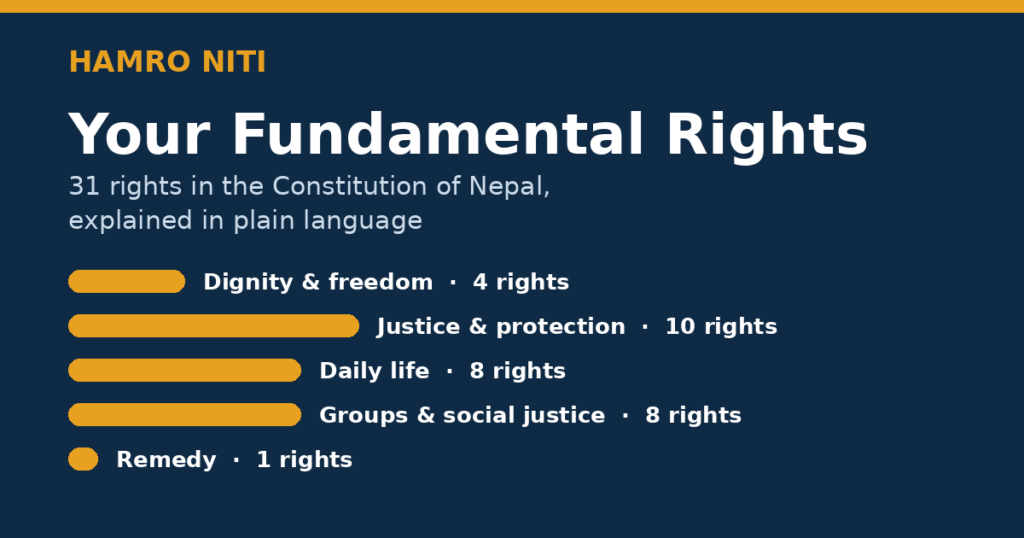
Fundamental rights Nepal constitution guarantees — 31 of them, in Part 3 of the Constitution of Nepal 2015 — belong to every person in Nepal. They are the promises the state cannot break: to treat you equally, to let you speak your mind, to keep you safe from torture, and to give your children a free education.
The Constitution was promulgated on 20 September 2015 (3 Ashoj 2072) and is the supreme law of the country: any law that contradicts it is void to the extent of the contradiction. Part 3, Articles 16 to 46, holds the fundamental rights — and Article 46 lets you go to court when one is violated. This article explains all 31 in plain language.
Table of Contents
- Fundamental Rights Nepal Constitution: The 31 Rights at a Glance
- Fundamental Rights Nepal Constitution: Your Everyday Freedoms
- Fundamental Rights Nepal Constitution: Education, Health, Food and Housing
- Fundamental Rights Nepal Constitution: Rights for Women, Children and Dalits
- Fundamental Rights Nepal Constitution: How to Enforce Them
- Frequently Asked Questions
Table of Contents
Fundamental Rights Nepal Constitution: The 31 Rights at a Glance
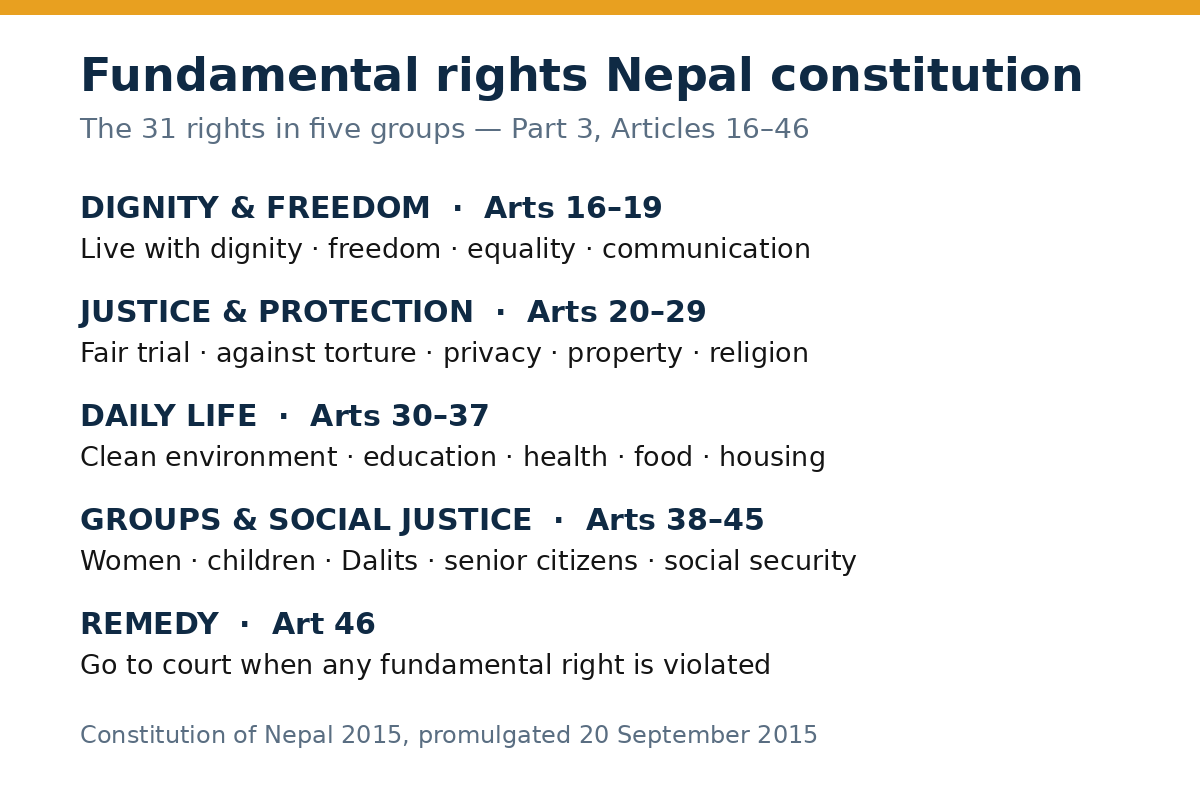
The 31 rights fall into five groups. Here is the full list, with each article number, so you can look up the exact wording.
Dignity and freedom (Articles 16–19): 16 — Right to live with dignity; 17 — Right to freedom; 18 — Right to equality; 19 — Right to communication.
Justice and protection (Articles 20–29): 20 — Rights relating to justice; 21 — Rights of the victim of crime; 22 — Right against torture; 23 — Right against preventive detention; 24 — Right against untouchability and discrimination; 25 — Right relating to property; 26 — Right to freedom of religion; 27 — Right to information; 28 — Right to privacy; 29 — Right against exploitation.
Daily life (Articles 30–37): 30 — Right to a clean environment; 31 — Right to education; 32 — Right to language and culture; 33 — Right to employment; 34 — Right to labour; 35 — Right to health; 36 — Right to food; 37 — Right to housing.
Groups and social justice (Articles 38–45): 38 — Rights of women; 39 — Rights of the child; 40 — Rights of Dalits; 41 — Rights of senior citizens; 42 — Right to social justice; 43 — Right to social security; 44 — Rights of consumers; 45 — Right against exile.
Remedy (Article 46): 46 — Right to constitutional remedies. This is the right that makes all the others enforceable: if any fundamental right is violated, you can ask a court to enforce it.
Article 47 required the state to pass the laws putting these rights into practice within three years — hence the Right to Information Act, the Right to Employment Act, and others. Article 48 lists citizens’ duties alongside the rights.
Fundamental Rights Nepal Constitution: Your Everyday Freedoms
Article 16 says every person has the right to live with dignity, and no law may provide for the death penalty. Article 17 gives citizens the freedoms of opinion and expression, peaceful assembly without arms, forming associations, moving freely, living anywhere in Nepal, and practising any profession or trade.
These freedoms are not unlimited: the Constitution allows “reasonable restrictions” by law — to protect sovereignty, public order, or other people’s rights. Defamation can still be punished, and a protest can be restricted if it blocks a hospital. The restriction must be reasonable and made by law.
Article 18 is the equality guarantee: every person is equal before the law, and the state may not discriminate on grounds including origin, religion, race, caste, tribe, sex, economic condition, language, or region. The same article allows special provisions for groups left behind — women, Dalits, indigenous peoples, Madhesis, Tharus, Muslims, and others — the constitutional basis for inclusion and reservation policies.
Article 19 protects communication: no publication, broadcast, or press can be closed, seized, or censored in advance except as provided by law. Article 26 protects freedom of religion; Article 27 gives you the right to seek information on matters of public importance — the basis for Nepal’s Right to Information law. Article 28 protects your privacy: your person, home, property, documents, data, and correspondence. Article 30 gives you the right to a clean and healthy environment, with compensation if environmental harm causes you loss.
Fundamental Rights Nepal Constitution: Education, Health, Food and Housing
Article 31 makes education free and compulsory up to the basic level and free up to the secondary level, and children may be educated in their mother tongue at the basic level. Article 35 guarantees free basic health services, emergency health care, and access to clean drinking water and sanitation. Article 36 protects the right to food and food sovereignty, including protection from a life-threatening shortage of food. Article 37 guarantees the right to appropriate housing, and no one may be evicted except in accordance with law.
Article 33 gives every citizen the right to employment, and Article 34 guarantees fair remuneration, facilities, and social security for workers, along with the right to form trade unions and bargain collectively. Article 25 protects property: it may only be acquired by the state for a public purpose, and only with compensation.
These rights work differently from the freedoms above. A court can strike down a law that bans a newspaper, but it cannot order the government to build a school in your village tomorrow. That is why Article 47’s three-year deadline mattered: the rights to education, health, and employment needed laws, budgets, and institutions to become real. The Constitution gives local governments responsibility for basic education and basic health services, which is why your municipality’s budget matters as much as the national one.
Fundamental Rights Nepal Constitution: Rights for Women, Children and Dalits
Article 38 guarantees women equal rights, including equal lineage rights, reproductive health rights, and freedom from physical, mental, sexual, or psychological violence, along with participation in state structures on the basis of proportional inclusion. Article 39 gives every child the right to a name, birth registration, and identity, along with education, health, and protection from exploitation and abuse. Article 40 gives Dalits the right to participate in public life with their identity, plus special provisions in education, health, and employment, and land for landless Dalit families. Article 41 gives senior citizens special protection and social security.
Article 42 guarantees the right of economically, socially, or educationally backward groups to participate in state bodies on the basis of proportional inclusion. Article 43 guarantees social security for the indigent, incapacitated, and helpless, and for workers in the formal and informal sectors. Article 44 gives consumers the right to quality goods and services and to compensation for harm. Article 45 says no citizen may be exiled.
The strongest of these protections is Article 24, which outlaws untouchability and discrimination based on caste: no one may be denied access to a public place or service because of their caste. The Constitution makes untouchability a punishable offence, and the Caste-based Discrimination and Untouchability (Offence and Punishment) Act makes it a crime.
Fundamental Rights Nepal Constitution: How to Enforce Them
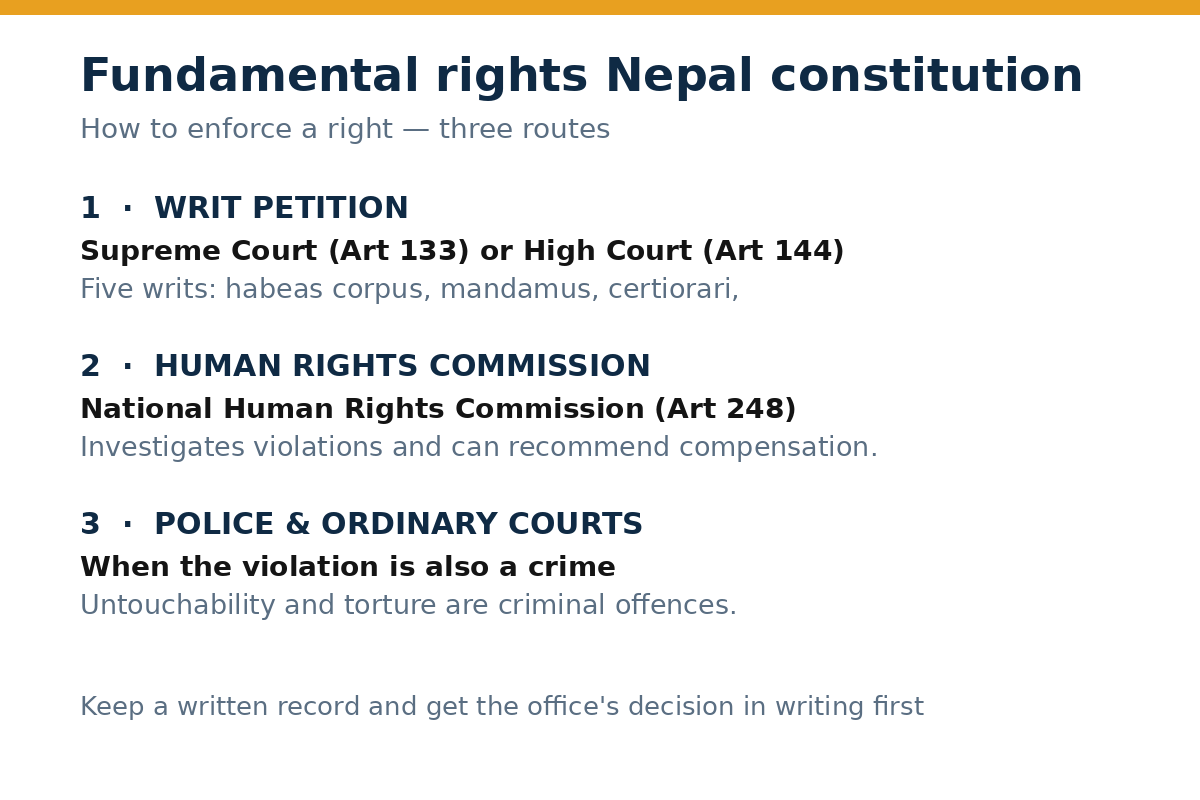
A right you cannot enforce is only a promise, so fundamental rights Nepal constitution gives you three routes when one is violated. The first route is the writ petition under Article 46: you can go directly to the Supreme Court under Article 133 or to a High Court under Article 144. The courts can issue five kinds of writs — habeas corpus (produce a detained person before the court), mandamus (order an official to do their legal duty), certiorari (quash an unlawful decision), prohibition (stop a body acting beyond its powers), and quo warranto (ask a person to show by what authority they hold a public office). Any law that contradicts a fundamental right can be declared void.
The second route is the National Human Rights Commission, a constitutional body under Article 248 that investigates violations and can recommend action, including compensation. The third is the ordinary courts and the police, for example when untouchability or torture is a crime under a specific law.
There are limits. During a state of emergency under Article 273, some fundamental rights can be suspended — but not the core ones: the right to live with dignity, the right to a fair trial, and the rights against torture, untouchability, and exploitation cannot be suspended even in an emergency. If you are unsure whether your situation is a rights violation, keep a written record of what happened, ask the relevant office for its decision in writing, and seek advice from a lawyer or a legal aid organisation before filing anything in court.
Knowing the fundamental rights Nepal constitution guarantees is the first step; using them — at the ballot box, in your municipality, and, when it comes to that, in court — is the next.
Frequently Asked Questions
How many fundamental rights does Nepal’s Constitution guarantee?
Fundamental rights Nepal constitution guarantees 31 rights, in Part 3, Articles 16 to 46. Article 46 gives the right to enforce them in court, and Article 47 required the state to pass the implementing laws within three years.
Can fundamental rights be suspended?
Some can be suspended during a state of emergency under Article 273, but the core rights cannot: the right to live with dignity, the right to a fair trial, and the rights against torture, untouchability, and exploitation remain in force even in an emergency.
What can I do if my fundamental right is violated?
File a writ petition at the Supreme Court (Article 133) or a High Court (Article 144), complain to the National Human Rights Commission, or report it to the police if the violation is also a crime, such as untouchability or torture.
Do fundamental rights apply to everyone, or only to citizens?
It depends on the right. The right to live with dignity in Article 16 belongs to every person; the freedoms in Article 17 and the social and economic rights in Articles 31 to 37 are written for citizens.
What is the difference between fundamental rights and the directive principles?
Fundamental rights in Part 3 are enforceable in court. The directive principles in Part 4 guide government policy but cannot be enforced by a court — they are goals, not rights you can claim.
Sources: Constitution of Nepal 2015, Part 3 (Articles 16–48) — full text via the Nepal Law Commission at lawcommission.gov.np (https://lawcommission.gov.np/); National Human Rights Commission (Article 248); Supreme Court of Nepal, writ jurisdiction under Articles 133 and 144. Related reading on Hamro Niti: How Elections Work in Nepal (https://hamroniti.com/how-elections-work-in-nepal/) explains how the Constitution’s rules shape voting and government formation, and Nepal Local Government Budget (https://hamroniti.com/nepal-local-government-budget/) shows how the Constitution’s promise of basic education and health is funded at the local level.