


Nepal trade deficit explained simply: in fiscal year 2025/26, Nepal bought Rs 2,096.38 billion worth of goods from other countries and sold only Rs 315.29 billion worth of goods to them. The difference — Rs 1,781.09 billion — is the trade deficit, the largest Nepal has ever recorded. For every rupee Nepal earned from exports, it spent Rs 6.65 on imports.
This article explains what the deficit is, what Nepal imports and exports, who it trades with, and how the bill gets paid — using figures from Nepal Rastra Bank and the Department of Customs.
Table of Contents
- Nepal Trade Deficit Explained: What the Number Actually Means
- Nepal Trade Deficit Explained: What Nepal Imports
- Nepal Trade Deficit Explained: What Nepal Exports
- Nepal Trade Deficit Explained: Who Nepal Trades With
- Why the Deficit Keeps Growing
- Nepal Trade Deficit Explained: How the Gap Gets Paid
- What It Means for Ordinary Nepalis
- Frequently Asked Questions
Table of Contents
Nepal Trade Deficit Explained: What the Number Actually Means
A trade deficit is simple arithmetic: when a country imports more goods than it exports, the difference is the deficit. Nepal has run one every year for decades — the question is how big it is and how fast it is growing.
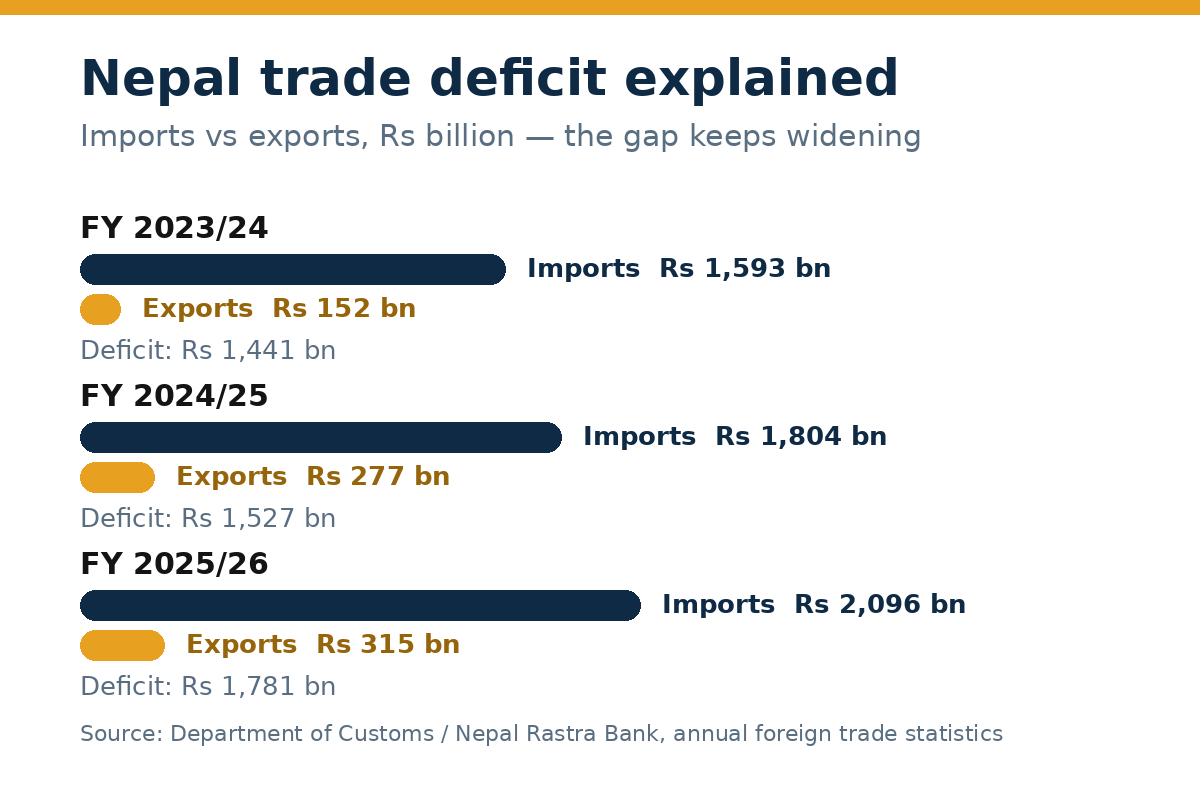
In fiscal year 2025/26, the deficit grew by 16.6 percent — the fastest increase in years, after just 6 percent the year before. Imports rose 16.2 percent while exports rose 13.8 percent, so even though exports grew, they grew from a much smaller base and the gap got bigger.
| Fiscal year | Imports (Rs bn) | Exports (Rs bn) | Trade deficit (Rs bn) | Export-import ratio |
|---|---|---|---|---|
| 2023/24 | 1,592.99 | 152.38 | 1,440.60 | 9.6% |
| 2024/25 | 1,804.12 | 277.03 | 1,527.09 | 15.4% |
| 2025/26 | 2,096.38 | 315.29 | 1,781.09 | 15.0% |
The export-import ratio shows the imbalance most clearly: at 15.0 percent, exports cover only 15 rupees out of every 100 rupees of imports. The ratio improved sharply in 2024/25, when exports jumped 81.8 percent, but slipped back in 2025/26 as import growth outpaced export growth.
A deficit is not automatically a crisis — many countries import more than they export and still prosper. What matters is what the imports are for, and how the gap is financed. Nepal’s problem is that the gap is very large, very persistent, and concentrated in essentials it cannot do without.
Nepal Trade Deficit Explained: What Nepal Imports
Nepal imports almost everything a modern economy needs, and three categories dominate the bill.
Petroleum is the biggest single import. Nepal produces no oil, so every litre of diesel, petrol, cooking gas, and aviation fuel comes from abroad. In 2025/26, diesel alone cost Rs 172.43 billion, and the total mineral fuels bill reached about Rs 386 billion, up nearly Rs 60 billion in a year. The year before, Nepal spent more than Rs 325 billion on petroleum — more than its entire export earnings. Fuel is the import Nepal cannot cut: it powers transport, farming, industry, and backup generators.
Food and raw materials come next. Nepal imported crude soybean oil worth Rs 132.77 billion in 2025/26 — nearly as much as the diesel bill — plus rice, wheat, and other food. Iron and steel, machinery, vehicles, gold, and smartphones fill out the list.
The pattern is structural, not temporary. As a landlocked country with a small manufacturing base, Nepal buys finished goods and fuel from abroad and sells far less in return. When the economy grows, imports grow faster — more vehicles, fuel, phones, and food — and the deficit widens.
Nepal Trade Deficit Explained: What Nepal Exports
Nepal’s export list is much shorter, and one item now dominates it: refined soybean oil earned Rs 128.74 billion in 2025/26 — 40.8 percent of everything Nepal exported. Together with refined palm olein and large cardamom, it accounted for 83.7 percent of the year’s export growth.
The soybean oil story flatters the headline numbers. Nepal does not grow the soybeans: it imports crude soybean oil — mostly from Argentina and Brazil — refines it in the Tarai, and sells the refined oil to India. In 2025/26, Nepal imported crude oil worth Rs 132.77 billion and exported refined oil worth Rs 128.74 billion. The refining adds some value and jobs, but the export is essentially a pass-through — and if the price gap narrows, or India changes its import duties, the boom can shrink as fast as it grew.
Behind soybean oil, the traditional exports are much smaller. Large cardamom, woollen carpets, tea, polyester yarn, jute goods, and pashmina have been Nepal’s export earners for years, but none comes close to oil: in 2024/25, woollen carpets earned Rs 12.25 billion, less than a tenth of soybean oil’s earnings the following year. Nepal also runs a genuine surplus in a few small items — coffee, tea, vegetables, carpets — but these are drops against a deficit of Rs 1.78 trillion.
Nepal Trade Deficit Explained: Who Nepal Trades With
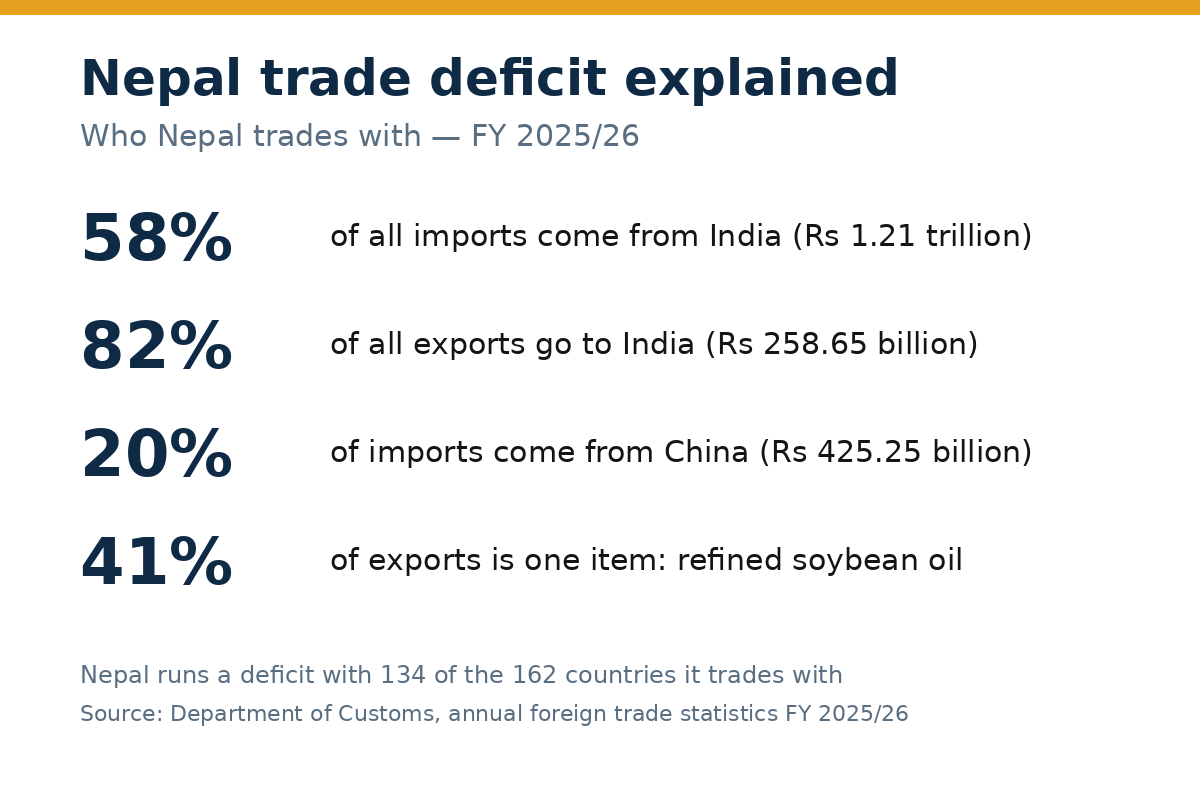
Nepal trades with 162 countries, but it runs a deficit with 134 of them and a surplus with only 28. Two neighbours dominate the picture.
India is by far Nepal’s largest trading partner. In 2025/26, it supplied about Rs 1.21 trillion of imports — close to 58 percent of the bill — and bought Rs 258.65 billion of exports, or 82 percent of everything Nepal sold abroad. Even so, Nepal’s deficit with India alone was about Rs 951 billion, more than half of the total. The open border, the currency peg, and deep integration mean this trade will not shrink — but Nepal’s balance also moves with India’s prices and policies.
China is the second-largest partner, and the gap there is growing fast: imports rose 24.7 percent to Rs 425.25 billion in 2025/26, while exports to China fell 28 percent to just Rs 1.89 billion, widening the deficit to Rs 423.35 billion. Together, India and China supply nearly 78 percent of Nepal’s imports. The third-largest bilateral deficit is less obvious: Argentina, at about Rs 116 billion, driven almost entirely by the crude soybean oil feeding Nepal’s refining trade.
Why the Deficit Keeps Growing
First, Nepal’s economy is consumption-led. When incomes rise — largely from remittance sent home by Nepalis working abroad — households spend more on imported goods: vehicles, phones, appliances, fuel, and food. Imports rise with prosperity, while exports depend on factories and farms that have not grown as fast.
Second, Nepal’s export base is narrow and fragile. The soybean oil boom depends on imported raw material and one market, India, while traditional exports grow slowly against tough competition. High transport costs, unreliable industrial electricity, and a small domestic market have held back higher-value manufacturing.
Third, some imports are unavoidable. Nepal cannot produce its own fuel, and food production falls short of demand in most years. Even successful exports, like refined oil, need imported inputs first. So the deficit grows even in good years: in the first two months of 2026/27, exports rose 88.6 percent to Rs 47.32 billion, but imports also rose 16.2 percent, and the deficit still widened 8.6 percent to Rs 257.84 billion.
Nepal Trade Deficit Explained: How the Gap Gets Paid
A deficit of Rs 1.78 trillion has to be paid for somehow — mainly with money earned outside trade, above all remittance.
In 2025/26, Nepalis working abroad sent home Rs 2,363.13 billion, up 37.1 percent — a flow larger than the entire trade deficit. That is why Nepal can run a huge merchandise deficit and still end the year with a current account surplus of Rs 802.06 billion in the first eleven months, and reserves at a record Rs 3,897.67 billion in mid-July 2026, enough to cover about 23 months of imports. To understand the reserves behind this cushion, read our explainer on Nepal’s foreign exchange reserves. For the full picture of the money that pays the gap, see our guide to remittance in Nepal.
But remittance is not a free lunch. It depends on millions of Nepalis working abroad, often in difficult conditions, and it does not build domestic industry. If migration slows, or host countries tighten labour rules, the money financing the deficit could shrink while the import bill stays the same — the deficit is sustainable only as long as remittance keeps flowing.
The government and Nepal Rastra Bank have tried to narrow the gap — promoting exports, restricting some luxury imports, and encouraging import substitution. Hydropower is the most promising long-term answer: exporting electricity at scale would earn foreign currency without imported raw materials. But no measure has yet changed the basic arithmetic.
What It Means for Ordinary Nepalis
For most people, the trade deficit is invisible until it bites — and the story of Nepal trade deficit explained for households comes down to prices, the exchange rate, and jobs. Because Nepal imports fuel and food, global price rises reach households quickly: a jump in world oil prices becomes a jump in bus fares and cooking-gas prices. Our explainer on inflation in Nepal shows how import dependence feeds directly into the cost of living.
The rupee’s peg to the Indian rupee keeps imported inflation from India in check, but a persistent deficit pressures foreign exchange reserves, leaving the central bank fewer tools to defend the currency. And a deficit this large means Nepal is, in effect, buying jobs abroad — paying foreign factories and farms for goods it could, in principle, make at home.
The deficit will not disappear soon, and it does not need to. What matters is whether Nepal uses the remittance cushion to build the industries — energy, agriculture, manufacturing — that can eventually narrow the gap, or keeps spending the cushion on imports. Nepal trade deficit explained in full: the gap is at its widest ever, and the question is what Nepal does with the time remittance buys.
Frequently Asked Questions
What is Nepal’s trade deficit?
Nepal trade deficit explained in one line: in fiscal year 2025/26, Nepal imported goods worth Rs 2,096.38 billion and exported goods worth Rs 315.29 billion, leaving a deficit of Rs 1,781.09 billion — the largest on record.
Why does Nepal have such a large trade deficit?
Nepal imports fuel, food, machinery, and consumer goods it cannot produce at home, while its export base is narrow — refined soybean oil alone is 40.8 percent of exports.
What does Nepal import most?
Petroleum products, with diesel alone costing Rs 172.43 billion in 2025/26. Crude soybean oil, food, iron and steel, machinery, vehicles, gold, and smartphones follow.
What does Nepal export most?
Refined soybean oil, worth Rs 128.74 billion in 2025/26, or 40.8 percent of all exports. It is made by refining crude soybean oil imported from Argentina and Brazil, then sold mostly to India.
How does Nepal pay for its trade deficit?
Mainly with remittance: in 2025/26, Nepalis abroad sent home Rs 2,363.13 billion — more than the entire deficit.
Sources: Nepal Rastra Bank, Current Macroeconomic and Financial Situation reports (annual data FY 2025/26; monthly data to mid-September 2026); Department of Customs, annual foreign trade statistics FY 2025/26 (via Nepal Rastra Bank reporting); Nepal Rastra Bank annual report FY 2025/26. Figures are for merchandise trade only; services trade is reported separately.