

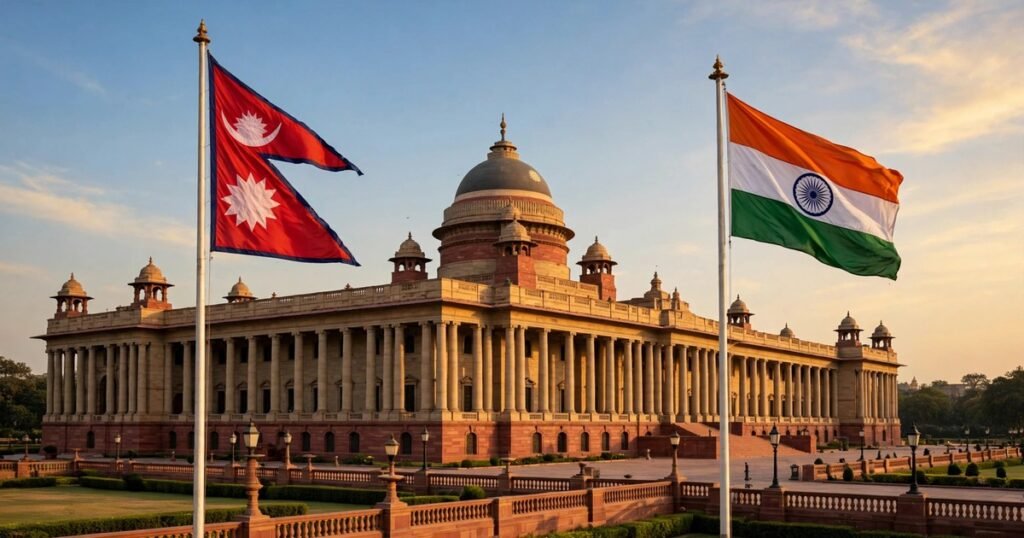
Balen Shah India visit explained: Nepal’s Prime Minister Balendra Shah arrived in New Delhi on Sunday, 22 November 2026, for a two-day state visit — his first trip abroad since taking office in March. In a little more than 24 hours, he will hold delegation-level talks with Prime Minister Narendra Modi, call on President Droupadi Murmu, and meet India’s External Affairs Minister S. Jaishankar. At the top of his agenda are a proposed $2 billion economic package, energy and hydropower, a new train link between Janakpur and Ayodhya, and more air routes for Nepal’s international airports.
Balen Shah India visit explained in this article: who Balen Shah is, what the visit’s schedule looks like, what Nepal is asking for, and what to watch when the two prime ministers meet on Monday. It was published on Sunday evening, before the main talks take place. Nothing in it claims an outcome: the results of the talks — including whether the $2 billion package is agreed — will only be known after the joint statement on Monday, and Hamro Niti will cover them in a follow-up once they are public.
Table of Contents
- Balen Shah India Visit Explained: Who Is Balen Shah?
- Balen Shah India Visit Explained: The Visit at a Glance
- Balen Shah India Visit Explained: The $2 Billion Package
- Balen Shah India Visit Explained: Energy, Trains and Air Routes
- Balen Shah India Visit Explained: The Difficult Issues
- Why This Visit Matters for Nepal
- What Happens Next
- Frequently Asked Questions
Table of Contents
Balen Shah India Visit Explained: Who Is Balen Shah?
Balendra Shah — known to almost everyone simply as Balen — is 36 years old, a rapper turned Kathmandu mayor turned prime minister. He was sworn in on 27 March 2026 as Nepal’s 43rd prime minister, leading a government formed by his Rastriya Swatantra Party (RSP), which won 182 of the 275 seats in the House of Representatives in the election of 5 March 2026.
He came to power after the youth-led Gen Z protests of September 2025, which forced the resignation of the government of KP Sharma Oli and led to the dissolution of the House of Representatives on 12 September 2025. The protests were driven by frustration with corruption, unemployment and a political system that many young Nepalis felt had stopped listening to them. Balen, who had built his public profile first as a rapper and then as the independent mayor of Kathmandu, became the face of that change. His government is now eight months old, and this visit to India is its first major test on the foreign stage.
The choice of India as his first bilateral destination follows a long tradition: Nepali prime ministers almost always make New Delhi their first foreign trip. India is Nepal’s largest trading partner, its main transit route to the sea, its biggest source of tourists and remittances, and the country with which Nepal shares its longest and most complicated relationship. For a new prime minister, the first visit to Delhi is where the relationship with the southern neighbour is reset — and where the new government’s priorities are stated in public for the first time.
India has described the visit as “very important” and promised full state honours. The two foreign ministries announced the visit jointly on Friday, 20 November, and the tone from both sides has been deliberately warm: New Delhi has presented the trip as a chance to deepen ties with the new government, and Kathmandu has presented it as a chance to secure concrete help for reconstruction and development.
Balen Shah India Visit Explained: The Visit at a Glance
The visit lasts a little more than 24 hours, and almost every hour of it is scheduled. Balen Shah India visit explained as a timetable, it runs like this:
Sunday, 22 November — arrival. Shah flew from Kathmandu to New Delhi on a Nepal Airlines flight and landed at Indira Gandhi International Airport in the afternoon, where he was received by Union Minister Jitin Prasada. He is staying at the Taj Mahal Hotel, where External Affairs Minister S. Jaishankar paid him a courtesy call at 6pm. A Nepal–India business roundtable followed at 7pm, bringing together business leaders from both countries.
Monday, 23 November — the main day. The day opens with a ceremonial welcome and guard of honour at Rashtrapati Bhavan at 10am. Shah then lays a wreath at Rajghat, the memorial to Mahatma Gandhi. The main event is the meeting with Prime Minister Modi at Hyderabad House at 11am: the two leaders first hold a restricted, one-on-one meeting, then lead delegation-level talks with their teams. After the talks, the two sides exchange agreements, address a joint press conference, and Modi hosts a luncheon in Shah’s honour. Shah then calls on President Droupadi Murmu before flying back to Kathmandu on Monday evening.
Shah is travelling with a 34-member government delegation that includes Finance Minister Swarnim Wagle, Foreign Minister Shisir Khanal and Chief Adviser Kumar Byanjankar. A separate 52-member business delegation is travelling with him as well — a signal that trade and investment are meant to be as much a part of this visit as diplomacy.
The two leaders are also expected to inaugurate completed projects virtually and lay the foundation stones for new ones, and a joint vision document and a joint communiqué are expected to be issued at the end of the visit. The exact wording of both was still being negotiated as the visit began.
Balen Shah India Visit Explained: The $2 Billion Package
The single biggest item on Nepal’s list is money. Kathmandu has proposed an economic package worth about $2 billion — a mix of concessional loans and grants — to support development projects and reconstruction in areas hit by the devastating glacial flash floods of August 2026. Reports say the package includes about $1 billion in grants, with the rest as concessional loans for infrastructure.
The floods are the reason the request is urgent. The August 2026 floods killed more than 1,000 people, according to reports, and damaged thousands of homes and hydropower projects. Nikkei Asia has put the cost of flood recovery at an estimated $4.8 billion — a sum Nepal cannot raise on its own. The $2 billion package would cover a large part of that bill, funding road and infrastructure rebuilding alongside other development work.
India has sent positive signals on the financing, according to officials familiar with the talks, and the two sides entered the final round of negotiations on the proposal in the days before the visit. But nothing has been settled in public yet. The final shape of any package — how much is a grant, how much is a loan, and what it is tied to — will only become clear after the two prime ministers meet on Monday. Until then, the $2 billion figure is a proposal, not an agreement, and this article will not present it as one.
The package matters beyond the floods. Nepal’s government is trying to fund an ambitious economic agenda — infrastructure, energy, jobs — while its revenues are under strain. A large, cheap financing package from India would give the new government room to spend on reconstruction without adding expensive debt. It would also be a political signal: that the new government in Kathmandu can deliver results from its most important relationship. Balen Shah India visit explained in one line: Nepal is asking India to help pay for rebuilding after the floods, and the answer comes on Monday.
Balen Shah India Visit Explained: Energy, Trains and Air Routes
Energy is the area where the two countries already work most closely, and it is where the visit is most likely to produce visible results. Balen Shah India visit explained through the energy numbers, the picture is this: in January 2024, Nepal and India signed a long-term power trade agreement under which India committed to buying up to 10,000 MW of electricity from Nepal over ten years. India currently imports about 1,200 MW of power from Nepal a year, and in fiscal year 2025/26 Nepal earned approximately NPR 18 billion (1,800 crore) from net electricity exports to India. Electricity has become one of Nepal’s most important exports — and one of the few where Nepal sells more than it buys.
Several energy and connectivity projects are expected to be inaugurated virtually during the visit, and the two leaders are expected to lay the foundation stones for new ones. The details of which projects will be announced after the talks.
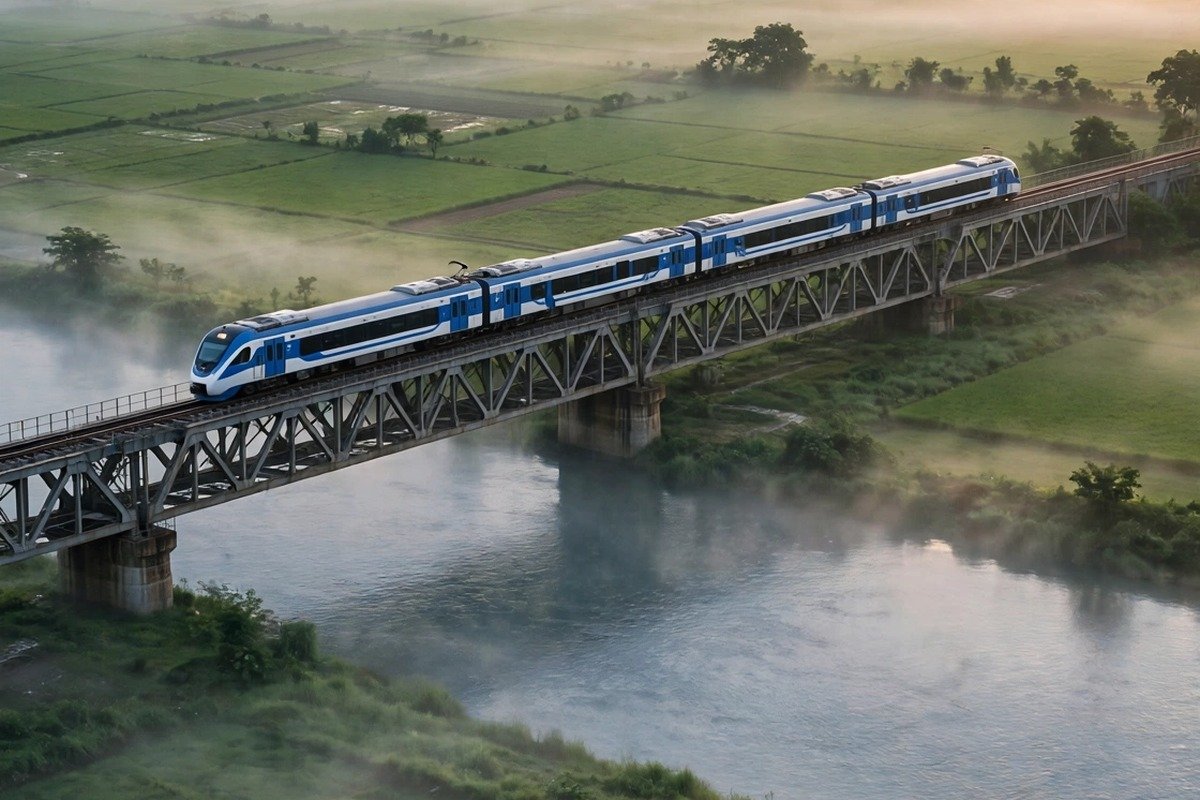
The most symbolic project is the train. The two prime ministers are expected to remotely launch a direct rail service between Janakpur in southern Nepal and Ayodhya in India’s Uttar Pradesh — revered as the birthplaces of the Hindu deities Sita and Rama. A trial run of the service took place on 5 November. The train matters for two reasons: it is a practical connection for the thousands of pilgrims and traders who cross that border, and it is a visible, popular deliverable that both governments can point to. A motorable bridge in Darchula is among the other projects expected to be marked during the visit.
Air routes are the hardest item on the agenda. Nepal wants additional air entry routes through Indian airspace for international flights — above all for Gautam Buddha International Airport in Bhairahawa and Pokhara International Airport, which need more routes to attract international carriers. The two sides are negotiating over the L626 route, which would connect Kathmandu and Mahendranagar as a two-way air corridor. They are also divided over the altitude at which aircraft entering Nepal through Indian airspace may fly: India has proposed 39,000 feet, while Nepal wants the limit lowered to around 29,000 feet. The talks have been further complicated by India’s proposal to allow its military aircraft to use the Bagdogra entry point, near the Nepal–India border. Officials say the money talks have gone well but the air route talks remain stuck — and this is the issue most likely to be left unresolved on Monday.
Balen Shah India Visit Explained: The Difficult Issues
Not everything on the table is a deal waiting to be signed. Two long-running disputes form the background to the visit, and both are expected to come up in the talks.
The first is the border. Nepal and India disagree over the territory of Lipulekh, Kalapani and Limpiyadhura, in the far west of Nepal. Nepal published a new political map in 2020 claiming the area; India maintains its own claim. The dispute has been a source of public anger in Nepal for years, and no Nepali prime minister can visit Delhi without it being raised. Neither side expects it to be settled on this visit, but how it is handled — and what, if anything, the joint statement says about it — will be watched closely in Kathmandu.
The second is Gurkha recruitment. Nepal and India have disagreed over the recruitment of Nepali Gurkhas into the Indian Army, an arrangement that goes back generations but has been strained by changes in India’s recruitment policy. It is, like the border, an issue of pride and history as much as of policy, and it sits in the background of every India visit.
Alongside these, the two sides are expected to exchange several agreements and memorandums of understanding covering education, health, agriculture, sports, disaster management and human resource development, and to announce a 10-point joint vision document built around the idea of a “Prosperous Nepal, Developed India”. The vision document is meant to set long-term targets across energy, connectivity, trade, investment, digital links, health, education and people-to-people ties — a framework for the relationship rather than a single deal. Balen Shah India visit explained in full, these background disputes are the reason the visit is about more than money and trains.
Why This Visit Matters for Nepal
Balen Shah India visit explained as a political test, this is a new government, eight months old, making its first foreign trip — and the stakes are practical, not ceremonial. If the visit produces the $2 billion package, the train launch and a set of energy and infrastructure agreements, Balen Shah returns to Kathmandu able to show that his government can deliver from its most important relationship. If it produces only warm words, the questions will start at home.
For India, the visit is a chance to deepen ties with a new government in a country where it competes with China for influence, and to advance its “Neighbourhood First” policy with a neighbour that has sometimes drifted away. The warm language from New Delhi — “very important”, full state honours, a joint vision document — suggests India wants this visit to be seen as the start of something, not a routine courtesy call.
There is also a simpler reason the visit matters: it is the first time the two countries’ leaders have sat down together since Balen Shah took office. Everything else — the package, the train, the air routes, the border — is negotiated by officials. The meeting on Monday morning is where the political decisions get made.
What Happens Next
The visit ends on Monday evening, but its results will be judged over the following days. The things to watch are: the joint statement and the joint vision document, and what they say about the $2 billion package; whether the Janakpur–Ayodhya train is launched as planned; what, if anything, is agreed on air routes; and whether the border and Gurkha issues get any mention at all.
Hamro Niti will publish a follow-up once the joint statement and the agreements are public, covering what the visit actually delivered. Until then, this article stands as the record of what was asked for — not of what was agreed. Balen Shah India visit explained so far covers only the asks; the follow-up will cover what Nepal got.
Frequently Asked Questions
When is Balen Shah’s India visit?
The visit runs from Sunday 22 November to Monday 23 November 2026. It is a two-day state visit at the invitation of Prime Minister Narendra Modi, and it is Balen Shah’s first trip abroad since taking office in March 2026.
Who is Balen Shah?
Balendra Shah, known as Balen, is Nepal’s 43rd prime minister. He is 36, a rapper turned Kathmandu mayor turned prime minister, and the leader of the Rastriya Swatantra Party, which won 182 of 275 seats in the House of Representatives in the 5 March 2026 election. He was sworn in on 27 March 2026, after the Gen Z protests of September 2025 brought down the previous government. How Nepal’s parliament works — including the election that brought his party to power — is explained in our separate guide: How Nepal’s Parliament Works.
What is the $2 billion package Nepal is asking for?
It is a proposed economic package of about $2 billion — a mix of concessional loans and grants, reportedly including about $1 billion in grants — for flood reconstruction and infrastructure. Nepal is seeking it after the August 2026 glacial flash floods, which killed more than 1,000 people and left an estimated $4.8 billion recovery bill. The package has not been agreed yet; the final shape will be decided in the talks on Monday.
Will the Janakpur–Ayodhya train start running?
The two prime ministers are expected to launch the direct rail service between Janakpur and Ayodhya during the visit, after a trial run on 5 November. The launch is a formal inauguration; the full timetable and ticketing details for regular service are expected to follow.
What are the air route issues?
Nepal wants more air entry routes through Indian airspace, above all for Bhairahawa and Pokhara international airports. The two sides are negotiating over the L626 Kathmandu–Mahendranagar corridor and the altitude at which aircraft may enter Nepal (India proposes 39,000 feet; Nepal wants around 29,000 feet). India has also proposed that its military aircraft be allowed to use the Bagdogra entry point. The air route talks remain the hardest part of the agenda.
What happens after the visit?
The two sides are expected to issue a joint statement and a joint vision document at the end of the visit. Hamro Niti will cover the outcomes — the package, the agreements, the train and the air routes — once they are confirmed by an official source.
Sources: Announcements by Nepal’s Ministry of Foreign Affairs and India’s Ministry of External Affairs (20 November 2026); The Kathmandu Post, “Shah leaves for India visit with $2bn financial proposal, air access on agenda” (22 November 2026); Nikkei Asia, “Nepal’s Shah to meet Modi for Indian flood aid and connectivity” (20 November 2026); The Times of India (22 November 2026); The Statesman (22 November 2026); Fiscal Nepal (22 November 2026); WION and Mathrubhumi on FY 2025/26 electricity export earnings; Nepal Electricity Authority annual report figures as reported. Trade context: Nepal’s Trade Deficit, Explained.