



Nepal national ID card explained in one line: it is a smart card that ties your citizenship, your fingerprints and your face to a single 10-digit number — and that number is becoming the key to almost every government service in the country. If you have not enrolled yet, you probably will have to soon. This guide explains what the card is, who has to get one, how to apply, where it is already mandatory, and why millions of Nepalis are still waiting for the physical card to arrive.
Table of Contents
- Nepal National ID Card Explained: What the Card and the NIN Actually Are
- Nepal National ID Card Explained: Who Has to Apply, and by When
- Nepal National ID Card Explained: How to Apply, Step by Step
- Nepal National ID Card Explained: Where the Card Is Now Mandatory
- Nepal National ID Card Explained: The Backlog — Why So Few Cards Have Arrived
- Nepal National ID Card Explained: Privacy, Data, and What the Law Protects
- Nepal National ID Card Explained: Common Problems and How to Fix Them
- Frequently Asked Questions
Nepal National ID Card Explained: What the Card and the NIN Actually Are
The National Identity Card — in Nepali, Rastriya Parichaya Patra — is a polycarbonate smart card with a microchip embedded in it. The chip stores the cardholder’s demographic details and biometric data. It is issued by the Department of National ID and Civil Registration (DoNIDCR), under the Ministry of Home Affairs, and it is governed by the National Identity Card and Registration Act, 2076 (2019) and the National Identity Card and Registration Rules, 2077 (2020).
The card itself is only half the system. The more important half is the National Identity Number, or NIN: a unique 10-digit number generated automatically by the department’s system. The NIN is yours for life. It stays the same even if your card is corrected, replaced, cancelled or reissued. The application number or QR code you get when you enrol is not the NIN — the NIN is issued at the biometric stage, and it is the number that links you to every service that uses the system.
The idea behind the card is simple. Nepal national ID card explained in practical terms, the card does two jobs at once: it proves who you are, and it proves it the same way at every office. Today, a Nepali citizen proves who they are with a paper citizenship certificate, and every office — the bank, the passport office, the ward office — checks that paper separately. The national ID card is meant to replace that paper for day-to-day verification, with one number and one set of biometrics that every office can check against the same database. The citizenship certificate itself is not being abolished: citizenship remains the foundation of Nepali nationality, and the card is built on top of it. What changes is how you prove your identity when you need a service.
Enrolment began in 2018, and the programme has grown steadily since. According to the department, 19,568,837 people had registered for the National Identity Card between July 2018 and 6 January 2026. That is roughly two-thirds of the population counted in the 2021 census. Nepal national ID card explained in numbers, the gap between registering and actually holding the card is the story of the whole programme — and it is the subject of a later section in this guide.
There is also a digital version. Once you have enrolled, your NIN and a digital copy of your card are available through the Nagarik App, and the department says services can be accessed with the number alone, even without the physical card. A separate Minor’s ID (Nabalik Parichaya Patra) was introduced for children under a 2025 amendment to the Rules, so the system now covers people below 16 as well.
Nepal National ID Card Explained: Who Has to Apply, and by When
Every Nepali citizen aged 16 or older who holds a citizenship certificate is expected to enrol. Nepal national ID card explained for families, the rule is simple: if you are 16 or older and hold a citizenship certificate, the card is for you. The law sets a deadline: a person who was already 16 when the card became applicable in their district must apply within two years of that commencement, and a person who turns 16 later must apply within two years of turning 16. In practice, the department has rolled the card out district by district, and the deadlines have been enforced less by fines than by making the card a condition for services — which is where most people actually feel the pressure.
If you do not yet have a citizenship certificate, you cannot take the standard route. The Rules do allow an application from someone who is eligible for citizenship but has not yet received the certificate, using the documents that prove eligibility, but the authority examines that case separately. If you are unsure which route applies to you, the citizenship guide on this site explains the four types of citizenship and the documents each one needs: Nepali Citizenship Explained
Children under 16, holders of NRN citizenship, and qualifying foreign residents have separate provisions in the law, and the relevant phase has to be open before they can apply. For the large majority of readers, though, the rule is straightforward: 16 or older, Nepali citizen, citizenship certificate in hand.
There are exemptions from the mandatory-use rule, not from enrolment itself. In March 2026 the government arranged that children, people with disabilities, people who cannot care for themselves, and citizens over 90 years of age can access essential services even without a national identity card. The exemption recognises what the rollout itself showed: the people least able to travel to an enrolment centre are the ones most likely to be cut off when a card becomes a condition for help.
Nepal National ID Card Explained: How to Apply, Step by Step
Getting the card is a two-stage process: online pre-enrolment, then an in-person visit for document checks and biometrics. Nepal national ID card explained as a process, the online step is the easy half — it starts the file; it does not replace the visit.
Step 1: Pre-enrol online. Go to the department’s pre-enrolment portal at enrollment.donidcr.gov.np and log in with your mobile number. You will receive a one-time password by SMS. Enter your personal details in the form — the names must match your citizenship certificate exactly — choose your District Administration Office (DAO) or Area Administration Office (AAO) and an appointment date, then review and submit. Print the application form with your Application ID. If you have no internet access, this step can be done at the DAO or AAO station itself.
Step 2: Visit the enrolment centre with your originals. On your appointment date, go to the DAO or AAO of your permanent-address district with your original citizenship certificate, plus a document that proves your date of birth — a birth registration, academic certificate, passport or pension record — if your citizenship certificate does not show it. Officials check the documents against the online form.
Step 3: Give your biometrics. This is the part that cannot be done online. The centre records your fingerprints, an iris scan, a photograph and an electronic signature. This is also the stage at which your 10-digit NIN is issued. You will receive a confirmation record, and the department communicates your NIN and card status afterwards.
Step 4: Wait for the card — and use the number meanwhile. The physical card is printed centrally and sent to the district for distribution, and the wait is long: the next section explains why. While you wait, your NIN and the digital card on the Nagarik App are enough for most of the services that require the card.
The first card is free. A replacement card costs Rs 500. There is no verified universal printing time — some guides quote three to six months, but the department itself has not published a fixed delivery period, and the real wait has often been far longer.
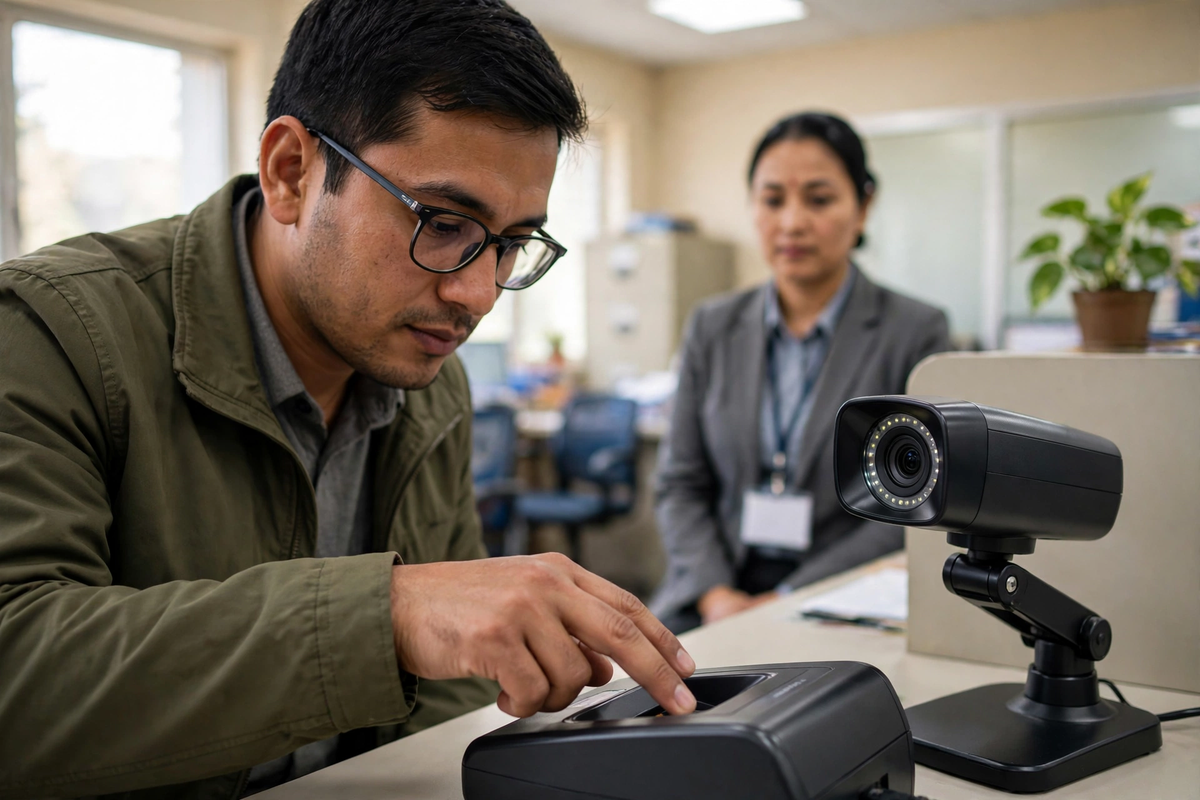
A practical warning from people who have been through the process: the online portal can be unreliable, and it sometimes rejects text typed directly in Nepali. If the form freezes or rejects your entries, type them in a separate Nepali Unicode tool and paste them in. Go to the office early in the morning, because tokens for the day are limited and the timing is rarely announced clearly. And if your permanent address is outside the Kathmandu Valley but you want to enrol in the Valley, check with the department first — it has set up designated enrolment centres in the Valley for residents of other districts, and the right centre depends on your home province.
Nepal National ID Card Explained: Where the Card Is Now Mandatory
The card became mandatory in stages, and the story of those stages explains much of the public argument about it. Nepal national ID card explained through its timetable, the rollout moved in three steps, each one widening the net. In June 2024 the Cabinet decided the card would be mandatory for public services. From 16 July 2024 it was required to renew social security allowances in 28 districts in the first phase. From 14 January 2025 it was required in 38 more districts, and from 17 July 2025 it has been required to receive the social security allowance in all 77 districts.
That timetable was challenged in court. In August 2024 the Supreme Court issued an interim order directing that the card not be made mandatory for government services, after a writ petition argued that senior citizens and others could be cut off from their allowances. But on 19 January 2025 a full bench headed by Chief Justice Prakash Man Singh Raut dismissed the writ petitions and issued a directive to implement the National Identity Card — clearing the way for the mandatory use to go ahead.
The allowance was only the beginning. The department says the card is now mandatory across 12 service-linked agencies. The list covers passport issuance, social security allowances, birth registration, Bagmati Province’s transport system, banks and financial institutions, the Office of the Company Registrar, elections, pension management, foreign employment, Nagarik App services, PAN registration at the Inland Revenue Department, and the Social Security Fund. Nepal Rastra Bank made the card compulsory to open a new bank account with effect from 14 January 2025. The government has also announced plans to integrate the driving licence, vehicle ownership certificate, banking services, tax payment system, voter ID card and social security system into the card, and the card is expected eventually to serve as a voter card linked to the Election Commission’s database.
The allowance link is the one that touches the most people directly, and it is also where the government claims its clearest success. The department says making the card mandatory for allowances has saved the state nearly Rs 5 billion a year, by removing duplicate payments. Where the number of beneficiaries used to rise by 200,000 to 250,000 every year, it has instead been falling by around 200,000 a year since the requirement came in. In the current fiscal year the government is providing social security allowances to 3,669,641 people under eight categories. The allowance system itself — who gets what, and how much — is covered in depth in our separate guide: Nepal Social Security Allowance Explained
Nepal National ID Card Explained: The Backlog — Why So Few Cards Have Arrived
Here is the uncomfortable arithmetic at the heart of the programme. Nepal national ID card explained in one set of numbers: of the 19,568,837 people who had registered by 6 January 2026, only 7,495,711 cards had been printed — and only 3,778,875 citizens had actually received their cards. In other words, fewer than one in five of the people who enrolled were holding a card, and fewer than two in five of the printed cards had reached their owners. The picture was similar six months earlier: by mid-2025, more than 17.21 million people had enrolled, but only around 2.31 million had collected the physical card.
Printing is the bottleneck. The department says daily printing has fallen from 20,000–22,000 cards to just 3,000–4,000, because the card-printing machines are ageing and breaking down, and Nepal lacks the skilled manpower to upgrade or expand capacity — the department has said it is preparing to seek technical support from abroad. At the same time, demand has surged: making the card mandatory pushed daily applications to 25,000–26,000 during the voter-list preparation period, and 10,000–12,000 applications are still being registered every day.
Distribution is the second bottleneck. Cards are printed centrally and sent to the districts, and the department says 5.53 million cards had been sent to the districts by early 2025 — but many sit uncollected, because people must visit a designated location to receive them and are not always told their card has arrived. The department pays a daily wage of Rs 600–Rs 1,200 to the people who distribute the cards, and it has said few are willing to do the work at that pay, which slows the last step further.
The result is a strange position for a system that is now mandatory: the number that matters — the NIN — is issued at enrolment and works without the card, while the card itself, the physical proof, reaches only a minority of those who applied. That is why the digital card on the Nagarik App and the NIN itself have become the practical way most people use the system, and why the department stresses that services can be obtained if identity can be verified through the number, even without the physical card.
Nepal National ID Card Explained: Privacy, Data, and What the Law Protects
A system that holds the fingerprints, iris scans and photographs of nearly 20 million people raises an obvious question: who can see that data, and what stops it being misused? Nepal national ID card explained honestly, the privacy question is the one the official guides answer least. The Act and the Rules set the framework, and the department administers it, but the public debate has been about how far the safeguards go in practice.
The core protection is purpose limitation in principle: the card is meant to verify identity for services, not to track where you go or what you do. The biometric data is stored on the card’s chip and in the department’s central system, and access is supposed to be limited to verification — checking that the person in front of an official is the person the number belongs to. What the law does not do, and what critics have repeatedly pointed out, is set out in plain language the full list of who may access the central database, for what purposes, and with what oversight. Nepal has no comprehensive data protection law yet, so the protections for this database rest largely on the ID card law itself and on the department’s own procedures.
The Supreme Court’s January 2025 decision is relevant here too. The court dismissed the writs against mandatory use, but the case itself was about access to services, not about data. The privacy question — how long biometric data is kept, whether it can be shared between agencies, and what happens if it leaks — remains governed by rules that few citizens have read and that the department has not explained in plain language. If you are concerned, the practical steps are modest but real: keep your NIN as carefully as your citizenship number, do not share photographs of your card, and use the Nagarik App’s digital card rather than handing the physical card to anyone who does not need it.
None of this is a reason not to enrol — the card is now a condition for services most people cannot avoid. But it is a reason to pay attention to the rules as they develop, because a database of this size, once built, tends to be used for more purposes than the ones it was built for. That is the pattern in every country that has built one, and Nepal is no exception.
Nepal National ID Card Explained: Common Problems and How to Fix Them
Nepal national ID card explained through the complaints people actually make, the same problems come up again and again — a card that never arrived, a wrong name, a portal that will not accept a form. Most of them have a fix, even if the fix is slow.
“I enrolled years ago and my card never arrived.” You are in the majority. Check your status on the department’s portal or at your DAO, and ask whether the card has been sent to your district. If it has, you can collect it from the designated distribution point — but go prepared for a second visit, and take your citizenship certificate and the application receipt.
“My name or date of birth is wrong on the card.” Corrections are made through the department, and because the NIN stays the same when a card is corrected, a correction does not change your number or your access to services. Take the original documents that prove the correct details to the DAO. Expect the correction to take time — it goes through the same printing queue as new cards.
“I lost my card.” Report the loss and apply for a replacement. The replacement fee is Rs 500, and the replacement carries the same NIN. Your old card should be cancelled in the system so it cannot be used.
“The portal will not accept my form.” This is the most common complaint about the online step. Try the Nepali Unicode copy-and-paste workaround described above, try a different browser, or skip the online step and do the whole pre-enrolment at the DAO station. The in-person route is slower but it works.
“I live abroad.” Enrolment is built around an in-person visit to a DAO or AAO in Nepal, and there is no fully remote route for citizens abroad. If you are returning to Nepal, plan the enrolment visit into your trip — and remember that a passport now requires the card, so enrol before you need to renew.
“I am over 90, or I care for someone who cannot travel.” The March 2026 exemption means children, people with disabilities, people who cannot care for themselves, and citizens over 90 can access essential services without the card. If an office still demands it, ask for the exemption to be applied and, if necessary, raise it with the ward office, which is the first point of contact for most of these services.
Frequently Asked Questions
What is the Nepal national ID card?
Nepal national ID card explained simply: it is a polycarbonate smart card with a chip, issued by the Department of National ID and Civil Registration, that links a Nepali citizen’s identity and biometrics to a unique 10-digit National Identity Number (NIN).
Who needs a national ID card in Nepal?
Every Nepali citizen aged 16 or older who holds a citizenship certificate. Nepal national ID card explained for anyone asking whether it applies to them: if you are 16 or older and hold a citizenship certificate, the law expects you to apply within two years of the card becoming applicable in your district, or within two years of turning 16.
How do I apply for the national ID card?
Pre-enrol online at enrollment.donidcr.gov.np with your mobile number and an OTP, then visit your District Administration Office or Area Administration Office with your original citizenship certificate for document checks, fingerprints, an iris scan, a photograph and an electronic signature. Nepal national ID card explained as a two-step job: the online form starts the file, and your NIN is issued at the biometric stage.
How much does the national ID card cost?
The first card is free. A replacement card costs Rs 500.
Is the national ID card mandatory in Nepal?
Yes, for an increasing number of services. Nepal national ID card explained in terms of where it is already required: it is needed for the social security allowance in all 77 districts (since 17 July 2025), for a new passport, and to open a new bank account (since 14 January 2025), among 12 service-linked agencies. The Supreme Court confirmed the mandatory use in a full-bench decision on 19 January 2025.
How long does it take to get the card?
There is no fixed delivery time. Nepal national ID card explained in the latest figures: as of 6 January 2026, 19,568,837 people had registered, 7,495,711 cards had been printed, and only 3,778,875 people had received theirs. Your NIN and the digital card on the Nagarik App work for most services while you wait.
Can I use the national ID card instead of my citizenship certificate?
For day-to-day verification at government offices, banks and other services, yes — that is what it is designed for. But the citizenship certificate remains the foundational proof of Nepali nationality, and you still need it to enrol for the card in the first place.
What is the difference between the NIN and the card?
The NIN is a permanent 10-digit number that identifies you in the system; the card is the physical smart card that carries it. The number stays the same even if the card is corrected, replaced or reissued.
Sources
- National Identity Card and Registration Act, 2076 (2019) and National Identity Card and Registration Rules, 2077 (2020) — Nepal Law Commission
- Department of National ID and Civil Registration (DoNIDCR), progress reports and portal — donidcr.gov.np
- My Republica, “National ID backlog: Details of 20m collected, only 7.5m cards printed”, 9 January 2026
- My Republica, “National ID system eliminates fraud, saves state Rs 5 billion”, April 2026
- My Republica, “Children, disabled, and senior citizens over 90 exempt from national identity card for essential services”, March 2026
- The Kathmandu Post, “Supreme Court clears way for National ID card implementation, but people continue to face hassles”, 2 February 2025
- Constitution of Nepal 2015, Part 2, Article 11 (citizenship)