

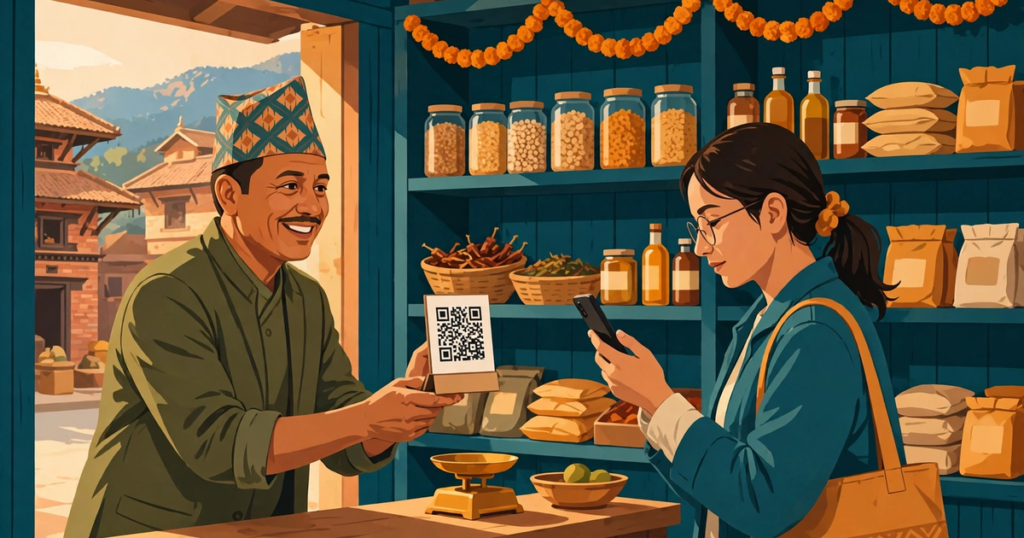
Digital payments Nepal has moved from a convenience to the default way many Nepalis pay. In a single month — mid-August to mid-September 2026 — Nepalis made 81.19 million mobile banking transactions worth Rs 614.67 billion, and 75.58 million QR payments worth Rs 167.93 billion, according to Nepal Rastra Bank. A decade ago, almost everything was cash. Today a tea shop in Kathmandu, a grocery in Pokhara, or a taxi driver on the highway can take a payment with a printed QR code and a phone. This guide explains how digital payments work in Nepal, who runs the systems behind them, what the numbers say, and what still needs fixing.
- Digital Payments Nepal: How Cash Started Losing Ground
- Digital Payments Nepal: The QR Code at Every Shop
- Digital Payments Nepal: Mobile Banking and Wallets
- Digital Payments Nepal: Paying Across Borders
- Digital Payments Nepal: What Still Needs Fixing
- Digital Payments Nepal: What’s Next
- Frequently Asked Questions
Table of Contents
Digital Payments Nepal: How Cash Started Losing Ground
Nepal was a cash economy for most of its modern history. Banks, ATMs and debit cards came first, but the real shift began when payments moved onto the phone. Two kinds of companies now sit behind almost every digital payment you make. Payment system operators run the rails — Nepal Clearing House (NCHL) operates connectIPS and the NEPALPAY QR network, while Fonepay Payment Service, which received its operator licence from Nepal Rastra Bank in February 2020, runs the country’s largest QR network. Payment service providers are the wallets you hold in your hand, such as eSewa and Khalti, licensed by the central bank to hold your money as e-money and move it on your instruction.
The central bank pushed the system toward openness early. On 4 February 2022, Nepal Rastra Bank issued a circular giving payment providers six months to make their wallets, apps and QR codes interoperable — so that a customer of one app could pay a merchant on another network. A month later, in March 2022, NCHL launched NEPALPAY QR, the national QR standard built on the central bank’s NepalQR framework. In July 2023, NEPALPAY QR became interoperable with the Smart QR network, and wallets including IME Pay, Khalti and Prabhu Pay began paying NEPALPAY QR merchants. By mid-2025, wallet users in Nepal had reached 27.4 million, according to Nepal Rastra Bank data.
The result is a system in which the customer rarely needs to know which network sits underneath a payment. You scan a code, confirm the merchant’s name, and the money moves. The rest of this article explains what happens behind that scan.
Digital Payments Nepal: The QR Code at Every Shop
The QR code is the most visible part of digital payments Nepal. A merchant prints a code — often a small sticker on the counter — and a customer scans it with a bank app or a wallet. The payment travels from the customer’s bank or wallet to the merchant’s account, usually in seconds, and both sides get a confirmation.
The scale is now enormous. In the month from mid-August to mid-September 2026, Nepalis made 75.58 million QR-based payments worth Rs 167.93 billion. That is 83.95 percent more transactions than the same month a year earlier, and the value rose 65.88 percent. QR is the fastest-growing way Nepalis pay, and it grew from a low base only a few years ago.
NEPALPAY QR alone handled 35.6 million payments worth Rs 263.4 billion in fiscal year 2025/26, and by 2026 it counted 1.1 million merchants payable through its network, including Smart QR merchants. Fonepay, the other big network, reports more than 20 million registered customers and over 1.7 million merchants, and says it carries most person-to-merchant QR payments in the country. These are the companies’ own figures, but the central bank’s totals confirm the direction: QR has become the default way to pay at small shops.
QR won for a simple reason: it is cheap. A card machine costs money, needs power and a connection, and charges the merchant a fee on every sale. A printed QR code costs almost nothing, and a single sticker can carry several networks at once, because the national standard leaves room for more than one operator on the same code. For a small shop, a street vendor or a taxi driver, that made accepting digital payment possible for the first time.
Much of the money moving through these rails arrives from abroad. Remittance sent home by Nepalis working overseas increasingly lands straight into bank accounts and wallets, and from there it is spent by QR and mobile banking — read our explainer on how remittance works in Nepal to see where that money comes from.
Digital Payments Nepal: Mobile Banking and Wallets
QR codes get the attention, but mobile banking moves the most money in digital payments Nepal. As of mid-September 2026, Nepal had 30.47 million mobile banking users and 2.52 million internet banking users, according to Nepal Rastra Bank’s monthly payment systems indicators. A single person can hold several accounts, so user counts run higher than the population — but the trend is unmistakable.
In the month from mid-August to mid-September 2026, mobile banking handled 81.19 million transactions worth Rs 614.67 billion — more than three times the value of all QR payments in the same month, and 29.73 percent more transactions than a year earlier. Wallets handled 51.49 million transactions worth Rs 49.10 billion in the same period, and the balance of e-money held in wallets stood at Rs 14.19 billion at the end of the month. Faster payment systems — instant transfers through connectIPS, Fonepay’s instant transfers, InstaFund and SCT’s instant service — moved another 22.19 million transactions worth Rs 583.32 billion.
Zoom out and the shift is even clearer. In the first seven months of fiscal year 2025/26, electronic payments in Nepal passed Rs 7 trillion. Mobile banking alone accounted for more than 67 million transactions worth roughly Rs 5.58 trillion in that period, and QR payments added 46.2 million transactions worth Rs 1.25 trillion.
It helps to know the difference between the two tools in your pocket. Mobile banking is your bank’s own app: it moves money directly from your bank account, and it is useful for larger transfers, bills and fund transfers between accounts. A wallet is stored e-money held by a licensed provider: you load it from your bank or an agent, and it is useful for small, everyday payments — a bus fare, a top-up, a shop payment. Both are regulated by Nepal Rastra Bank, which licenses the operators and the wallet providers and sets the rules they must follow.
Nepal Rastra Bank is the same institution that sets interest rates and manages the money supply — see our plain-language guide to Nepal’s monetary policy for how that side of its job works.
Digital Payments Nepal: Paying Across Borders
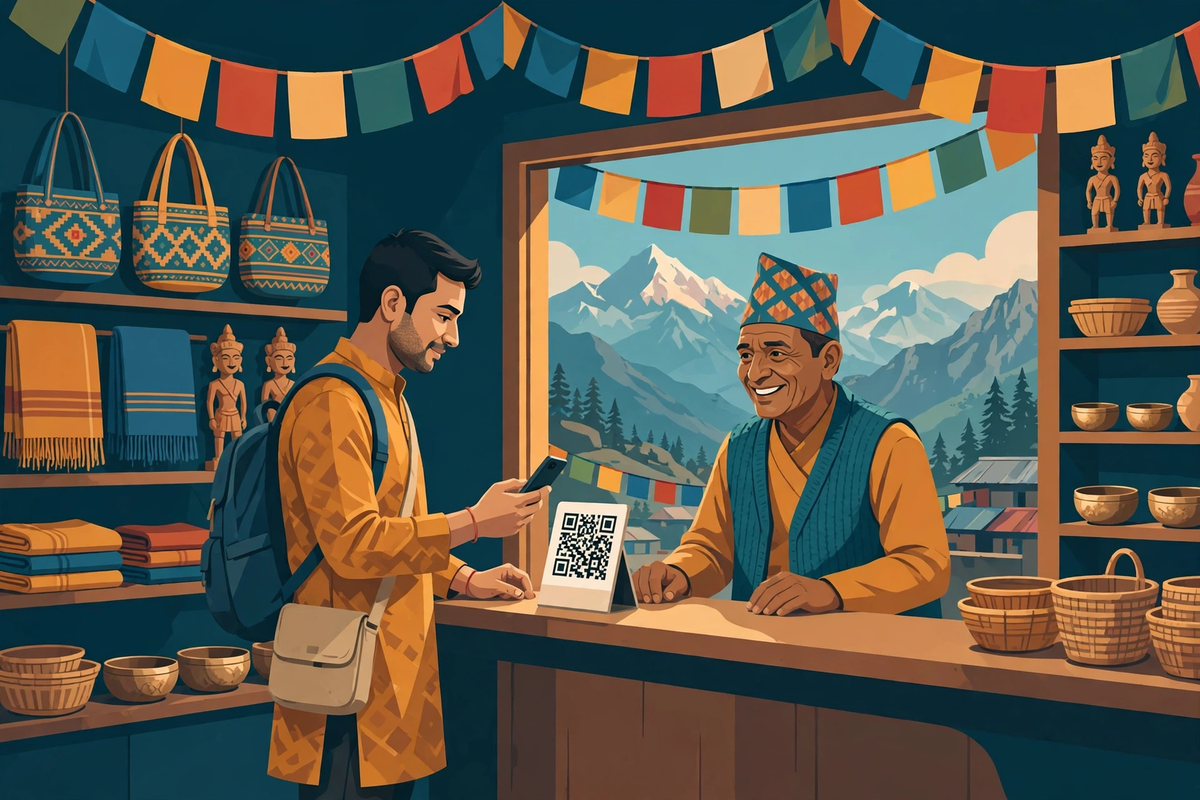
Digital payments Nepal is no longer a domestic story. In March 2024, Indian visitors became able to pay Nepali shops by scanning Fonepay merchant QR codes with Indian UPI apps such as PhonePe, Google Pay, Paytm and BHIM. The service was fully operational from 8 March 2024, and it works because India’s National Payments Corporation and Fonepay connected their systems: the visitor pays in Indian rupees, and the merchant receives Nepali rupees. Nepal Rastra Bank’s data now tracks this separately — in the month to mid-September 2026, cross-border QR acquiring recorded 306,867 transactions worth Rs 792 million.
Tourists from further away followed. Alipay+ wallets became accepted on NEPALPAY QR in November 2024, Fonepay added Alipay+ in August 2025, and UnionPay joined the QR network in May 2026, so visitors carrying those wallets can now pay at Nepali merchants too.
The newest link is person-to-person. On 6 June 2026, Nepal’s National Payments Interface, run by NCHL, was connected to India’s UPI for direct transfers between people. Transfers from India to Nepal are capped at ₹200,000 each. Transfers from Nepal to India are capped at ₹15,000 each and ₹100,000 a month, and only Indian citizens with accounts at participating Nepali banks may send them.
One direction is still missing. Nepalis travelling to India cannot yet pay Indian shops by scanning a QR code with a Nepali app — even though the two countries agreed in June 2023 to connect their payment systems. Nepal Rastra Bank has said preparations on the infrastructure side are complete and discussions with the relevant authorities are under way, but as of November 2026 the facility is still not available. For now, cross-border QR is a one-way street, and it is the clearest unfinished item in the system.
Digital Payments Nepal: What Still Needs Fixing
The growth figures are real, but digital payments Nepal still has gaps that matter for ordinary users.
First, cash is not gone, and it should not be. Nepal Rastra Bank Executive Director Anuj Dahal has said cash remains useful during emergencies, network outages and for people without smartphones. When the power or the mobile network fails, a QR code is just a sticker. Keeping cash as a fallback is not old-fashioned; it is resilience.
Second, the system depends on connectivity and electricity that are not equally reliable everywhere. A payment that fails halfway — money debited but the merchant not paid — is rare, but it happens, and reversing it takes time and a complaint to the bank or wallet provider. Rural areas, where networks are weaker and fewer merchants accept QR, still run largely on cash.
Third, fraud follows the money. Fake QR stickers pasted over a real merchant’s code, phishing messages asking for one-time passwords, and fake payment screenshots are all known tricks. The defence is simple and worth repeating: check the merchant’s name on your screen before confirming, never share your PIN or one-time password with anyone, and treat any message asking you to “verify” your account as a scam until proven otherwise.
Fourth, the rules set limits. Nepal Rastra Bank’s unified directive on payment systems sets per-transaction and daily caps for digital payments, and the caps differ by channel and by provider. Check your bank or wallet app for the current limits before a large payment, rather than discovering them at the counter.
Finally, the one-way border, described above, remains unresolved. Until Nepalis can pay in India the way Indians can pay in Nepal, the cross-border system is only half built.
Digital Payments Nepal: What’s Next
The direction of travel is clear: more merchants, more tourists paying by phone, and the remaining cross-border links switched on. The government has folded digital payments into its wider digital ambitions — read our explainer on the Digital Nepal Framework for what that programme promises and what it changes. The practical test is simpler: whether a shopkeeper in a small town, a farmer selling at a haat bazaar, and a Nepali traveller in Delhi can all pay the same way a Kathmandu cafe customer already does.
Digital payments Nepal has grown from a novelty into the country’s everyday payment system in less than five years. The rails are built, the numbers are large, and the remaining work — reliable connectivity, protection against fraud, and finishing the cross-border links — is now the difference between a system that works for the connected and one that works for everyone.
Frequently Asked Questions
What are digital payments in Nepal? Digital payments Nepal means paying without cash — through mobile banking apps, digital wallets, QR codes, internet banking and instant transfer services — on systems regulated by Nepal Rastra Bank.
How do QR payments work in Nepal? The merchant displays a QR code. You scan it with your bank app or wallet, check the merchant’s name and the amount, and confirm. The money moves from your account or wallet to the merchant’s account, usually in seconds. Most merchant codes work with several apps, because the national NEPALPAY QR standard is interoperable with other networks.
Are digital payments safe in Nepal? They run on systems licensed and supervised by Nepal Rastra Bank, which is a strong starting point. The main risks are frauds that target the user, not the system: fake QR stickers, phishing messages and requests for your PIN or one-time password. Never share those codes, and always check the merchant name before confirming a payment.
Can Indians pay by QR in Nepal? Yes. Since March 2024, Indian visitors can scan Fonepay merchant QR codes with UPI apps such as PhonePe, Google Pay, Paytm and BHIM. They pay in Indian rupees; the merchant receives Nepali rupees. Alipay+ and UnionPay wallets are also accepted at many merchants.
Can Nepalis pay by QR in India? Not yet. As of November 2026, Nepalis travelling to India cannot pay Indian shops by scanning a QR code with a Nepali app. Person-to-person transfers through the NPI–UPI link launched in June 2026, but only for Indian citizens with accounts at participating Nepali banks, with caps of ₹15,000 per transfer and ₹100,000 a month. Nepal Rastra Bank says the infrastructure is ready and discussions are under way.
Sources: Nepal Rastra Bank, Monthly Payment Systems Indicators: Bhadra 2083 (mid-September 2026) and Saun 2083 (mid-August 2026); Nepal Rastra Bank, Current Macroeconomic and Financial Situation (nine months of 2025/26); Nepal Clearing House Ltd, NEPALPAY QR; Fonepay Payment Service Ltd; ICT Frame, “Nepal Electronic Payment Transactions Seven Months”, 12 March 2026; The Himalayan Times, “QR payments, mobile banking surge as Nepal logs Rs 852bn in digital transactions in one month”, 12 May 2026; Peoples’ Review, “Digital payments surge in Nepal”, 24 October 2026; Online Khabar, “Will PM Balen Shah’s India visit resolve cross-border QR payment problem?”, 14 November 2026. Related reading on Hamro Niti: How Remittance Works in Nepal, Nepal’s Monetary Policy Explained and Digital Nepal Framework, Explained.