

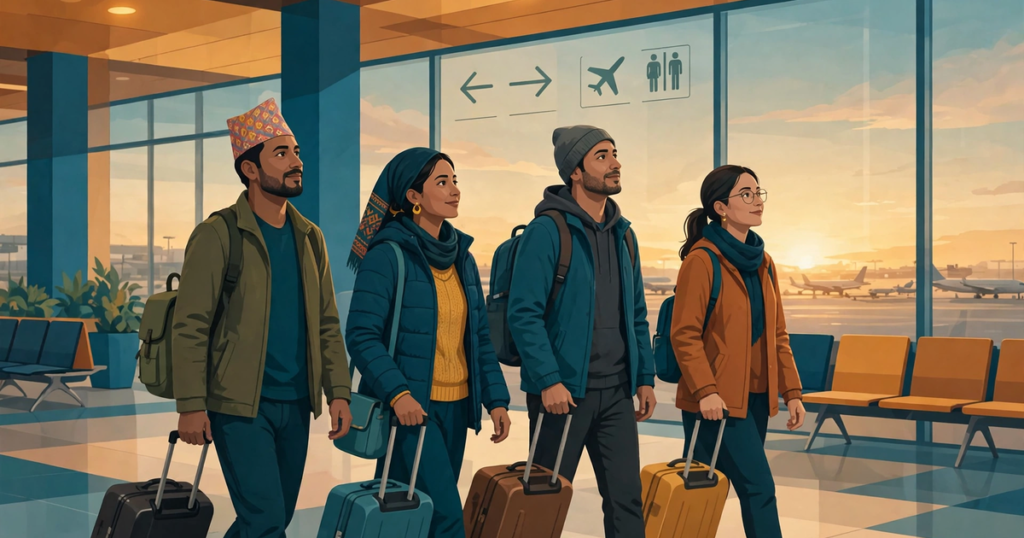
Nepal labour migration explained in plain language: every year, hundreds of thousands of Nepalis leave home to work abroad — on Gulf construction sites, in Malaysian factories, in South Korean plants, and increasingly on European farms and in warehouses. In the last fiscal year alone, the government issued a record 839,266 labour permits. Behind that number are families paying off loans, villages emptied of young men, and money sent home that now equals more than a quarter of the entire economy. This article explains how the system works, what it costs, where it fails workers, and what is being done to fix it.
Table of Contents
- How Big Is It, Really?
- The Legal Route, Step by Step
- What It Costs — and What the Law Says It Should Cost
- The Risks Workers Face
- The Reforms on the Table
- Frequently Asked Questions
Table of Contents
Nepal Labour Migration Explained: How Big Is It, Really?
The scale is hard to overstate. In fiscal year 2024/25, the Department of Foreign Employment (DoFE) issued 839,266 labour permits — the highest annual total ever recorded. Of those, 505,957 were first-time permits and 333,309 were renewals for workers returning abroad. Men received 744,811 permits and women 94,455. Over the past five years, more than 3.5 million permits have been issued.
The flow has grown almost every year since the pandemic. The year before, in 2023/24, DoFE issued 741,297 new approvals. But a single year’s permits understate how many Nepalis are actually abroad, because many workers stay for years and renew. The Nepal Labour Migration Report 2024, published by the Ministry of Labour, Employment and Social Security with the International Labour Organization, estimates around 3,017,000 Nepalis are currently abroad for employment — including about 1,088,371 in India alone, where no permit is needed. Qatar, Malaysia, Saudi Arabia and the UAE together host about 1,232,349 Nepali workers.
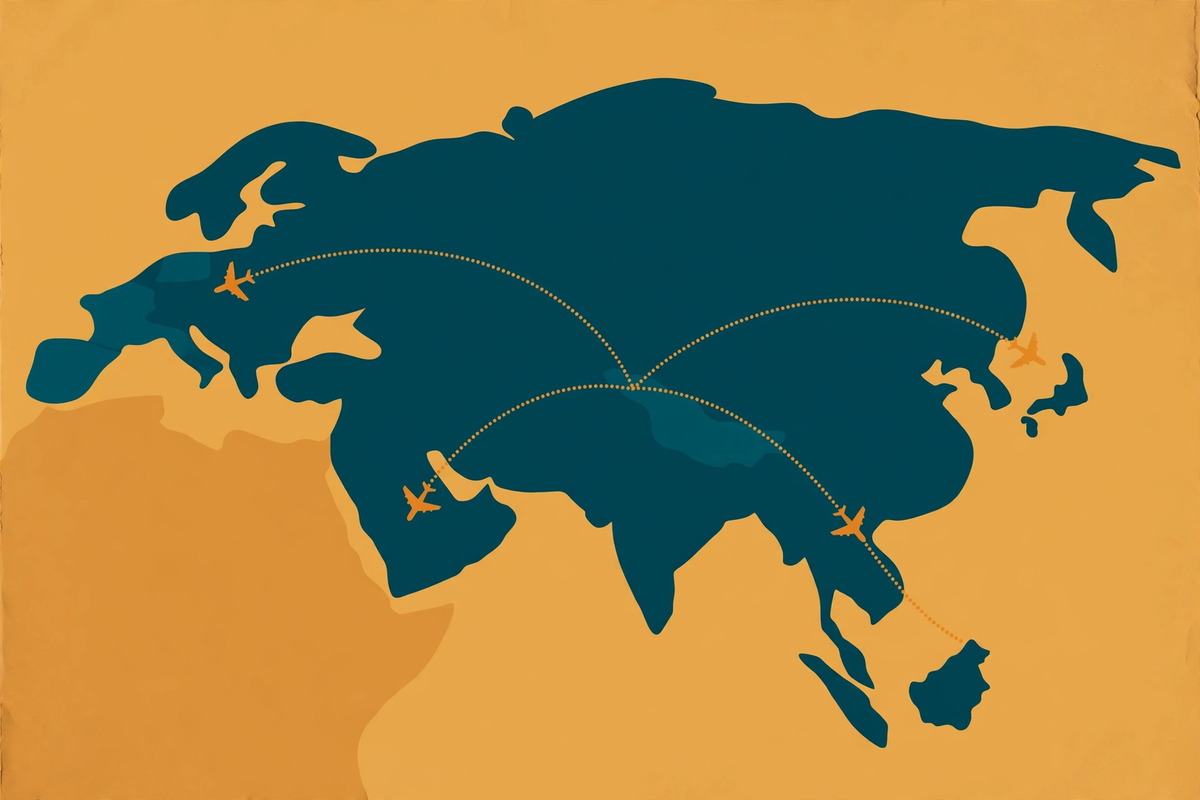
Where do they go? Nepal labour migration explained by destination is a story of concentration. The six Gulf Cooperation Council states plus Malaysia absorbed about 81.3 percent of new approvals, according to the 2024 report. In 2024/25, the UAE was the top destination, followed by Saudi Arabia, Qatar, Kuwait, Malaysia, Romania, Japan, South Korea and Bahrain. But the map is slowly changing: Europe took 72,953 approvals in 2024/25 — 8.69 percent of the total, up from just 4 percent four years earlier. Romania alone went from 316 Nepali workers in 2017/18 to 12,700 by 2024.
Who goes? About half of departing workers are aged 25 to 34. Madhesh Province sends the most workers of any province. Women made up 11.3 percent of permits in 2024/25 — still a small share, but up from under 7 percent in 2008. About one in five workers (21.2 percent) arrange their jobs individually rather than through an agency. The government has now opened 111 countries for institutional foreign employment, and around 1,670 licensed manpower companies operate in Nepal.
The money coming back is just as large. In 2024/25, migrant workers sent home Rs 1,723.27 billion in remittances, according to Nepal Rastra Bank — roughly 28 percent of GDP. That money pays school fees, builds houses, clears debts and keeps foreign exchange reserves high. For the full picture of what remittances do to the economy, see our explainer on how remittance works in Nepal. In short, Nepal labour migration explained in one sentence: a record outflow, concentrated in a few countries, sending home money worth more than a quarter of GDP.
Nepal Labour Migration Explained: The Legal Route, Step by Step
Foreign employment in Nepal is governed by the Foreign Employment Act 2007 (2064 BS). The Department of Foreign Employment, under the Ministry of Labour, Employment and Social Security, issues the labour permit — the shram swikriti — that every Nepali worker needs before taking a job abroad, except in India, where the open border means no permit is required. Nepal labour migration explained as a process has seven steps:
1. Find a job through a licensed agency — or on your own. Recruitment agencies must hold a DoFE licence. Before paying anyone, check the agency on DoFE’s public list at foreignjob.dofe.gov.np. Unlicensed brokers are the single biggest source of fraud.
2. Get the demand attested. The foreign employer’s job demand must be verified and approved by DoFE before recruitment begins. This is meant to stop fake job offers.
3. Complete pre-departure orientation training. A 12-hour course spread over two days, covering contracts, workers’ rights, destination-country rules and safety. It costs Rs 700 and the certificate is required for the labour permit.
4. Pass a medical test. Destination countries, especially in the Gulf, require medical fitness certificates from approved clinics.
5. Buy foreign employment insurance. A mandatory term-life policy from a DoFE-enlisted insurer (see the costs section below for what it covers).
6. Pay into the Foreign Employment Welfare Fund. A contribution of Rs 1,500 for contracts up to three years, or Rs 2,500 for longer contracts.
7. Get the labour permit. Applications are filed online through DoFE’s Foreign Employment Management System, and DoFE says permits are issued on the same day the application is filed.
There are also government-to-government routes that bypass private agencies. The best known is the Employment Permit System (EPS) with South Korea, through which 7,509 Nepalis went in 2024/25. In September 2026, DoFE opened applications for 1,464 Nepali caregivers to work in Israel under a bilateral labour agreement, and Nepal and Mauritius were reported in October 2026 to be finalising a similar government-to-government recruitment deal.
Nepal Labour Migration Explained: What It Costs — and What the Law Says It Should Cost
This is where the law and reality part ways. Since 2015, Nepal’s “free visa, free ticket” policy has required employers in seven destinations — Qatar, Saudi Arabia, the UAE, Kuwait, Bahrain, Oman and Malaysia — to pay for the worker’s visa and air ticket. The recruitment agency’s service charge is capped at Rs 10,000. On top of that, the worker’s legal bill is a small, fixed stack: a passport (Rs 5,000), a medical test (around Rs 6,500), orientation training (Rs 700), insurance (roughly Rs 3,500 to Rs 5,500 for a two-year policy) and the welfare fund contribution (Rs 1,500 to Rs 2,500).
All together, the legal cost of going abroad for work is roughly Rs 18,000. Nepal labour migration explained in money terms: the law says about Rs 18,000; the market often charges ten times that.
In practice, many workers pay far more. DoFE’s own director general has said workers pay between Rs 130,000 and Rs 700,000 for Gulf and Malaysia jobs — mostly in fees charged by agents and brokers above the legal cap. That debt, often borrowed at high interest, is the first risk a worker faces, before even boarding a plane.
What does the legal money buy? The insurance policy provides cover of up to Rs 2 million in total: Rs 1,000,000 in life cover, Rs 200,000 for loss of income, Rs 100,000 for funeral costs and up to Rs 100,000 for medical expenses. Separately, the Foreign Employment Welfare Fund pays a Rs 1,000,000 survivors’ benefit to the family of a worker who dies abroad. The fund also pays for scholarships — 3,430 children of migrant workers received them in 2024/25 — and for legal and medical help to workers in distress.
Nepal Labour Migration Explained: The Risks Workers Face
The risks begin with the debt described above and continue abroad. The most common complaints are contract substitution (the job or salary on arrival differs from what was promised), unpaid or delayed wages, excessive working hours, confiscated passports and poor living conditions. In Gulf countries, the kafala sponsorship system ties a worker’s legal status to a single employer, which makes it hard to leave a bad job. In the first six months of 2024/25 alone, DoFE received 954 complaints from workers and their families.
The human cost is visible in the Foreign Employment Board’s figures: 1,517 Nepali migrant workers died abroad in fiscal year 2024/25. Most deaths are recorded as natural causes or workplace accidents, but the number itself — more than four deaths a day on average — is a reminder that this is dangerous work, done far from home and family. Any honest account of Nepal labour migration explained in full has to include that number.
Women face a particular trap. Since 2016–17, Nepal has effectively barred legal permits for domestic work in the Gulf and Malaysia, after repeated reports of abuse. Parliament directed a full stop in 2017, and guidelines set a minimum age of 24 for domestic workers in the listed countries.
But the ban did not stop women from going — it pushed many onto irregular routes through India, Sri Lanka and Bangladesh, without documents or protection. In one six-month period, 60 of 73 women rescued and sheltered by the migrant women’s group AMKAS Nepal had reached Gulf countries through such routes. A pilot agreement with the UAE to send 5,000 domestic workers legally was reported in early 2025, but the wider ban remains in place.
Even the overall flow is fragile. In the first nine months of the current fiscal year, 2025/26, labour permits fell to 587,340 from 607,874 in the same period a year earlier, as the West Asia crisis disrupted departures — a reminder that Nepal’s biggest source of income depends on politics in faraway countries.
Nepal Labour Migration Explained: The Reforms on the Table
Nepal labour migration explained as a policy debate comes down to one question: how does a country that depends on migration make it safer and fairer? Several reforms are already in motion or under discussion:
Enforcing the employer-pays rule. DoFE has stepped up enforcement of the Rs 10,000 service-charge cap, including questioning returnees at the airport about what they were charged. The gap between the legal Rs 18,000 and the Rs 130,000-plus many workers actually pay is now treated as the central problem, not a side issue.
Expanding government-to-government recruitment. The Korea EPS model — no private agent, fixed costs, a transparent selection process — is the template. The Israel caregiver programme and the Mauritius deal point in the same direction.
Bringing domestic work back into the legal system. The reported UAE pilot would let women migrate as domestic workers legally, with a bilateral agreement setting pay and protections, instead of through traffickers.
Skills before departure. Most Nepali workers leave as unskilled labourers, which means the lowest wages. Pre-departure skills training — caregiving, construction trades, hospitality — is meant to raise both pay and bargaining power.
Support for returnees. Return is the forgotten half of migration. Reintegration support, recognition of skills learned abroad, and easier access to loans for returnee businesses are all part of the current debate.
None of these reforms removes the basic fact: for now, foreign employment is how millions of Nepali families survive. The goal is not to stop migration, but to make sure the worker who leaves Kathmandu airport comes home with savings, not debt and injury. For anyone planning to go, Nepal labour migration explained as a checklist is simple: verify the licence, never pay far above the legal cost, keep a copy of your contract, complete the orientation, and make sure your insurance and welfare fund payments are done before you fly.
Frequently Asked Questions
Short answers — Nepal labour migration explained in brief — to the questions workers and families ask most:
Do I need a labour permit to work in India?
No. Under the open border between Nepal and India, Nepali citizens do not need a labour permit — or even a passport — to live and work in India. The permit system applies to all other countries. That is also why official permit numbers understate the true number of Nepalis working abroad: the roughly 1.1 million Nepalis working in India are not counted in DoFE figures.
How much should going abroad for work legally cost?
Around Rs 18,000 in total — passport, medical test, orientation training, insurance and the welfare fund contribution — plus a service charge capped at Rs 10,000. For the seven “free visa, free ticket” destinations (Qatar, Saudi Arabia, the UAE, Kuwait, Bahrain, Oman and Malaysia), the employer must pay for your visa and air ticket. If an agent asks for far more, that is a warning sign: check the agency’s licence on DoFE’s list and consider filing a complaint.
What happens to my family if I die while working abroad?
Two separate payments apply. The mandatory insurance policy pays Rs 1,000,000 in life cover to your family, and the Foreign Employment Welfare Fund pays a separate Rs 1,000,000 survivors’ benefit. The insurance also covers funeral costs (Rs 100,000) and medical expenses. Your family can claim through the Foreign Employment Board in Kathmandu.
Can Nepali women work as domestic workers in the Gulf?
Not through the legal permit system at present. Nepal has effectively barred permits for domestic work in Gulf countries and Malaysia since 2016–17 because of abuse cases. Many women still travel through irregular routes, which is far more dangerous. This is why Nepal labour migration explained for women looks different from the general picture: the same system that counts their permits also shuts its most common job abroad. A pilot agreement with the UAE was reported in early 2025, which may reopen a legal route with agreed pay and protections.
How do I check whether a manpower company is licensed?
Check DoFE’s public list of licensed recruitment agencies at foreignjob.dofe.gov.np before paying any money. A licence is mandatory under the Foreign Employment Act. If the agency is not on the list, do not deal with it — and you can report it to DoFE.
Sources: Department of Foreign Employment (DoFE) labour permit data for FY 2024/25; Nepal Labour Migration Report 2024, Ministry of Labour, Employment and Social Security with ILO support; Nepal Rastra Bank remittance data for FY 2024/25; Foreign Employment Board figures for FY 2024/25; Economic Survey FY 2025/26, Ministry of Finance. Figures are as reported by these sources; fees and rules change, so confirm current amounts with DoFE before you pay.
Related reading: Remittance in Nepal: how it works, and why it matters so much · The remittance paradox