

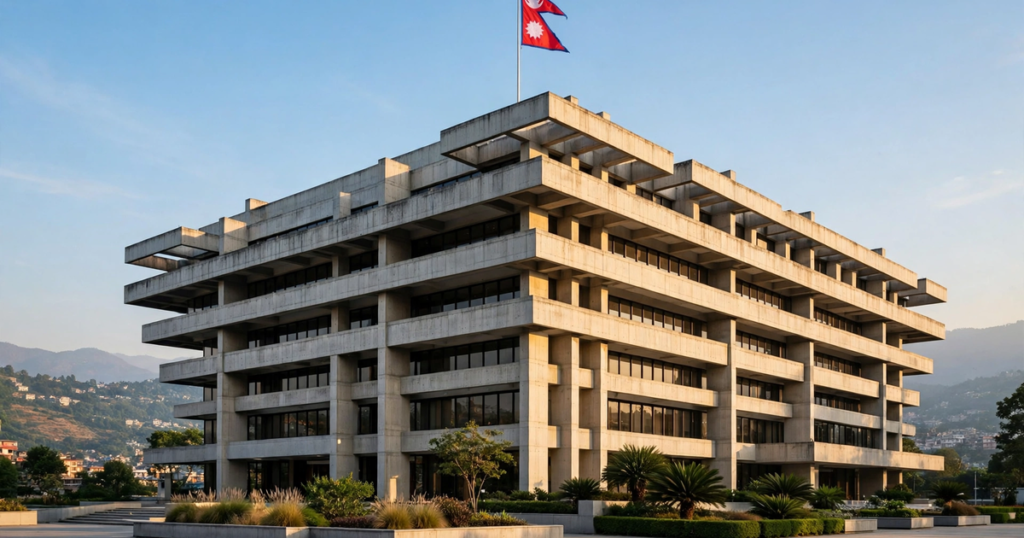
Nepal monetary policy explained simply: it is the set of decisions Nepal Rastra Bank (NRB), the country’s central bank, makes about interest rates, the money in the banking system, and how much banks can lend. Those decisions shape the interest on your home loan, the return on your fixed deposit, and the price of everyday goods. Every July, NRB announces a monetary policy for the new fiscal year.
Table of Contents
- Nepal Monetary Policy Explained: What It Is
- Nepal Monetary Policy Explained: Who Decides It
- Nepal Monetary Policy Explained: The Interest Rate Corridor
- Nepal Monetary Policy Explained: Reserves and Open Market Operations
- Nepal Monetary Policy Explained: How It Reaches Your Loan
- Nepal Monetary Policy Explained: What It Means for 2026/27
- Frequently Asked Questions
Table of Contents
Nepal Monetary Policy Explained: What It Is
Monetary policy is how a central bank manages money in the economy. In Nepal, the job belongs to Nepal Rastra Bank, established in 1956 under the Nepal Rastra Bank Act. Its main goals are to keep prices stable, support economic growth, and keep the financial system safe. When prices rise too fast, the central bank can make borrowing more expensive to cool spending. When the economy is slow, it can make borrowing cheaper to encourage investment.
One feature shapes everything else: the Nepali rupee is pegged to the Indian rupee at NPR 1.60 per INR 1. Because the exchange rate is fixed, NRB cannot set interest rates far above or below India’s without putting pressure on the peg. The fixed exchange rate is the intermediate target of monetary policy — the anchor the rest of the framework is built around.
NRB announces its monetary policy once a year, usually in July, just after the government presents the annual budget. The policy for fiscal year 2026/27 (2083/84) was unveiled on 7 July 2026 — the twenty-fifth annual monetary policy NRB has published — and it is reviewed every quarter.
Nepal Monetary Policy Explained: Who Decides It
The policy is prepared by Nepal Rastra Bank and presented by its Governor. The 2026/27 policy was presented by Governor Dr Biswo Nath Poudel, and the final decisions are approved by NRB’s Board of Directors. The law requires the central bank to review the previous year’s policy and justify its plans for the year ahead, under Section 94 of the Nepal Rastra Bank Act, 2002.
The government has a different role: it sets the broad economic targets in the budget — for 2026/27, growth of about 7 percent and inflation of around 5.5 percent. NRB then designs monetary policy to support those targets while keeping prices and the financial system stable. For the fiscal side of that partnership, read our plain-language guide to Nepal’s budget for 2026/27.
This division matters because the central bank takes a longer view than any single government. A government facing an election may want cheap credit today; the central bank must also think about whether that credit will push up prices tomorrow.
Nepal Monetary Policy Explained: The Interest Rate Corridor
The most quoted part of any monetary policy is the interest rate corridor — three rates that set the boundaries for what banks charge each other for overnight money.
- The policy rate, 4.25 percent. The headline rate in the news, and the rate at which NRB lends to banks in its regular repo operations. It sits in the middle of the corridor.
- The standing deposit facility rate, 2.75 percent. The floor. A bank with surplus cash can always park it at NRB and earn this rate, so no bank will lend to another bank for less.
- The bank rate, 5.75 percent. The ceiling, charged under the standing liquidity facility. A bank short of cash can always borrow from NRB at this rate, so no bank will pay more than this to borrow overnight from another bank.
For 2026/27, NRB left all three rates unchanged. But the headline rate is not the rate at which money actually changes hands. NRB’s operating target is the weighted average interbank rate — the rate banks actually charge each other. In mid-August 2026, that rate stood at 2.75 percent, on the floor of the corridor, a full 1.5 percentage points below the 4.25 percent policy rate, because banks held roughly Rs 1.1 trillion in surplus funds they could not lend out fast enough. When banks are flush with cash, the floor — not the headline policy rate — becomes the rate that matters.

Nepal Monetary Policy Explained: Reserves and Open Market Operations
Interest rates are only one lever in Nepal monetary policy explained through its tools. NRB also controls how much of a bank’s deposits must be kept aside, and it buys and sells securities to add or drain cash from the system.
The cash reserve ratio (CRR) is the share of deposits every bank must hold as cash with NRB. Raise it, and banks have less money to lend; lower it, and more money flows into loans. The statutory liquidity ratio (SLR) is the share of deposits banks must hold in liquid assets, mostly government securities. Both were left unchanged in the 2026/27 policy.
Open market operations are NRB’s day-to-day tool. When the banking system has too much cash, NRB absorbs it by selling its own bonds or running deposit-collection auctions. When cash is short, it injects money through repo operations — short-term loans to banks against government securities. In the first ten months of fiscal year 2025/26, NRB absorbed hundreds of billions of rupees this way, yet the system still ended up with excess liquidity, because remittance inflows kept bringing in more money than banks could lend.
The result shows up in the credit-to-deposit ratio: in mid-2026 it stood at about 74 percent, against a regulatory ceiling of 90 percent. Banks had room to lend — the constraint was not a shortage of money, but a shortage of borrowers willing and able to take loans. Private-sector credit grew by only 6.6 percent in the year to mid-July 2026.
Nepal Monetary Policy Explained: How It Reaches Your Loan
A change in NRB’s rates does not change your loan rate the next morning. It travels through a chain, and each link takes time. First, the interbank rate moves. Then banks reprice their deposits — in mid-July 2026, the average commercial bank paid about 3.21 percent on deposits. Then they reprice their loans, through the base rate, the floor rate each bank calculates from its own cost of funds. The average base rate was 4.83 percent in mid-July 2026, and the average lending rate was about 6.55 percent.

That gap is the key number: the difference between the 4.25 percent policy rate and the roughly 6.55 percent a borrower actually pays is more than two percentage points — the cost of running a bank, the risk of default, and the bank’s margin. The delay matters too. Deposit rates adjust within a quarter or so; lending rates can take two quarters or more, because existing loans reprice slowly. When NRB cut its policy rate from 7 percent in mid-2023 to 4.25 percent by mid-2026, borrowers felt the relief gradually, not all at once — and the same lag applies if rates rise.
For savers, the deposit rate you are offered is set by your bank, not by NRB — but NRB’s corridor sets the range within which your bank can move. And because inflation in 2026/27 is targeted at around 5.5 percent while average deposit rates sit near 3 percent, money left in a savings account is, in real terms, losing purchasing power.
Nepal Monetary Policy Explained: What It Means for 2026/27
The 2026/27 policy is best described as cautiously supportive. NRB kept rates unchanged, aiming to support the government’s 7 percent growth target while keeping inflation near 5.5 percent and foreign exchange reserves high enough to cover at least seven months of imports. It also set a target of about 11 percent growth in private-sector credit — ambitious, given that credit grew only 6.6 percent the previous year.
Three things will decide whether it works. First, credit demand: with banks already holding surplus cash, cheaper money only helps if businesses actually want to borrow and invest. Second, government spending: the budget for 2026/27 is the largest ever, at about Rs 2,124 billion, and whether that money is spent on time — especially capital spending on roads, energy, and infrastructure — matters more for growth than any interest rate. Third, the outside world: Nepal imports most of its fuel and many of its goods, so a rise in global oil prices can push up inflation no matter what NRB does.
There is also a limit the policy is honest about. NRB’s own estimates put the economy’s potential growth at around 4.2 percent, while actual growth in 2025/26 was 3.85 percent — below potential since the pandemic. Cheap credit can help close that gap, but it cannot fix the deeper constraints: slow capital spending, weak private investment, and an economy that still depends heavily on remittance. The central bank has said it will review its stance if inflation rises, liquidity tightens, or financial stability risks grow.
For an ordinary citizen, the practical takeaway is simple. That, in short, is Nepal monetary policy explained — not a distant announcement in July. It is the reason your loan rate is what it is, why your fixed deposit pays what it pays, and why market prices move the way they do.
Frequently Asked Questions
What is monetary policy in Nepal?
Nepal monetary policy explained in one sentence: it is the set of decisions Nepal Rastra Bank makes each year about interest rates, bank reserves, and credit, aimed at keeping prices stable, supporting growth, and keeping the financial system safe.
Who decides Nepal’s monetary policy?
Nepal Rastra Bank prepares it, the Governor presents it, and NRB’s Board of Directors approves it. The government sets the broad growth and inflation targets in the budget.
What is the current policy rate in Nepal?
For fiscal year 2026/27, the policy rate is 4.25 percent, the standing deposit facility rate is 2.75 percent, and the bank rate is 5.75 percent — all unchanged from the previous year. The interbank rate was about 2.75 percent in mid-August 2026.
How does monetary policy affect my loan?
NRB’s rates set the range for what banks charge each other, which feeds into deposit rates, then the base rate, then your loan rate. Deposit rates adjust within a quarter; lending rates can take two quarters or more.
Why doesn’t the policy rate match the rate I pay?
Because the policy rate is the rate at which NRB lends to banks, not the rate at which banks lend to you. Your loan rate adds the bank’s cost of funds, the risk of default, and its margin — in mid-July 2026, the average lending rate was about 6.55 percent against a 4.25 percent policy rate.
How often does Nepal Rastra Bank change monetary policy?
It announces a full policy once a year, in July, and reviews it every quarter. The quarterly reviews can adjust rates and rules if economic conditions change.
Sources: Nepal Rastra Bank, Monetary Policy for Fiscal Year 2083/84 (2026/27), announced 7 July 2026; Nepal Rastra Bank Act, 2002, Section 94; NRB, Current Macroeconomic and Financial Situation (data to mid-August 2026); Nepal News, “Can Nepal achieve 7 percent growth? Everything you need to know about NRB’s monetary policy for FY 2026/27”; The Rising Nepal, “Monetary Policy for FY 2026/27 eyes robust growth”, 8 July 2026; Nepalytix, “How to read Nepal’s monetary policy”. Related reading on Hamro Niti: How Nepal Rastra Bank Sets Interest Rates — and What It Means for Your Loan and Budget 2026/27 in Plain Language: Where the Money Goes.