

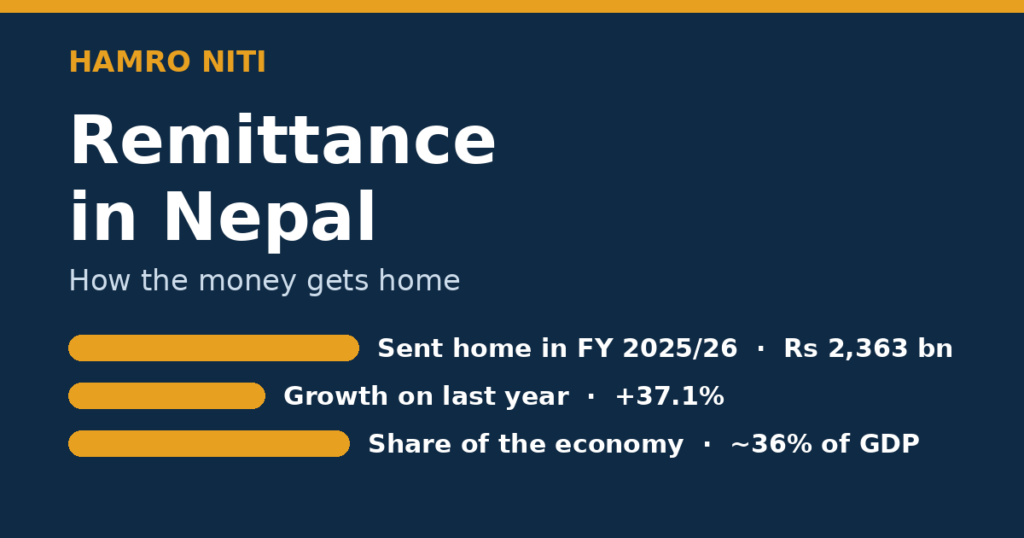
Remittance Nepal explained in one line: it is the money Nepalis working abroad send home to their families — and in fiscal year 2025/26 that flow reached Rs 2,363.13 billion, about Rs 2.36 trillion, according to Nepal Rastra Bank. That is more than the federal government’s entire annual budget. It pays school fees, clears loans, builds houses and keeps the country’s foreign exchange reserves full.
Table of Contents
Remittance Nepal explained: what it actually is
Remittance Nepal explained at its simplest: it is money sent home by people working in another country. In Nepal’s case, that mostly means Nepalis in the Gulf states — Saudi Arabia, Qatar and the United Arab Emirates — plus Malaysia, India, South Korea, Japan, and increasingly the United States, the United Kingdom and Australia. About 1.9 million Nepalis work in the Gulf alone, and the Middle East accounts for roughly 40% of the money that comes in.
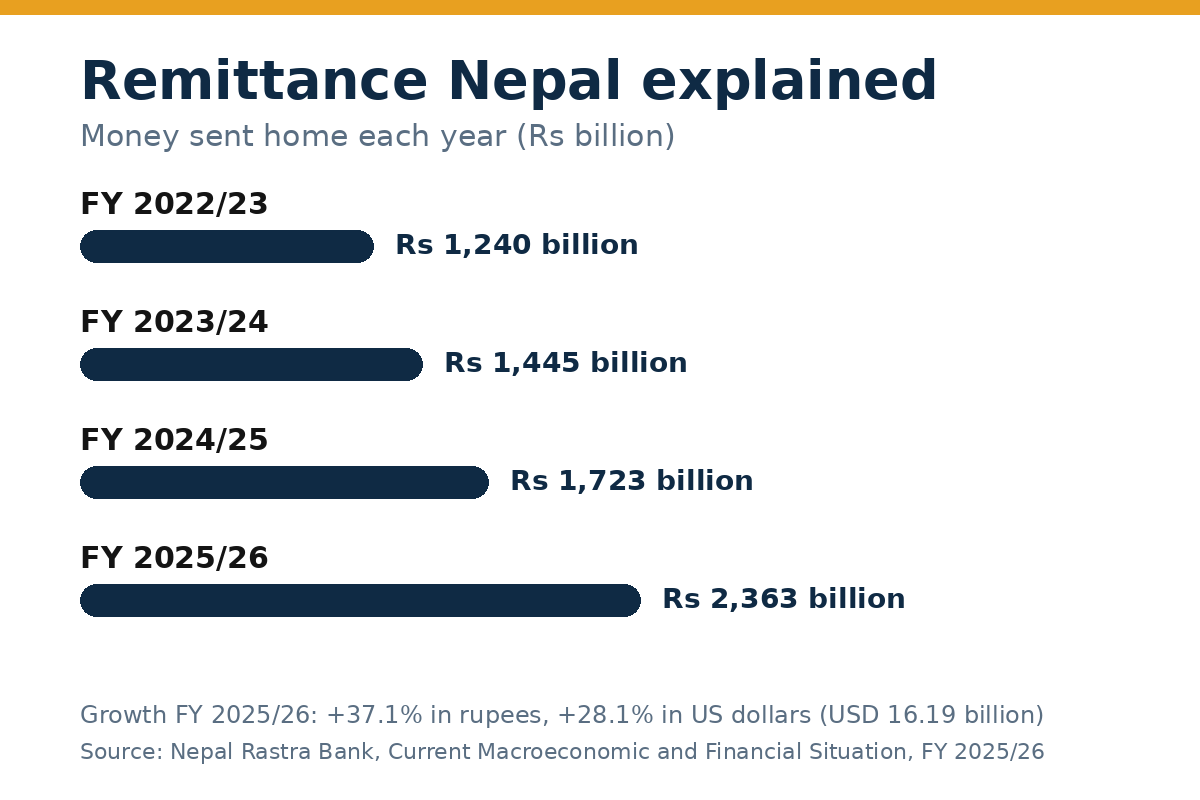
The scale is hard to overstate. Nepal Rastra Bank’s annual data shows remittance inflows of Rs 2,363.13 billion in fiscal year 2025/26 (mid-July 2025 to mid-July 2026), up 37.1% in rupee terms on the year before. In US dollars the rise was 28.1%, to USD 16.19 billion — the gap reflects the rupee weakening against the dollar, which makes each dollar sent home worth more rupees. The year before, FY 2024/25, inflows were Rs 1,723.27 billion, up 19.2%.
| Fiscal year | Remittance inflows | Change on previous year |
|---|---|---|
| 2022/23 | Rs 1,240 billion | — |
| 2023/24 | Rs 1,445 billion | +16.5% |
| 2024/25 | Rs 1,723.27 billion | +19.2% |
| 2025/26 | Rs 2,363.13 billion | +37.1% |
Against the size of the economy, the flow is extraordinary: about 28% of gross domestic product (GDP) in FY 2024/25 and roughly 36% in FY 2025/26, against the National Statistics Office’s projected GDP — one of the highest ratios in the world. Roughly one in three Nepali households receives money from abroad, according to household survey data.
Remittance Nepal explained: how the money reaches home
A worker’s paycheque abroad usually ends up in a bank account or a mobile wallet in Nepal, through one of three formal routes.
Banks. A worker can send money directly from a bank abroad to a bank account in Nepal. The transfer is recorded, traceable and safe.
Money transfer operators. Companies such as IME and Western Union let a worker hand over cash abroad and have it paid out in Nepal within minutes or hours, either as cash at an agent or straight into an account. For many workers this is the fastest route.
Mobile wallets and digital transfers. Increasingly, money arrives through mobile banking and wallet apps. The Reserve Bank of India’s Indo-Nepal Remittance Facility handles transfers by Nepali workers in India and pension payments to former Indian army servicemen settled in Nepal.
Then there is the informal route: hundi. A worker gives cash to an agent abroad; the agent’s counterpart in Nepal pays the family in rupees, and the money never crosses a border through official channels. Hundi is illegal, the family has no proof of payment if something goes wrong, and the money never enters Nepal’s foreign exchange reserves or its statistics. Nepal Rastra Bank has pushed for years to bring these flows into formal channels, because money that arrives formally is money the country can count and use.
Remittance Nepal explained: why it matters so much
Remittance Nepal explained in terms of impact comes down to three things: households, reserves, and stability.
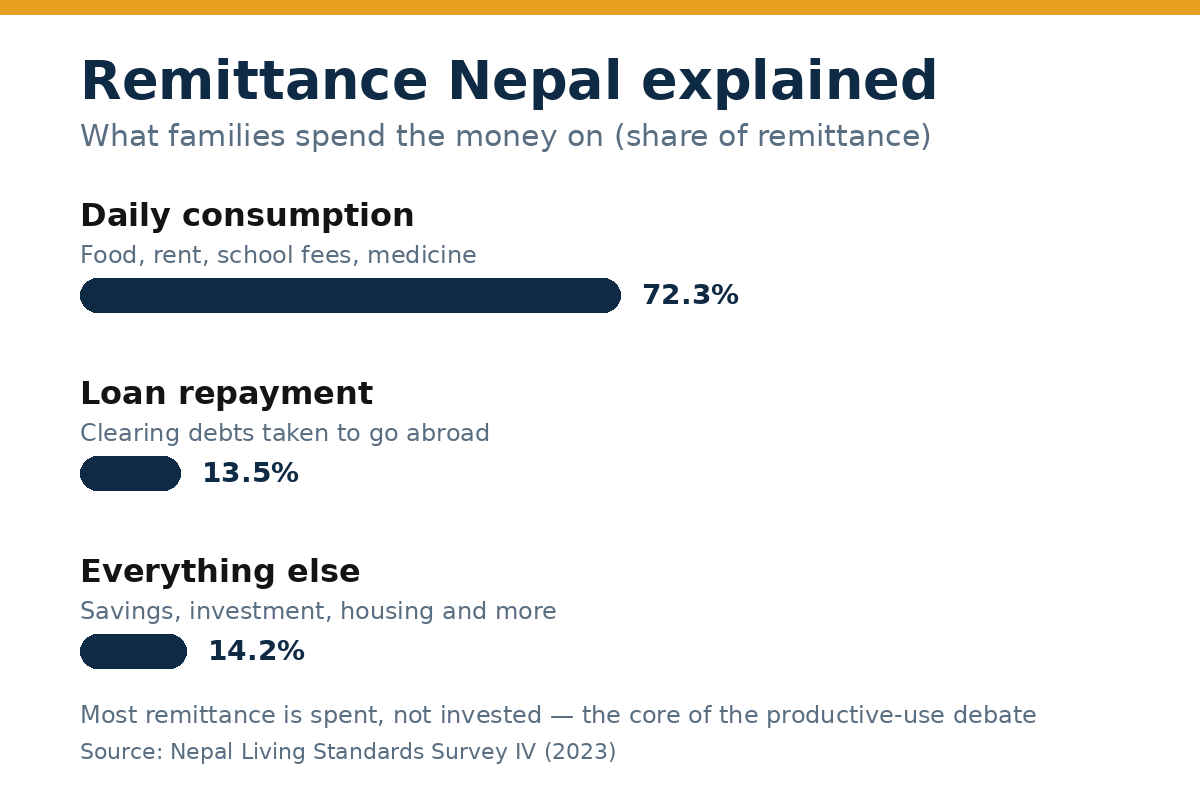
Households. For the families that receive it, remittance is income — often the main income. The Nepal Living Standards Survey (NLSS IV, 2023) found that 72.3% of remittance goes on daily consumption — food, rent, school fees, medicine — and 13.5% on repaying loans. It has kept children in school and paid for healthcare that wages at home could not cover. This is the human side of the numbers, and the reason remittance is so fiercely defended.
Reserves. Remittance is Nepal’s single largest source of foreign exchange — the dollars and other foreign currency the country needs to pay for imports. Because of the remittance surge, gross foreign exchange reserves reached Rs 3,897.67 billion, about USD 25.31 billion, by mid-July 2026, up 45.6% in rupee terms in a year. In FY 2024/25, reserves were enough to cover 18.2 months of merchandise imports.
Stability. Remittance is what keeps Nepal’s external accounts in balance. In FY 2025/26, net secondary income — mostly remittance — reached Rs 2,581.53 billion. Without it, Nepal’s trade deficit, which widened to Rs 1.78 trillion that year, would be unpayable. Our explainer on how Nepal Rastra Bank sets interest rates shows how that liquidity shapes the cost of borrowing at home.
Remittance Nepal explained: the risks of depending on it
Remittance Nepal explained honestly has to include the other side: a flow this big is also a vulnerability. Four risks stand out.
First, the jobs are not Nepal’s to control. If host countries close their labour markets, or a war disrupts them, the money can fall fast. After the Iran war began in late February 2026, new approvals for Gulf-bound workers fell by more than half compared with the same period a year earlier. And even in a record year, the pipeline weakened: first-time foreign employment approvals fell to 406,414 in FY 2025/26, down from 505,957 the year before, even as renewals rose to 385,783. The money kept rising — but fewer new workers were leaving to earn it.
Second, the headline growth flatters the reality. The 37.1% jump was partly a currency effect: in dollar terms the rise was 28.1%. When the rupee weakens, the same dollars become more rupees, so the growth looks bigger than the rise in earnings abroad. A stronger rupee would do the opposite.
Third, most of the money is spent, not invested. With 72.3% going on daily consumption and 13.5% on loans, little is left for starting a business or building something that earns money of its own. Families understandably spend on what they need today — but the economy as a whole ends up importing more and producing little extra. Our earlier piece on the remittance paradox looks at how that cycle can dull the drive to build businesses at home.
Fourth, the workers themselves are missing. The young people most likely to start a company or learn a new trade are the ones abroad earning the money. Their absence is felt in farms, classrooms and workshops — the subject of our piece on the bidesh syndrome and youth migration.
Remittance Nepal explained: what productive use looks like
Remittance Nepal explained as a resource, not a problem: it is something to be used better. Nepal Rastra Bank’s own research recommends channelling remittance into productive use, and other countries show how. The Philippines has used diaspora bonds to direct migrant savings into infrastructure. Bangladesh has tried financial products that steer remittance into small industries.
In Nepal, the pieces already exist: remittance-linked savings accounts, incentives for investing in shares and small enterprises, and bank or wallet transfers that leave a record a family can use to get a loan. The missing step is scale — enough families choosing investment over consumption, and enough trustworthy places to put the money.
What would make remittance work harder for Nepal
Three things would change the equation. First, keep pushing money into formal channels, so every rupee is counted, saved in the banking system, and available to lend. Second, give families investment options they can trust — savings products, bonds and small-business finance designed for remittance receivers, not just for the already wealthy. Third, build the jobs at home that make migration a choice rather than the only option — the subject of our explainer on Nepal’s budget for 2026/27.
Remittance has carried Nepal through crises that would have broken a poorer country. The question now is whether the country can turn a lifeline into capital — money that does not just sustain families, but builds the economy those families come home to.
Frequently asked questions
How much remittance does Nepal receive each year?
Rs 2,363.13 billion (about Rs 2.36 trillion, or USD 16.19 billion) in fiscal year 2025/26, up 37.1% on the year before, according to Nepal Rastra Bank. FY 2024/25 brought in Rs 1,723.27 billion.
What is remittance in simple terms?
Remittance Nepal explained simply: money sent home by Nepalis working abroad — mostly in the Gulf states, Malaysia, India, Korea and Japan — to their families in Nepal, through banks, money transfer operators or wallets.
How does remittance reach Nepal?
Through banks, money transfer operators such as IME and Western Union, and mobile wallets — or informally through hundi, which is illegal and leaves the family with no proof of payment.
Why is remittance so large compared to Nepal’s economy?
Because so many Nepalis work abroad: remittance was about 28% of GDP in FY 2024/25 and roughly 36% in FY 2025/26, one of the highest ratios in the world.
What happens if remittance falls?
Household incomes would drop first — school fees, loan repayments and daily spending all depend on it. Nationally, foreign exchange reserves would shrink and the trade deficit would become much harder to finance.
Sources: Nepal Rastra Bank, Current Macroeconomic and Financial Situation FY 2025/26; Nepal Living Standards Survey IV (2023); Department of Foreign Employment data. Figures checked 13 November 2026.