

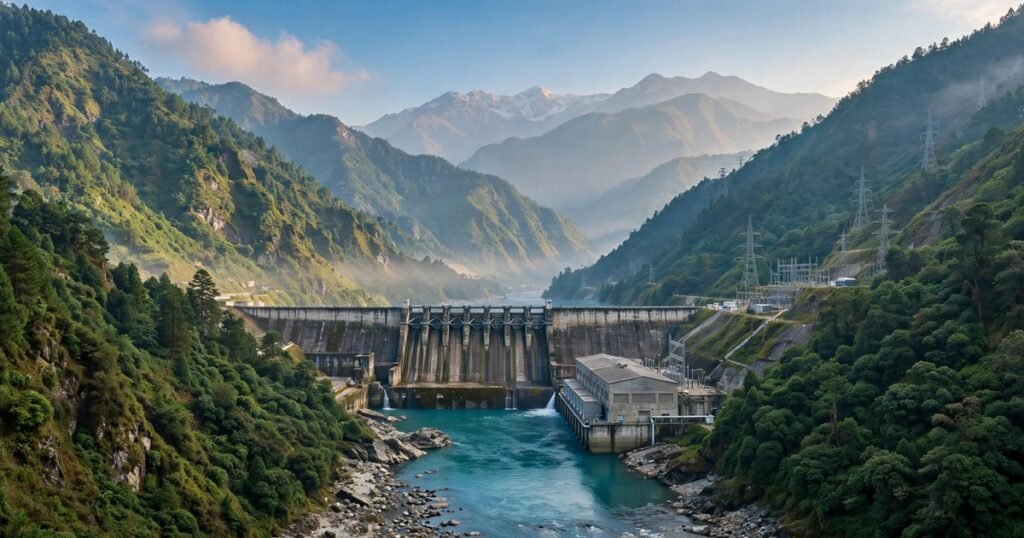
Nepal hydropower explained in plain language: the rivers that fall thousands of metres from the Himalaya now light almost every home in the country, and the surplus electricity they produce in the monsoon is sold to India and Bangladesh. In less than a decade, Nepal has gone from power cuts of up to 18 hours a day to earning Rs 29.32 billion a year from electricity exports. Yet the same country still has to import electricity every winter, when the rivers run low. This article explains how Nepal’s hydropower works — how the plants are built, who owns them, how the money flows, and what has to change before the country can use its full potential.
Table of Contents
Nepal hydropower explained: how big is it now
Nepal hydropower explained: from load shedding to exporter
Nepal hydropower explained: how a plant actually works
Nepal hydropower explained: who builds the plants
Nepal hydropower explained: how the money works
Nepal hydropower explained: selling electricity to India and Bangladesh
Nepal hydropower explained: the winter problem
Nepal hydropower explained: what comes next
Frequently asked questions
Sources
Table of Contents
Nepal Hydropower Explained: How Big Is It Now
Nepal’s total installed electricity generation capacity reached 4,120 megawatts by the end of fiscal year 2025/26, according to the Nepal Electricity Authority’s annual report released on 17 August 2026. That is the figure formally recorded in the report as the year-end position. The Economic Survey 2082/83, presented to Parliament by the Ministry of Finance, gives a closely matching figure of 4,105 megawatts, of which hydropower accounts for 3,798 megawatts. In other words, more than nine out of every ten megawatts of capacity in Nepal comes from water.
The growth has been fast, and Nepal hydropower explained through the capacity numbers shows how recent the change is. In fiscal year 2025/26 alone, 529 megawatts of new capacity was added to the national grid — almost all of it, 528.89 megawatts from 23 plants, built by private developers. A decade ago, Nepal’s total capacity was barely above 1,000 megawatts. The country crossed 2,000 megawatts in February 2022 and 3,000 megawatts in July 2024. Roughly 69 percent of today’s capacity has come online since 2020.
The potential is far larger still. Nepal’s theoretical hydropower potential is about 83,000 megawatts, and roughly 42,000 megawatts of that is considered commercially and technically viable. At 4,120 megawatts, the country has developed less than a tenth of what its rivers could economically produce. That gap — between what the rivers can do and what has been built — is the central fact of Nepal hydropower explained through the numbers.
Electricity now reaches almost everyone. The Economic Survey 2082/83 puts access at 99.1 percent of the population, up from just 58 percent in fiscal year 2015/16. The Nepal Electricity Authority serves 5,927,000 customers, of whom 90.64 percent are households and only 1.20 percent are industrial customers. But the headline hides a gap: only 539 of the country’s 753 local levels are fully electrified, and Karnali Province sits at 74.38 percent electrification, with Humla still not connected to the national grid at all. Access, in other words, is nearly universal on paper — but the quality and reach of supply are still uneven.
Consumption has grown with the supply. Nepal used 3.72 billion units of electricity in fiscal year 2015/16; by fiscal year 2023/24 that had reached 10.02 billion units. Per-capita consumption rose from 131 units to about 400 units over the same period. Households are the biggest users, followed by industry. For more on how the national economy is measured, see our explainer on how to read Nepal’s GDP.
Nepal Hydropower Explained: From Load Shedding to Exporter
Anyone who lived in Nepal between 2007 and 2017 remembers load shedding. At its worst, power was cut for up to 18 hours a day, and the evening festival of lights was the year’s worst day for demand. The Nepal Electricity Authority began phasing out load shedding in 2016, starting with a trial on Laxmi Puja day, and declared the country completely load-shedding-free on 14 May 2018 — first for households in mid-April 2017, then for industry a year later.
The turnaround was not magic. It came from three things: better management of the limited supply, more imports from India to cover the shortfall, and new plants coming online. The 456-megawatt Upper Tamakoshi plant, Nepal’s largest, began commercial generation in August 2021 and became the backbone of the system. Nepal started exporting electricity in November 2021, and has not looked back since.
The change shows up clearly on festival nights. On Laxmi Puja in 2024, peak demand reached 1,602 megawatts — up from 1,438 megawatts the year before — and the entire demand was met from domestic plants, with 253 megawatts left over to export to India during the peak hours. Eight years earlier, the same evening had to be managed with imports. That is what Nepal hydropower explained through one festival night looks like: a country that once imported power to keep its lights on now sells its surplus on the same night.
The export story is now a major part of the national economy. In fiscal year 2025/26, Nepal exported 3.877 billion units of electricity and imported only 1.1498 billion units — exporting more than three times what it bought. Export earnings reached Rs 29.32 billion against an import bill of Rs 10.56 billion, a net surplus of about Rs 18.76 billion. The average price achieved on exports was about Rs 7.56 per unit. For a country that runs a large trade deficit on almost everything else, electricity is the rare product Nepal sells more of than it buys. Our explainer on Nepal’s trade deficit puts that surplus in context.
Nepal Hydropower Explained: How a Plant Actually Works
A hydropower plant is a simple idea made complicated by geography, and Nepal hydropower explained from the plant level starts with the river itself. Water from a river is diverted or stored, dropped through a height, and passed through a turbine that spins a generator. The higher the drop and the greater the flow, the more electricity the plant produces. Nepal’s steep rivers are ideal for this: short, fast rivers falling thousands of metres from the Himalaya to the plains.
Most of Nepal’s plants are run-of-river. They take water from the river, run it through the turbine, and return it downstream, with little or no storage. More than 85 percent of Nepal’s operating hydropower capacity is run-of-river. These plants are cheap to build and quick to finish, but they produce electricity only when the river flows. In the monsoon, they run at full capacity. In the dry winter, when river flows fall to a fraction of monsoon levels, their output collapses.
A few plants store water behind a dam and release it when it is needed. Kulekhani I, II and III — 106 megawatts in total in Makwanpur — form Nepal’s only true reservoir system, and they are the grid’s main tool for meeting evening peaks. Storage plants are expensive and slow to build, and they flood valleys, which is why Nepal has so few of them. Between the two types sits the peaking run-of-river plant, like Upper Tamakoshi, which holds a small pond of water for a few hours and releases it during the evening peak.
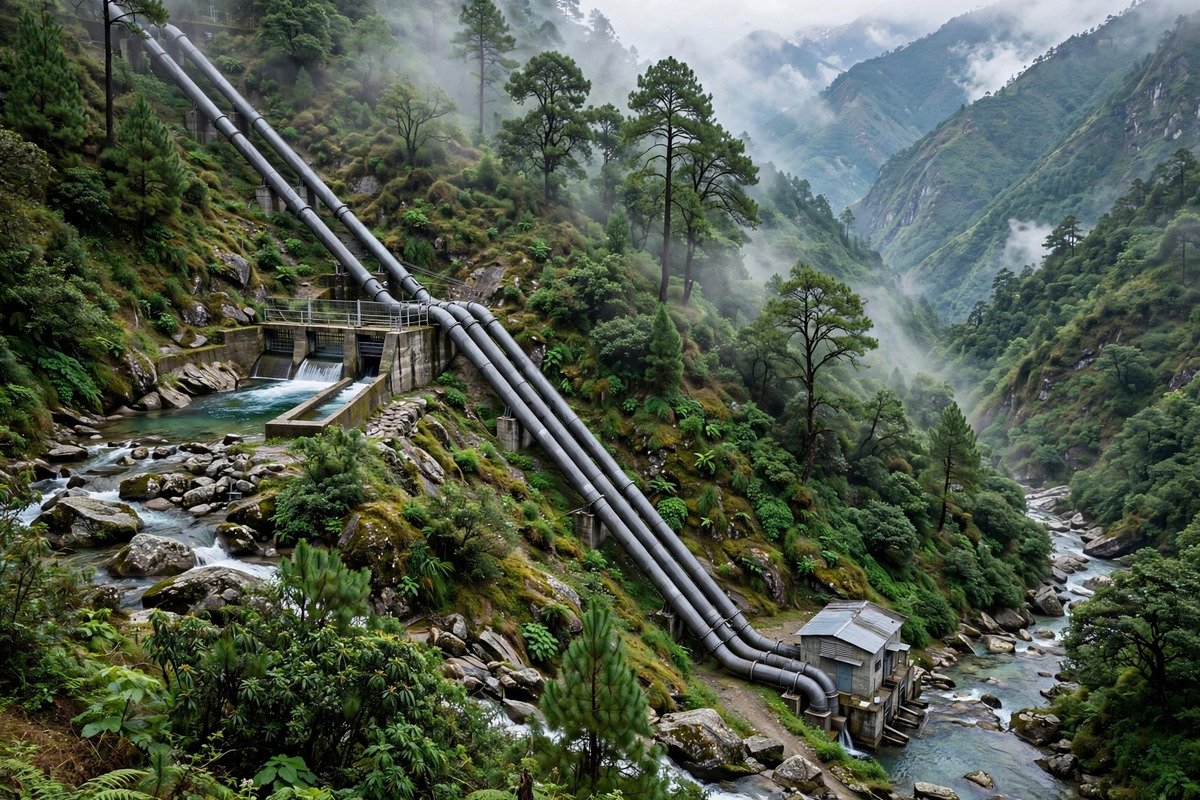
The distinction matters because it explains Nepal’s central energy problem. A country that builds almost entirely run-of-river plants will always have too much electricity in the monsoon and too little in winter. Nepal hydropower explained through plant types is really a story about storage: the country has the rivers, but it has almost no way to save monsoon water for January.
The main projects tell the story. Upper Tamakoshi (456 MW, Dolakha, 2021) is the largest plant in the country. Kaligandaki A (144 MW, Syangja, 2002) was the largest for nearly two decades. Marsyangdi (69 MW, Tanahu, 1989) anchored the central grid for thirty years. Rasuwagadhi (111 MW, Rasuwa, 2024) and Madhya Bhotekoshi (102 MW, which began commercial production in fiscal year 2025/26) are the newest large additions. The 40-megawatt Rahughat project was in its testing phase when the Nepal Electricity Authority’s annual report was compiled.
Nepal Hydropower Explained: Who Builds the Plants
Three kinds of organisations build Nepal’s hydropower, and Nepal hydropower explained through its builders starts with who owns what: the Nepal Electricity Authority itself, its subsidiary companies, and private developers known as independent power producers, or IPPs. The private sector now builds almost everything new. Of the 4,105 megawatts recorded in the Economic Survey 2082/83, private projects account for 2,587 megawatts, NEA subsidiaries for 748.4 megawatts, and the NEA’s own plants for 661.57 megawatts.
The NEA is the buyer of nearly all the electricity produced. Under the Electricity Act 2049, a developer needs a licence from the Department of Electricity Development, and then signs a power purchase agreement — a PPA — with the NEA, which buys the plant’s output for 25 to 30 years. The Electricity Regulatory Commission, set up under its own Act in 2017, regulates tariffs and licences. The system is sometimes called the single-buyer model: one buyer, many sellers.
For a private developer, the process starts with a survey licence, then a generation licence, then financing, construction, and connection to the grid. Most small and medium plants are built by Nepali companies and listed on the Nepal Stock Exchange, where hydropower shares are among the most traded. Our guide to how NEPSE works explains how ordinary Nepalis buy shares in these companies.
The model has a bottleneck. As of July 2026, 281 licensed projects totalling 16,425.77 megawatts held licences but had no power purchase agreement — meaning they cannot sell their electricity even if they are built. The NEA has moved slowly on new agreements, partly because it already has more power than it can use in the monsoon, and partly because of disputes over terms. In February 2026, the NEA announced PPAs on a take-or-pay basis for projects up to 10 megawatts, removing the old quota system. But for larger projects, the wait for an agreement remains one of the biggest frustrations in the sector.
Nepal hydropower explained through its builders is therefore a story of two speeds. Small private plants get built quickly and in large numbers. Large strategic projects — the ones that could change the country’s energy balance — move slowly, held back by financing, land acquisition, environmental clearances, and politics.
Nepal Hydropower Explained: How the Money Works
A hydropower plant earns money by selling units of electricity to the NEA at a price fixed in its power purchase agreement, and Nepal hydropower explained through the money starts with that contract. The NEA’s published rate sheet, in force since 27 April 2017 and unchanged since, sets the standard price for run-of-river plants up to 100 megawatts at Rs 4.80 per unit in the wet season and Rs 8.40 per unit in the dry season, with a 3 percent annual escalation for eight years. Storage plants earn more — Rs 7.10 in the wet season and Rs 12.40 in the dry season — because they can deliver power when it is scarce. Peaking run-of-river plants earn between Rs 8.50 and Rs 10.55 per unit in the dry season, depending on how many hours of peak power they commit to.
The seasonal split is the point. Dry-season electricity is worth nearly twice as much as monsoon electricity, because that is when the country is short. A plant that can generate in winter earns far more per unit than one that can only generate in the monsoon — which is why developers and the government both want more storage and peaking capacity, even though it costs more to build.
Whether the NEA has to pay for power it does not take is a separate, much-argued question. Under a take-or-pay agreement, the NEA pays for the agreed energy whether it uses it or not. Under take-and-pay, it pays only for what it actually takes. The budget for fiscal year 2025/26 moved new run-of-river agreements toward take-and-pay; the budget for fiscal year 2026/27 moved back to take-or-pay and promised immediate agreements for projects under 10 megawatts. For developers, take-or-pay is what makes a project bankable — a bank will not lend against a plant whose buyer might refuse the power. For the NEA, take-and-pay limits the cost of surplus monsoon electricity it cannot sell.
The NEA’s own finances show the tension. In fiscal year 2025/26, the authority reported total income of Rs 166 billion and electricity sales revenue of Rs 148.62 billion, up 18.20 percent on the year. Its total profit was Rs 31.23 billion and its operating profit Rs 24.81 billion — but its net profit before tax was only Rs 5.04 billion, because foreign exchange losses on its foreign-currency loans jumped to Rs 11.51 billion, up 272.86 percent. The NEA borrows in foreign currency to build projects and earns in rupees, so a weakening rupee inflates its debt even when its operations are healthy.
Royalties add another layer. Under the Intergovernmental Fiscal Arrangement Act 2074, royalties from natural resources such as hydropower are shared 50 percent to the federal government, 25 percent to the province, and 25 percent to the local level where the project sits. For a district hosting a large plant, that royalty share is one of the few direct financial benefits of having a dam in its backyard — and one of the reasons communities negotiate hard over new projects.
Nepal Hydropower Explained: Selling Electricity to India and Bangladesh
Nepal’s surplus electricity has only two buyers that matter: India and Bangladesh. India is the market that makes the whole export story possible, because Nepal has no direct transmission line to Bangladesh — every unit sold to Bangladesh crosses Indian territory. Nepal hydropower explained through its buyers is therefore also a story about geography and diplomacy, not just engineering.
The long-term agreement with India, signed on 4 January 2024, aims for Nepal to export 10,000 megawatts to India over ten years. In practice, exports are far smaller: Nepal currently exports about 1,160 megawatts to India, and India’s Central Electricity Authority has approved export capacity of about 1,650 megawatts. The gap between the 10,000-megawatt ambition and the 1,650-megawatt approval is the difference between a political agreement and the physical and regulatory reality of transmission lines and market access.
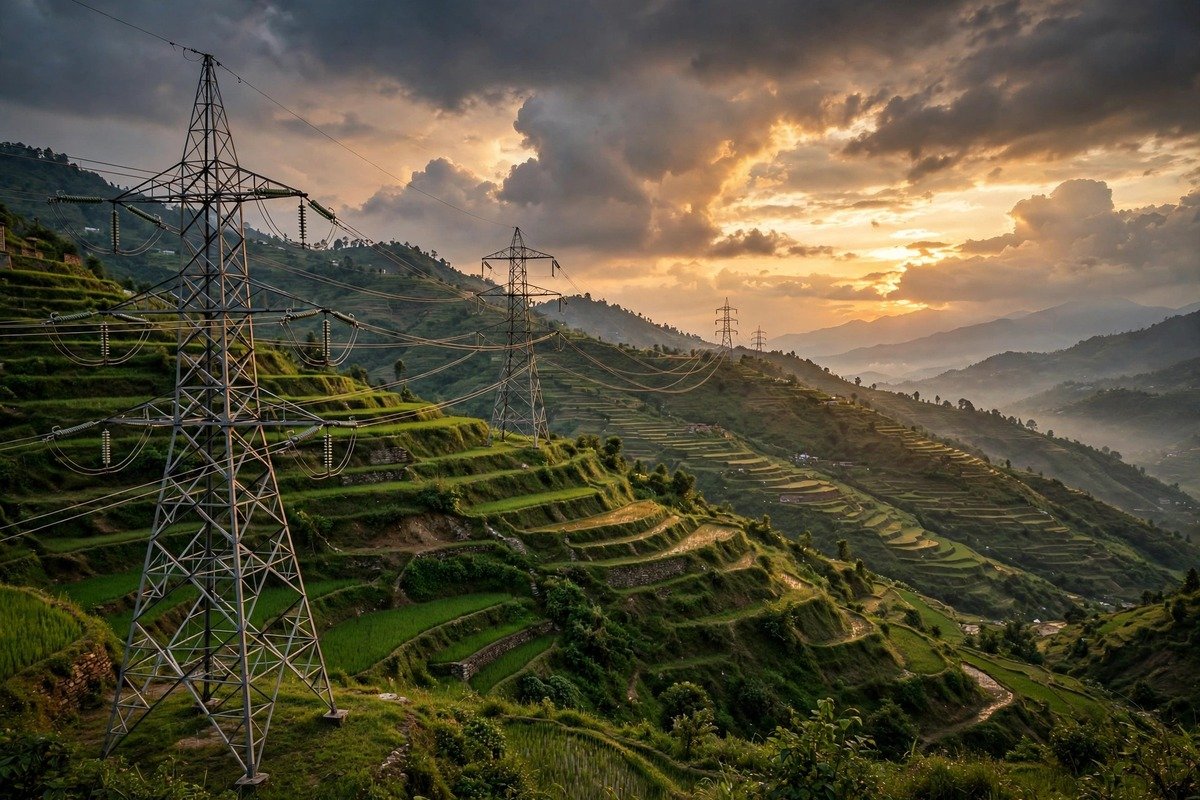
Electricity reaches India through cross-border transmission lines. The main one is the 400-kilovolt Dhalkebar–Muzaffarpur line, which can carry 600 megawatts, plus the 132-kilovolt Tanakpur–Mahendranagar line and several smaller connections through Bihar. Nepal sells into India’s power exchanges — the day-ahead and real-time markets — as well as through longer-term bilateral deals. In October 2025, India and Nepal signed agreements for two more high-capacity 400-kilovolt lines, from Inaruwa to New Purnea in Bihar and from Lamki to Bareilly.
Bangladesh is the newer market. On 15 November 2024, Nepal began exporting 40 megawatts to Bangladesh through the Indian grid, under a tripartite agreement signed on 3 October 2024 between the NEA, the Bangladesh Power Development Board, and India’s NTPC Vidyut Vyapar Nigam. The power comes from the Trishuli (25 MW) and Chilime (22 MW) plants, is sold at 6.40 US cents per unit, and flows only during the monsoon season, from 15 June to 15 November each year. Bangladesh has said it wants to import 9,000 megawatts from Nepal by 2040, and Nepal aims to send 5,000 megawatts there eventually. In June 2026, an attempt to raise the Bangladesh export from 40 to 60 megawatts was blocked when India’s Central Electricity Authority declined to approve the extra 20 megawatts, citing transmission capacity limits — a reminder that Nepal’s access to its second market depends on India’s grid.
The export window is short. Nepal can only sell when it has surplus, which is roughly June to November. In winter, the flow reverses, and Nepal buys electricity from India. Nepal hydropower explained through trade is therefore a seasonal story: a seller for five months of the year, a buyer for the rest.
Nepal Hydropower Explained: The Winter Problem
Winter is Nepal’s energy test, and it comes every year. Nepal hydropower explained through the dry season is a story of abundance turned upside down: river flows fall sharply in the dry months, and run-of-river plants that produce at full capacity in July may produce a quarter of that in January. The Nepal Electricity Authority estimates that even with nearly 4,000 megawatts of installed capacity, domestic generation in winter is limited to about 1,218 megawatts. Last winter, peak demand reached about 2,292 megawatts, and this winter it is projected at 2,250 to 2,300 megawatts.
The gap is filled by imports. The NEA has planned to import 1,154 megawatts from India this winter — 600 megawatts through the Dhalkebar–Muzaffarpur 400-kilovolt line, 54 megawatts through Tanakpur–Mahendranagar, and 350 megawatts through various points in Bihar. Combined with domestic generation, that makes about 2,372 megawatts available, enough to meet demand without load shedding. But it is a fragile balance: it depends on India’s willingness to sell, on transmission lines staying in service, and on demand not spiking beyond the forecast.
The floods of 26 August 2026 showed how quickly the balance can break. Floods in the Trishuli and Bhotekoshi basins knocked about 430 megawatts of capacity out of the system by damaging generation plants and transmission lines, at the same time as they killed around 1,500 people and left 5,200 missing. The damage to the power sector was part of a wider disaster estimated by the World Bank at about $1.66 billion. A power system built on rivers in steep, landslide-prone valleys is always one flood away from a bad week.
The long-term fix is storage. The 140-megawatt Tanahu project, a seasonal storage plant being built by an NEA subsidiary with co-financing from the Asian Development Bank, the Japan International Cooperation Agency and the European Investment Bank, is expected to provide six hours of full-capacity generation a day in winter. It is due for completion in 2026–27. Beyond it sit much bigger storage schemes — Budhi Gandaki (1,200 MW), Upper Arun (1,063 MW, under study), and the binational Pancheshwar project (6,480 MW) — but none of them has a firm construction timeline. Nepal hydropower explained through winter is a warning: until storage is built, the country will keep selling cheap monsoon power and buying expensive winter power.
Nepal Hydropower Explained: What Comes Next
The government’s answer is the Energy Development Roadmap and Action Plan 2081, approved in January 2025. It sets a target of generating 28,500 megawatts by 2035 — 13,000 megawatts for domestic use and 15,000 megawatts for export. Nepal hydropower explained through the roadmap is a plan to turn a seasonal surplus into a permanent export industry. The Sixteenth Five-Year Plan (2024/25–2028/29) sets a nearer target of 11,769 megawatts by 2028/29, with electrification reaching 100 percent and per-capita consumption rising to 700 units.
The pipeline has the projects to match the ambition, on paper at least. Arun-3 (900 MW, Sankhuwasabha) is under construction by India’s SJVN and is the largest plant currently being built. Upper Trishuli-1 (216 MW, Rasuwa) has signed its power purchase agreement and is expected to generate 456.4 gigawatt-hours a year. Tanahu (140 MW) is nearing completion. Further out are Budhi Gandaki (1,200 MW), Pancheshwar (6,480 MW, shared with India), and Karnali Chisapani (about 10,800 MW) — projects so large that each one would more than double today’s entire national capacity.
But the history of Nepal’s hydropower is a history of delays. Projects have been held up by land acquisition, environmental clearances, financing gaps, contractor disputes, and political changes. The 281 licensed projects with no power purchase agreement are a reminder that a licence is not a plant. And the August 2026 floods are a reminder that the rivers that make Nepal’s fortune can also break its infrastructure.
What would have to change for the roadmap to work is well understood: faster power purchase agreements, transmission lines built ahead of generation rather than behind it, storage projects given priority over more run-of-river plants, and a settlement with India that turns the 10,000-megawatt agreement into actual market access. None of that is new. The question is whether the country that ended load shedding in two years can now build storage and transmission at the same speed.
For ordinary Nepalis, the stakes are concrete. Hydropower already pays for itself in two ways: it keeps the lights on, and it earns foreign currency that reduces the trade deficit. If the storage and export plans work, electricity could become Nepal’s most valuable export — a product the country makes from its own rivers, with no imported raw material. If they do not, Nepal will keep the strange pattern it has now: a country rich in water that still buys electricity every winter.
Frequently Asked Questions
How much hydropower does Nepal have?
Nepal’s total installed electricity generation capacity reached 4,120 megawatts by the end of fiscal year 2025/26, according to the Nepal Electricity Authority’s annual report, and hydropower accounts for more than 90 percent of it. The country’s economically viable potential is about 42,000 megawatts — roughly ten times what has been built so far. That gap is the short version of Nepal hydropower explained: enormous potential, fast recent growth, and most of the resource still unused.
When did Nepal end load shedding?
Load shedding for households ended in mid-April 2017, and the country was declared completely load-shedding-free on 14 May 2018, when power cuts for industry were also removed. At its worst, between 2007 and 2017, load shedding lasted up to 18 hours a day.
What is Nepal’s largest hydropower plant?
Upper Tamakoshi, at 456 megawatts in Dolakha district, is Nepal’s largest power plant. It began commercial generation in August 2021 and was financed almost entirely from domestic sources. The next largest operating plants are Kaligandaki A (144 MW) and Rasuwagadhi (111 MW).
How much electricity does Nepal export, and to whom?
In fiscal year 2025/26, Nepal exported 3.877 billion units of electricity worth Rs 29.32 billion, mostly to India, and imported 1.1498 billion units worth Rs 10.56 billion — a net surplus of about Rs 18.76 billion. Nepal also exports 40 megawatts to Bangladesh through the Indian grid during the monsoon season, under a tripartite agreement signed in October 2024.
Why does Nepal still import electricity in winter?
Because most of Nepal’s plants are run-of-river, their output falls sharply when river flows drop in the dry season. Domestic generation in winter is limited to about 1,218 megawatts against peak demand of about 2,300 megawatts, so the shortfall is imported from India. Only Kulekhani’s 106 megawatts of storage can save monsoon water for winter use.
What is the 28,500-megawatt target?
Under the Energy Development Roadmap and Action Plan 2081, approved in January 2025, Nepal aims to generate 28,500 megawatts by 2035 — 13,000 megawatts for domestic consumption and 15,000 megawatts for export. The nearer target in the Sixteenth Five-Year Plan is 11,769 megawatts by 2028/29.
Sources
Nepal Electricity Authority, Annual Report FY 2025/26 (released 17 August 2026), as reported by Nepal News — installed capacity 4,120 MW; 529 MW added; 5,927,000 customers; total income Rs 166 billion; electricity sales Rs 148.62 billion; exports Rs 29.32 billion; imports Rs 10.56 billion; exports 3.877 billion units; imports 1.1498 billion units; average export price Rs 7.56 per unit; transmission 7,110 circuit km; substation capacity 15,541 MVA; Madhya Bhotekoshi 102 MW in commercial production; Rahughat 40 MW in testing.
Ministry of Finance, Economic Survey 2082/83 — installed capacity 4,105 MW; hydropower 3,798 MW; electricity access 99.1 percent; private sector 2,587 MW; NEA subsidiaries 748.4 MW; NEA 661.57 MW; customers 5.708 million (Asar 2082) and 5.859 million (Falgun 2082).
Nepal Electricity Authority, Nepal Electrification Statistics 2024, as reported by My Republica and Ratopati (August 2024) — 99 percent access; 539 of 753 local levels fully electrified; Karnali 74.38 percent; Humla not connected to the national grid.
My Republica (1 November 2024) — Laxmi Puja peak demand 1,602 MW; 253 MW exported; Kathmandu Valley 390 MW; load shedding phased out from 2016, fully ended May 2018.
Nepal News — winter 2025/26 peak demand about 2,292 MW; projected winter demand 2,250–2,300 MW; domestic winter generation about 1,218 MW; planned imports 1,154 MW; 26 August 2026 floods knocked about 430 MW of capacity out of the system.
Nepal Context — NEA PPA rate sheet effective 27 April 2017: run-of-river up to 100 MW Rs 4.80 wet / Rs 8.40 dry; storage Rs 7.10 wet / Rs 12.40 dry; peaking run-of-river dry Rs 8.50–10.55; 281 projects totalling 16,425.77 MW licensed with no PPA (July 2026); FY 2025/26 budget take-and-pay; FY 2026/27 budget take-or-pay.
My Republica and NIICE — 10,000 MW export agreement with India signed 4 January 2024; about 1,160 MW currently exported to India; approved export capacity about 1,650 MW; 40 MW to Bangladesh from 15 November 2024 at 6.40 US cents per unit, 15 June–15 November; Trishuli 25 MW and Chilime 22 MW; Bangladesh target 9,000 MW by 2040; June 2026 request for 60 MW declined by India’s Central Electricity Authority.
South Asia Monitor and Ratopati — Energy Development Roadmap and Action Plan 2081 approved January 2025: 28,500 MW by 2035 (13,000 MW domestic, 15,000 MW export); Inaruwa–New Purnea and Lamki–Bareilly 400 kV lines agreed October 2025.
NEA subsidiary reports and project records — Upper Tamakoshi 456 MW (August 2021); Kaligandaki A 144 MW (2002); Marsyangdi 69 MW (1989); Kulekhani I, II, III 106 MW total; Rasuwagadhi 111 MW (2024); Tanahu 140 MW storage under construction (2026–27); Arun-3 900 MW under construction; Upper Trishuli-1 216 MW, 456.4 GWh a year; Budhi Gandaki 1,200 MW; Pancheshwar 6,480 MW; Karnali Chisapani about 10,800 MW; Upper Arun 1,063 MW under study.
The Himalayan Times and Kathmandu Post (May 2018) — load shedding fully ended 14 May 2018; domestic users freed mid-April 2017; up to 18 hours of cuts at the worst.