

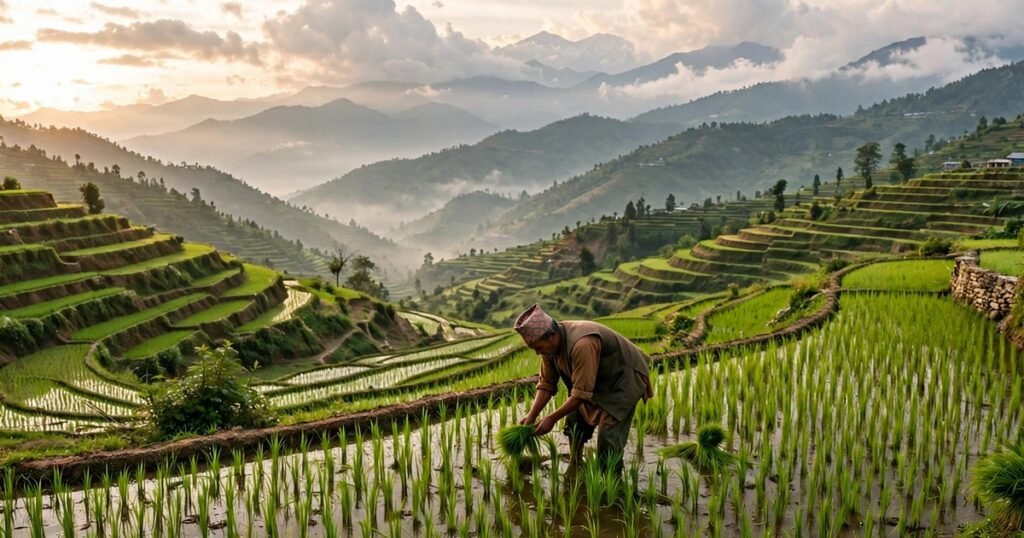
Nepal agriculture explained in plain language: it is still the country’s biggest employer and about a quarter of the entire economy — yet most of the people who work in it farm tiny plots of land, depend on the monsoon for water, and earn far less than workers in any other sector. Nepal calls itself an agricultural country, and the numbers still support that claim. But the sector is shrinking as a share of the economy, the average farm keeps getting smaller, and the country that grows rice on more than a million hectares still has to import about a million tonnes of it every year. This article explains what Nepal’s farmers grow, who they are, how the system around them works, and why farming matters far beyond the fields.
Table of Contents
Nepal agriculture explained: how big is the sector
Nepal agriculture explained: what farmers grow
Nepal agriculture explained: who does the farming
Nepal agriculture explained: water, the monsoon, and irrigation
Nepal agriculture explained: fertiliser, prices, and the budget
Nepal agriculture explained: why Nepal still imports so much food
Nepal agriculture explained: what the government is trying
Nepal agriculture explained: what could change
Frequently asked questions
Sources
Table of Contents
Nepal Agriculture Explained: How Big Is the Sector
Agriculture contributed about 24 percent of Nepal’s gross domestic product in fiscal year 2025/26, according to the Economic Survey 2082/83 presented to Parliament by the Ministry of Finance. That is down slightly from 24.5 percent the year before, and far below the 48 percent share agriculture held in 1990/91. The rest of the economy — services at about 62 percent and industry at about 14 percent — has grown faster. But agriculture still matters more than its GDP share suggests, because it is where most Nepalis work.
The sector grew by only 1.58 percent in fiscal year 2025/26, down sharply from 3.05 percent the year before. The Economic Survey blames drought and unseasonal rain during key farming periods. When the rains fail or arrive at the wrong time, the whole economy feels it: overall economic growth for the year is projected at 3.85 percent, on an economy of about Rs 6.61 trillion. A bad harvest does not just hurt farmers. It pushes up food prices, which is why the price of rice, vegetables, and cooking oil shows up so quickly in Nepal’s inflation numbers.
The other way to see the size of the sector is through jobs. The National Statistics Office puts the share of the labour force engaged in agriculture at 50.1 percent, down from more than 75 percent in 1991. Other estimates, including those used by development agencies, put the figure closer to 60 percent. Either way, roughly half of all working Nepalis depend on farming for their living. That is the central fact of Nepal agriculture: a sector that produces a quarter of national output but employs about half the workforce. It is, by definition, a low-productivity sector — and that gap between its share of jobs and its share of output is the story of rural Nepal. Nepal agriculture explained this way is less about farming techniques and more about jobs: half the country works the land, and the land pays less than anything else.
For more on how the national economy is measured, see our explainer on how to read Nepal’s GDP.
Nepal Agriculture Explained: What Farmers Grow
Rice is Nepal’s most important crop, and paddy is the single biggest item in the farm economy. In fiscal year 2024/25, farmers produced a record 5.96 million tonnes of paddy from 1,420,636 hectares, at an average yield of 4.19 tonnes per hectare, according to the Ministry of Agriculture and Livestock Development. The next year was worse: preliminary estimates put fiscal year 2025/26 paddy output at about 5.7 million tonnes, down 4.2 percent, with yields slipping to 4.14 tonnes per hectare and the planted area shrinking to 1,376,872 hectares. Koshi Province grew the most paddy, about 1.4 million tonnes.
After paddy, the big three staples are maize, wheat, and potato. In fiscal year 2024/25, Nepal produced 3.28 million tonnes of maize, 2.06 million tonnes of wheat, and 3.68 million tonnes of potato. Vegetables are now a major crop in their own right, at 4.57 million tonnes in the same year. Together, the six main cereals — paddy, maize, wheat, millet, barley, and buckwheat — totalled 11.61 million tonnes in fiscal year 2024/25.
Where crops grow follows Nepal’s geography, and Nepal agriculture explained through its crops is really a map of the country. Paddy dominates the flat Terai, where most of the country’s rice is grown, and the fertile valleys of the hills. Maize is the hill crop, grown on steep terraces where paddy cannot survive. Wheat is the winter crop, planted after the paddy harvest. Potatoes grow best in the high hills and mountains, where they are a staple food as well as a cash crop. And in the eastern hills, cash crops such as large cardamom, tea, and ginger earn money that food grains cannot — cardamom in particular is one of Nepal’s best-known agricultural exports.
The pattern matters because it decides who eats what. Rice is the food Nepalis eat most: the National Statistics Office’s Household Consumption Survey puts average per-capita rice consumption at 131 kilograms a year. At that rate, the country needs roughly 4.1 to 4.2 million tonnes of milled rice a year. Domestic production, after milling, falls short by about a million tonnes. That shortfall is the reason Nepal imports rice, and it is the reason the price of rice in Kathmandu depends on harvests and border trade as much as on anything farmers do.
Nepal Agriculture Explained: Who Does the Farming
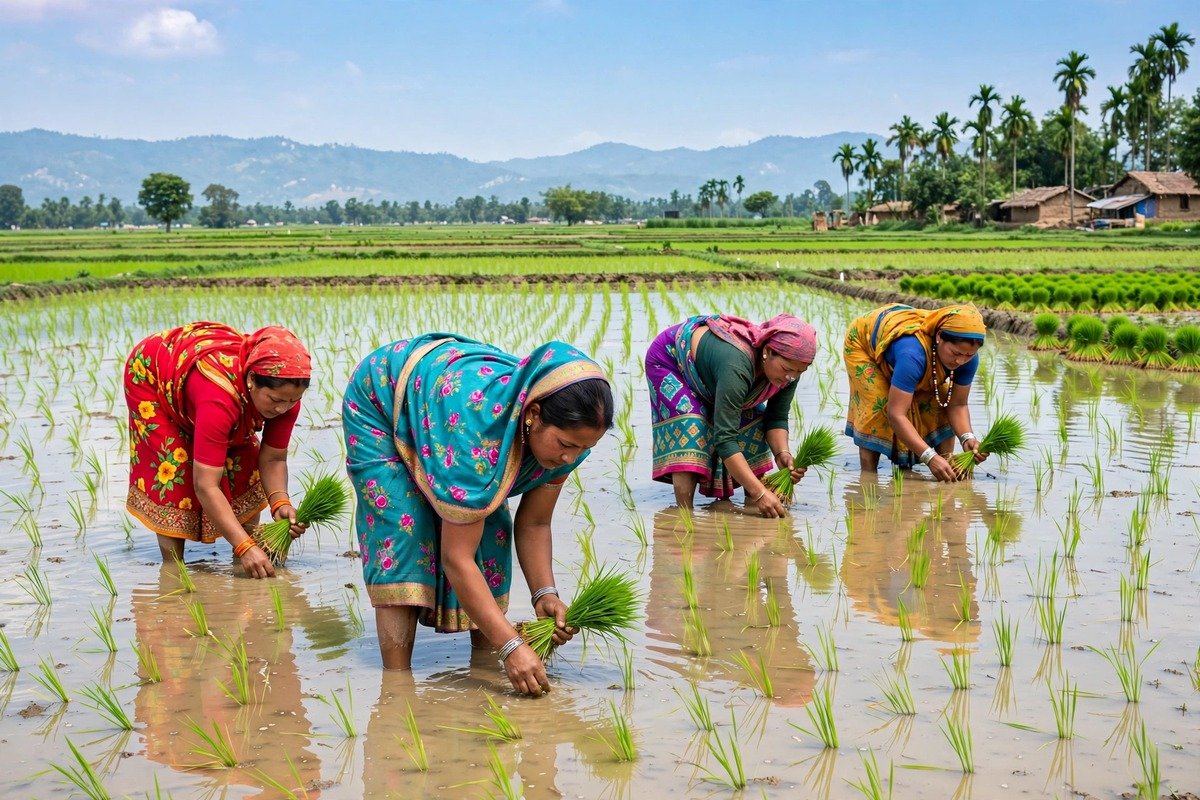
Nepal’s farmers are mostly smallholders, and Nepal agriculture explained through its people is a story of shrinking plots and absent men. The National Sample Census of Agriculture 2021/22 counted 4,130,789 farm holdings working 2,218,410 hectares of land. That works out to an average holding of about 0.54 hectares — roughly one bigha in the Terai, or about ten ropani in the hills. A decade earlier, the average holding was 0.68 hectares. Farms are getting smaller because land is divided between children in every generation, and because farmland is being lost to housing plots around towns.
Six in ten households in Nepal — 62 percent — are farmer households, down from 71 percent in the previous census. But farming is no longer the only income for most of them. Only 70.4 percent of farmer households say agriculture is their main source of income, down from 83.1 percent a decade earlier. A quarter of farming families now earn money from something else as well. That something else is usually a family member working abroad: remittances have become the second income of rural Nepal, and our explainer on remittance in Nepal covers how that money flows.
Women do most of the farm work. With so many men working abroad or in towns, women now make up more than 60 percent of the agricultural workforce, doing the planting, weeding, harvesting, and livestock care. This “feminisation” of agriculture is one of the biggest changes in rural Nepal, and it has a practical consequence: agricultural programmes designed for a male farmer often reach the wrong person, because the person actually working the field is a woman who may not hold the land title or the bank account.
Mechanisation is arriving, but slowly. The agricultural census found 1,639,000 farmers using tractors for farm work, nearly double the 845,000 of a decade earlier. Power tillers and threshers are now common in the Terai, where flat land suits machines. In the hills, where terraces are narrow and steep, most work is still done by hand and by oxen. The result is a sector split in two: commercial pockets that use machines, improved seed, and fertiliser, and a much larger subsistence majority that grows mainly to feed its own family.
Nepal Agriculture Explained: Water, the Monsoon, and Irrigation
Nepal has more water than almost any country its size, and yet most of its farmers still wait for the rain. Nepal agriculture explained through water is a paradox: a country of rivers where most fields are dry for half the year. The monsoon, which runs from June to September, decides the paddy crop. A late monsoon delays transplanting; a dry spell in the middle of the season stunts the plants; unseasonal rain at harvest time ruins the grain. The Economic Survey’s explanation for the 2025/26 slowdown — drought and unseasonal rain — is the same explanation farmers have given for generations.
Irrigation is the obvious fix, and it has expanded, but not far enough. The Department of Irrigation and Water Resources reports that irrigation infrastructure now covers 1.59 million hectares, or 62.68 percent, of the country’s 2.53 million hectares of land that needs regular irrigation. Nepal has about 3.56 million hectares of cultivable land in total. The agricultural census gives a more modest picture from the farmer’s side: irrigation is used on 1,209,265 hectares, or 54.5 percent of the land held by farm families. Either way, roughly four in ten hectares of farmland still have no irrigation at all.
The gap matters because irrigation is what turns farming from a gamble into a business. With reliable water, a farmer can grow a second crop in winter — wheat, or vegetables — instead of leaving the field empty. Without it, the land produces one crop a year and the family depends on a single monsoon. That is why the government keeps announcing irrigation projects, and why farmers keep asking when the canal will actually reach their field.
Nepal Agriculture Explained: Fertiliser, Prices, and the Budget
Fertiliser is the most politically sensitive input in Nepali farming, and Nepal agriculture explained through its inputs is a story of subsidies and shortages. Nepal does not manufacture chemical fertiliser, so every bag of urea and DAP is imported, mostly through India and the Middle East. Annual demand is around 700,000 tonnes. The government buys it at world prices and sells it to farmers at a heavily subsidised rate: urea costs the government about Rs 84 per kilogram and is sold to farmers for about Rs 15, while DAP costs about Rs 129 per kilogram and is sold for about Rs 44.
The subsidy is one of the largest single items in the agriculture budget. For fiscal year 2025/26, the government allocated Rs 28.82 billion to buy 550,000 tonnes of chemical fertiliser. For fiscal year 2083/84, the allocation rises to Rs 32.36 billion. Total spending on agriculture and livestock development in the fiscal year 2083/84 budget is Rs 46.92 billion — about 2.2 percent of the total budget of Rs 2,124.34 billion. That gap, between a sector that employs half the workforce and receives about two percent of public spending, is a regular complaint in farm politics.
Shortages are the other recurring problem. Because the government is the only legal importer of subsidised fertiliser, a delayed tender or a cancelled shipment means farmers queue at cooperatives and depots during planting season. In fiscal year 2025/26, global price rises cut the government’s purchasing power, and tens of thousands of tonnes of contracted fertiliser were stalled by supply disruptions. The ministry has responded with a subsidised fertiliser distribution information system to track quotas and stop diversion, and with a government-to-government purchase of 80,000 tonnes from India. But the underlying problem remains: Nepal’s fertiliser supply depends on world prices and foreign suppliers, and the subsidy bill grows every year.
Prices for what farmers sell are set, in theory, by the government as well. The minimum support price for monsoon paddy in fiscal year 2025/26 is Rs 3,660 per quintal for coarse paddy and Rs 3,860 for medium-grade paddy. Spring paddy has a support price of Rs 2,866.41 per quintal, and wheat Rs 3,945 per quintal. The government planned to buy 15,000 tonnes of paddy at the support price this year, for Rs 675 million. In practice, procurement starts late and covers only a fraction of the harvest, so many farmers sell to traders at Rs 2,500 to Rs 2,900 per quintal — well below the official floor price. The support price exists on paper; the market price is what farmers actually receive.
Nepal Agriculture Explained: Why Nepal Still Imports So Much Food
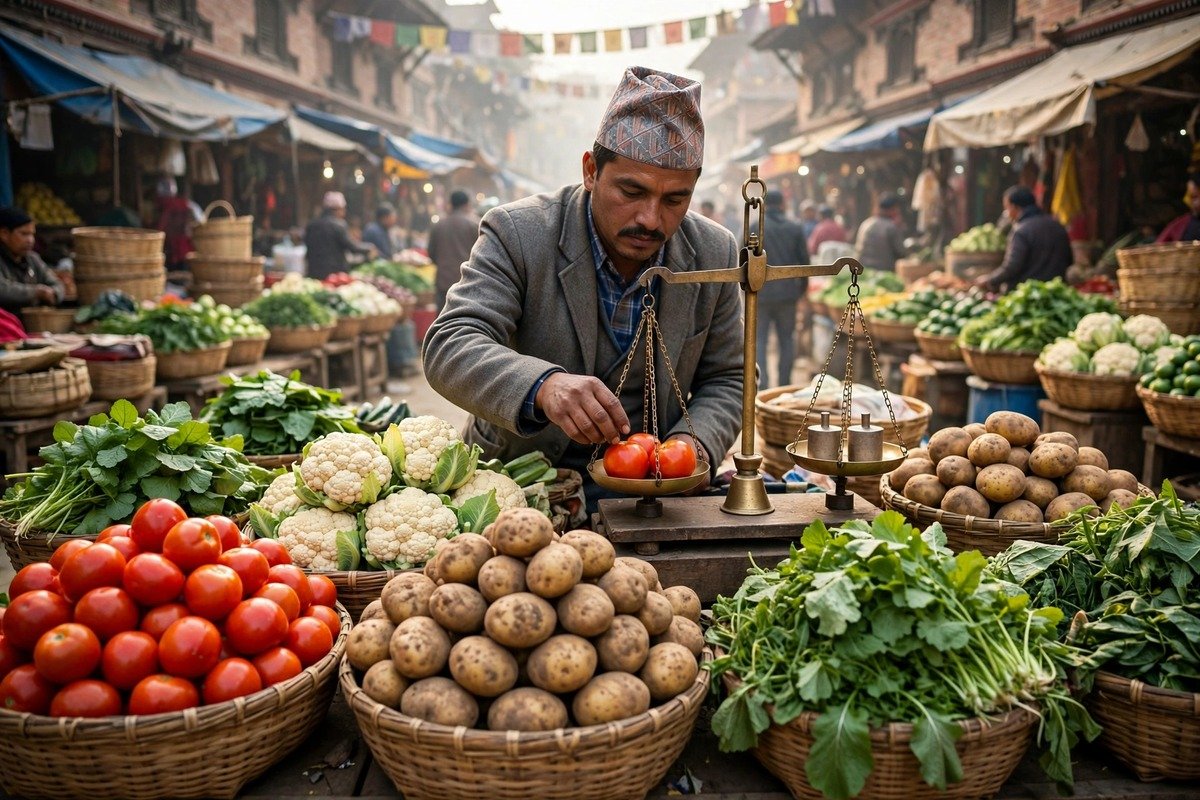
Nepal grows a lot of food and still imports a lot of food, and Nepal agriculture explained through its imports shows why. In the first ten months of fiscal year 2025/26, Nepal imported paddy and rice worth Rs 35.53 billion. The country is not self-sufficient in its staple food, and the shortfall of about a million tonnes of rice a year is only the most visible part of the gap. Nepal also imports maize for animal feed, wheat, edible oil, and large quantities of vegetables and fruit from India.
There are three reasons. First, production is not keeping up with demand. The population has grown, diets have shifted towards more rice and more processed food, and paddy area is shrinking as farmland is converted to housing. Second, productivity is low. Nepal’s paddy yield of about 4.14 tonnes per hectare is below the levels achieved in countries with similar conditions, because of small plots, limited irrigation, and late or insufficient fertiliser. Third, the marketing chain is weak: even when farmers produce a surplus, getting it to market at a fair price is hard, so traders import instead.
The result is a food system that depends on the open border with India. When India restricts rice exports, as it has done in recent years, prices in Nepal rise within weeks. Food security in Nepal is therefore not only a farming question but a trade question — which is why the government has made rice self-sufficiency an explicit goal, and why the budget for fiscal year 2025/26 included a programme to add 1.2 million tonnes of spring paddy in 22 districts of the Terai and Inner Madhesh, with Rs 330 million allocated.
For the other side of this story — what food actually costs the people who buy it — see our explainer on the food price puzzle: why farmers still earn so little.
Nepal Agriculture Explained: What the Government Is Trying
The government’s long-term plan for the sector is the Agriculture Development Strategy, a twenty-year framework running from 2015 to 2035 that aims to raise productivity, commercialise farming, and improve food security. Nepal agriculture explained through its policies is a long list of plans whose results arrive slowly. Its main delivery vehicle is the Prime Minister Agriculture Modernization Project, which sets up “super zones”, zones, blocks, and pockets for specific crops and livestock — areas where the government concentrates subsidies, technical support, and infrastructure on a single product, such as citrus in the hills or fish in the Terai.
More recent measures are practical rather than strategic. The spring paddy programme is one. Agricultural insurance has been expanded, with the government subsidising most of the premium, so that a failed crop does not wipe out a farming family. The minimum support price system, imperfect as it is, gives farmers a floor to bargain against. And the fertiliser distribution system is meant to make the subsidy reach the farmer instead of the black market.
None of this has yet changed the basic numbers. Agriculture’s share of GDP keeps falling, the average farm keeps shrinking, and the food import bill keeps growing. The official target — self-sufficiency in rice, and eventually in other staples — is still a goal rather than a fact. What has changed is the direction of policy: from treating agriculture as a subsistence safety net to treating it as a business that should pay. Whether that shift reaches the small farmer with half a hectare and no irrigation is the open question.
Nepal Agriculture Explained: What Could Change
Three changes would matter more than any single programme. The first is water: completing irrigation on the remaining four-tenths of farmland would let millions of farmers grow two crops a year instead of one. The second is land: slowing the fragmentation of holdings, and making it easier for farmers to lease or consolidate land, would let machines and commercial farming reach more of the country. The third is markets: reliable procurement at the support price, cold storage for vegetables, and collection centres near farms would let farmers sell what they grow at a fair price instead of watching traders import the same goods.
None of these is quick or cheap. But the stakes are high. About half of Nepal’s workers still depend on farming, and the national poverty rate — 20.27 percent, according to the National Statistics Office — is concentrated in rural areas. When agriculture grows slowly, as it did at 1.58 percent in fiscal year 2025/26, the whole country grows slowly, and the poorest Nepalis feel it first. Nepal agriculture explained in one sentence is this: a sector that feeds the country, employs half of it, and still waits for the rain.
Frequently Asked Questions
How much of Nepal’s GDP comes from agriculture?
About 24 percent in fiscal year 2025/26, according to the Economic Survey 2082/83. The share has fallen steadily from 48 percent in 1990/91 as services and industry have grown faster.
What is Nepal’s main crop?
Paddy, or rice. Nepal produced a record 5.96 million tonnes of paddy in fiscal year 2024/25. Maize (3.28 million tonnes) and wheat (2.06 million tonnes) are the next biggest food crops.
Is Nepal self-sufficient in rice?
No. Nepal needs roughly 4.1 to 4.2 million tonnes of milled rice a year and falls short by about a million tonnes, which it imports — mostly from India. In the first ten months of fiscal year 2025/26, paddy and rice imports were worth Rs 35.53 billion.
How much land does the average Nepali farmer own?
About 0.54 hectares, according to the National Sample Census of Agriculture 2021/22, which counted 4,130,789 farm holdings on 2,218,410 hectares. The average holding was 0.68 hectares a decade earlier.
How much of Nepal’s farmland is irrigated?
Irrigation infrastructure covers 1.59 million hectares, or 62.68 percent, of the 2.53 million hectares that need regular irrigation, according to the Department of Irrigation and Water Resources. The agricultural census found irrigation actually used on 54.5 percent of farm families’ land.
What is the minimum support price for paddy in Nepal?
For fiscal year 2025/26, the minimum support price for monsoon paddy is Rs 3,660 per quintal for coarse paddy and Rs 3,860 for medium-grade paddy. In practice, many farmers sell below these prices because government procurement starts late and covers only part of the harvest.
Why do Nepali farmers struggle to get fertiliser on time?
Nepal imports all its chemical fertiliser, and the government is the only importer of the subsidised supply. Delayed tenders, rising world prices, and supply disruptions can leave depots empty during planting season, even though the fertiliser is sold to farmers at a fraction of its cost.
Sources
- Ministry of Finance, Government of Nepal — Economic Survey 2082/83 (fiscal year 2025/26): agriculture 24 percent of GDP, growth 1.58 percent, economy Rs 6.609 trillion. mof.gov.np
- Ministry of Agriculture and Livestock Development — Statistical Information on Nepalese Agriculture 2081/82 (2024/25): paddy 5,955,476 tonnes, maize 3,275,592 tonnes, wheat 2,055,811 tonnes, vegetables 4.57 million tonnes, potato 3,681,517 tonnes.
- Ministry of Agriculture and Livestock Development — preliminary estimates for fiscal year 2025/26: paddy about 5.7 million tonnes, down 4.2 percent; yield 4.14 tonnes per hectare.
- National Statistics Office — Nepal in Figures 2026: agriculture employs 50.1 percent of the labour force; poverty headcount 20.27 percent; agriculture 24.03 percent of GDP.
- National Statistics Office — National Sample Census of Agriculture 2021/22: 4,130,789 farm holdings, 2,218,410 hectares, 62 percent of households are farmer households, irrigation on 54.5 percent of holding land, 70.4 percent of farmer households rely mainly on agriculture.
- National Statistics Office — Household Consumption Survey: average per-capita rice consumption 131 kilograms per year.
- Department of Irrigation and Water Resources — irrigation covers 1.59 million hectares, 62.68 percent of 2.53 million hectares of irrigable land; cultivable land 3.56 million hectares.
- Budget Speech, fiscal year 2083/84 (Finance Minister Swarnim Wagle): agriculture and livestock Rs 46.92 billion; chemical fertiliser Rs 32.36 billion; total budget Rs 2,124.34 billion.
- Ministry of Agriculture and Livestock Development / My Republica — minimum support prices for fiscal year 2025/26: coarse paddy Rs 3,660, medium paddy Rs 3,860, spring paddy Rs 2,866.41, wheat Rs 3,945 per quintal; government procurement 15,000 tonnes for Rs 675 million.
- My Republica — Nepal imported paddy and rice worth Rs 35.53 billion in the first ten months of fiscal year 2025/26; spring paddy programme targeting 1.2 million additional tonnes in 22 districts, Rs 330 million allocated.