


Nepal driving licence explained in plain language: it is the smart card the Department of Transport Management (DoTM) issues after you apply online, pass a written test and a practical trial — and since August 2025, it is valid for ten years, not five. Getting one is no longer a matter of queuing with paper forms. You apply through an online portal, book an appointment, give your biometrics at a transport office, and sit two exams. This is the Nepal driving licence explained in full: which category you need, how to apply, what the tests ask, what it costs, and how renewal works — including the fines that apply if you let it expire.
Table of Contents
- Nepal driving licence explained: the categories and who can apply
- Nepal driving licence explained: how to apply online, step by step
- Nepal driving licence explained: the written test
- Nepal driving licence explained: the trial (practical) test
- Nepal driving licence explained: what it costs
- Nepal driving licence explained: the smart card and the 10-year validity
- Nepal driving licence explained: renewal, late fines, and cancellation
- Nepal driving licence explained: driving without a licence
- Frequently asked questions
- Sources
Nepal driving licence explained: the categories and who can apply
Nepal driving licence explained from the start means choosing the right category, because the licence you get only covers the vehicles in that category. The categories are set by the Department of Transport Management, and the minimum age rises with the size of the vehicle.
| Category | Vehicles | Minimum age |
|---|---|---|
| A / K | Motorcycle, scooter, moped | 16 years |
| B | Car, jeep, delivery van | 18 years |
| C | Tempo, auto-rickshaw | 21 years |
| D | Power tiller | 21 years |
| E | Tractor | 21 years |
| H | Road roller, dozer | 21 years |
Heavier categories, from F to J, cover minibuses, trucks, buses and construction machines, and also carry a minimum age of 21. Several categories can be endorsed on the same smart card, so a driver who later wants to drive a car as well as a motorcycle adds Category B to the card they already hold. If you already hold a heavier category and want to add another one, you must sit the written exam again.
Who can apply is simple: you must be a Nepali citizen, meet the minimum age for the category, and be medically fit to drive. Offices commonly ask for proof of schooling — a Class 8 pass certificate is the usual document — and you will need your citizenship certificate and your National ID number. Since 1 Shrawan 2083 (17 July 2026), the National ID has been compulsory for a new licence application, and you must sign up with a mobile number registered in your own name. Our full explainer on the National ID card covers how to get one and where it is now required.
Nepal driving licence explained: how to apply online, step by step
Nepal driving licence explained as a process has two halves: the online part, which you do from home, and the in-person part, which happens at a transport management office. There are around 40 such offices across the country, from Ekantakuna, Chabahil, Thulobharyang and Radhe Radhe in the Kathmandu Valley to Pokhara, Biratnagar, Birgunj, Butwal, Nepalgunj and Dhangadhi.
Step 1: Apply on the portal. Go to the official DoTM portal — this is the only official site, and you should avoid third-party sites that charge to fill in the form for you. Since 1 Shrawan 2083, licence services have moved from one national website to seven provincial portals under the Electronic Driving Licence and Vehicle Registration System (EDL-VRS), so the portal will direct you to your province’s system. Create an account with your mobile number, fill in your details, upload a scanned copy of your citizenship certificate, and select the category and the transport office you want. New application forms open on a 16-day cycle, at 7am, and stay open for up to seven days or until the category quota for that office runs out — so the form is not always open, and popular offices fill up fast.
Step 2: Book an appointment. Choose a date to visit the transport office for biometrics and document verification. You will need your original citizenship certificate: our explainer on Nepali citizenship covers the certificate itself and how it is issued.
Step 3: Biometric day. At the office, your documents are verified against your citizenship certificate, and your fingerprint, photo and digital signature are recorded. You also take a short medical and eyesight test, including a colour-blindness check, and pay the fee, which covers the written test and one trial attempt. Once that is done, you receive your written-exam admit card.
Step 4: Sit the exams. The written test comes first, then the trial. Both are described in detail below.
Step 5: Collect the card. Once you have passed the trial and paid the licence fee, your smart card is produced at the secure printing centre and issued to you. The revenue receipt you are given in the meantime works as your legal proof of licence while the card is being printed, and a digital version of the licence is also available in the Nagarik App.
Honestly, the system cannot do everything. No website or agent can get you a licence without the trial — advertisements promising a licence “in two days, no trial” are scams. Every applicant must pass the written test and the trial in person.
Nepal driving licence explained: the written test
Nepal driving licence explained through the written test — the likhit — starts with the format. It is a computer-based test of 25 multiple-choice questions, to be finished in 30 minutes, and you can take it in Nepali or English. The questions cover traffic signs and road markings, right-of-way rules, overtaking and speed limits, penalties, and safe-driving basics. The Department of Transport Management publishes an official question bank — reported to hold 500 questions — and the test questions are drawn from it, so studying the bank directly is the most useful preparation.
The pass mark is set by each province’s directive. In Bagmati Province, you need 13 correct answers out of 25 to pass. Other provinces use their own pass marks, so check the figure on your admit card or at your office rather than assuming Bagmati’s number applies everywhere.
If you fail the written test, you may retake it after a short waiting period set by your province — commonly around ten days. You do not have to repeat the biometric and document steps to retake it. Once you pass, you move on to the trial, and you do not have to sit the written test again if you fail the trial.
Nepal driving licence explained: the trial (practical) test
Nepal driving licence explained through the trial is where most applicants fail, and it is scored, not simply passed or failed on a single mistake. In Bagmati Province, the trial is scored out of 100 marks, and you need 70 marks to pass. Other provinces set their own pass marks.
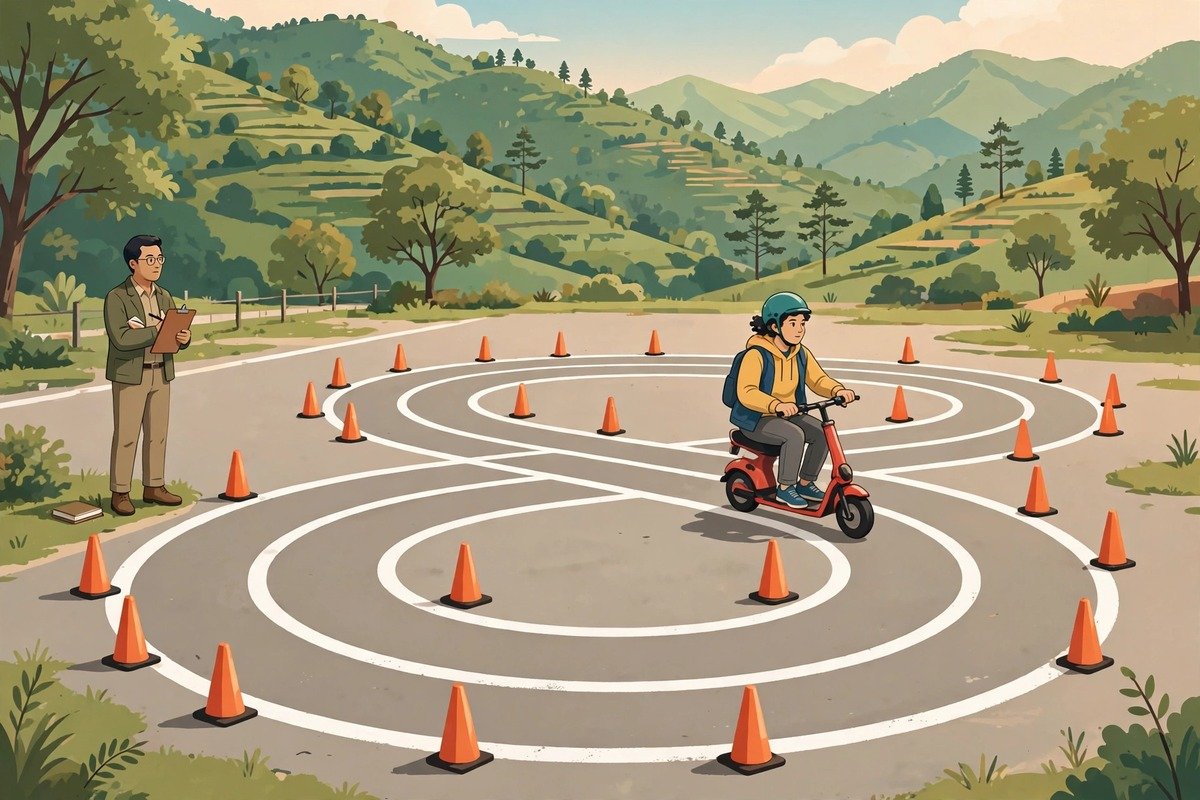
For a two-wheeler (Category A), the trial tests seven things: the figure-of-eight track, the uphill climb, following traffic signals, riding over bumps, balancing on the narrow plank, the U-turn, and your overall behaviour. In Bagmati’s marking scheme, the figure-of-eight is worth 20 marks and the uphill 20, signals 15 and bumps 15, the narrow plank 10 and the U-turn 10, and overall behaviour 10. Marks are lost for specific mistakes — putting a foot down on the figure-of-eight, stalling on the slope, or running a signal, for example.
For a four-wheeler (Category B), the trial covers the figure-of-eight, L-shape and U-turn tracks, uphill and downhill driving, parking, reversing, and signalling. As with two-wheelers, the test is scored out of 100 in Bagmati, with 70 needed to pass.
If you fail the trial, you may take a retrial up to three times within 90 days of your first failed attempt. After that, you must start the process again. The most common reason for failing is the figure-of-eight: it looks easy and it is not, so practice it — slowly, with your eyes up — before your trial date.
Nepal driving licence explained: what it costs
Nepal driving licence explained through the fees needs one warning first: fees are now set by the provinces, not by Kathmandu, so the amount you pay depends on where you apply. The figures below are for Bagmati Province, which roughly doubled its licence fees on 17 July 2026 (1 Shrawan 2083), when the new provincial system began. Other provinces have their own rates under their provincial finance laws, so confirm the current amount on the portal or at your office before you pay.
| Stage | Category A (motorcycle/scooter) | Category B (car/jeep/van) |
|---|---|---|
| New licence fee | Rs 3,000 | Rs 4,000 |
| Renewal fee | Rs 3,000 | Rs 4,000 |
| Application fee (new licence) | Rs 1,000 | Rs 1,000 |
Before the July 2026 change, the renewal fees were Rs 1,500 for Category A and Rs 2,000 for Category B, so the doubling is real — and because the late-renewal fine is calculated as a percentage of the renewal fee, the fine doubled too. Medium and heavy vehicle categories cost more than cars, and small extra charges apply along the way: a medical and eye-test fee at the office, and the cost of the smart card itself, which is printed at the secure centre. Fees can be paid online through Connect IPS, eSewa or Khalti, or at bank counters — keep the receipt for every DoTM visit, because the receipt is your proof until the card arrives.
Nepal driving licence explained: the smart card and the 10-year validity
Nepal driving licence explained as a card: the modern licence is a smart card, not the old paper booklet. It carries your identity, your photo, the categories you hold, and a QR code that lets traffic police verify it digitally. The card is printed at a secure centre after you pass, which is why there is a wait between passing the trial and holding the card — the revenue receipt and the Nagarik App digital licence cover you in between.
The biggest recent change to the Nepal driving licence is how long it lasts. In August 2025, the government amended the Motor Vehicles and Transport Management Act, 2049, replacing “five years” with “ten years” in Section 54(3) for new licences and Section 56(3) for renewals. The amendment was published in the Nepal Gazette on 1 August 2025, and it applies to both newly issued and renewed licences. So a licence issued or renewed today is valid for ten years from the date of issue.
Two things to note. First, if your card was issued before the change, the expiry date printed on it still governs — it does not automatically extend to ten years. Check the date on your own card. Second, drivers over the age of 60 are reported to stay on a five-year cycle, though this has not been clearly confirmed in the current rules — if you are in that age group, confirm your exact validity at the transport office rather than assuming ten years.
Nepal driving licence explained: renewal, late fines, and cancellation
Nepal driving licence explained through renewal is mostly about one date: the expiry date printed on your card. You can apply for renewal up to 90 days before that date, and you should — the renewal is a short process, and doing it early costs nothing extra.
After the expiry date, you get a 90-day grace period. Renew inside those 90 days and you pay only the normal renewal fee, with no fine. The clock starts on the expiry date printed on your card, not on the day you notice it expired — the most common and most expensive misunderstanding in the whole system.
Once the 90 days are over, a percentage fine applies, and it grows every year:
| Time since expiry | Extra charge | Total you pay |
|---|---|---|
| Within 90 days | None | 1× the renewal fee |
| 91 days to 1 year | +100% of the fee | 2× the fee |
| 1 to 2 years | +200% | 3× the fee |
| 2 to 3 years | +300% | 4× the fee |
| 3 to 4 years | +400% | 5× the fee |
| 4 to 5 years | +500% | 6× the fee |
| More than 5 years | Renewal not possible | Licence cancelled |
So a Category A renewal that costs Rs 3,000 on time costs Rs 6,000 if you are a year late, and Rs 18,000 at four to five years late. After five years, the licence is cancelled automatically in the central database, and you start again from scratch — written exam and trial included. The law makes no exception for portal downtime or office closures, so the fine applies even when the system itself was down.
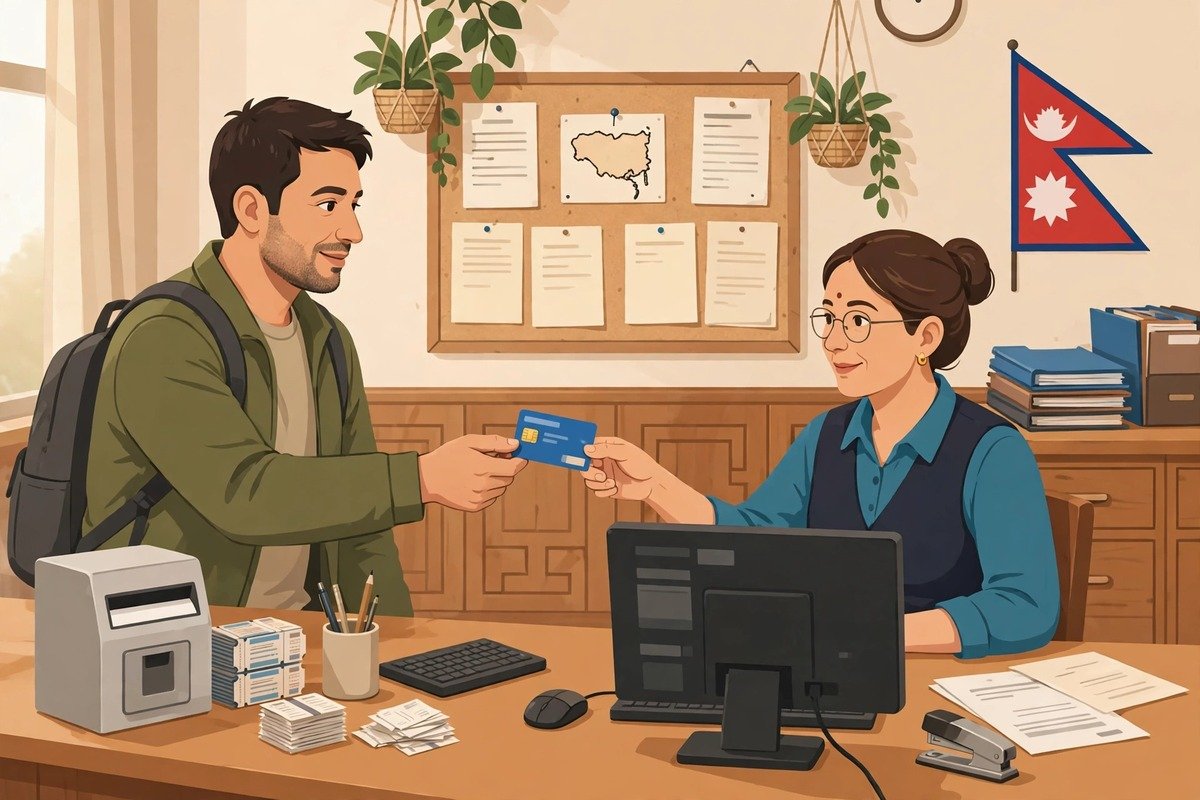
Renewal itself follows the same portal: book an appointment on the DoTM portal, visit the office with your original citizenship certificate and your old licence (or the revenue bill, if you never received the card), take the medical and eye test, give your biometrics again, and pay. The stamped revenue receipt you receive is legally valid as your driving authorisation while the new card is being printed.
Nepal driving licence explained: driving without a licence
Nepal driving licence explained through the penalties is the part nobody wants to need. Driving without ever having obtained a licence carries a fine of up to Rs 2,000 under Section 45 of the Motor Vehicles and Transport Management Act, and the vehicle may be detained. Driving without carrying your licence when you do hold one is a different offence, fined under the repeat-offence structure of Section 164(1): Rs 500 for a first offence, Rs 1,000 for a second, and up to Rs 1,500 for a third or later offence. Most on-the-spot fines can be paid through the Nagarik App’s e-challan system.
The consequences go beyond the fine. If you are in an accident while driving without a licence, your insurance will not pay out. Repeat offences can lead to a court case, and in serious cases a jail sentence. And a draft bill now under public consultation proposes much higher fines — up to Rs 100,000 for some offences — but it is still a draft, not law, and the fines above are the ones that can actually be enforced today.
Frequently asked questions
How long is a Nepal driving licence valid for?
Nepal driving licence explained on validity: new and renewed licences are valid for ten years, after the Motor Vehicles and Transport Management Act was amended in August 2025. Licences issued before the change keep the expiry date printed on the card.
What is the minimum age for a driving licence in Nepal?
16 years for a motorcycle or scooter (Category A/K), 18 years for a car, jeep or van (Category B), and 21 years for tempos, power tillers, tractors, and all heavier categories.
How many questions are in the written test, and what is the pass mark?
25 multiple-choice questions in 30 minutes, in Nepali or English. In Bagmati Province the pass mark is 13 correct answers; other provinces set their own pass marks.
What happens if I fail the trial test?
Nepal driving licence explained on retrials: you may take the trial again up to three times within 90 days of your first failed attempt. If you pass the written test but fail the trial, you do not have to sit the written test again.
How much does it cost to renew a driving licence in Nepal?
Nepal driving licence explained on renewal fees: in Bagmati Province, Rs 3,000 for a motorcycle or scooter and Rs 4,000 for a car, since the fees doubled on 17 July 2026. Other provinces set their own rates, so confirm the amount at your office before paying.
What happens if my licence expires and I do not renew it?
You have a 90-day grace period with no fine. After that, a fine of 100% of the renewal fee applies, rising by 100 percentage points each year to 500%. After five years the licence is cancelled automatically and you must reapply from the beginning.
Sources
- Department of Transport Management, online driving licence portal: https://applydlnew.dotm.gov.np/login
- “Driver’s license now valid for 10 years”, My Republica, 1 August 2025: https://myrepublica.nagariknetwork.com/amp/news/drivers-license-now-valid-for-10-years-81-28.html
- “Driving licenses will now come with 10-year validity”, Himal Press, 1 August 2025: https://en.himalpress.com/driving-licenses-will-now-come-with-10-year-validity/
- Motor Vehicles and Transport Management Act, 2049 (1993), Sections 45, 52, 54(3), 56(3) and 164(1)
- Nepal Police Traffic Directorate, published violation and fine schedule (via Merokalam, verified August 2026)
- Bagmati Province transport office notices and provincial Economic Act 2083, on the fee changes of 17 July 2026 (via Wilson Shrestha, September 2026)