

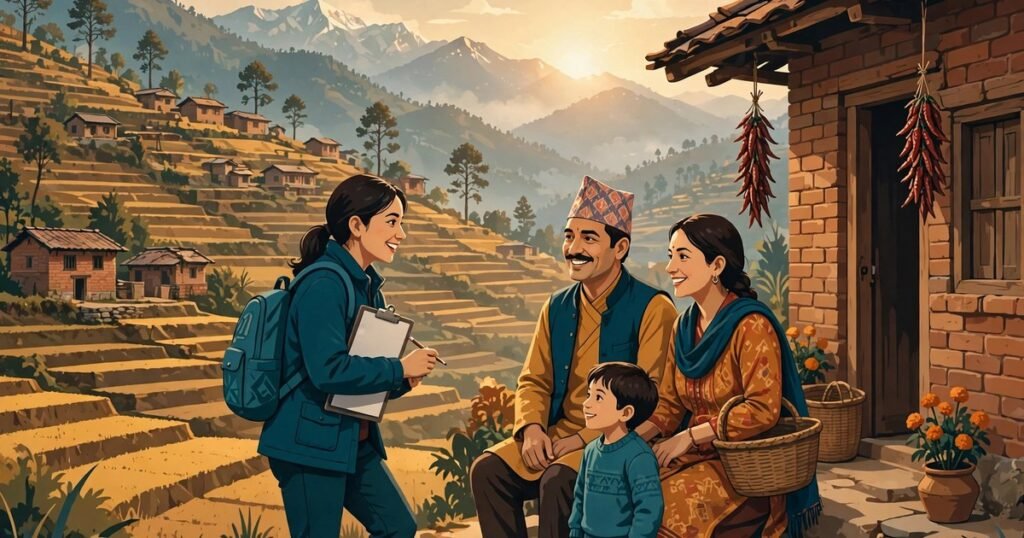
Nepal census explained: every ten years, Nepal counts every single person in the country — where they live, what language they speak, whether they can read, and whether a family member is working abroad. The last one, the National Population and Housing Census 2021, counted 29,164,578 people. It is the single most important source of facts about who Nepalis are, and almost every big decision — from how many seats each province gets in Parliament to where schools and hospitals are built — starts from its numbers.
Yet most of us never read the census. We hear a headline number, maybe argue about it for a day, and move on. This article explains, in plain language, what the Nepal census is, how it is done, what the 2021 census found, and why its results still matter in 2026.
Table of Contents
- What the Nepal census is
- How the Nepal census is done
- Nepal census 2021: the headline numbers
- What the Nepal census found about where people live
- What the Nepal census says about language, caste and religion
- Nepal census and migration: the 2.19 million abroad
- Why the Nepal census matters for policy
- What the Nepal census gets wrong
- When is the next Nepal census?
- Frequently asked questions
- Sources
Table of Contents
What the Nepal census is
A census is a complete count of a country’s population. Unlike a survey, which asks a sample of people and estimates the rest, the Nepal census tries to reach every household in the country. The National Statistics Office (NSO) — formerly the Central Bureau of Statistics — runs it under the National Planning Commission.
The census is not optional or occasional. Article 281 of the Constitution of Nepal requires a census every ten years. Nepal’s first census was held in 1911, and the 2021 count was the twelfth. The first modern, scientific census was in 1961; before that, early counts were mainly lists of property owners and buildings.
The 2021 census was historic in one more way: it was the first census held under Nepal’s federal system, covering all 7 provinces, 77 districts and 753 local levels. Earlier censuses were organised around the old zone-and-district structure, so the 2021 results are the first full population picture of the federal Nepal we live in today.
The census asks far more than “how many people are there?” Enumerators record age, sex, mother tongue, caste and ethnicity, religion, literacy, education, disability, marital status, occupation, housing conditions, access to water, electricity and toilets, and whether any family member is living abroad. That is why a single census produces dozens of reports — on population composition, migration, housing, disability and more.
How the Nepal census is done
The Nepal census is done in two phases, and both involve a person knocking on your door.
In the first phase, supervisors visit every home and fill in a household listing form: who lives there, how many rooms the house has, whether the family owns agricultural land, whether anyone has a bank account, and whether anyone has received technical or vocational training.
In the second phase, enumerators return with the main questionnaire and collect detailed information about every member of the household — demographic, educational, housing, economic, disability and reproductive health details. Ward offices also fill in a community questionnaire about local resources, infrastructure and disaster risk.
The 2021 census was originally scheduled for June 2021, but the COVID-19 pandemic forced a postponement. Enumeration finally took place from 11 to 25 November 2021, with 25 November 2021 as the reference day — meaning everyone was counted as they were on that date. The slogan for the count was “My Census, My Participation”. The final national report was released in March 2023, and detailed reports on caste, language and religion followed.
Counting nearly 30 million people across mountains, hills and plains is a huge logistical exercise, and it depends on tens of thousands of enumerators and supervisors, most of them hired temporarily and trained for a few weeks. That scale is part of why the census is both powerful and imperfect — a point we return to below.
Nepal census 2021: the headline numbers
The headline figure of the Nepal census 2021 is the population itself: 29,164,578 people — 14,253,551 men and 14,911,027 women. That is 2,670,074 more people than in the 2011 census, an increase of about 10% over the decade.
But the more important story is how slowly Nepal is now growing. The average annual population growth rate fell to 0.92%, down from 1.35% in 2011 and the lowest in recent censuses. Nepal’s fertility rate has fallen to 1.85 children per woman — below the replacement level of about 2.1 — which means that, without migration, the population would eventually start to shrink. Nepal is still growing, but the pace of growth has clearly turned.
Other headline figures from the Nepal census 2021:
- Sex ratio: 95.59 men for every 100 women. There are more women than men in Nepal, largely because so many working-age men are abroad.
- Households: 6,666,937, with an average household size of about 4.4 people.
- Population density: 198 people per square kilometre.
- Literacy rate: 76.2% of people aged 5 and above can read and write — 83.6% of men and 69.4% of women. The gender gap in literacy has narrowed, but it has not closed.
These are the numbers that newspapers quoted. The deeper story is in how the population is distributed — and who is missing from it.
What the Nepal census found about where people live
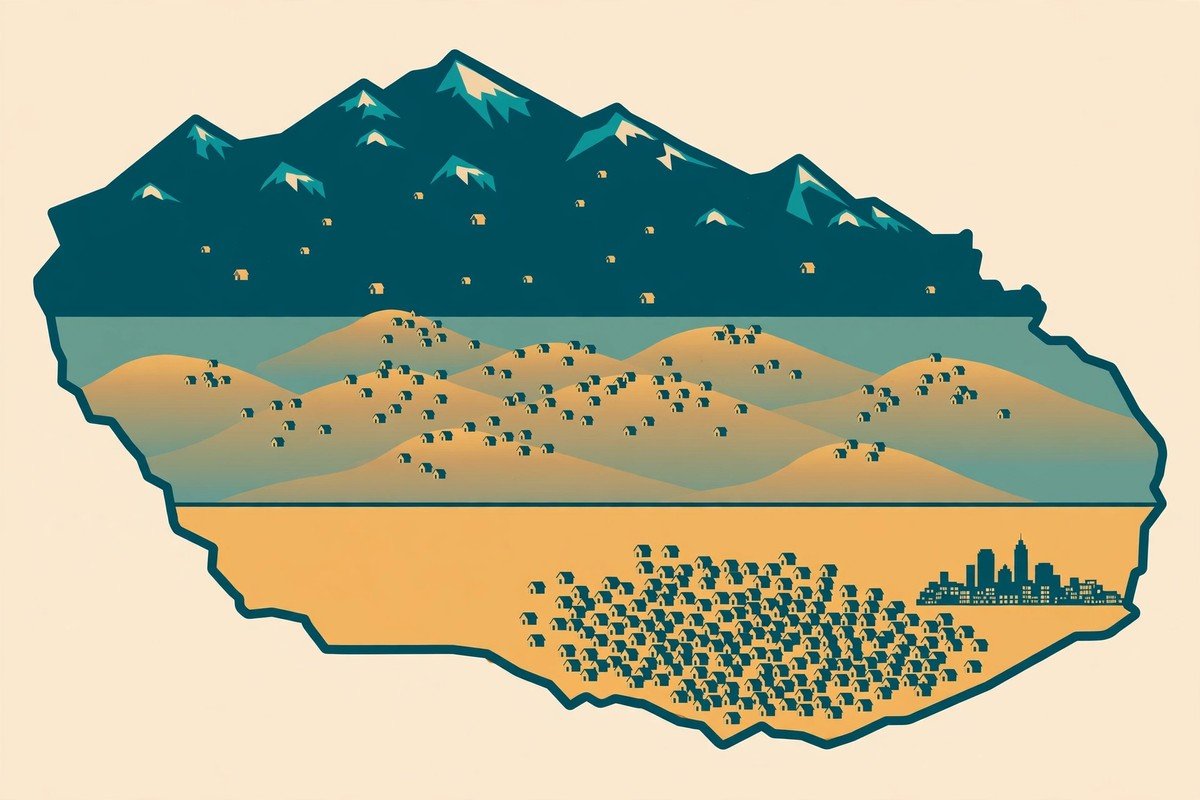
The Nepal census shows a country that has moved — from villages to towns, from hills to the Tarai, and from the mountains outward.
Two-thirds of the population, 66.17% (about 19.3 million people), now lives in urban municipalities, while 33.83% lives in rural municipalities. That does not mean two-thirds of Nepalis live in cities as we usually picture them: many “urban municipalities” in Nepal are still largely rural in character. But the direction is clear. Urban areas grew at 1.36% a year, while rural areas barely grew at all, at 0.11%.
By ecological belt, the Terai now holds more than half the country — 53.61% of the population (15.6 million people). The hills hold 40.31% (11.8 million), and the mountains just 6.08% (1.77 million). The mountain belt’s population is actually shrinking, at −0.05% a year, as people leave for the plains and the cities.
The provincial picture is close. Bagmati Province is the most populous, with 6,116,866 people (20.97%), just ahead of Madhesh Province with 6,114,600 (20.97%). Lumbini follows with 5,122,078, Koshi with 4,961,412, Sudurpashchim with 2,694,783, Gandaki with 2,466,427, and Karnali — the largest province by area — with the fewest people, 1,688,412.
At district level, Kathmandu is by far the most populous district, with 2,041,587 people and a density of 5,169 people per square kilometre. Manang, at the other end, has just 5,658 people. Bhaktapur grew fastest, at 3.35% a year, while Ramechhap shrank fastest, at −1.67% a year. More than 30 districts lost population between 2011 and 2021 — a fact that matters for everything from school planning to local budgets.
What the Nepal census says about language, caste and religion
The Nepal census is the only official count of Nepal’s diversity — and the 2021 census recorded more of it than ever before.
It counted 146 caste and ethnic groups, 17 of them recorded for the first time. The largest groups are Chhetri (16.45% of the population), Hill Brahmin (11.29%), Magar (6.9%), Tharu (6.2%) and Tamang (5.62%). It also counted 124 mother tongues, 13 of them new. Nepali is the mother tongue of 44.86% of the population (about 13.1 million people), followed by Maithili (11.05%), Bhojpuri (6.24%), Tharu (5.88%) and Tamang (4.88%).
On religion, the census found 81.19% Hindu, 8.21% Buddhist, 5.09% Muslim, 3.17% Kirat and 1.76% Christian. The 2021 census was also the first to recognise people of a third gender, giving them a separate category in the count.
These figures are politically sensitive — language and caste data feed into debates about representation, official languages and inclusion — which is also why they are among the most contested parts of the census. Some communities argued that enumerators did not properly ask about language and religion, a criticism discussed below.
Nepal census and migration: the 2.19 million abroad
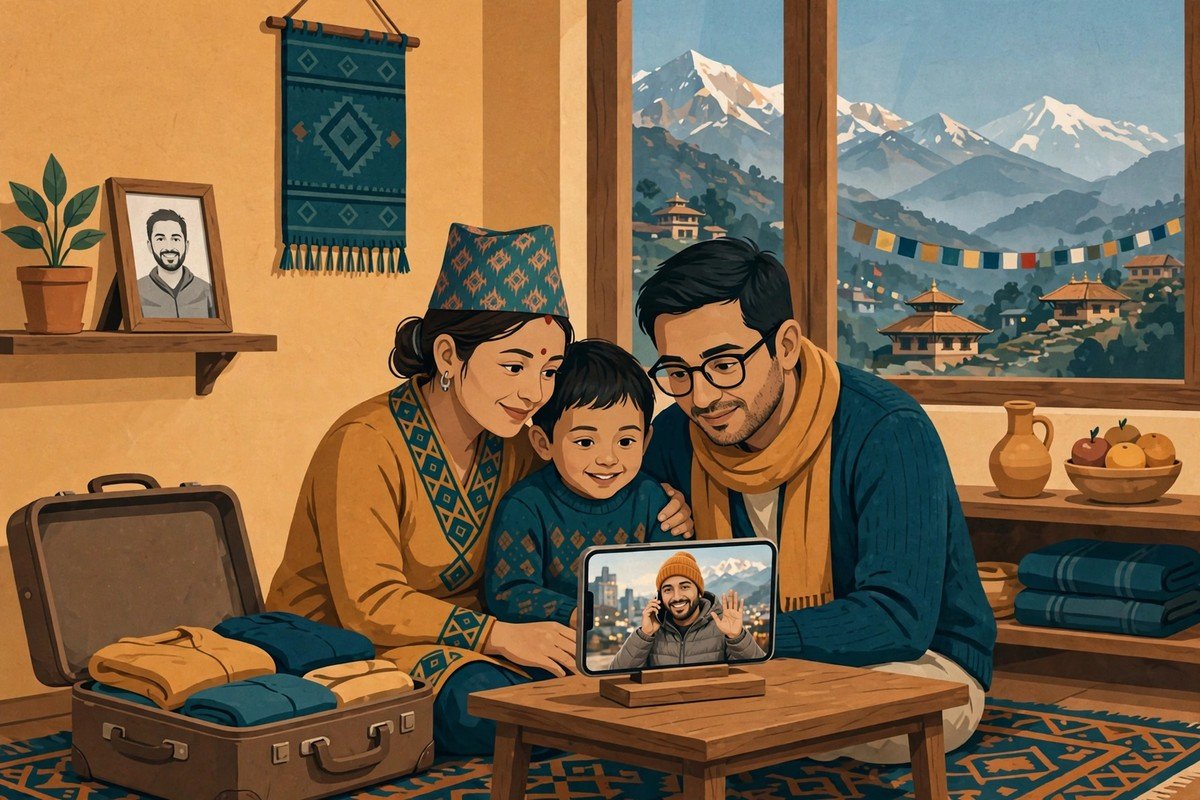
One of the most talked-about findings of the Nepal census is the absent population: 2,190,592 people — about 7.5% of the total population — were living abroad at the time of the census. They came from 1,555,961 families, meaning nearly a quarter of all households had at least one member abroad.
That is 269,098 more absentees than in 2011, when 1,921,494 people were abroad. Of the 2021 absentees, 1,799,675 were men (82.2%) and 390,917 were women (17.8%) — but the number of women abroad rose by 71% in a decade, one of the sharpest changes in the census.
Most absentees left for work. The census also records internal migration: about 10.8% of the population had moved from one local level to another, and 9.34 million people in total had migrated at some point — within Nepal or abroad.
This is the census figure that connects most directly to the rest of the economy. The same households that send members abroad receive remittances, and remittance now equals roughly a third of Nepal’s GDP. The census tells us who is leaving, from which districts, and in what numbers — the raw material for any honest conversation about migration policy. For the rules and risks of labour migration itself, see our explainer on Nepal’s labour migration.
Why the Nepal census matters for policy
The Nepal census is not an academic exercise. Its numbers are wired into how the country is governed.
Seats and representation. The census determines how parliamentary seats are allocated among provinces and districts, and how many people each elected representative speaks for. When the population shifts toward the Tarai and the cities, the map of political power shifts with it.
Money. Federal grants to provinces and local levels, and the money each level gets for schools, health posts and roads, are calculated using population figures. A district that lost population in the census may receive less money — which is why local leaders watch the census so closely.
Planning services. The census tells the government how many children will need school places, how many elderly people will need social security allowances, and where health facilities are most needed. Nepal’s social security allowance system, for example, is built on the age structure the census reveals.
Measuring progress. The census is the baseline for the Sustainable Development Goals and for national targets on literacy, housing, water and sanitation. Without it, the government cannot say whether things are actually improving.
Elections. Voter rolls and election planning rely on census-based population data. For how that data flows into voting and government formation, see our explainer on how elections work in Nepal.
In short, the census is the map the state uses to see its own people. A wrong map means wrong decisions — which is why getting the census right matters so much.
What the Nepal census gets wrong
No census is perfect, and the 2021 census drew serious criticism. Reporting it honestly is part of explaining it.
Some enumerators were reported to have filled in forms in pencil rather than ink, raising doubts about whether answers could later be changed. Indigenous organisations alleged that enumerators sometimes filled in language and religion answers without asking, including recording Nepali as a second language by default. In at least one case, an enumerator was detained by locals for recording a Buddhist family as Hindu.
Some communities boycotted the count altogether, and residents of one rural municipality demanded a re-count after alleging that enumerators wrote answers in notebooks instead of on the official forms. The final report also excluded data from three villages in the Kalapani area — Kuti, Gunji and Nabi — which had appeared in the preliminary results.
These criticisms do not make the census useless. Every census in the world has errors, and the NSO publishes its methods and reports openly. But they are a reminder that census numbers are a best effort, not a perfect photograph — and that the next census needs better training, supervision and community trust.
When is the next Nepal census?
The next Nepal census — the thirteenth — is due in 2031, ten years after the 2021 count, as required by the Constitution. Preparations normally begin two to three years in advance, with questionnaire design, pilot testing and the hiring and training of enumerators.
Between censuses, the National Statistics Office publishes population projections, and the government uses sample surveys to track change. But the projections are only as good as the last census — another reason the 2031 count matters, and why the debates about the 2021 results are worth having now, while there is still time to fix the process.
Until then, the 2021 census remains the official picture of Nepal: 29.16 million people, growing more slowly, moving to towns and the Tarai, more literate than ever, and with more than 2 million family members working abroad. That is the Nepal the census counted — and the Nepal policy must be built for.
Frequently asked questions
What is the Nepal census?
The Nepal census is a complete count of every person in Nepal, held every ten years as required by Article 281 of the Constitution. It is conducted by the National Statistics Office and records population, age, sex, language, caste, religion, literacy, housing and migration.
When was the last Nepal census?
The last Nepal census was the 12th national census, held from 11 to 25 November 2021, with 25 November 2021 as the reference day. It was originally scheduled for June 2021 but postponed because of COVID-19. The final results were released in March 2023.
What is the population of Nepal according to the 2021 census?
The 2021 census counted 29,164,578 people — 14,253,551 men and 14,911,027 women — growing at 0.92% a year, the slowest rate in recent censuses.
How many people from Nepal live abroad?
According to the 2021 census, 2,190,592 Nepalis — about 7.5% of the population — were living abroad, most of them for work. That is 269,098 more than in the 2011 census.
When is the next Nepal census?
The next Nepal census, the thirteenth, is due in 2031, ten years after the 2021 count.
Why does the Nepal census matter?
The census decides how parliamentary seats and government money are shared out, helps plan schools, hospitals and social security, and provides the baseline for measuring Nepal’s development goals.
Sources
- National Statistics Office, National Population and Housing Census 2021 (National Report), 2023.
- National Statistics Office, National Population and Housing Census 2021 — National Report on Caste/Ethnicity, Language & Religion, 2023.
- National Statistics Office, Population Composition of Nepal (National Population and Housing Census 2021), 2024.
- Constitution of Nepal 2015, Article 281.
- My Republica, “Government unveils result of National Census 2021”, 25 March 2023.
- Prachhai, D. B., “Demographic Dynamics of Nepal: Key Findings from the National Population and Housing Census 2021”, Patan Prospective Journal, 2025.