

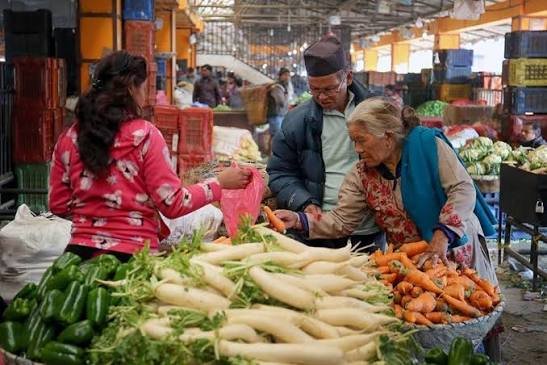
A sharp rise in vegetable prices in Kathmandu might sound like good news for farmers. If consumers are paying more, it seems reasonable to assume that producers are also earning more. In practice, however, the additional money paid at the retail counter does not always reach the farm.
Farmers are often affected by the same pressures that push food prices higher. When fuel becomes expensive, they pay more for tractors, irrigation, fertilizer, packaging, and transportation. Consumers notice these increases at the market, but farmers experience them much earlier, often before their produce has even left the farm.
This raises an important question: when food prices increase, how much of that increase reaches farmers, and how much is absorbed elsewhere in the supply chain?
According to Nepal Rastra Bank’s macroeconomic report, published in June 2026, year-on-year consumer inflation reached 5.04 percent in mid-May 2026. During the same period, fruit and vegetable prices increased by 18.60 percent and 5.40 percent respectively, while inflation in the Kathmandu Valley stood at 4.90 percent.[1]
Although international crude-oil prices have fallen from their previous highs and Nepal Oil Corporation has adjusted domestic rates, fuel remains expensive for farmers, transporters and consumers. The citizens still must pay Rs. 200 per liter for petrol, and Rs. 200 per liter for both diesel and kerosene.[2] These matters because fuel is used at almost every stage of Nepal’s agricultural supply chain. Food inflation and fuel costs should therefore not be viewed as separate issues.
How do fuel prices affect food prices?
Fuel is needed to transport seeds, fertilizer, machinery, and other agricultural inputs to farms. It is also used for irrigation pumps, tractors, collector vehicles, refrigeration, and the transportation of produce to wholesale and retail markets.
An increase in fuel prices can therefore raise costs throughout the entire process—from planting and harvesting to storage and final delivery. These additional costs eventually influence the price consumers pay.
However, costs and price increases are not shared equally. Retail prices may rise quickly when transport and operating costs increase, while the farm-gate price offered to producers may remain low. This creates a widening gap between the amount paid by consumers and the share received by farmers.
Perishable products make farmers particularly vulnerable. A farmer cannot store ripe tomatoes, leafy vegetables, or fruit indefinitely while waiting for a better price. If there is no affordable cold storage, the farmer must either accept the available offer or risk losing the entire harvest. This weakens the farmer’s bargaining position and gives buyers greater control over the transaction.
Does Nepal have a single agricultural price?
There is no single price for an agricultural product in Nepal. The same product may have one price at the farm, another at a collection center, a different wholesale price, and a much higher retail price.
Consider a simple example. A farmer may sell tomatoes for Rs.30 per kilogram. The tomatoes are then collected, sorted and transported, increasing the price to around Rs.50 per kilogram. By the time transportation expenses, commissions, handling costs, spoilage and retail margins are added, consumers may pay considerably more. This difference does not automatically prove that traders are earning excessive profits. Moving perishable produce involves real costs and risks. Nevertheless, the example illustrates why a high retail price does not necessarily mean that the farmer has received a good price.
Nepal’s Agriculture Market Price Information System publishes wholesale prices for different products and markets.[3] The Kalimati Fruits and Vegetable Market Development Board also publishes daily minimum, maximum and average wholesale prices.[4] These systems have improved access to market information, particularly in the Kathmandu Valley.
Their usefulness to an individual farmer, however, remains limited. A published wholesale price in Kalimati does not show how much a farmer in Kavre, Dhading or Chitwan will receive after transportation; loading, commissions and possible spoilage are deducted.
A small farmer may not produce enough to fill a truck or negotiate an affordable transport rate. Some farmers also require immediate payment and therefore depend on intermediaries who can provide cash in advance. In such situations, knowing the Kalimati price does not automatically give the farmer the ability to obtain it. Price information is valuable only when farmers have the means to act on it.
Information inequality in Nepal’s agricultural market
Traders generally participate in several markets and deal with many buyers and sellers. As a result, they may understand current prices, expected demand, transport costs, seasonal changes and retailer requirements.
A farmer in a remote village may have access to far less information. In many cases, the only price available to the farmer is the price offered by the nearest collector. Although the trader and farmer participate in the same supply chain, they do not enter the negotiation with equal information or bargaining power.
Research on Nepal’s mandarin market provides a balanced picture of this relationship. The study found that farmers generally received a fair share of the benefits from mandarin marketing. However, it also identified cases in which intermediaries took advantage of farmers’ weak bargaining position and poor economic circumstances.[5] Research on Nepal’s rice market similarly found that marketing costs, wholesale and retail prices, access to market information and farmers’ participation in price determination can influence marketing margins.[6]
These findings do not mean that every intermediary exploit farmer. Intermediaries often provide essential services, including transportation, aggregation, access to markets, informal credit, and the management of price and spoilage risks. Without these services, many small farmers would struggle to sell their produce at all.
The more useful question is therefore not whether every intermediary is exploitative. It is how much of the difference between farm and retail prices represents genuine costs and how much results from weak competition, limited transparency and unequal bargaining power.
Why do prices rise faster than they fall?
Consumers often notice that food prices increase quickly when fuel prices rise, or supplies become limited. When those pressures ease, however, retail prices may take much longer to fall. Economists commonly describe this as asymmetric price transmission or downward price stickiness.[7] There are several possible reasons for this. Retailers may still be selling stock purchased when transportation and wholesale prices are higher. Businesses may also be trying to recover earlier losses. Other costs—including rent, wages, storage, electricity and commissions—may remain high even after fuel prices decline.
Weak competition may also slow down the reduction in prices. If consumers become accustomed to paying a higher amount and there is little pressure from competing sellers, businesses may have limited incentives to reduce prices immediately. This does not prove that every trader or retailer is deliberately overcharging. It does, however, show that price changes are not always passed through the agricultural supply chain quickly or transparently.
Who benefits from higher prices?
Retail prices alone cannot show who benefits from food inflation. A proper assessment would need to compare farm-gate, collection-center, wholesale, and retail prices. It would also need to examine transportation, fertilizer, seed, labor, handling, commissions, storage, and losses caused by spoilage. A farmer may receive a slightly higher price for a crop but still earn less in real terms.
For example, an additional Rs.5 per kilogram may provide little benefit if the costs of fertilizer, pesticides, labour and transportation have increased by a greater amount. For this reason, rising food prices should not automatically be interpreted as rising farm income. The price received by the farmer is only one part of the calculation. What matters is the amount that remains after production and marketing expenses have been paid.
What should Nepal do?
Nepal already collects agricultural price information, but publishing daily wholesale prices is not enough. Farmers need information that is timely, reliable, and directly connected to practical market opportunities. An improved information system should report farm-gate, wholesale and retail prices according to product variety and quality grade. It should also include market location, date, expected demand, available buyers, transportation options, storage availability, and estimated delivery costs.
Farmer cooperatives could play an important role in making this information useful. By combining produce from several small farms, cooperatives can fill vehicles, reduce transportation costs, compare buyers, and negotiate better terms. Collective selling can give farmers more bargaining power than they would have when selling small quantities individually.
Investment in rural roads, collection centers, refrigerated transportation, and affordable cold storage is equally important. Farmers who can store perishable goods safely are less likely to accept the first offer because they fear losing their harvest. Standardized grading could also improve pricing. If products are consistently graded according to quality, buyers can make clearer comparisons and farmers producing better-quality goods can negotiate higher prices.
Digital platforms may support these reforms, but technology itself will not solve the problem. A farmer may know that tomatoes are selling for Rs.60 per kilogram in Kalimati but still be unable to afford the journey to Kathmandu. In that case, the farmer has information but not genuine market access. Digital information must therefore be supported by transportation, storage, finance, and collective bargaining.
Conclusion
Nepal’s agricultural market problem is not simply that prices are hidden. Prices are fragmented across locations, dates, product grades, and different stages of the supply chain. When fuel prices rise, the effects spread throughout the economy, but they do not affect everyone equally. Consumers pay more at the market, while farmers face higher production and transportation costs. Traders and retailers may have better information and greater flexibility when responding to changing market conditions. The central policy question is not merely why food prices have increased or whether farmers are receiving a higher selling price. Nepal needs to determine who receives the additional income, who carries the additional costs and who has enough information and bargaining power to influence the outcome. Until reliable farm-gate, wholesale and retail data can be compared with actual supply-chain costs; farmers and consumers will continue to experience two very different sides of the same agricultural market.
References:
1. Nepal Rastra Bank, Macroeconomic Report: July 2026
2. Government Increases Fuel Prices
3. Agriculture Market Price Information System
4. Kalimati Fruits and Vegetable Market Development Board
5. Are Market Intermediaries Exploiting Mountain Farmers in Nepal?
6. Factors Affecting Price Spread of Rice in Nepal 7. Prices Rise Faster than They Fall