

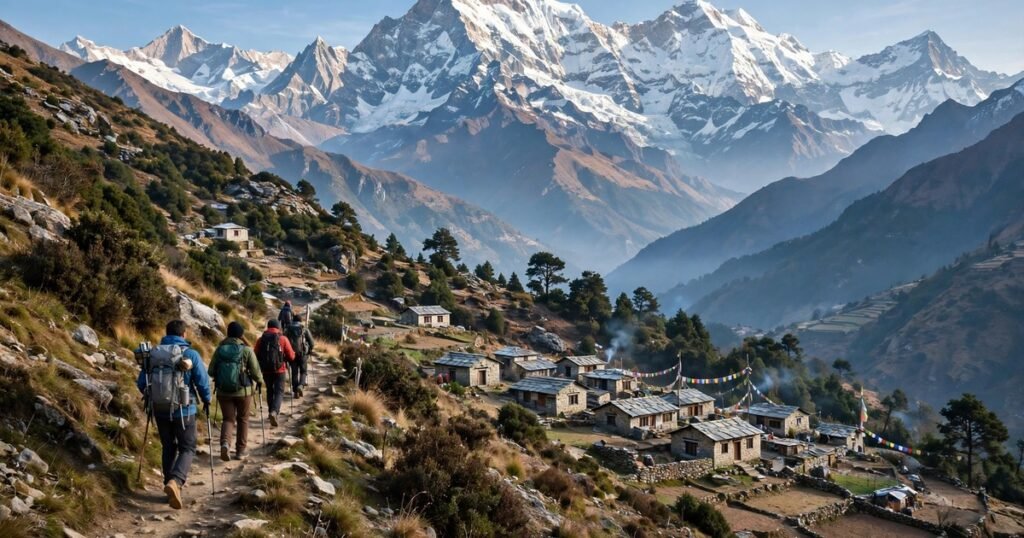
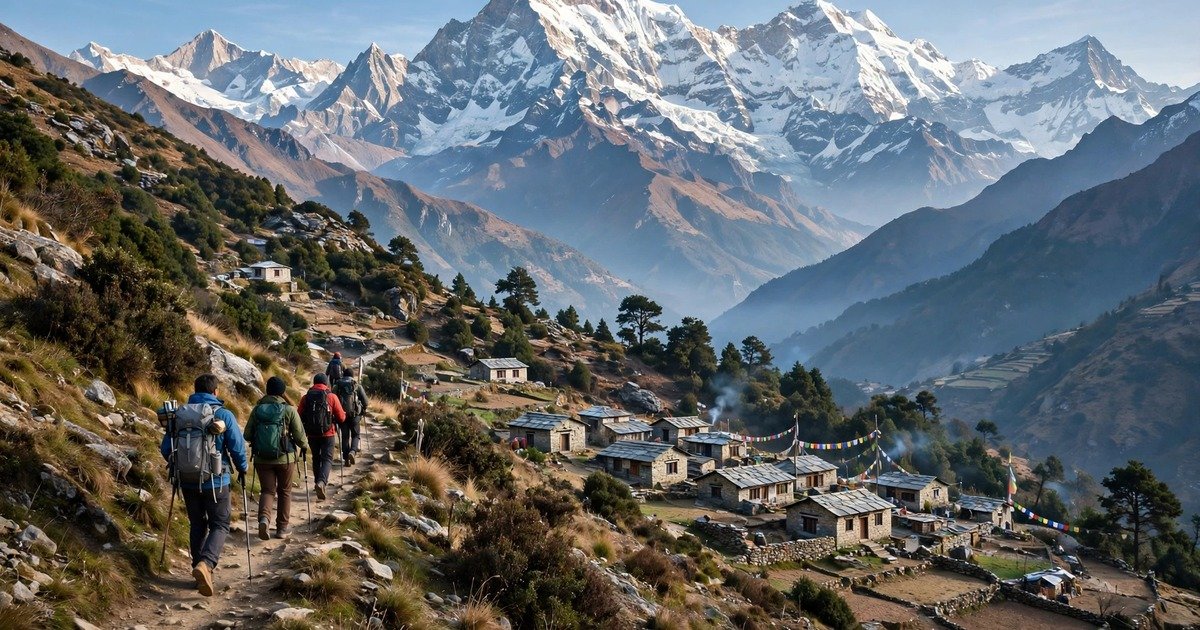
Nepal tourism economy explained in plain language: in 2025, about 1.16 million foreign visitors came to Nepal, and the money they spent inside the country — Rs 88.66 billion in fiscal year 2024/25, roughly US$650 million — made tourism one of Nepal’s largest sources of foreign currency. Only remittances bring in more. Yet in the same year, Nepalis spent more than twice that amount travelling abroad, mostly to study. This article explains how Nepal’s tourism economy works: who comes, what they spend, where the money goes, who earns a living from it, and what keeps it smaller than it could be.
Table of Contents
Nepal tourism economy explained: the numbers in brief
Nepal tourism economy explained: who comes, and why
Nepal tourism economy explained: what visitors spend
Nepal tourism economy explained: where the money goes
Nepal tourism economy explained: who earns a living from it
Nepal tourism economy explained: what the government collects
Nepal tourism economy explained: what holds it back
Nepal tourism economy explained: what comes next
Frequently asked questions
Sources
Nepal Tourism Economy Explained: The Numbers in Brief
Nepal welcomed 1,162,365 foreign visitors in 2025, according to the Ministry of Culture, Tourism and Civil Aviation’s Nepal Tourism Statistics 2025 report, published in April 2026. That is a rise of 1.3 percent on the 1,147,548 visitors of 2024. The Nepal Tourism Board’s preliminary count, published in January 2026, was slightly lower at 1,158,459 — the difference is a few thousand visitors out of more than a million, and both counts tell the same story.
Nepal tourism economy explained through the arrivals curve is a story of recovery that has nearly, but not quite, reached the old record. The best year ever was 2019, when 1,197,191 foreign visitors arrived. The pandemic then cut arrivals to 230,085 in 2020 and 150,962 in 2021. The recovery brought 614,869 in 2022 and 1,014,882 in 2023, before the 13 percent jump of 2024. At 1.16 million, 2025 sits about 3 percent below the 2019 record — and growth has slowed sharply, from 13 percent in 2024 to barely 1 percent in 2025.
The money tells a similar story. In fiscal year 2024/25, Nepal earned Rs 88.66 billion from foreign visitors — the figure the Nepal Rastra Bank records as travel income — up 7.7 percent on the year before, and worth about US$650.5 million. In calendar-year terms, tourism earnings reached Rs 87.37 billion in 2025, up 4.8 percent from Rs 83.39 billion in 2024.
How big is that in the national economy? Nepal tourism economy explained in money terms starts with the tourism statistics report, which puts travel income at 1.5 percent of gross domestic product in fiscal year 2024/25, and at 16.2 percent of Nepal’s total merchandise and service exports. That second figure matters: of everything Nepal sells to the rest of the world — goods and services combined — about one rupee in six comes from visitors spending money inside the country. For a country whose trade deficit in goods alone was Rs 1,781.09 billion in fiscal year 2025/26, tourism is one of the few export earners that actually works. Our explainer on Nepal’s trade deficit puts that gap in context, and our guide to how to read Nepal’s GDP explains what the 1.5 percent figure does and does not capture.
One caution about the 1.5 percent, and about Nepal tourism economy explained through a single figure: it counts only the foreign currency visitors spend, as recorded in the balance of payments. The wider tourism economy — the hotels, restaurants, buses, guides, porters, shops and trekking agencies that exist because visitors come — is larger than that single number. Nepal has no single official count of tourism jobs, so this article does not invent one. What the official figures do show, clearly, is a sector that has recovered almost to its pre-pandemic size, but has stopped growing fast.
Nepal Tourism Economy Explained: Who Comes, and Why
India is by far Nepal’s biggest source of visitors. About 293,000 Indians visited in 2025 — roughly one in four of all arrivals. The United States was second, with about 113,000 visitors, followed by China with about 96,000. Together, the top three countries account for more than four in ten visitors. Arrivals from South Asian countries as a whole made up 35.2 percent of the total in 2025.
Nepal tourism economy explained by nationality is dominated by one country, and most visitors arrive by air. In 2025, 1,015,735 tourists — 87.4 percent — flew in, almost all through Tribhuvan International Airport in Kathmandu. The remaining 146,630 arrived by road, and of those, 104,088 entered at Belahiya, near Bhairahawa, on the Indian border. Land arrivals grew 18.6 percent in 2025, much faster than air arrivals, which reflects the growing number of Indian visitors travelling overland.
Why do they come? Nepal tourism economy explained by purpose of visit starts with the official statistics, which sort visitors by the purpose they declare at immigration, and the 2025 split looks like this:
| Purpose of visit | Visitors in 2025 | Share |
|---|---|---|
| Holiday and leisure | 699,744 | 60.2% |
| Pilgrimage | 167,380 | 14.4% |
| Trekking and mountaineering | 165,056 | 14.2% |
| Other (business, visiting family, medical) | 130,185 | 11.2% |
Nepal tourism economy explained by what visitors actually do starts here: six in ten visitors come for a holiday. That is the broad category — sightseeing in Kathmandu, Pokhara and Chitwan, short walks, food, festivals — and it grew 1 percent in 2025. Pilgrimage is now the second-largest reason, at 14.4 percent: Lumbini, the birthplace of the Buddha, and Pashupatinath draw hundreds of thousands of visitors, most of them from India and other South Asian countries.
Trekking and mountaineering, the activity Nepal is most famous for abroad, is now third, at 14.2 percent. The 165,056 visitors who gave trekking or climbing as their main reason in 2025 were 6 percent fewer than in 2024. That is the lowest share in several years, and it is worth pausing on: the image of Nepal as a trekking destination is stronger than the numbers. Part of the dip may be a counting change — 2025 was the first year the new electronic tourism system, CETMIS, supplied these figures, and a visitor who treks as part of a longer holiday may simply declare “holiday” at immigration. But the direction is clear enough: trekking is no longer growing, while holiday and pilgrimage travel is.
Nepal tourism economy explained by the calendar is a story of two peaks. The seasons shape everything. Arrivals peak in October, the main trekking month — 128,443 visitors in October 2025 — and again in March and April. They fall sharply in the monsoon months of June, July and August, and dip again in mid-winter. That seasonality is the first thing any business in the sector has to plan around, and it is one reason the money is unevenly spread.
Nepal Tourism Economy Explained: What Visitors Spend
The average visitor to Nepal in 2025 stayed 16.34 days, according to the tourism statistics report — the longest average stay on record, up from 13.30 days in 2024. The same report puts average daily spending at US$33.09, down from US$40.84 the year before.
Those two numbers pull in opposite directions, and Nepal tourism economy explained through spending needs a careful reading of both. Visitors stayed longer but spent less per day, so total earnings still rose — but only modestly. And part of the change is measurement, not behaviour: 2025 was the first year the figures came from CETMIS, the new electronic system, which counts stays and spending differently from the old survey-based method. The longer stay may partly reflect better counting of visitors who extend their trips, and the lower daily spend may partly reflect the system capturing budget travellers more completely.
Even with that caution, the level is low — and that is the central weakness Nepal tourism economy explained through spending reveals. Thirty-three dollars a day is what a budget traveller spends, not what a luxury traveller spends. It covers a bed in a teahouse, meals, a bus ticket, a park entry fee. It is the arithmetic of a sector built on backpackers and pilgrims, not on high-spending visitors. Nepal’s challenge is not only getting more people through the airport — it is getting each of them to spend more while they are here.
The comparison that puts tourism in perspective is remittances, and Nepal tourism economy explained against migration income looks small by comparison. In fiscal year 2025/26, Nepalis working abroad sent home Rs 2,363.13 billion — about twenty-seven times what foreign visitors spent in Nepal. Tourism matters, but it is not the engine of the economy. It is a valuable export, and a lifeline for the places that depend on it, but it does not come close to the money migration brings in. Our explainer on remittance in Nepal explains how that far larger flow works.
The other comparison runs the other way, and it is less flattering. In fiscal year 2024/25, Nepalis spent Rs 223.72 billion travelling abroad — on education, medical treatment, holidays and business — while foreign visitors spent Rs 88.66 billion in Nepal. More than three-fifths of the outbound spending, Rs 138.48 billion, went on education abroad alone. Nepal earns from other people’s holidays and spends on its own students’ tuition. The net result is a services deficit of Rs 90.94 billion for the year. Tourism helps, but it does not cover what Nepal spends abroad.
Nepal Tourism Economy Explained: Where the Money Goes
Nepal tourism economy explained as a chain of businesses starts with a simple fact: a visitor’s money does not land in one place. It splits across a chain of businesses, and following the chain shows who actually benefits.
The first stop is transport. International flights are mostly operated by foreign airlines, so much of the airfare never reaches Nepal at all. Inside the country, the money goes to domestic airlines, buses, jeeps and taxis. The second stop is accommodation — from five-star hotels in Kathmandu and Pokhara to teahouses on the trekking trails, where a night’s stay can cost a few hundred rupees and the margin is thin. The third is food, and the fourth is the services that make a trip possible: guides, porters, trekking agencies, tour operators, and the shops that sell gear, souvenirs and handicrafts.
On the trails, the economics are personal. A trekker’s daily spending supports the teahouse owner, the cook, the porter who carries the bag, and the guide who walks ahead. When a trail is busy, a village along it earns; when the season ends, the same village goes quiet. Nepal tourism economy explained through the trails shows why the Annapurna region matters so much: in 2025, the Annapurna Conservation Area recorded 313,549 foreign visitors, up 30.6 percent on 2024, and accounted for about six in ten of all foreign visits to Nepal’s protected areas. The total across all protected areas was 514,160 foreign visitors, up 10.65 percent. One caution: the Annapurna figure includes many Indian and South Asian pilgrims who drive or fly to Muktinath temple and never trek, so it overstates the number of people actually on the trails.
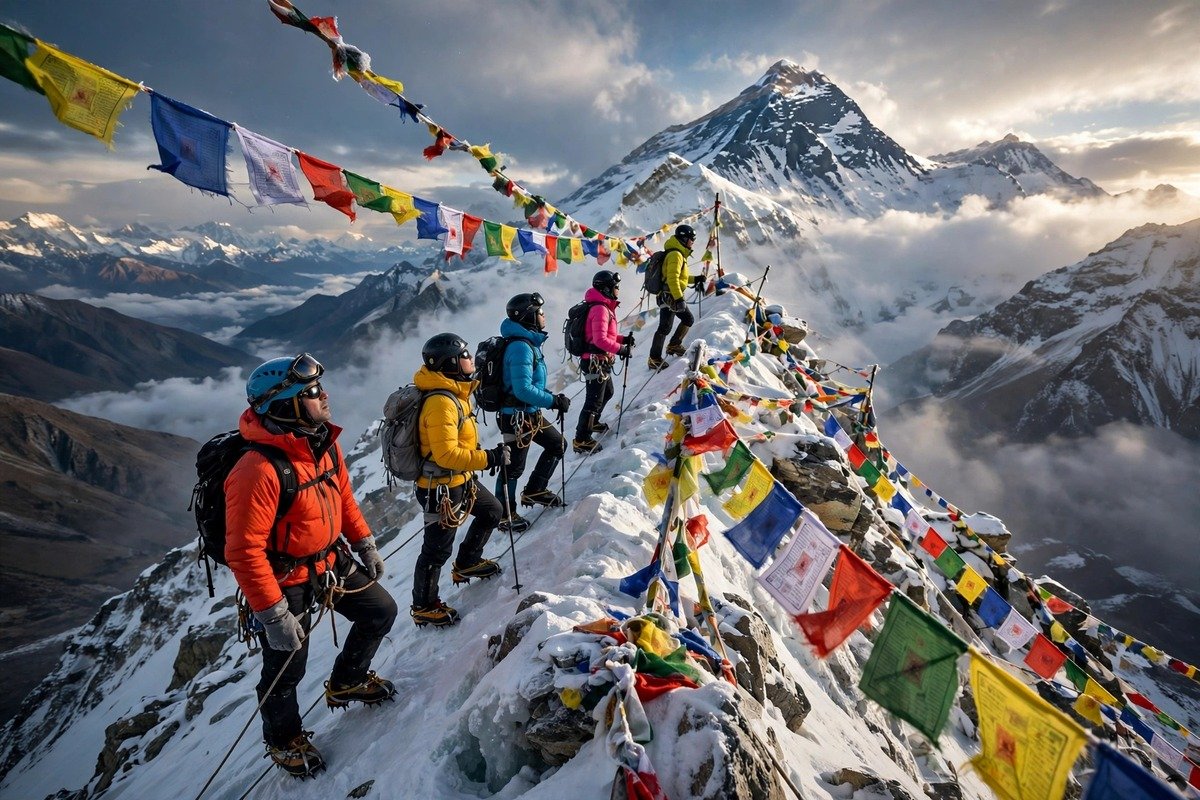
Mountaineering is the small, high-value end of the chain, and Nepal tourism economy explained through climbing royalties shows how concentrated that value is. In 2025, the Department of Tourism permitted 334 expedition teams with 2,766 climbers across 78 peaks, and collected Rs 1.36 billion in climbing royalties — up from Rs 928.2 million the year before. The biggest single fee is Everest. Since 1 September 2025, a foreign climber pays a royalty of US$15,000 to climb Everest by the normal route in spring, up from US$11,000 — the first increase in a decade. The fee is US$7,500 in autumn and US$3,750 in winter and summer. That royalty is only the permit: the full cost of an Everest expedition, with guiding, oxygen and logistics, is several times higher, and most of that money goes to expedition companies, not to the state.
Not all of the money stays in Nepal. Hotels import food, fuel and equipment; airlines are foreign-owned; online booking platforms take a commission before the money arrives. Economists call this leakage, and Nepal has never published a reliable estimate of how large it is. What is certain is that the part that stays — the wages of guides and porters, the income of teahouse owners, the rent of a family-run hotel — is the part that matters most to the communities along the trails.
Nepal Tourism Economy Explained: Who Earns a Living From It
Tourism’s most important product is not foreign currency. It is work, in places where there is little other work.
In the Khumbu, around Everest, almost every household depends on visitors — as guides, porters, lodge owners, cooks, yak herders or shopkeepers. In Pokhara, the lakeside strip of hotels, restaurants and trekking agencies is the city’s economy. In Lumbini, pilgrims support hotels, guides and souvenir sellers. In Chitwan, safari lodges and jeep drivers depend on the wildlife visitors. For many mountain villages, the trekking season is the year’s only cash income: the money earned in October and November has to last until the spring season.
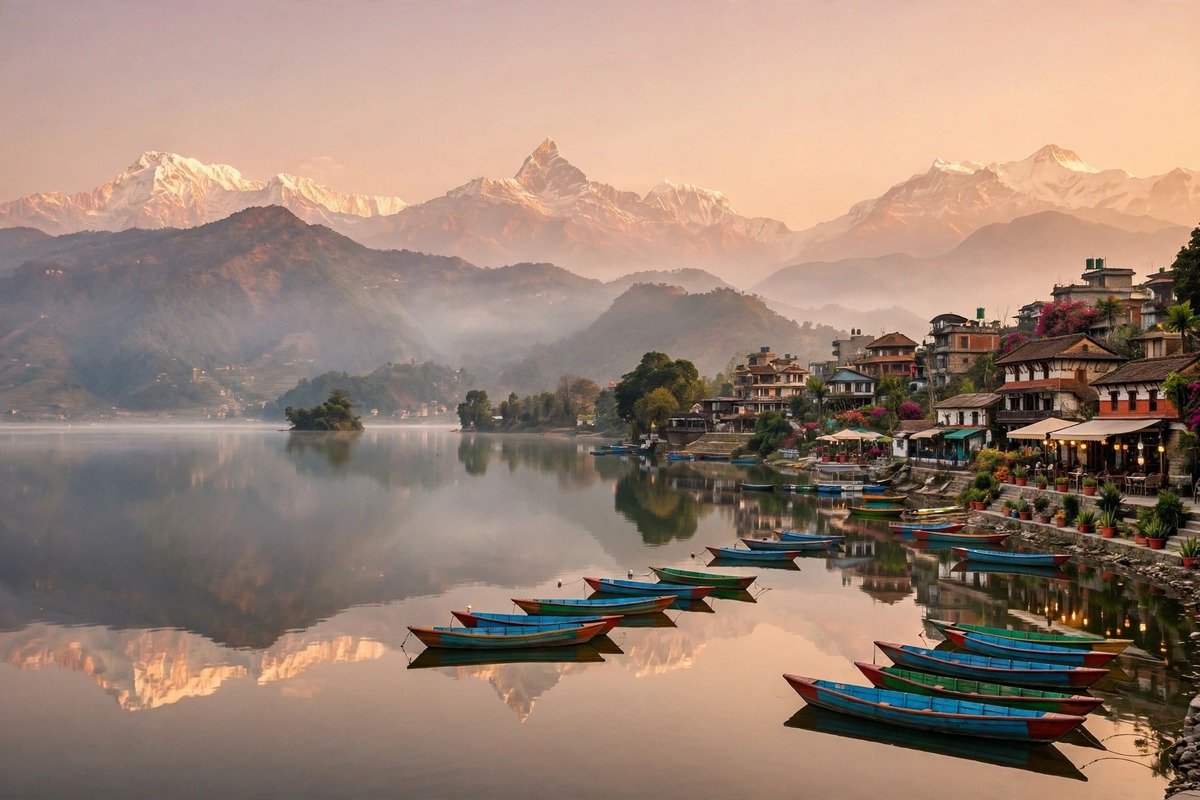
Nepal tourism economy explained through the villages that depend on it shows that dependence is also a vulnerability. When arrivals fall, the income stops, and there is no other employer to fall back on. The pandemic showed this brutally: in 2020 and 2021, arrivals fell by more than 80 percent, and the teahouses, lodges and agencies that had borrowed to expand were left with empty rooms and debts. The recovery since 2022 has restored the work, but the memory of those two years shapes how cautiously many small operators now invest.
Nepal tourism economy explained through the people who do the work shows it is also seasonal and informal. A porter may work five months a year and farm the rest. A guide may be employed by an agency for the season and unpaid between seasons. A teahouse owner may earn well in October and nothing in February. There is no single register of tourism workers, and most of the sector’s jobs are not covered by the formal social security system. That is part of why the money looks large in the national accounts and feels thin on the ground: it is spread across a very large number of people, in small amounts, for part of the year.
Women’s participation is real but uneven. Women run many of the teahouses and lodges along the trails, and a growing number work as guides — but the higher-paid expedition and management roles remain mostly male. The sector has no published gender breakdown of its workforce, so this article does not invent one. What can be said is that tourism is one of the few industries in Nepal where a woman in a mountain village can run a business of her own, and keep the income.
Nepal Tourism Economy Explained: What the Government Collects
Nepal tourism economy explained through the public purse starts here: the government earns from tourism in several ways, and the amounts are small compared with the sector’s size — but they are direct, visible, and contested.
The most visible is the mountaineering royalty. The Rs 1.36 billion collected in 2025 goes, by law, to the three levels of government: 50 percent to the federal government, 25 percent to the province, and 25 percent to the local level where the peak stands. For Khumbu Pasang Lhamu Rural Municipality, home to Everest, that share is one of its largest sources of own revenue. The same split applies to other natural-resource royalties, and it is one reason local governments bargain hard over new projects.
Then there are the entry fees. Foreign visitors to national parks and conservation areas pay entry fees — for example, the Sagarmatha National Park fee and the Annapurna Conservation Area permit — which fund the conservation bodies that manage the trails, the forests and the wildlife. Trekkers also buy a TIMS card, the Trekkers’ Information Management System card, which is both a permit and a safety register. These fees are small per person, but across half a million protected-area visitors a year, they add up to a meaningful budget for conservation.
Nepal tourism economy explained through tax shows the ordinary side of the sector: value-added tax applies to most tourism services at the standard 13 percent rate, and hotels and restaurants also pay the other taxes any business pays. The Department of Tourism collects the royalties; the Inland Revenue Department collects the taxes; the Nepal Tourism Board, set up in 1998 under the Nepal Tourism Board Act 2055 (1997), spends its budget on promoting Nepal abroad. The board is funded by a tourism service fee levied on departing passengers and on hotel bills, not by a direct grant from the treasury.
The airport is a revenue earner too. Tribhuvan International Airport handles nearly all of Nepal’s international passengers — 5,045,077 international passenger movements in 2025 — and the airport service charge on each departing passenger goes to the Civil Aviation Authority of Nepal. A second international airport at Pokhara opened in January 2023 and one at Bhairahawa in May 2022, but neither yet carries significant international traffic, so the revenue — and the congestion — remains concentrated in Kathmandu.
Nepal Tourism Economy Explained: What Holds It Back
If the numbers are nearly back to 2019, why did growth slow to 1 percent in 2025? Part of the answer is the calendar. The September 2025 protests disrupted the autumn season, the busiest time of the year, and arrivals in the months after were soft. But the slower growth also reflects problems that predate 2025.
Nepal tourism economy explained through its bottlenecks starts with the first: infrastructure. Nepal has one international airport that works at scale, and it is congested. Roads to the main destinations are slow and, in the monsoon, unreliable. The 26 August 2026 floods damaged roads, bridges and hydropower plants across the hills, and rebuilding that infrastructure competes with every other claim on the budget. A visitor who loses a day to a landslide or a delayed flight is a visitor who spends less — and may not come back.
The second bottleneck Nepal tourism economy explained through the calendar reveals is seasonality. Two short peaks, spring and autumn, carry the year. Hotels, airlines and agencies must earn in a few months what has to last twelve. Spreading visitors across the year — winter trekking, monsoon culture tourism, conferences — has been talked about for years, but the numbers still show the same two peaks.
The third is the product itself. Nepal sells the Himalaya, and it sells it well, but the rest of the offer is thinner than it could be. Heritage sites are under-maintained, museums are modest, and the evening economy of Kathmandu and Pokhara is small. A visitor who has trekked for ten days has little reason to stay for five more. That is why the average stay is long — the trek takes time — while the daily spend is low: the days are spent walking, not buying.
The fourth is air connectivity. Nepal has few direct flights to its biggest potential markets, and fares are high compared with competing destinations. Indian visitors can drive in; everyone else must fly, usually through Delhi, Doha or Dubai. Every connection is a reason to choose somewhere easier.
And the fifth is policy churn. Visit Nepal 2020, the big promotion campaign, was cancelled by the pandemic before it began. Tourism policy has been revised repeatedly — the Tourism Act dates to 2035 (1978), the Tourism Policy to 2065 (2008) — and the sector’s wish list, from a new tourism act to a tourism master plan, has been waiting for years. The institutions exist, but they have not delivered the sustained, funded promotion that a country competing with Bhutan, Sri Lanka and Vietnam needs.
Nepal Tourism Economy Explained: What Comes Next
The recovery is not over. Preliminary counts show 998,734 arrivals in January to October 2026, 5.4 percent more than the same months of 2025, and October 2026 alone brought 132,814 visitors. If the final two months hold up, 2026 should finally pass the 2019 record. That would be a genuine milestone — the first time Nepal has beaten its best year.
Passing the record is not the same as fixing the economics, and Nepal tourism economy explained through what comes next is about earning more from each visitor, not only from more visitors. The task now is the one the numbers have been pointing at for years: earn more from each visitor, not only from more visitors. That means longer stays in the cities as well as on the trails, better hotels and restaurants, more direct flights, and a promotion budget that is actually spent. It means fixing the roads and the airport, and it means giving the trekking regions a reason to earn in winter as well as in October.
It also means deciding what kind of tourism Nepal wants. The Everest royalty rise to US$15,000 was a deliberate choice: fewer climbers, more revenue per climber, less pressure on the mountain. The same logic applies to the sector as a whole. Nepal cannot compete on volume with Thailand or Vietnam, and it should not try. Its advantage is the mountains, the culture, and the fact that a visitor’s money, when it reaches a teahouse in the Khumbu or a hotel in Lumbini, changes a family’s year. The tourism economy is at its best when it does that — and at its worst when it counts arrivals and forgets the people behind them.
Frequently Asked Questions
How many tourists visit Nepal each year?
Nepal recorded 1,162,365 foreign visitors in 2025, according to the Ministry of Culture, Tourism and Civil Aviation’s Nepal Tourism Statistics 2025 report. That is about 3 percent below the 2019 record of 1,197,191. Arrivals in January to October 2026 were 5.4 percent ahead of the same period in 2025, so 2026 may finally pass the record.
How much money does tourism bring into Nepal?
In fiscal year 2024/25, Nepal earned Rs 88.66 billion — about US$650.5 million — from foreign visitors, according to the Nepal Rastra Bank. That is 1.5 percent of GDP and 16.2 percent of Nepal’s total merchandise and service exports. In calendar-year terms, earnings were Rs 87.37 billion in 2025.
What do tourists spend their money on?
The official statistics do not publish a spending breakdown by item, so there is no reliable figure for how much goes to hotels, food or transport. What is certain is the shape of the chain: accommodation, food, domestic transport, guides and porters, park and permit fees, and shopping. On the trails, most spending goes to teahouses and to the wages of guides and porters.
How long do tourists stay in Nepal?
The average stay in 2025 was 16.34 days, the longest on record, according to the Nepal Tourism Statistics 2025 report. Average daily spending was US$33.09. Both figures come from the new CETMIS electronic system, which was used for the first time in 2025, so comparisons with earlier years should be read with care.
Does tourism money reach ordinary Nepalis?
Some of it does, directly. Mountaineering royalties are shared by law — 50 percent to the federal government, 25 percent to the province and 25 percent to the local level where the peak stands. Park entry fees fund conservation in the areas visitors walk through. But most of the money reaches ordinary people through wages and small businesses: guides, porters, teahouse owners and hotel staff. There is no official count of tourism jobs, so the total employment effect cannot be stated as a single number.
Why did tourism grow so slowly in 2025?
Arrivals grew only about 1 percent in 2025, after 13 percent in 2024. The September 2025 protests disrupted the autumn trekking season, the busiest time of the year. Underneath that, the sector faces older problems: a congested single international airport, seasonal demand, low daily spending, and limited direct flights to major markets.
Sources
- Ministry of Culture, Tourism and Civil Aviation, Nepal Tourism Statistics 2025 (published April 2026): arrivals, purpose of visit, length of stay, daily spending, protected-area visitors, mountaineering royalties.
- Nepal Tourism Board, monthly arrival releases (January 2026): preliminary 2025 total of 1,158,459 visitors; 2026 monthly counts.
- Nepal Rastra Bank, Current Macroeconomic and Financial Situation, fiscal year 2024/25: travel income Rs 88.66 billion; travel payments Rs 223.72 billion; services deficit Rs 90.94 billion.
- Ministry of Finance, Economic Survey 2082/83: tourism income and arrivals 2016–2025.
- Department of Tourism, mountaineering royalty schedule (effective 1 September 2025): Everest spring royalty US$15,000, up from US$11,000.
- The Himalayan Times, “More than 1.1 million foreign visitors arrived in Nepal in 2025” (2 January 2026).
- My Republica, “Govt fails to meet its target to increase tourist arrivals by 10 percent in 2025” (6 January 2026).
- Nepal Rastra Bank, annual report and monthly data via earlier Hamro Niti reporting: remittance inflows Rs 2,363.13 billion in fiscal year 2025/26.