

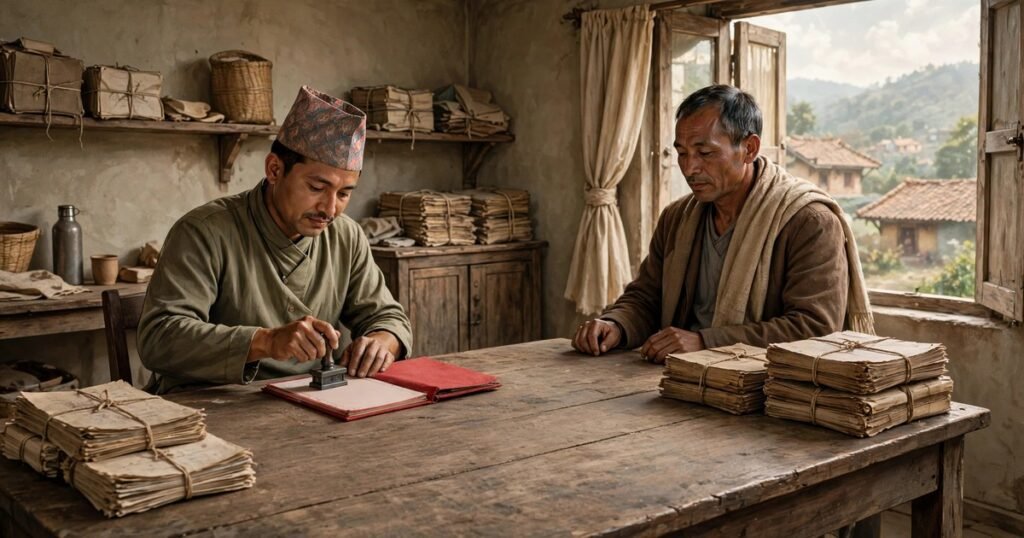
Nepal land registration explained in plain language: it is the official process of recording who owns a piece of land, and it ends with a red-covered certificate called the lalpurja. In Nepal, paying for land does not make you its owner. Signing a private agreement does not either. Ownership changes only when the transfer is registered at the Land Revenue Office — the Malpot Karyalaya — of the district where the land sits, and a new lalpurja is issued in the buyer’s name. Until that happens, the government still treats the seller as the owner, and the buyer cannot sell the land, mortgage it, or prove in a dispute that it is theirs. This is Nepal land registration explained in full: the certificate, the plot number, the offices, the documents, the fees and taxes, the other ways land changes hands, and the two limits — the land ceiling and the land-use categories — that catch more buyers than any other rule.
Table of Contents
Nepal land registration explained: what registration actually does
Nepal land registration explained: the lalpurja and the kitta number
Nepal land registration explained: the transfer process, step by step
Nepal land registration explained: the documents you need
Nepal land registration explained: what it costs — fees and taxes
Nepal land registration explained: other kinds of transfer — gift, inheritance, partition
Nepal land registration explained: land ceilings and land-use categories
Nepal land registration explained: common problems and how to avoid them
Frequently asked questions
Sources
Table of Contents
Nepal land registration explained: what registration actually does
Nepal land registration explained from the start means understanding that Nepal runs on a deed system, not a title-guarantee system. The government records the deed of transfer and issues the lalpurja, but it does not guarantee that the title is clean. If the seller was not the real owner, or the land was already mortgaged, or a boundary is wrong, the registration does not fix those problems — it records what the parties presented. That is why the checks before registration matter more than the registration itself.
The law behind the system is a small set of old statutes. The Land Act, 2021 (1964) sets who can own land and how much. The Land Revenue Act, 2034 (1977) governs registration, transfer, partition and the collection of land revenue. The Registration Act, 2034 (1977) makes registration of immovable-property deeds mandatory. The National Civil Code, 2074 (2017) sets out property rights and how ownership passes. And the Land Use Act, 2076 (2019) decides what each piece of land may be used for. Together they form the framework every transfer must pass through.
Three offices do the work. The Land Revenue Office (Malpot Karyalaya) is where the transfer is registered and the lalpurja is issued — one office per district, for the land inside that district. The Survey Office (Napi Karyalaya) holds the cadastral maps and measures the plots. The ward office or municipality issues the recommendation letter and the land-tax clearance. No single office can complete a transfer alone, and a file that is missing any one of them stalls.
Nepal land registration explained: the lalpurja and the kitta number
Nepal land registration explained through its two key documents starts with the lalpurja, the land ownership certificate. It is the red-covered booklet that proves who owns a piece of land. It records the owner’s name, the district, municipality and ward, the kitta number, the area of the plot, and the type of land. A buyer should always ask to see the original, not a photocopy, and check three things against it: that the seller’s name matches their citizenship certificate, that the plot number matches the land being sold, and that the area is what the seller claims. A tampered or mismatched lalpurja is the first sign of a problem.
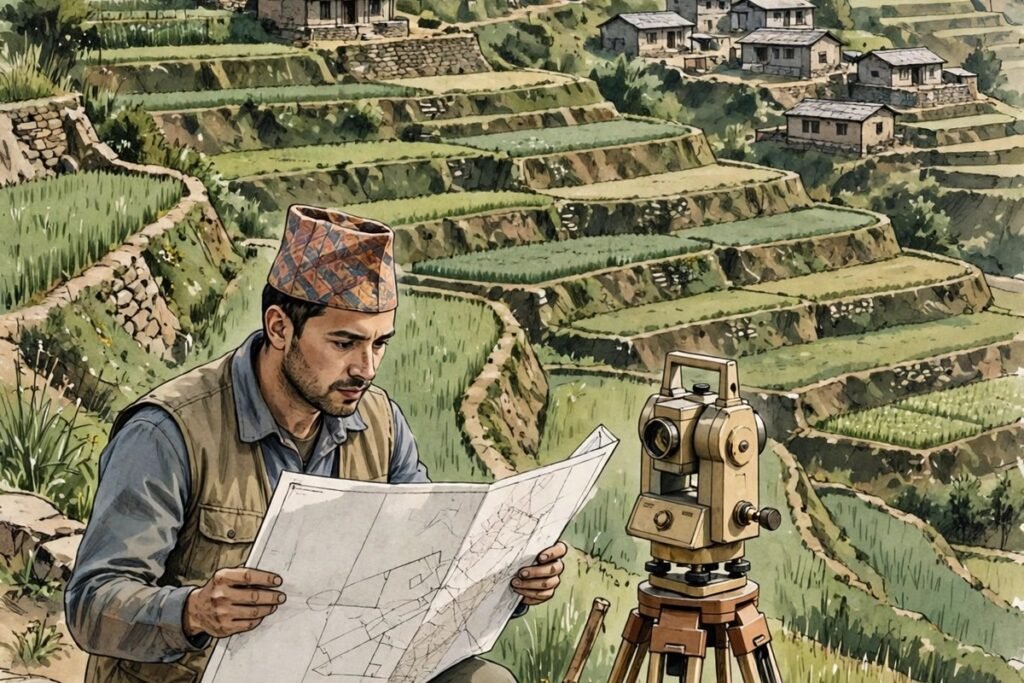
The kitta number is the plot number — the unique number the Survey Office gives to each parcel of land. One kitta number means one parcel, with fixed boundaries. When land is divided, the old kitta number is split and new kitta numbers are issued for the new parcels. The kitta number is what ties the lalpurja to a specific piece of ground, and it is what the Land Revenue Office checks against its own record book, the Moth Shrestha, before it will register anything.
Two more documents complete the picture. The naapi naksa is the cadastral map — the blueprint of the plot — obtained from the Survey Office. It shows the shape of the land, its boundaries, and the plots around it. The char killa is the written description of the four boundaries: who owns the land to the east, west, north and south. Together, the lalpurja, the kitta number, the map and the char killa are what prove that the land being sold is the land on the certificate, in the place the seller says it is, with the neighbours the seller says it has.
Nepal also measures land in its own units, and the lalpurja uses them. In the hills and mountains, including the Kathmandu Valley, land is measured in the ropani system: 1 ropani = 16 anna = 64 paisa = 256 dam, and 1 ropani is about 508.72 square metres. In the Terai, land is measured in the bigha system: 1 bigha = 20 kattha = 400 dhur, and 1 bigha is about 6,772.63 square metres. Government valuations, tax assessments and the lalpurja itself all use these units, so a buyer who confuses ropani with bigha can misunderstand the size — and the price — of what they are buying by a factor of more than thirteen.
Nepal land registration explained: the transfer process, step by step
Nepal land registration explained as a process has eight steps, and the order matters. Skipping the checks at the start is how buyers end up owning a dispute instead of a plot.
Step 1: Do your due diligence. Before paying anything, verify the lalpurja, the kitta number and the cadastral map at the Survey Office. Visit the Land Revenue Office and ask whether the land has a mortgage registered against it, whether it is involved in a court case, and whether it is government land, guthi land or public land — none of which can be sold. Check the land-use category (see the section below), and check that buying the land would not push your family’s total holdings over the land ceiling. Only Nepali citizens can hold registered title to land; foreign nationals and foreign companies cannot buy land, though they can lease it.
Step 2: Agree the terms and sign a sale agreement. Buyer and seller agree the price, the plot and the conditions, and usually sign a bainapatra — a sale agreement — often with an advance of 10 to 20 percent. The bainapatra is a private contract. It is useful evidence, but it does not transfer ownership. Only registration at the Land Revenue Office does that.
Step 3: Get the land tax clearance. The seller must clear all land tax (malpot) dues and obtain a tax clearance receipt from the ward office or municipality. Unpaid dues must be paid before the transfer can proceed. Note that this land tax is not the same as the annual property tax on a house — our explainer on property tax (https://hamroniti.com/nepal-property-tax-explained/) covers the difference between the two.
Step 4: Get the ward recommendation letter. The local ward office issues a sifarish — a recommendation letter — confirming basic details about the property and that there are no local-level objections to the transfer. Some municipalities also require proof that property tax is paid up to date, and a building completion certificate if a house stands on the land.
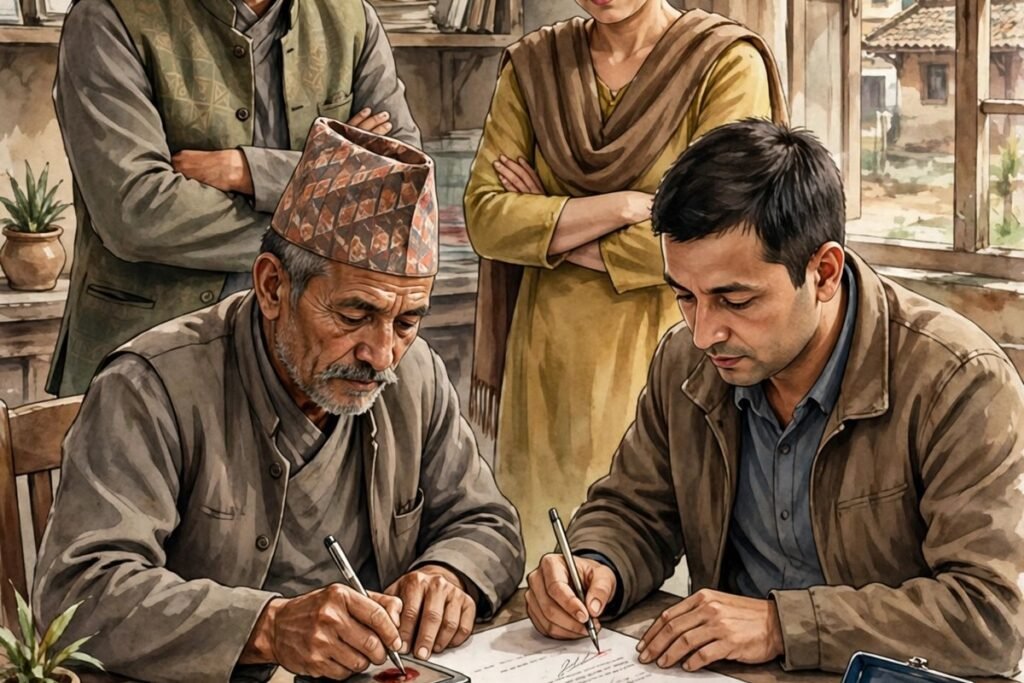
Step 5: Prepare the deed. A licensed deed writer prepares the transfer deed — the rajinama (or likhat) — on stamp paper. It records the buyer and seller, the kitta number, the area and boundaries, the price, and the conditions. Both parties sign it in front of two witnesses.
Step 6: Get the valuation. The Land Revenue Office applies the government minimum valuation (nyunatam mulya) — the rate the district valuation committee sets for each area. Registration fees and taxes are calculated on whichever is higher: the government’s minimum valuation or the actual sale price stated in the deed. Understating the price does not reduce the tax.
Step 7: Appear at the Land Revenue Office. Both buyer and seller must appear in person with all the documents. The office verifies them against the Moth Shrestha, the official record book, checks signatures and thumbprints against the record, and takes fresh biometrics. The deed is then approved and the fees and taxes are calculated.
Step 8: Pay, and collect the new lalpurja. The buyer pays the registration fee and the seller pays the capital gains tax (both detailed below). The office updates its records, cancels the old lalpurja, and issues a new lalpurja in the buyer’s name. That moment — not the payment, not the handshake — is when ownership changes.
Nepal land registration explained: the documents you need
Nepal land registration explained through paperwork is a short list for a standard sale between two private individuals, and a longer one for anything else. For a sale, the file is: the original lalpurja; the citizenship certificates of both buyer and seller; passport-sized photographs of both; the land tax clearance receipt; the ward recommendation letter; the cadastral map (naapi naksa) from the Survey Office; the transfer deed (rajinama) prepared by a licensed deed writer; and the completed application form from the Land Revenue Office.
For company-owned land, add the memorandum and articles of association, a board resolution authorising the sale, and the company’s PAN certificate. For inheritance, the file changes: a death certificate, a legal heir certificate (hakwala pramanpatra), and the relationship papers proving who the heirs are. For a gift, the gift deed replaces the sale deed. Offices differ slightly in what they ask for, so confirm the list at the counter of the specific Land Revenue Office before you travel — a missing paper is the most common reason a file is sent back.
One document deserves special attention: the fantawari, the declaration of total landholdings. Because the land ceiling applies to the whole family, not just the buyer, the buyer must declare all land the family already owns, anywhere in Nepal. The Land Revenue Office will refuse to register a deed that pushes the family’s total over the limit.
Nepal land registration explained: what it costs — fees and taxes
Nepal land registration explained through the money starts with a warning: the rates vary by district and by province, and the figures below are the commonly applied ones. Confirm the exact amount at your Land Revenue Office before you pay, and pay only at the office counter or through the official e-revenue channel.
| Cost | Who pays | Usual rate |
|---|---|---|
| Registration fee | Buyer | About 4% inside the Kathmandu Valley, about 2% outside it |
| Local development fee | Buyer | About 1.5% in many areas |
| Capital gains tax | Seller | 7.5% of the gain if held 5 years or more; 10% if held less |
| Deed writing fee | Usually the buyer | Nominal |
| Land tax clearance | Seller | Any arrears owed |
The registration fee is calculated on the higher of the declared sale price or the government minimum valuation. For transfers between unrelated parties it is commonly around 4% of the value inside the Kathmandu Valley and around 2% outside it, though the exact rate depends on the district. Transfers to close family members attract lower rates, commonly around 1.5%, and in many areas women buyers are charged a reduced rate — commonly 2% instead of 4%. A local development fee of about 1.5% applies in many areas, and some municipalities add a road or town development fee. All together, the buyer typically pays between 5 and 7 percent of the property value on top of the purchase price.
The capital gains tax is the seller’s cost, and it changed in the fiscal year 2083/84 budget. Under the Finance Act, 2083, which took effect on 17 July 2026, a resident individual pays 7.5% of the gain if the land was held for five years or more, and 10% if it was held for less than five years. The tax is charged on the gain — the sale value minus the purchase price minus allowable expenses — not on the full sale price, and the sale value is the higher of the declared price or the government minimum valuation. Companies pay 1.5% of the sale value at the Malpot office, and land acquired compulsorily by the government is taxed at 2.5%. The tax is collected by the Land Revenue Office at the moment of registration, before the deed is cleared — so the seller pays it before the money is banked, not after. The previous rates were 5% and 7.5%, so the 2026 change raised the cost of selling for everyone.
Nepal land registration explained: other kinds of transfer — gift, inheritance, partition
Nepal land registration explained beyond buying and selling covers the four other ways land changes hands, and each has its own deed and its own tax treatment.
Gift (bakas patra). Land can be given without payment through a gift deed. The tax depends on the relationship: transfers to close family attract a low rate, commonly between 0.5% and 5%, while gifts to unrelated people are taxed more like a sale. Registration is mandatory if the value exceeds Rs 100,000. A gift deed, like a sale deed, must be registered at the Land Revenue Office to have legal effect.
Inheritance (namasari). When an owner dies, the land passes to the legal heirs through a name transfer. The heirs apply with the death certificate, the legal heir certificate, and the original lalpurja. Direct heirs pay minimal or no registration tax. This is the transfer most families meet, and it is the one most often left undone — land that still sits in a dead parent’s name cannot be sold or mortgaged by the children until the namasari is completed.
Partition (banda). When joint owners divide land among themselves, a partition deed records who gets which part. New kitta numbers are issued for the new parcels, and tax is charged on the value of each share. Partition is how most family land is split between siblings, and it is also how many boundary disputes begin — so the new kitta numbers and the new cadastral map matter as much as the deed itself.
Exchange (adla badli) and mortgage. Two owners can swap plots through an exchange deed, with tax charged on the difference in value. Land can also be mortgaged: the mortgage is registered at the Land Revenue Office, and it stays on the record until it is cleared. A buyer who skips the mortgage check at Step 1 can discover that the land they just bought already belongs, in effect, to a bank.
Nepal land registration explained: land ceilings and land-use categories
Nepal land registration explained through its two big limits starts with the ceiling. Section 7 of the Land Act, 2021 caps how much land one person or family may own: 10 bigha in the Terai (including inner Terai), 25 ropani in the Kathmandu Valley, and 70 ropani in the hilly regions outside the Valley. On top of that, a family may own extra land for a house and premises: 1 bigha in the Terai, 5 ropani in the Kathmandu Valley, and 5 ropani in the hills. The ceiling applies to the family as a whole — land in a spouse’s name and in the names of children under 16 counts toward the same total — and the Land Revenue Office will refuse to register a deed that takes the family over it. Land held above the ceiling can be acquired by the government on payment of compensation. Exemptions exist for the government itself, local governments, educational and health institutions, industries and other institutions the federal government prescribes, and industries may be permitted to hold land above the ceiling for approved projects.
The second limit is the land-use category. The Land Use Act, 2076 (2019) and the Land Use Regulations, 2022 divide land into ten categories: agricultural, residential, commercial, industrial, mining and mineral, forest, river, stream, pond and wetland, public use, cultural and archaeological, and others. Land classified for one use cannot be used for another — in particular, agricultural land cannot be commercially plotted and sold for housing unless it is classified residential. That matters to buyers, because a cheap plot that turns out to be agricultural land cannot legally become a housing plot.
In practice, classification is still incomplete. Local governments were supposed to classify all their land, but many have not finished, and as of November 2026 land subdivision was halted in 333 local units while the federal government prepared a fourth amendment to the Land Use Regulations. The first amendment, in August 2023, had already eased the minimum plot sizes: residential and commercial land can now be subdivided into plots as small as 80 square metres, and agricultural land into plots of one ropani. Before buying, check the land-use category of the plot at the ward office or the Land Revenue Office — a plot whose category is not yet fixed can be impossible to subdivide, sell, or use as collateral for a bank loan.
Nepal land registration explained: common problems and how to avoid them
Nepal land registration explained through its failures is a short list, and every item on it is avoidable. The most common is buying land whose lalpurja does not match the ground: the kitta number is right but the boundaries on the map are different, or the area on the certificate is larger than the plot. The fix is a field visit with the cadastral map in hand, before paying.
The second is the hidden mortgage. Land with a registered mortgage cannot be transferred cleanly, and the buyer who does not ask at the Land Revenue Office may find the bank’s claim waiting after the sale. The check costs a visit and nothing else.
The third is the family dispute. Land owned jointly by siblings, or land still in a dead parent’s name, is sold by one person without the others’ consent — and the sale is then challenged. The fix is the namasari first, then the consent of all recorded owners, in writing, at the office.
The fourth is the price trap. Because fees and taxes are charged on the higher of the declared price or the government minimum valuation, a seller who suggests declaring a low price to save tax is offering a saving that does not exist — and a buyer who agrees to it is recording a purchase price that will raise their own capital gains tax when they later sell.
The fifth is the agent. Deed writers, brokers and middlemen are part of the system, and most are honest, but no agent can register a transfer without both parties appearing in person at the Land Revenue Office, and no one can get a lalpurja issued without the file passing the office’s own checks. Anyone who promises a registration “without coming to the office” is promising something the law does not allow. Land records are maintained by the Department of Land Information and Archive, and offices are moving from paper registers to digital records — but the paper record at the Land Revenue Office is still the one that decides a dispute, so keep your own copies of every receipt and certificate.
If a dispute does arise — over a boundary, a forged deed, or a refused registration — it goes to the district court. Our explainer on how Nepal’s courts work (https://hamroniti.com/how-nepal-courts-work/) covers the route from the district court to the Supreme Court.
Frequently asked questions
What is a lalpurja?
Nepal land registration explained through the lalpurja: it is the land ownership certificate, the red-covered booklet that proves who owns a piece of land. It records the owner’s name, the kitta number, the area, and the type of land. Without it, you cannot sell, mortgage, or transfer the land.
What is a kitta number?
The kitta number is the unique parcel number the Survey Office gives to each piece of land. It ties the lalpurja to one specific plot with fixed boundaries. When land is divided, the old kitta number is split and new kitta numbers are issued for the new parcels.
How much is the land registration fee in Nepal?
Nepal land registration explained on fees: the standard registration fee is commonly around 4% of the value inside the Kathmandu Valley and around 2% outside it, calculated on the higher of the declared sale price or the government minimum valuation. Family transfers and women buyers commonly attract lower rates, and a local development fee of about 1.5% applies in many areas. Confirm the exact rate at your Land Revenue Office before paying.
How long does land registration take in Nepal?
There is no fixed timeline in the law. A clean file — all documents ready, no mortgage, no dispute, taxes cleared — can be registered in a single visit to the Land Revenue Office. A file with missing papers, an uncleared tax, or a boundary problem can take weeks. The preparation, not the office visit, is what takes the time.
Can a foreigner buy land in Nepal?
No. Only Nepali citizens can hold registered title to land. Foreign nationals and foreign companies cannot buy land, though they can lease it under the Civil Code. A foreign buyer who is offered a lalpurja in their name is being offered something the Land Revenue Office will not register.
What happens if land is not registered after a sale?
Nepal land registration explained on the consequence: an unregistered transfer has no legal effect. The seller remains the legal owner in the government’s records, the buyer cannot sell or mortgage the land, and if the seller sells the same land to someone else and that sale is registered first, the second buyer — not the first — is the owner in law.
Sources
- Land Act, 2021 (1964), Section 7 (land ceiling) — full text via FAO: http://faolex.fao.org/docs/pdf/NEP006239_nep.pdf
- Land Revenue Act, 2034 (1977); Registration Act, 2034 (1977); National Civil Code, 2074 (2017)
- Land Use Act, 2076 (2019) and Land Use Regulations, 2022 (ten land-use categories)
- “Land classification delays force government to amend regulations for fourth time”, The Kathmandu Post, 13 November 2026: https://kathmandupost.com/money/2026/11/13/land-classification-delays-force-government-to-amend-regulations-for-fourth-time
- “Land subdivision halted in 333 local units as federal government plans another rule change”, The Kathmandu Post, 2 November 2026: https://kathmandupost.com/national/2026/11/02/land-subdivision-halted-in-333-local-units-as-federal-government-plans-another-rule-change
- Finance Bill, 2083 — capital gains tax on land and buildings, 7.5% (five years or more) and 10% (less than five years), effective 17 July 2026: https://infinitynp.com/api/uploads/5d095e36-4c59-4bbe-b5b3-a8c332cc28b4.pdf?name=Finance-Bill-2083-Key-Tax-Changes-and-Legal-Implications-for-Businesses-in-Nepal-2026-infinitynp.com.pdf
- “Transfer of Land and Property in Nepal: A Step-by-Step Guide”, Summit Legal Advisory: https://www.summitlegal.com.np/blog/transfer-of-land-and-property-in-nepal-a-step-by-step-guide
- “Rajinama in Nepal”, Attorney Nepal: https://attorneynepal.com/publications/rajinama-in-nepal
- Land (Measurement and Survey) Act, 2019 BS (1963); ropani and bigha conversions: 1 ropani ≈ 508.72 sq m; 1 bigha ≈ 6,772.63 sq m