

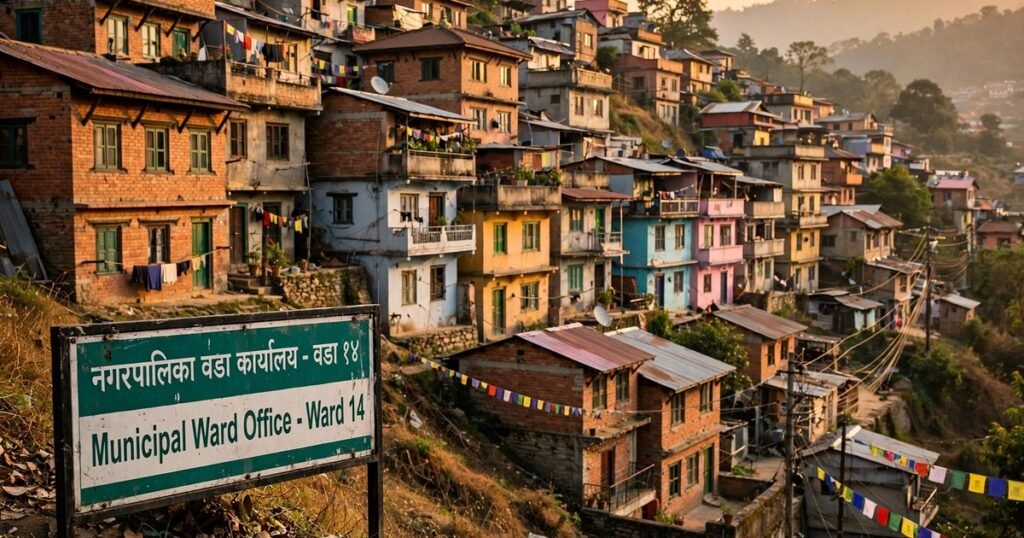
Nepal property tax explained in one sentence: every year, the local government where your house or land sits charges you a small percentage of what that property is worth — and that money pays for the roads, streetlights, and waste collection in your own ward.
The subject confuses almost everyone, because Nepal does not have one property tax. It has several charges with similar names, collected by different offices, under different laws. There is the annual property tax on your house and the land under it. There is malpot, the old land revenue, paid to the Land Revenue Office. There is a one-time registration fee when you buy land, and a capital gains tax when you sell it. And if you rent your house out, there is a house rent tax on top.
This guide puts the whole system on one page: what each charge is, who collects it, how much it costs, who is exempt, and how to pay on time.
Table of Contents
- Nepal Property Tax Explained: What It Is and Who Collects It
- Nepal Property Tax Explained: How Your Bill Is Calculated
- Nepal Property Tax Explained: The Rates — Kathmandu’s Example
- Nepal Property Tax Explained: Property Tax vs Malpot
- Nepal Property Tax Explained: What You Pay When You Buy or Sell
- Nepal Property Tax Explained: House Rent Tax, the Other Bill on Your Property
- Nepal Property Tax Explained: Exemptions, Discounts, and How to Pay
- Nepal Property Tax Explained: Why It Matters to Your Ward
- Frequently Asked Questions
- Sources
Table of Contents
Nepal Property Tax Explained: What It Is and Who Collects It
Nepal property tax explained at its simplest is a local tax, not a federal one. It is collected by the municipality or rural municipality where the property sits — one of Nepal’s 753 local governments, in 6,743 wards — and the money stays with that local government. The federal government does not collect it, and the province does not set it.
The power comes from the Local Government Operation Act, 2074 (2017), which gave local governments the right to levy their own taxes after federalism. Section 55 of the Act says a local government may levy property tax on houses and on the land a house occupies — the house’s footprint, and up to the same area again. Section 56 covers land revenue, or malpot, on other land. The Act also sets out how a property is valued: by its size, the type and construction of the building, its condition, its market value less depreciation, and whether it is used as a home or commercially — and the rate must take into account people’s living standards, economic means, and ability to pay.
Two things follow from that. First, there is no single national rate. Each local government fixes its own rates every year in its annual Finance Act, so the bill for the same house can differ between Kathmandu and Pokhara, or between a municipality and a rural municipality next door. Second, the Act caps the combined rate on land and house value at 10% — far above what any local level actually charges, so the cap is a ceiling, not a rate anyone pays.
Kathmandu Metropolitan City’s integrated property tax system, which replaced the old separate land and house taxes, dates to fiscal year 2075/76. Most other local levels followed the same model: one annual bill covering the house and the land under it, instead of two separate taxes.
Nepal Property Tax Explained: How Your Bill Is Calculated
Nepal property tax explained as a formula is simple:
(Total land value + total building value) × tax rate
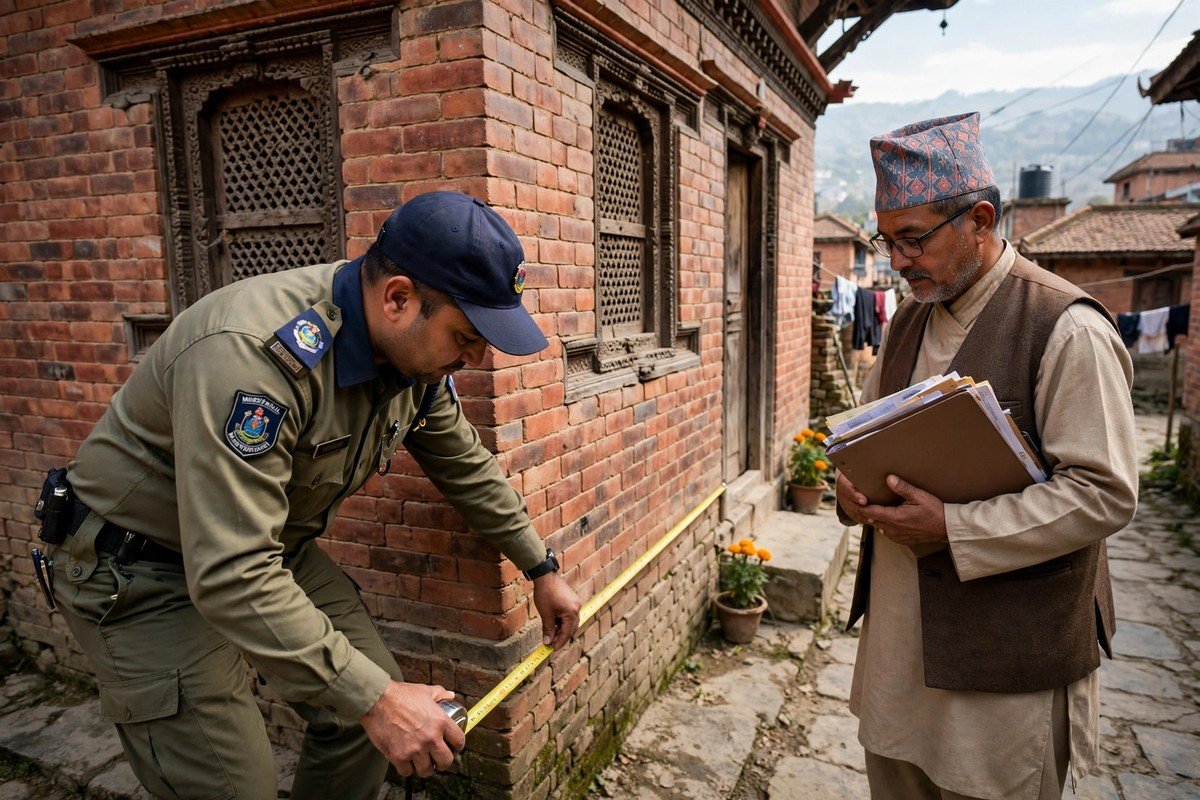
The hard part is the valuation, and it is done in two halves. The land is valued at the government rate for your area — the minimum valuation published by the district valuation committee before each fiscal year. The building is valued by the local government on the basis of its size, construction type (concrete, brick, mud-and-timber), condition, and age, with depreciation for older buildings. A new concrete house on a main road is valued higher than an old mud-brick house on a side lane, even if the plots are the same size.
That valuation is not the market price. It is an administrative value, and it is usually well below what the property would sell for. That is the main reason the tax bills look small: the rate is applied to a conservative value, not to the price a buyer would pay.
A worked example makes it concrete. In Kathmandu Metropolitan City, a house and land valued at Rs 1 crore attracts a property tax of about Rs 1,000 a year. A property valued at Rs 5 crore attracts about Rs 14,500. The bill is annual, it is due once a year, and it is paid at the ward office or the municipality’s revenue section — some metropolitan cities also accept online payment.
Nepal Property Tax Explained: The Rates — Kathmandu’s Example
Nepal property tax explained through Kathmandu’s published schedule shows how the system is progressive: the rate rises as the property value rises. The figures below are from Kathmandu Metropolitan City’s published schedule, and they are revised in the city’s annual Finance Act, so always confirm the current year’s rates at your ward office.
| Property value (Rs) | Annual property tax (Rs) |
|---|---|
| 1 crore | 1,000 |
| 2 crore | 2,500 |
| 3 crore | 4,500 |
| 4 crore | 8,500 |
| 5 crore | 14,500 |
| 6 crore | 24,500 |
| 8 crore | 84,500 |
| 10 crore | 174,000 |
| Above 10 crore | 0.60% of the value |
The pattern is worth noticing. The bill stays modest for ordinary houses — a Rs 1 crore home costs about Rs 1,000 a year, less than Rs 3 a day — and climbs steeply only for very high-value property. In percentage terms, the effective rate on a Rs 1 crore property is 0.01%, rising to 0.60% only above Rs 10 crore. Rural municipalities generally charge lower rates than metropolitan cities, and the exact slabs differ from place to place. There is no rate you can safely quote for the whole country; the schedule of your own local level is the only one that matters for your bill.
Nepal Property Tax Explained: Property Tax vs Malpot
Nepal property tax explained properly has to separate two charges that people constantly mix up: property tax and malpot. They are different taxes, collected by different offices, under different laws.
| Property tax | Malpot (land revenue) | |
|---|---|---|
| What it taxes | Your house and the land under it | Land, including empty land |
| Who collects it | Your municipality or rural municipality | The Land Revenue Office (Malpot Karyalaya) |
| Governing law | Local Government Operation Act, 2074, Section 55 | Land Revenue Act, 2034 (1977) |
| When it is due | Every year you own the property | Every year, as an annual land revenue |
| Valuation | Local government assessment of land + building | District committee’s minimum valuation, set under Section 8(2) of the Land Revenue Act before each fiscal year |
The two bills also do different jobs. The minimum valuation that malpot uses is the floor value for a land sale: when land changes hands, the registration fee and any capital gains tax are calculated on the higher of the declared sale price or the government’s minimum valuation. The property tax valuation, by contrast, only sets your annual bill.
One practical rule ties them together: you cannot transfer land until the dues are cleared. The seller must have paid the annual land revenue up to date — the tax clearance receipt, or tiro rasid — and the property tax must also be settled, because the Land Revenue Office will not register a transfer with arrears outstanding. And a transfer that is not registered at the Land Revenue Office has no legal validity at all.
Nepal Property Tax Explained: What You Pay When You Buy or Sell
Nepal property tax explained is only half the story of what property costs in tax. Buying and selling attract one-time charges that are much larger than the annual bill, and they catch first-time buyers by surprise.
The biggest is the registration fee, paid by the buyer at the Land Revenue Office when the sale deed (rajinama) is registered. There is no single national rate: each province sets it in its annual Finance Act, and within a province it varies by the type of local government where the land sits. The commonly reported schedule for fiscal year 2083/84 is:
| Local government type | Registration fee |
|---|---|
| Metropolitan city | 5% |
| Sub-metropolitan city | 4.5% |
| Municipality | 4% |
| Rural municipality | 2% |
| Apartment, any area | 1% flat |
The fee is charged on the higher of the declared value in the deed or the government’s minimum valuation for that location — so under-declaring the price does not reduce the fee. Property inside the Kathmandu Valley also commonly carries an extra surcharge, the Bagmati Savyata Kosh, of 5% of the registration fee itself (not 5% of the property value).
The seller has a separate bill: capital gains tax on the profit from the sale. Under the current Finance Act, an individual seller pays 10% of the gain if the property was held for five years or less, and 7.5% if it was held longer, applying to gains above Rs 10 lakh. The tax is collected at the Land Revenue Office at the moment of registration, so it cannot be deferred or overlooked.
Two more details matter at the point of sale. First, local governments collect the registration fee and share 40% of it with the province — so the fee is also a revenue-sharing arrangement, not just a cost to the buyer. Second, always get the seller’s latest municipal tax receipts before you sign: any unpaid property tax or land revenue becomes your problem, because the transfer will not be registered until it is cleared.
Nepal Property Tax Explained: House Rent Tax, the Other Bill on Your Property
Nepal property tax explained would be incomplete without the house rent tax — ghar bahal kar — which applies when you rent your property out. It is a separate local tax under the same Local Government Operation Act, and it is charged on the rental income, not on the property value.
Kathmandu Metropolitan City levies 10% of the annual rent. The tax is legally the landlord’s, even if the lease tries to pass it to the tenant. There is a split in who collects it: rent paid to a company or legal person is subject to federal withholding tax of 10% under the Income Tax Act, while rent paid to an individual landlord is taxed locally. The Supreme Court clarified this in a decision in 2081/82, ruling that local governments may tax rent only from natural persons, not from companies.
The rates are moving. In its budget for fiscal year 2083/84, Kathmandu Metropolitan City cut the rent tax for small landlords: where the annual rental income is below Rs 240,000, the rate falls to 7% for residential use and 5% in other cases, down from 10%. Rental income is also part of your income tax — for the slabs that apply, see our explainer on Nepal’s income tax.
The sums involved are large. In fiscal year 2079/80, Kathmandu Metropolitan City collected Rs 10.25 billion in rental taxes from institutions, and Rs 8.08 billion in property tax — the two together are the backbone of the city’s own revenue.
Nepal Property Tax Explained: Exemptions, Discounts, and How to Pay
Nepal property tax explained in full includes who does not pay. Section 55(5) of the Local Government Operation Act exempts property owned by the federal, provincial, or local government; government hospitals; Guthi property; non-profit government educational institutions and other public bodies; religious institutions such as temples, monasteries, churches, and mosques; public places such as drinking-water ponds, cremation grounds, bus parks, stadiums, and parks; and embassies and diplomatic missions. Ordinary private homes do not qualify — but many local levels exempt very small properties, or charge only a nominal amount, so check your own municipality’s schedule.
The discount is the part most people miss. Local governments commonly offer an early-payment discount of around 10% if you pay within the first months of the fiscal year. Kathmandu Metropolitan City, in its fiscal year 2083/84 budget, announced a 10% discount for taxpayers who pay by mid-October, and a waiver of penalties for those who clear arrears by the same date. Paying early is the simplest way to cut the bill.
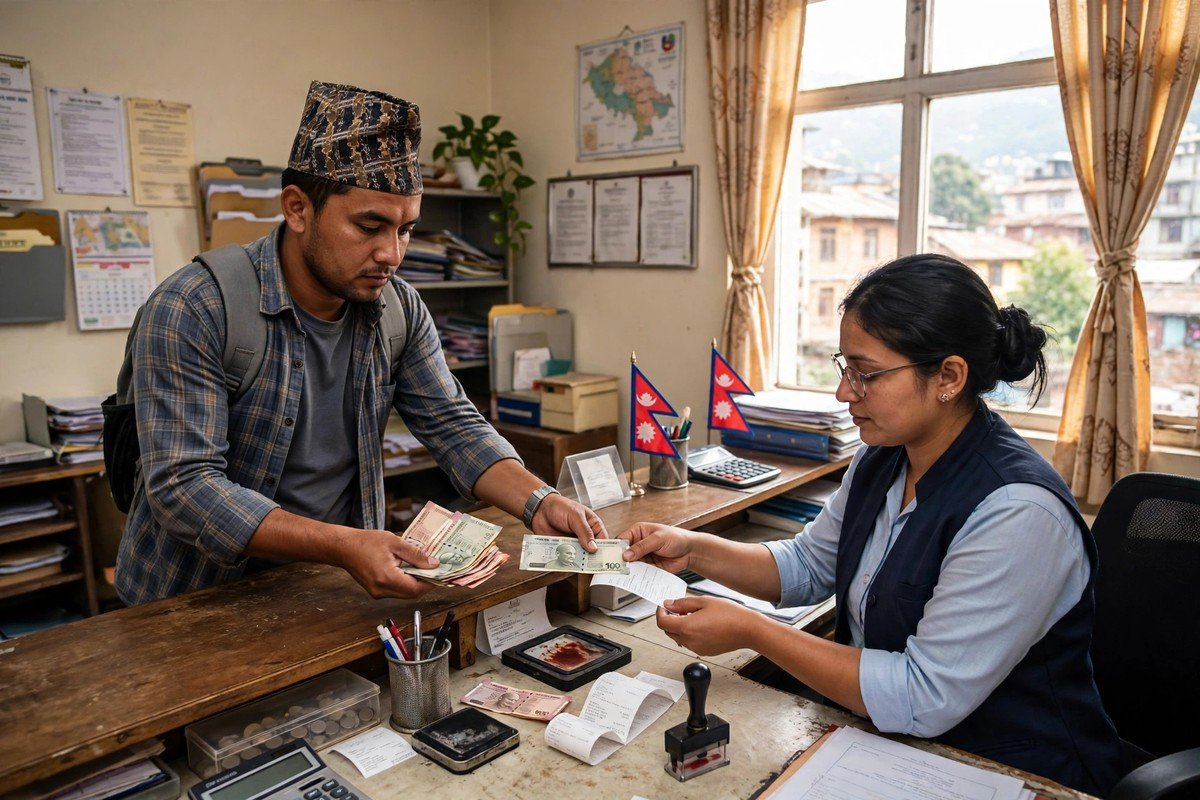
Paying is straightforward: take your citizenship certificate and the property ownership document (lalpurja) to your ward office or the municipality’s revenue section, and pay the assessed amount. Some metropolitan cities now accept payment online. Keep the receipt — you will need it for any land transfer, any recommendation from the ward, and any bank loan against the property.
If the valuation looks wrong, ask the ward office for the calculation in writing: the land rate applied, the building valuation, and the slab used. There is no straightforward appeal route written into the Local Government Operation Act for challenging a valuation, so the practical step is to get the figures on paper and raise it with the municipal executive — and to check the current year’s published rates before you pay, because rates are revised every year.
Nepal Property Tax Explained: Why It Matters to Your Ward
Nepal property tax explained as a civic question comes down to this: it is the tax that most directly connects what you pay with what you get. Unlike income tax or VAT, which go to the federal government and come back as grants, property tax is raised locally and spent locally — on the road outside your house, the streetlight on your lane, and the waste collection in your ward.
It is also the largest single source of money that local governments raise themselves. A 2021 study by the Ministry of Federal Affairs and General Administration found that property tax made up 13% of local governments’ internal revenue — 19% for metropolitan cities, with Pokhara highest at 29.41% and Kathmandu at 18%. The same study found that the average metropolitan city collected less than $5 per person per year in property tax — a sign of how much potential is still uncollected, and how low the burden is for most households.
That is the trade-off at the heart of the system. Nepal’s local governments depend heavily on federal grants — transfers made up nearly half of all local revenue in fiscal year 2023/24 — and their own-source revenue is what gives them room to act without waiting for Kathmandu. For the full picture of where local money comes from and where it goes, see our explainer on how local governments spend your tax money.
Property tax will not make headlines the way income tax or VAT does. But it is the one tax where the link between paying and receiving is visible from your own doorstep — and that is exactly why it is worth understanding.
Frequently Asked Questions
What is property tax in Nepal?
Nepal property tax explained in brief: it is an annual tax on your house and the land under it, collected by your municipality or rural municipality under Section 55 of the Local Government Operation Act, 2074. The rate is set by your local government each year, and the bill is based on the assessed value of the land and building — not the market price.
How much is property tax in Kathmandu?
Under Kathmandu Metropolitan City’s published schedule, a property valued at Rs 1 crore attracts about Rs 1,000 a year, a Rs 5 crore property about Rs 14,500, and a Rs 10 crore property about Rs 174,000. Above Rs 10 crore the rate is 0.60% of the value. Rates are revised in the city’s annual Finance Act, so confirm the current year’s schedule at your ward office.
Is property tax the same as malpot?
No. Property tax is an annual local tax on your house and the land under it, collected by the municipality under the Local Government Operation Act, 2074. Malpot is the annual land revenue on land, collected by the Land Revenue Office under the Land Revenue Act, 2034, and it also applies to empty land. The two are separate bills, paid to different offices.
Who is exempt from property tax in Nepal?
Government-owned property, government hospitals, Guthi property, non-profit educational institutions and public bodies, religious institutions, public places such as parks and cremation grounds, and embassies are exempt under Section 55(5) of the Local Government Operation Act. Ordinary private homes are not exempt, though many local levels charge only a nominal amount on very small properties.
What happens if I don’t pay property tax?
Arrears accumulate, and penalties apply. More importantly, unpaid property tax and land revenue block a land transfer: the Land Revenue Office will not register a sale until all dues are cleared, and you will also need a tax clearance receipt for ward recommendations and bank loans. Paying early — by mid-October in Kathmandu — earns a 10% discount.
Do I pay property tax on empty land?
Property tax applies to a house and the land under it. Empty land without a house is charged land revenue (malpot) through the Land Revenue Office instead. When you later build on it, the property tax assessment begins.
Sources: Local Government Operation Act, 2074 (2017), Sections 54–63, via the Law Commission of Nepal (lawcommission.gov.np); Land Revenue Act, 2034 (1977), Sections 8(2) and 31; Kathmandu Metropolitan City published property tax schedule (Rs 1 crore → Rs 1,000; Rs 5 crore → Rs 14,500; Rs 10 crore → Rs 174,000; above Rs 10 crore 0.60%) and fiscal year 2083/84 budget (10% early-payment discount by mid-October; rent tax cut to 7% residential / 5% where annual rental income is below Rs 240,000), reported by Artha Sarokar, 19 June 2026; My Republica (Kathmandu Metropolitan City collected Rs 8.08 billion in property tax and Rs 10.25 billion in rental taxes in fiscal year 2079/80); Ministry of Federal Affairs and General Administration study 2021, via The Kathmandu Post, 2 May 2023 (property tax 13% of local internal revenue; metropolitan cities 19%; Pokhara 29.41%; Kathmandu 18%; metropolitan per-capita property tax below $5); land registration fee schedule for fiscal year 2083/84 — 5% metropolitan city, 4.5% sub-metropolitan city, 4% municipality, 2% rural municipality, 1% apartments; Bagmati Savyata Kosh 5% of the registration fee in the Kathmandu Valley; capital gains tax 10% (held five years or less) / 7.5% (held longer) on gains above Rs 10 lakh under the Finance Act; Supreme Court decision 2081/82 on house rent tax jurisdiction (local tax applies to natural persons only)