

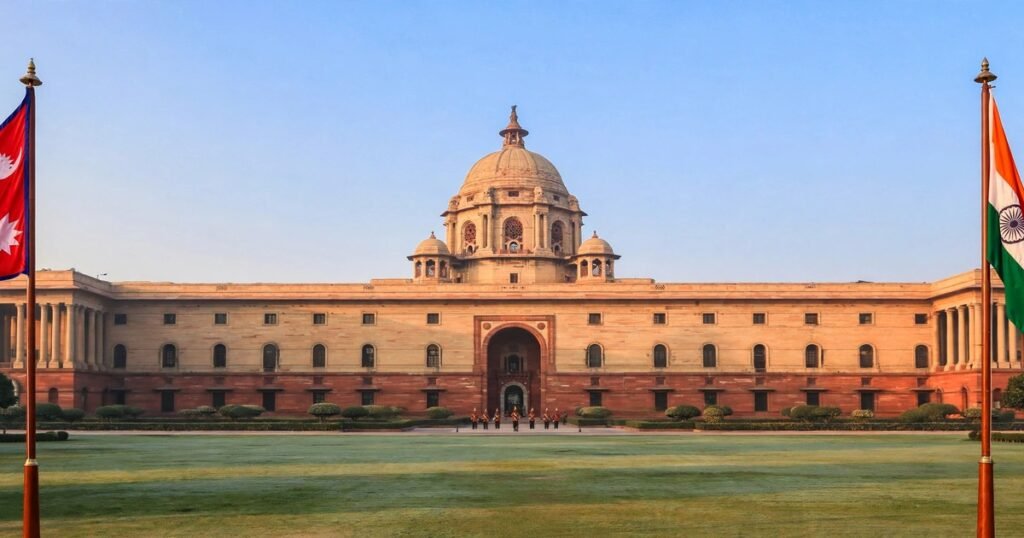
Balen Shah India visit different in almost every way that matters — the man, the mandate, the moment, and the message. As this article is published on Monday 23 November 2026, Nepal’s prime minister is in delegation-level talks with Indian Prime Minister Narendra Modi at Hyderabad House in New Delhi, on a visit that lasts barely a day and carries a request worth about $2 billion.
Every Nepali prime minister since the republic was declared has made this trip. The destination is the same, the ceremonial welcome at Rashtrapati Bhavan is the same, and the list of issues — energy, trade, transit, the border, air routes — is largely the same. What makes the Balen Shah India visit different is not where he has gone. It is who is going, how he got there, and what he is asking for.
This is not a story about the outcomes. The two prime ministers are still talking as this piece goes live, and the joint press statement is scheduled for 12:35pm Indian time (12:50pm Nepali time). What the visit delivers will be covered in a separate outcomes explainer this evening. This piece is about why the visit itself is unlike any prime ministerial trip to Delhi before it.
Table of Contents
- Balen Shah India visit different: the man at the centre
- Balen Shah India visit different: the mandate behind him
- Balen Shah India visit different: the moment he arrives in
- Balen Shah India visit different: the format of the trip
- Balen Shah India visit different: the agenda on the table
- What has not changed: the old issues still on the table
- Balen Shah India visit different: what to watch next
- Frequently asked questions
Balen Shah India visit different: the man at the centre
No Nepali prime minister has arrived in Delhi with a biography like Balen Shah’s. He is 36 now — he was 35 when he was sworn in on 27 March 2026, having been born on 27 April 1990. He is the 43rd prime minister of Nepal, the first Madhesi prime minister, and the youngest democratically elected prime minister the country has had.
That last point needs care. He is not the youngest person ever to hold the office — Surya Bahadur Thapa and Jung Bahadur Rana were younger when they were appointed, in 1963 and 1846. Balen Shah is the youngest to reach it through an election.
His route to the top is without precedent. He was a rapper and a civil engineer before he entered politics. In 2022 he was elected mayor of Kathmandu as an independent, defeating the candidates of the established parties. Four years later he entered Parliament for the first time — and became prime minister the same day he entered it, having defeated former prime minister KP Sharma Oli in Jhapa-5 by 49,614 votes.
Every prime minister before him came to Delhi as a career politician: a party leader with decades of organisation behind him, a record of earlier visits, and a foreign-policy establishment that had worked with Delhi for years. Balen Shah has none of that. He has no previous foreign-policy record to defend, no old promises to Delhi to honour, and no party machine to fall back on. For Delhi, that is unfamiliar ground: the Balen Shah India visit different begins with a prime minister India has never dealt with before, in any role. That is the first way the Balen Shah India visit different stands out from the trips that came before it.
Balen Shah India visit different: the mandate behind him
The second difference is the mandate. Balen Shah leads the Rastriya Swatantra Party (RSP), which won 182 of the 275 seats in the House of Representatives in the election of 5 March 2026 — a result no party had achieved before, with a turnout of about 60 percent.
The RSP is a new party, formed only a few years before the election. It did not grow out of the old party system. It won because of the Gen Z protests of September 2025, when young Nepalis took to the streets against corruption and misgovernance. Seventy-six people were killed in those protests, according to Amnesty International. The House of Representatives was dissolved on 12 September 2025, and Balen Shah was appointed prime minister under Article 76(1) of the Constitution — the first use of that article since the Constitution was adopted in 2015.
That history matters in Delhi. Earlier prime ministers arrived as leaders of parties that had governed before, negotiated before, and made compromises before. Balen Shah arrives as the product of a street movement that overthrew the old order. His government was not built by a party machine; it was built by a protest. The Balen Shah India visit different in this respect: the man across the table was put there by a generation that had never voted for the old parties — and that generation is watching what he brings home.
It also means his room for manoeuvre is different. A career politician can return from Delhi with a partial result and explain it to his party. Balen Shah’s support is younger, less patient, and less attached to any party. A weak outcome would be read not as a negotiating failure but as proof that the new politics is no different from the old. That is the pressure the Balen Shah India visit different carries into Hyderabad House.
Balen Shah India visit different: the moment he arrives in
The third difference is the moment. Nepal’s prime ministers have visited Delhi after elections, after crises, and after blockades. This is the first visit after a government was brought down by its own young people — and the first by a prime minister whose entire authority rests on that change.
It is also a visit shaped by a disaster. On 26 August 2026, floods in the Bhotekoshi and Trishuli river basins caused destruction on a scale Nepal had not seen in years. The World Bank estimated the physical damage at about $1.66 billion. The government’s own Rapid Disaster Needs Assessment put the total reconstruction and recovery need at about $4.77 billion. That is the background to the visit’s biggest ask: roughly $2 billion in Indian assistance for flood reconstruction and infrastructure.
The timing is also different in a narrower sense. This is Balen Shah’s first bilateral trip abroad as prime minister — his first state visit anywhere. Earlier prime ministers usually made their first foreign trip to India too, but they did so as experienced leaders with established relationships. Balen Shah is meeting Narendra Modi for the first time as prime minister, in a visit that was arranged within weeks of his government taking office.
And the relationship itself is at a familiar crossroads. Nepal-India relations run in a cycle: a new government arrives, both sides talk of a reset, agreements are signed on trains, power and roads, and the hard issues — the 1950 treaty, Kalapani, Lipulekh and Limpiyadhura, the Pancheshwar project — are referred to officials and stall. The Balen Shah India visit different in this respect too: it arrives at the start of that cycle with a leader who has no stake in how the cycle has always run.
Balen Shah India visit different: the format of the trip
The fourth difference is the format. The visit was cut from three days to about 25 hours. Balen Shah arrived in New Delhi on Sunday afternoon, 22 November, and is due to fly back to Kathmandu on Monday evening, with his flight scheduled for 6:35pm. The longer legs that had been planned — to Bengaluru, Ahmedabad and Uttarakhand — were dropped.
What remains is concentrated. On Sunday evening he was received by Union Minister Jitin Prasada and held a courtesy meeting with India’s External Affairs Minister S. Jaishankar at the Taj Mahal Hotel, followed by a business roundtable. On Monday he received a ceremonial welcome at Rashtrapati Bhavan at 10:00am, paid tribute at Rajghat, and moved to Hyderabad House for talks: a one-on-one meeting with Modi that began at 11:15am, followed by delegation-level talks at 11:50am. A joint press statement is scheduled for 12:35pm Indian time, then a luncheon hosted by Modi, a call on President Droupadi Murmu at 3:15pm, and the flight home.
The delegation is large for such a short trip: a 34-member government delegation, including Finance Minister Swarnim Wagle, Foreign Minister Shishir Khanal, Chief Adviser Kumar Byanjankar, Foreign Secretary Amrit Bahadur Rai and Nepal’s Ambassador to India, Dr Nischal Nath Pandey — plus a 52-member business delegation. The size of the business delegation is itself a signal: this is a visit about money and projects, not only about politics. That emphasis on deals over ceremony is another way the Balen Shah India visit different from the state visits of the past.
Compare that with the past. K.P. Sharma Oli’s first visit in February 2016 lasted six days. Sher Bahadur Deuba’s state visit in August 2017 lasted five days. Pushpa Kamal Dahal’s visit in May–June 2023 lasted four days. The Balen Shah India visit different in its very shape: a single working day, built around one meeting and one press conference, with no time for the ceremonial touring that usually fills a state visit.
Balen Shah India visit different: the agenda on the table
The fifth difference — and the one the Balen Shah India visit different will be judged on — is the agenda, and the size of the ask. Nepal is seeking about $2 billion in Indian assistance, a mix of concessional loans and grants for flood reconstruction and infrastructure. To be clear: this is a proposal, not an agreed package. The exact split between loans and grants is reported differently by different outlets, and nothing is settled until the talks conclude. The package is examined in detail in a separate piece later today.
The rest of the agenda is familiar, but the context has changed:
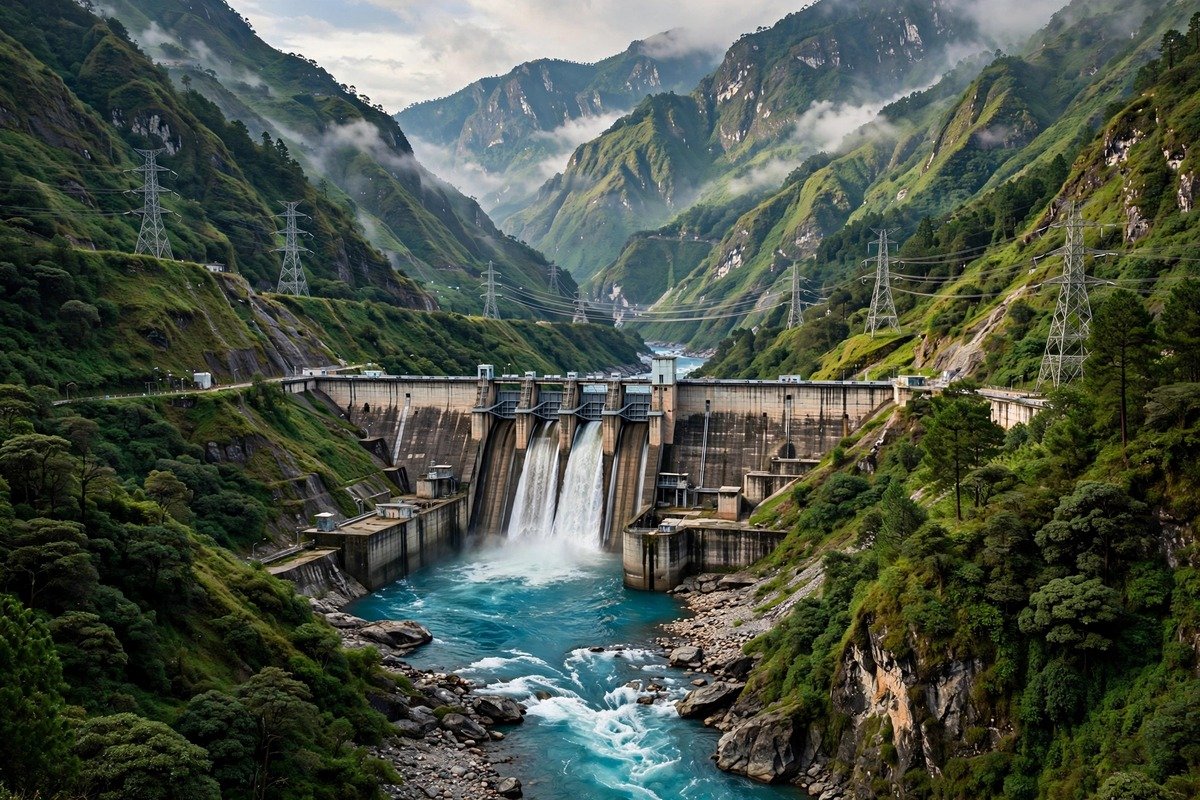
Energy. The long-term power deal agreed in January 2024 — India to import 10,000 MW of Nepali electricity over ten years — is the centrepiece of the economic relationship. Nepal now exports power to India and, in the last fiscal year, earned about NPR 18 billion in net power export earnings. The two prime ministers are also scheduled to lay the foundation stone of the 669 MW Lower Arun Hydropower Project in Sankhuwasabha, being built by India’s SJVN.
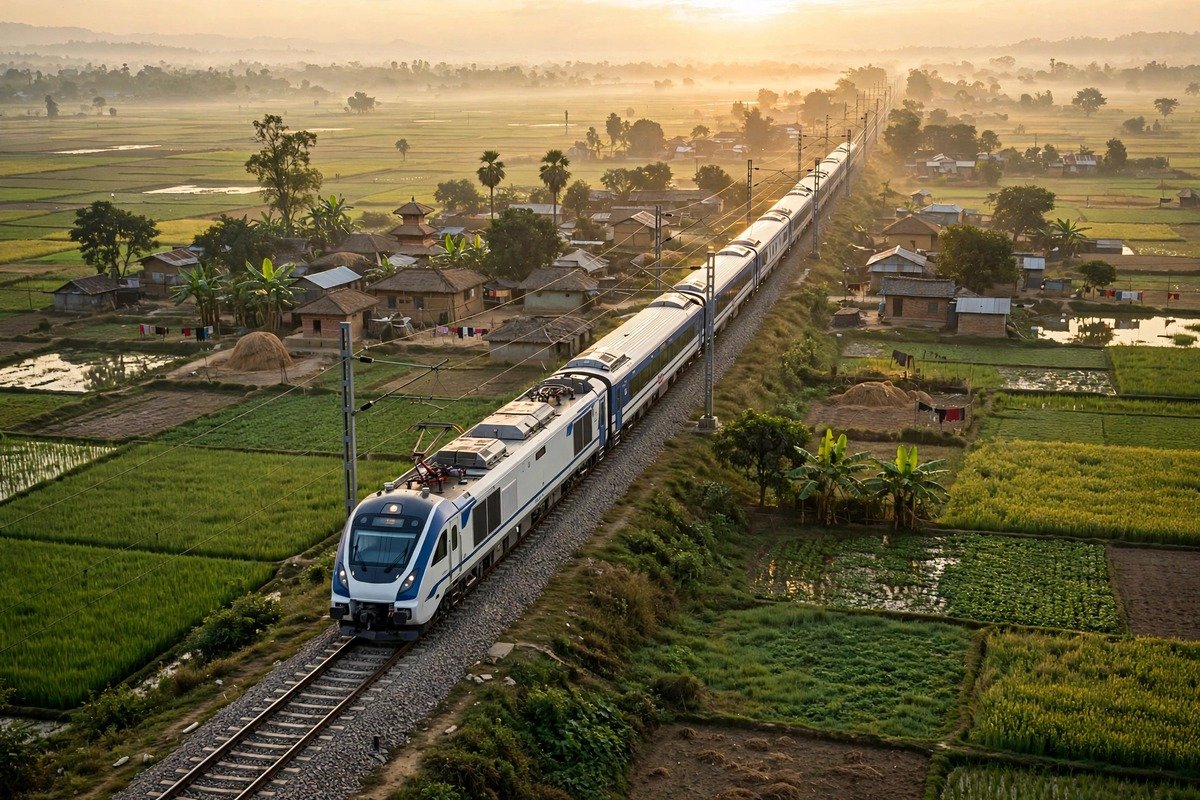
Connectivity. The two leaders are expected to virtually flag off the Saryu-Kamala Express, a new weekly train service connecting Ayodhya in India with Janakpur Dham in Nepal. It is the latest in a line of cross-border rail links — Jaynagar–Kurtha was flagged off during Deuba’s 2022 visit — but this one carries religious and cultural weight that the earlier ones did not.
Air routes. Nepal has long asked for additional air entry routes through Indian airspace, including a high-altitude route. The request has been on the table since at least 2022. It is expected to be raised again, with India seeking a reciprocal concession in return.
A joint vision. The two sides are expected to unveil a ten-point joint vision document, “Prosperous Nepal, Developed India”, setting long-term targets in sectors including energy, transit, digital connectivity and health. A joint vision was also the outcome of Deuba’s 2022 visit, when the two sides issued a Joint Vision Statement on Power Sector Cooperation. The test, as always, is whether the vision is followed by projects.
Cooperation agreements. Memoranda of understanding are expected on education, health, agriculture, sports, disaster management and human resource development — the working-level agreements that fill out a state visit.
What is striking is how much of the agenda is about building things: a train, a dam, a highway, a power line. The Balen Shah India visit different in this respect as well: the ask is concrete and priced — about $2 billion — rather than a general appeal for goodwill.
What has not changed: the old issues still on the table
For all that is different, the hardest issues are the same ones that have stalled every visit for a decade.
The 1950 Peace and Friendship Treaty, the Kalapani–Lipulekh–Limpiyadhura border dispute, and the Pancheshwar multipurpose project have been on the agenda of every prime ministerial visit since the republic. Each time they are discussed; each time they are referred to officials for further study. The pattern is documented in our earlier piece on how Nepal’s earlier prime ministers handled India.
The Eminent Persons Group (EPG) is the clearest example. Formed in 2016 to review the whole bilateral relationship, including the 1950 treaty, it agreed its final joint report on 30 June 2018. Prime Minister Modi has never formally received it, and the report has never been officially published. Eight years later, it is still waiting.
Whether Balen Shah raises these issues differently is one of the things to watch in the joint statement. A new prime minister with no history of compromise on them could press harder — or could decide, like his predecessors, that a short first visit is not the place to open them. Either way, the issues themselves have not changed: in that respect, the Balen Shah India visit different is not different at all. Only the man raising them has.
Balen Shah India visit different: what to watch next
The visit is not over as this article is published, and the outcomes are not yet public. Three things will tell us whether the Balen Shah India visit different produced a different result:
First, the $2 billion. Was the package agreed, and on what terms — how much is grant, how much is loan, and what conditions are attached? India has been reported as “favourably considering” the proposal, with funds released in tranches tied to project reports and progress. An agreement in principle would be a major result; a promise to consider it further would be a familiar one.
Second, the joint vision. Is the ten-point “Prosperous Nepal, Developed India” document adopted, and does it carry measurable targets and deadlines? A vision with numbers is different from a vision with adjectives.
Third, the old issues. Does the joint statement mention the border, the 1950 treaty, or the EPG report — or does it stay silent, as the 2018 joint communiqué did on the trade deficit and the border?
The joint press statement is scheduled for 12:35pm Indian time. Hamro Niti will publish a full outcomes explainer this evening, once the agreements are public and confirmed by official sources. Until then, the honest summary is this: the Balen Shah India visit different in four ways — a new kind of prime minister, a new kind of mandate, a shorter trip than any of his predecessors, and a bigger, more specific ask than any of them made — and he returns home tonight to a country that is watching closely to see what he brings back.
Frequently asked questions
Is this Balen Shah’s first visit to India as prime minister?
Yes. The visit on 22–23 November 2026 is his first bilateral trip abroad as prime minister, and his first state visit to India since taking office on 27 March 2026. He met India’s External Affairs Minister S. Jaishankar on Sunday evening and Prime Minister Narendra Modi on Monday.
How long is Balen Shah’s India visit?
About 25 hours. He arrived in New Delhi on Sunday afternoon, 22 November, and is due to fly back to Kathmandu on Monday evening, with his flight scheduled for 6:35pm. The visit was cut from a planned three days, with legs to Bengaluru, Ahmedabad and Uttarakhand dropped.
What is the $2 billion package Nepal is asking for?
It is a proposal — not an agreed package — for about $2 billion in Indian assistance, a mix of concessional loans and grants for flood reconstruction and infrastructure. The exact split between loans and grants is reported differently by different outlets. Nepal’s flood reconstruction need is estimated at about $4.77 billion by the government’s own assessment, while the World Bank estimated the physical damage from the August 2026 floods at about $1.66 billion.
Why is the Balen Shah India visit different from earlier prime ministers’ visits?
Four reasons: the man (a rapper-turned-mayor-turned-prime-minister, 36, a first-time MP who defeated a former prime minister); the mandate (a new party, the RSP, that won 182 of 275 seats after the Gen Z protests of September 2025); the moment (a post-protest government with a flood reconstruction bill); and the format (a 25-hour trip built around a single meeting, with a specific $2 billion ask).
What happened on earlier prime ministers’ India visits?
The pattern is consistent: agreements on trains, power and roads usually deliver, while the hard issues — the 1950 treaty, the Kalapani border dispute and the Pancheshwar project — stall. K.P. Sharma Oli’s 2016 visit produced nine agreements and a $250 million grant but no joint statement; his 2018 visit produced a 12-point communiqué silent on the border and the trade deficit; Pushpa Kamal Dahal’s 2023 visit produced the 10,000 MW power deal. Our earlier piece covers these visits in detail.
When will we know what the visit achieved?
The joint press statement is scheduled for 12:35pm Indian time (12:50pm Nepali time) on Monday 23 November, after the delegation-level talks. Hamro Niti will publish a full outcomes explainer this evening, once the agreements are confirmed by official sources.
Sources
- Ministry of Foreign Affairs, Nepal (mofa.gov.np) — visit schedule and delegation details: https://www.mofa.gov.np/
- The Kathmandu Post — “Shah, Modi hold one-on-one talks in New Delhi”, 23 November 2026: https://kathmandupost.com/national/2026/11/23/shah-modi-hold-one-on-one-talks-in-new-delhi
- The Himalayan Times — “PM Shah holds talks with Modi during India state visit”, 23 November 2026: https://thehimalayantimes.com/nepal/pm-shah-holds-talks-with-modi-during-india-state-visit
- The Himalayan Times — “PM Shah in New Delhi on maiden visit to India, reportedly seeking $2b in aid”: https://thehimalayantimes.com/nepal/pm-shah-in-new-delhi-on-maiden-visit-to-india-reportedly-seeking-2b-in-aid
- NDTV — “Nepal PM Balendra Shah To Meet PM Modi Today. What’s On Agenda”: https://www.ndtv.com/world-news/nepal-pm-balendra-shah-to-meet-pm-modi-today-whats-on-agenda-12363959
- The Hindu BusinessLine — “Nepal PM visit: India weighs $2 billion development package for Kathmandu”, 22 November 2026: https://www.thehindubusinessline.com/economy/nepal-pm-visit-india-weighs-2-billion-development-package-for-kathmandu/article71731299.ece
- My Republica — “Balen Shah sworn in as Nepal’s youngest democratically elected PM”, 27 March 2026: https://myrepublica.nagariknetwork.com/news/balen-shah-sworn-in-as-nepals-youngest-democratically-elected-pm-32-52.html
- Hamro Niti — “PM Balen Shah’s India Visit, Explained” (B1): https://hamroniti.com/balen-shah-india-visit-explained/
- Hamro Niti — “How Nepal’s Earlier Prime Ministers Handled India” (B3): https://hamroniti.com/nepal-pm-india-visit-history/
- Hamro Niti — “Nepal’s trade deficit, explained”: https://hamroniti.com/nepal-trade-deficit-explained/
Published as the talks are under way in New Delhi on Monday 23 November 2026. Outcomes will be covered in a separate explainer this evening, once confirmed by official sources.