

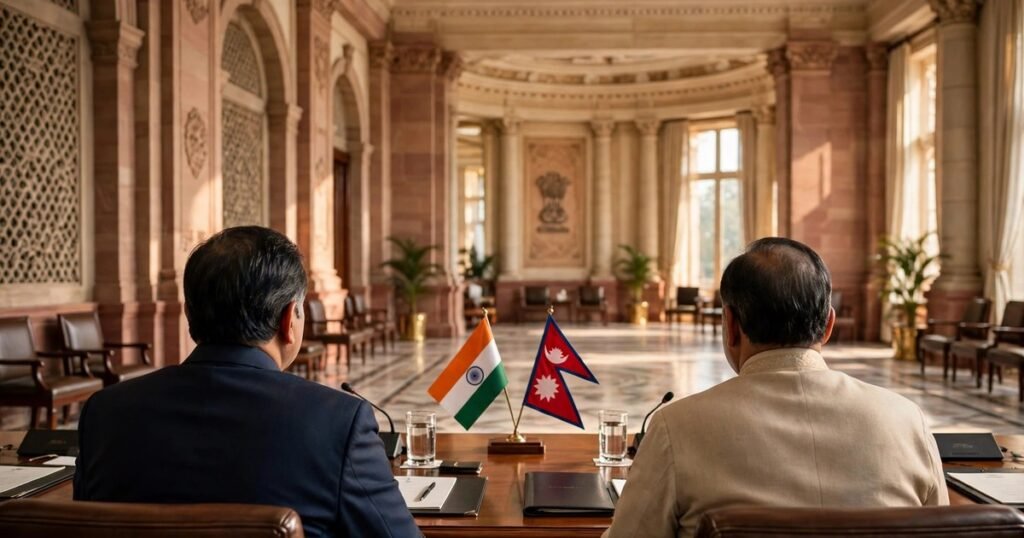
Nepal PM India visit history is a story of resets. Every prime minister since the republic has arrived in New Delhi promising a fresh start, and every one of them has left with a mix of signed papers and unfinished business. Trains got built. Power lines got switched on. Pipelines got laid. But the hardest questions — the 1950 treaty, the border at Kalapani, the Pancheshwar dam — kept getting sent back to officials for another round of talks.
That pattern matters right now. Prime Minister Balen Shah arrived in New Delhi on Sunday, 22 November 2026, for his first bilateral trip abroad, with talks scheduled for Monday morning. He is stepping into a cycle that is now more than a decade old. To understand what he can realistically expect, it helps to look at what his three predecessors actually did in Delhi — and what they brought home. Read closely, Nepal PM India visit history shows the same split, visit after visit.
Table of Contents
- Why Nepal PM India visit history matters
- Nepal PM India visit history: Oli’s first visit — rebuilding after the blockade
- Nepal PM India visit history: Oli’s second visit — railways, waterways, and silence
- Nepal PM India visit history: Deuba and the long game
- Nepal PM India visit history: Prachanda and the power deal
- The pattern: what delivers, and what stalls
- What Balen Shah is stepping into
- Frequently asked questions
- Sources
Table of Contents
Why Nepal PM India Visit History Matters
India is Nepal’s largest trading partner, its main transit route to the sea, and the buyer of most of the electricity Nepal exports. No Nepali prime minister can ignore Delhi — and no Nepali prime minister has ever fully solved the relationship with it either.
That is why the first foreign visit of a new prime minister is watched so closely. It is the moment a new government sets out what it wants: cheaper fuel, more power trade, a new railway, a border settlement, or simply a better tone. The visit is also a test. A prime minister who comes home with signed agreements looks effective. One who comes home with only promises looks weak.
Over the past decade, three men have made that trip as prime minister: KP Sharma Oli, Sher Bahadur Deuba, and Pushpa Kamal Dahal “Prachanda”. Between them, they visited India ten times in twenty years, by one count. Nepal PM India visit history shows a clear split. Practical projects — power lines, railways, pipelines, check posts — move forward. Political questions — the treaty, the border, the big dam — do not.
Nepal PM India Visit History: Oli’s First Visit — Rebuilding After the Blockade
KP Sharma Oli’s first visit to India, from 19 to 24 February 2016, was the most loaded of all. Nepal had just promulgated its new constitution in September 2015. An economic blockade followed — roughly six months in which fuel, medicines, and essential goods barely crossed the southern border. By the time Oli landed in Delhi, the blockade had been lifted, but the anger in Kathmandu had not.
It was the first bilateral visit by a Nepali prime minister to India since Baburam Bhattarai in 2011. Oli did not come with what analysts called a “shopping list”. He came to repair the relationship — and he left with nine agreements.
The biggest was money for rebuilding. India signed a memorandum of understanding on using a US$250 million grant it had pledged after the April 2015 earthquake: US$100 million for 50,000 houses in 14 severely affected districts, and US$50 million each for health, education, and cultural heritage in 31 affected districts.
The visit also delivered on connectivity. The two prime ministers jointly inaugurated the 400 kV Muzaffarpur–Dhalkebar transmission line, which would bring 80 MW of Indian electricity to Nepal immediately, rising to 200 MW by October 2016 and 600 MW by December 2017. A separate agreement sped up the remaining 518 km of the first phase of the Hulaki (Postal) Highway in the Tarai. Two smaller cross-border power lines — Kataiya–Kushaha and Raxaul–Parwanipur — were also inaugurated remotely.
On trade, Nepal won transit access it had long wanted: the use of Bangladesh through the Kakarbhitta–Banglabandh corridor, the operationalisation of Visakhapatnam port for third-country trade, and rail transit through Singhabad in West Bengal.
And there was one agreement that pointed at the future. The two sides formally announced an eight-member Eminent Persons Group — four members from each country — mandated to review all aspects of bilateral relations, including the 1950 Treaty of Peace and Friendship.
But there was a telling omission: no joint statement was issued. India still differed with Nepal over the new constitution, and the visit ended without the usual shared document. Oli got the papers signed. He did not get the political endorsement.
Nepal PM India Visit History: Oli’s Second Visit — Railways, Waterways, and Silence
Oli returned to Delhi from 6 to 8 April 2018, this time as the head of a government with a near two-thirds majority. The mood was different, and so was the agenda. Instead of repair, the talk was about ambition.
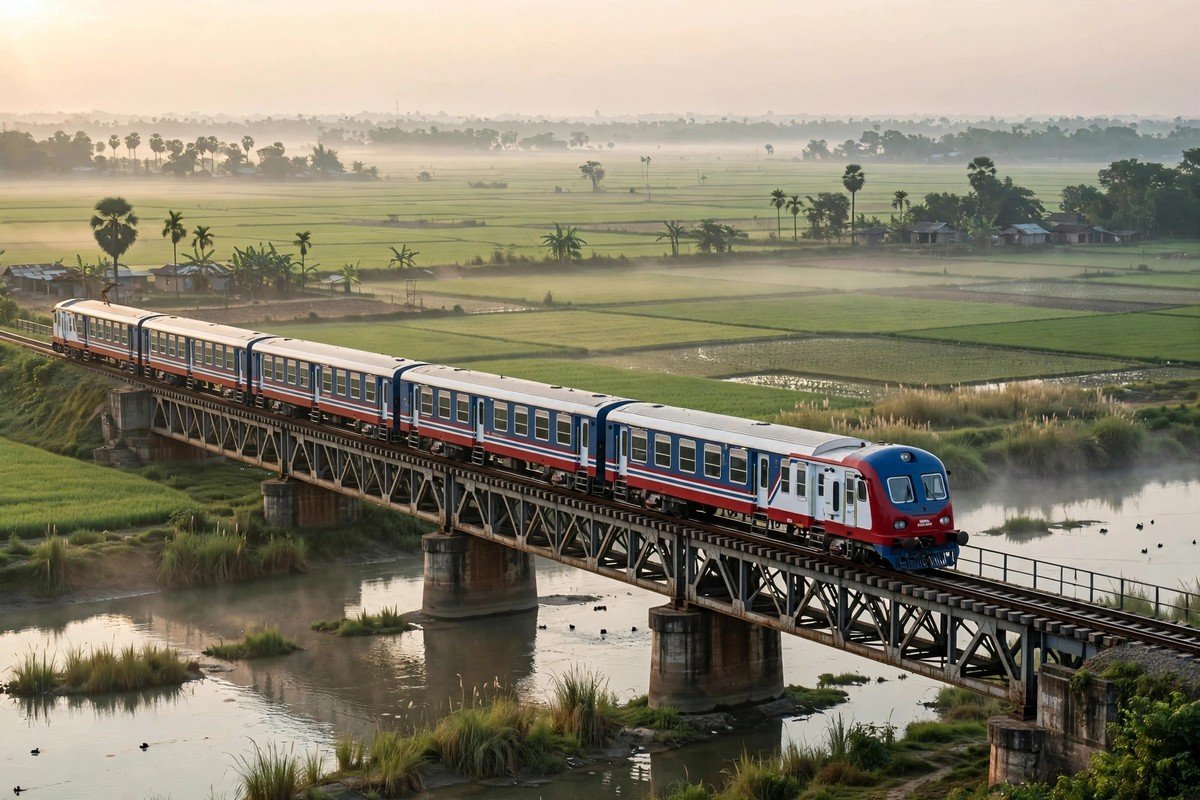
The headline items were a pre-feasibility study for an electric railway from Raxaul to Kathmandu, and access to the sea through inland waterways — Nepal would be able to move cargo by river to Indian ports. An agriculture memorandum was signed as well.
The two sides issued a 12-point joint communiqué. But what it left out mattered as much as what it included. It did not mention Nepal’s trade deficit with India. It did not mention the border disputes at Kalapani and Susta. The big political questions were simply not on the page.
The pattern was now visible. When a visit focused on projects, it produced results. When it touched the old disputes, both sides preferred silence. It is the first clear lesson of Nepal PM India visit history.
Nepal PM India Visit History: Deuba and the Long Game
Sher Bahadur Deuba’s relationship with Delhi stretches back further than any other recent prime minister, and in Nepal PM India visit history his is the longest arc. It was during his 1996 visit that Nepal and India signed the Mahakali Treaty, the agreement that was supposed to unlock the Pancheshwar multipurpose project on the Mahakali river. Thirty years later, Pancheshwar is still not built — and the detailed project report was still being promised “within a month” during his 2017 visit.
Deuba visited India again in March 2002 and September 2004, but neither trip produced concrete decisions on the 1950 treaty or Pancheshwar. The pattern held: the visits happened, the handshakes were photographed, and the hard files stayed open.
His five-day state visit from 23 to 27 August 2017 was more productive on the practical side. The two sides agreed on the procedure for an Indian grant to rebuild 50,000 earthquake-damaged houses, inaugurated the Birgunj Integrated Check Post remotely, and broke ground on the Motihari–Amlekhgunj petroleum pipeline — the first cross-border fuel pipeline in South Asia.
His last visit, from 1 to 3 April 2022, covered Delhi and Varanasi. The two prime ministers flagged off the Jaynagar–Kurtha passenger train, issued a Joint Vision Statement on Power Sector Cooperation, launched India’s RuPay card in Nepal, and agreed on the Solu Corridor 132 kV transmission line and a five-year fuel supply deal between Nepal Oil Corporation and Indian Oil Corporation. Deuba also raised Nepal’s long-standing request for additional air entry routes — at Mahendranagar, Nepalgunj, and Janakpur — so that flights to the new international airports at Bhairahawa and Pokhara could fly in directly instead of detouring.
Once again, there was no joint statement. And once again, the air routes were requested, not granted.
Nepal PM India Visit History: Prachanda and the Power Deal
Pushpa Kamal Dahal “Prachanda” visited India from 31 May to 3 June 2023 — his fourth visit as prime minister, after trips in September 2008 and in September and October 2016. In Nepal PM India visit history, it was the most consequential visit of the three on a single issue: electricity.
The two sides completed a long-term power trade agreement under which India aims to import 10,000 MW of hydropower from Nepal over ten years. The formal agreement was signed later, during Indian External Affairs Minister S. Jaishankar’s visit to Kathmandu, but the commitment was made in Delhi. For a country that had spent decades unable to sell its hydropower at scale, it was the biggest single promise any Nepali prime minister had brought home from India.
The visit delivered plenty else besides. A project development agreement was signed for the 669 MW Lower Arun hydropower project, and a memorandum of understanding for the 480 MW Phukot Karnali project. The two sides exchanged a revised Treaty of Transit, flagged off a cargo train from Bathnaha to the Biratnagar customs yard, and handed over the Kurtha–Bijalpura section of the cross-border railway. New integrated check posts were agreed at Nepalgunj–Rupaidiha and Bhairahawa–Sunauli. And India agreed in principle to let Nepal sell 50 MW of power to Bangladesh using the Indian transmission network — a first for a trilateral power arrangement in the region.
Prachanda also raised the air entry routes, including a high-altitude route from Mahendranagar, and asked for approval to export an additional 1,200 MW of power to India, including from the 456 MW Upper Tamakoshi project.
The power deal was real. But so was the limit. The border, the 1950 treaty, and Pancheshwar were nowhere in the outcome. And the air routes — the same request Deuba had made a year earlier — were still only a request.
The Pattern: What Delivers, and What Stalls
Look at the three prime ministers together, and Nepal PM India visit history shows the split unmistakably.
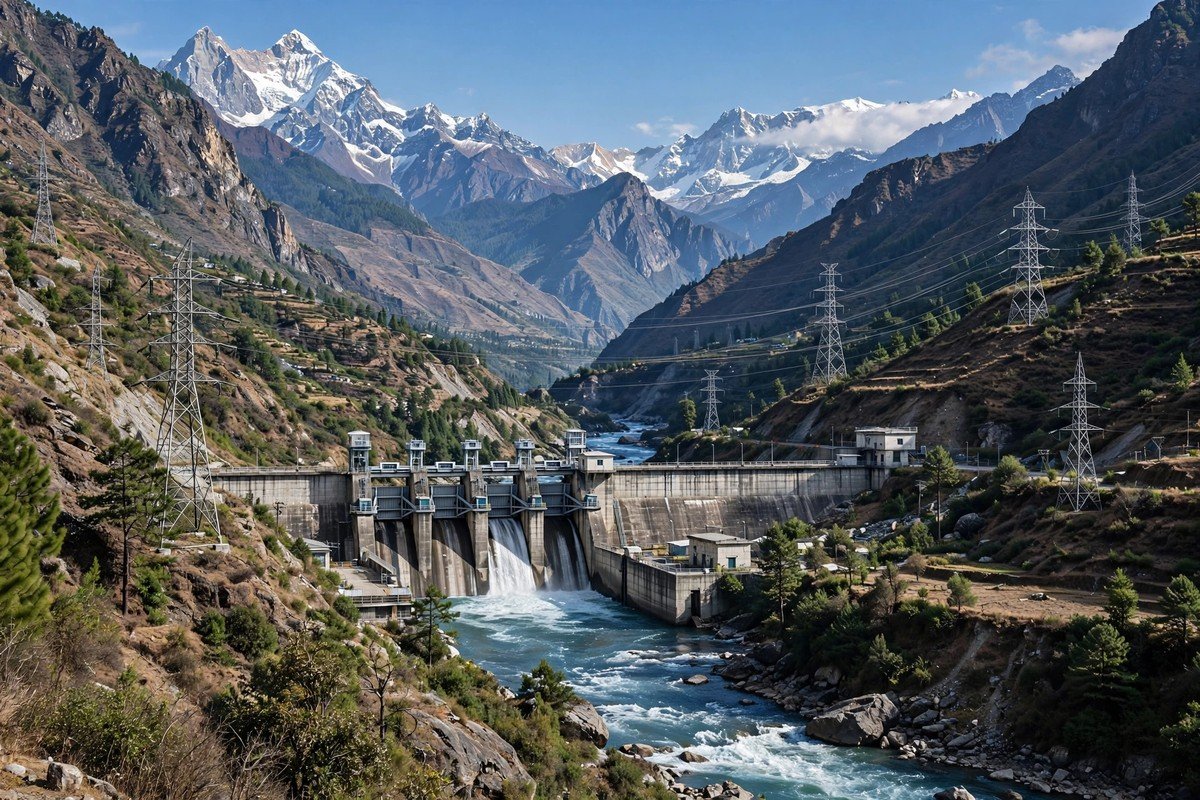
What delivers: power, trains, roads, and pipelines. The Muzaffarpur–Dhalkebar line, the Jaynagar–Kurtha train, the Motihari–Amlekhgunj pipeline, the integrated check posts — these are concrete, fundable, and useful to both sides. They get signed, inaugurated, and photographed. The 10,000 MW power trade commitment is the largest example of all.
What stalls: the 1950 Treaty of Peace and Friendship, the border at Kalapani, Lipulekh, and Limpiyadhura, and the Pancheshwar project. These are the issues that get referred to officials, to joint commissions, or to expert groups — and then wait.
The Eminent Persons Group is the clearest example. Formed in 2016 with a mandate to review the entire relationship, it agreed its final joint report on 30 June 2018, at its ninth meeting in Kathmandu. Its two-year term ended on 4 July 2018. The report has never been officially made public, and Prime Minister Modi has never formally received it. Media reports say it recommends replacing or revising the 1950 treaty and creating a “smart border”. Eight years after it was written, it remains unreceived and unpublished.
That is the cycle Balen Shah is stepping into — and the central lesson of Nepal PM India visit history. Every prime minister arrives hoping to be the one who breaks it. Every prime minister leaves with projects signed and the old questions still open.
What Balen Shah Is Stepping Into
Balen Shah’s visit is different in one important way: it is the first by a prime minister from a new party, the Rastriya Swatantra Party, which won the March 2026 election after the Gen Z protests of September 2025. He is also the first prime minister in this cycle to make India his first bilateral trip abroad — and he has cut the visit short, to about 25 hours, after dropping planned legs to Bengaluru, Ahmedabad, and Uttarakhand.
His agenda, as reported before the talks, is dominated by one number: a proposed economic package of around US$2 billion in concessional loans and grants, mainly for flood reconstruction and infrastructure. The details are still only reported, not confirmed — different reports give different splits between loans and grants — and nothing is agreed until the talks conclude. Our earlier explainer covers what Nepal is asking for on this visit.
The rest of his list will sound familiar to anyone who has followed the history above: energy trade, the Ayodhya–Janakpur train, and the air entry routes. All three were on the table for his predecessors too.
Whether his visit breaks the pattern will be judged the same way theirs were judged — not by the welcome ceremony, but by what is signed, what is funded, and what is still “under discussion” when the delegation flies home. Nepal PM India visit history suggests the power lines and the trains will move. The treaty, the border, and Pancheshwar will probably still be waiting. That is not a prediction. It is the record.
For the wider economic picture — including why Nepal’s trade deficit with India keeps growing — see our explainer on Nepal’s trade deficit.
Frequently Asked Questions
How many times have Nepal’s prime ministers visited India since the republic?
By one count, Nepal’s prime ministers have visited India ten times in twenty years, and Nepal PM India visit history records them all. Oli visited twice (2016, 2018), Deuba visited in 2017 and 2022 among others, and Prachanda visited four times as prime minister (2008, 2016 twice, and 2023).
What was the biggest outcome of any recent Nepal PM visit to India?
The 10,000 MW long-term power trade commitment from Prachanda’s June 2023 visit — India aims to import 10,000 MW of Nepali hydropower over ten years. The formal agreement was signed later in Kathmandu.
What is the Eminent Persons Group, and why does it matter?
The Eminent Persons Group (EPG) is an eight-member body — four from each country — formed in 2016 to review all aspects of Nepal–India relations, including the 1950 Treaty of Peace and Friendship. It agreed its final report in June 2018, but the report has never been officially made public and Prime Minister Modi has never formally received it.
Why do Nepal’s prime ministers keep raising air entry routes with India?
Nepal wants additional air entry routes — notably at Mahendranagar, Nepalgunj, and Janakpur — so international flights can reach its new airports at Bhairahawa and Pokhara directly. Deuba raised it in 2022, Prachanda raised it in 2023, and it remains unresolved.
What did Oli’s 2016 visit achieve after the blockade?
Nine agreements, including a US$250 million Indian grant for post-earthquake reconstruction, faster work on the 518 km first phase of the Hulaki Highway, the inauguration of the Muzaffarpur–Dhalkebar power line, new transit access through Bangladesh and Visakhapatnam port, and the formation of the Eminent Persons Group. No joint statement was issued — a telling detail in Nepal PM India visit history.
What is Balen Shah asking for on his India visit?
As reported before the talks, a proposed economic package of around US$2 billion in concessional loans and grants, mainly for flood reconstruction and infrastructure. The split between loans and grants is reported differently by different outlets, and nothing is agreed until the talks conclude on Monday, 23 November 2026.
Sources
- Ministry of External Affairs, Government of India — Question No. 1460, agreements signed during PM Oli’s February 2016 visit (mea.gov.in)
- Press Information Bureau, Government of India — “Visit of Nepalese PM to India”, February 2016 (pib.gov.in)
- Embassy of Nepal, New Delhi — Press release on Prime Minister Prachanda’s official visit to India, 2 June 2023
- My Republica — “Nepal, India reach slew of agreements, including a long-term energy deal”, 1 June 2023; “Nepal-India sign nine agreements”, 20 February 2016
- The Himalayan Times — “Nepal, India seal nine agreements in New Delhi”, 20 February 2016
- The Print — “Modi, Prachanda announce 10-year power trade deal between India & Nepal”, 1 June 2023
- ORF — “Major breakthrough in Nepal-India relations”, June 2023
- Ratopati (English) — “Nepal’s prime minister has visited India 10 times in 20 years: these are the agreements”
- The Nepal Journal — “Shah’s Delhi trip joins a long cycle of resets”, 20 November 2026
- The Kathmandu Post — “Old differences continue to weigh on Nepal-India ties”, 20 November 2026