

Introduction
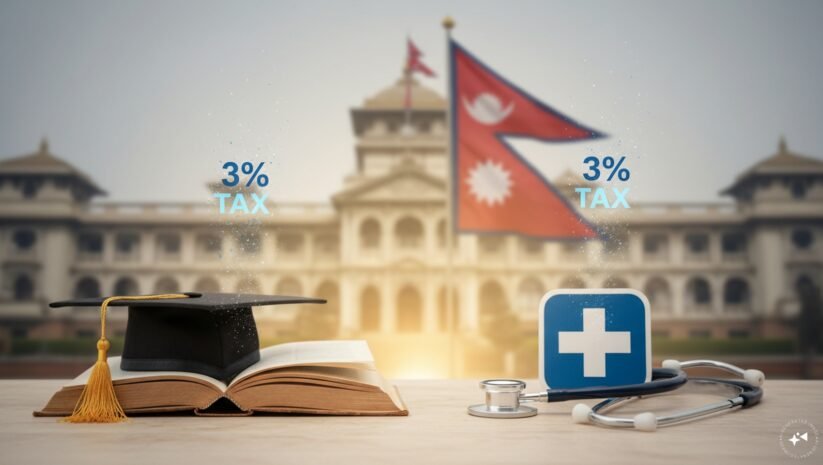
On July 17, 2026, the government of Nepal introduced a 3 percent equity tax on private education and health services, part of the budget for fiscal year 2026/27. By July 22, barely five days after the levy took effect, Prime Minister Balendra Shah announced on social media that it would not be implemented after all. The Cabinet formally scrapped the tax on July 23, and the government promised to refund every rupee already collected within 50 days.
Few policies in recent Nepali history have been introduced and abandoned so quickly. The episode is worth studying closely, not only because it touched two sectors that almost every household depends on, but because it exposes something deeper about how fiscal policy gets made in Nepal, and what happens when governments try to raise revenue from services that citizens consider basic rights rather than luxuries.
What the Tax Actually Was
The equity tax charged an additional 3 percent on fees paid to private schools, colleges, and hospitals. According to Finance Minister Swarnim Wagle, the money collected was meant to feed a new “Equity Fund,” modeled loosely on the Reconstruction Fund created after the 2015 earthquake. The plan was to combine revenue from the education and health levy with excise duties on alcohol and tobacco, along with certain charges on foreign currency used by Nepalis traveling abroad, to build a multi billion rupee fund. That fund was intended to finance nutrition programs for Dalit and marginalized children, expand health insurance coverage, and upgrade public schools and hospitals.
On paper, the goal was redistribution. Money from families who could afford private education and treatment would help subsidize services for those who could not. This is not an unusual idea globally. Progressive taxation, where those with more resources contribute more, is a standard tool of public finance.
Why the Backlash Was So Fast and So Strong
The problem was less the idea itself and more how it collided with reality. Criticism came from several directions almost simultaneously.
First, students, parents, and patients pointed out that private schools and hospitals routinely pass added costs straight to consumers. A tax on the institution becomes, in practice, a tax on the family paying tuition or a hospital bill. The Nepal Student Union and the Parents’ Association of Nepal were among the groups demanding withdrawal.
Second, critics asked an uncomfortable question: why tax private education and health at all when government schools and public hospitals already struggle with quality and capacity? Many families turn to private institutions precisely because the public alternative is overcrowded or under resourced. Taxing the private option, in this view, punished people for filling a gap that the state itself had failed to close.
Third, the timing made things worse. The equity tax arrived at the same time the government was also introducing a 5 percent VAT on household electricity use above 50 units a month, and reportedly considering trimming the scope of the national health insurance program. To many citizens, this looked less like a coordinated equity strategy and more like a scramble for revenue that happened to land on the two sectors people care about most personally: their children’s schooling and their own health.
Fourth, there was a constitutional and moral undertone to the criticism. Education and health are widely treated in Nepal as constitutionally guaranteed rights, not optional purchases. Taxing access to them, even indirectly, struck many commentators as inconsistent with that principle.
Responsiveness or Poor Planning? Both, Really
The government’s own framing was that this was democratic responsiveness in action. Prime Minister Shah described his administration as people centered and said decisions would be corrected when they failed to meet public expectations. There is something genuinely positive in a government reversing course within days rather than defending an unpopular measure for months out of stubbornness.
But responsiveness after the fact does not erase weak planning before the fact. A tax that lasted six days suggests the consultation process before the budget was passed was thin. Private school associations, hospital associations, and consumer groups were apparently not meaningfully brought into the conversation before the Finance Act went to Parliament. If they had been, the scale of the backlash could likely have been anticipated, and the policy could have been redesigned, targeted more narrowly, or phased in with exemptions, rather than announced and then abandoned within a week.
There is also a legal and administrative problem that the reversal exposed. Because the tax was created through the Finance Act passed by Parliament, withdrawing it was not as simple as a social media announcement. Under Section 18 of the Finance Act, any change to tax rates needs Cabinet approval and publication in the Nepal Gazette before it has legal force. For nearly a week after the Prime Minister’s announcement, the tax remained technically enforceable even though politically it was already dead. This created real confusion for schools, hospitals, and tax officials about whether to keep collecting the fee, and left open questions about refunding amounts already paid. That gap between political announcement and legal reality is itself a sign of a policy process that moved faster in reverse than it had moved forward.
So the honest answer is that this episode reflects both things at once. The reversal shows a government capable of listening. The need for a reversal shows a government that did not listen enough, early enough.
The Numbers Behind the Debate
It helps to look at where Nepal actually stands on education and health financing, because the equity tax was, at its core, an attempt to solve a real funding gap.
On education, government spending on education equals a little over 10 percent of total government expenditure, according to World Bank data for 2025. Literacy in Nepal stood at about 76 percent as of 2021, with a noticeable gap between men (around 84 percent) and women (around 69 percent), showing that access and equity gaps are real, even if the equity tax was not the right tool to close them.
On health, the numbers are more concerning. Nepal’s total health expenditure sits at roughly 2 to 6.7 percent of GDP depending on the measure and year used, well below the 5 to 6 percent of GDP that the World Health Organization considers necessary to meaningfully reduce what patients pay out of their own pockets and move toward universal health coverage. Currently, more than half of all health spending in Nepal, around 57 to 60 percent by various estimates, is paid directly by patients rather than covered by government programs or insurance. Only about 7 percent of the population has health insurance. These figures explain why the government wanted new revenue for health. They do not, however, explain why taxing private healthcare fees, rather than broadening insurance coverage or improving public hospital capacity, was chosen as the mechanism.
How Other Developing Countries Handle This
Nepal is far from alone in wrestling with how to tax essential services without hurting the people who use them. The comparison is instructive.
India’s Goods and Services Tax framework explicitly exempts core education and healthcare services from GST. Services provided by educational institutions up to higher secondary level, along with services from doctors, dentists, diagnostic labs, and clinical establishments, are kept outside the tax net specifically because policymakers judged that taxing them would work against affordability and access goals.
This is not unique to India. Globally, most countries that operate a GST or VAT system, and there are around 166 of them, carve out exemptions or zero rates for essential goods and services including food, education, and health. Australia zero rates health services and education. The United Kingdom applies reduced or zero rates to many essential categories under its VAT system. The general pattern across both developed and developing economies is that broad based consumption taxes are considered a poor tool for funding equity goals in health and education specifically, because they are difficult to target only at wealthier consumers and tend to be passed through to ordinary users regardless of income.
The lesson for Nepal is fairly direct. Where other countries wanted more equitable education and health outcomes, the more common approach was to exempt these sectors from broad taxation and instead fund equity goals through general tax revenue, targeted subsidies, or expanded insurance schemes, rather than through a new levy charged at the point where families are already paying for school fees or a hospital bill.
What Nepal Could Learn From This Episode
A few lessons stand out.
Genuine stakeholder consultation before a budget is finalized, not after public anger forces a reversal, would likely have caught this problem early. Private school federations, hospital associations, and civil society groups exist precisely to provide this kind of input.
Redistribution goals are better served by expanding public capacity and insurance coverage than by taxing the private alternative that people turn to when public capacity falls short. If government schools and hospitals were better funded and more capable, fewer families would need the private option in the first place, and the equity gap the tax was trying to address would shrink on its own.
Legal and administrative readiness matters as much as the policy idea itself. A government should not announce a tax reversal on social media while the tax remains legally enforceable for another week. Clear, fast, and legally sound implementation builds public trust; confusion erodes it, even when the underlying decision is the right one.
Conclusion
The equity tax episode was, in the end, a case study in how quickly a well intentioned idea can go wrong when it is not tested against the practical realities of who actually pays and how people will react. The government deserves some credit for reversing course quickly rather than digging in. But a policy that survives barely a week in force says more about weaknesses in planning and consultation than it does about genuine responsiveness. Nepal’s real equity problems in education and health, an underfunded public system, low insurance coverage, and heavy reliance on money paid directly by patients, remain unsolved. The bigger test now is whether the government replaces this failed attempt with a better designed one, informed by how other developing countries have handled the same tradeoff, or simply moves on to the next idea without learning from this one.