

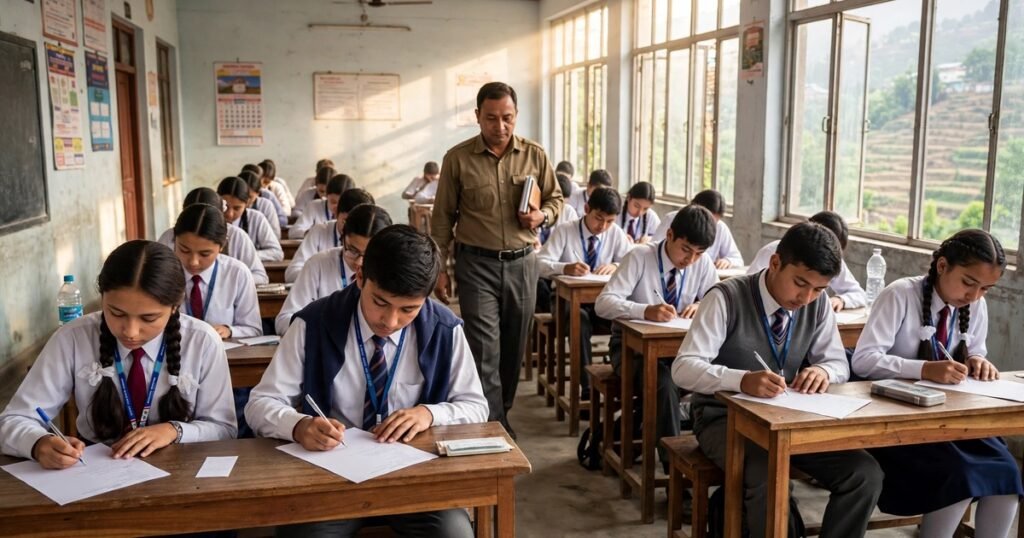
SEE exam Nepal explained simply: it is the national board examination every Nepali student sits at the end of Grade 10, run by the National Examination Board (NEB). It replaced the old School Leaving Certificate (SLC) in 2016, and it is the gate between school and whatever comes next — Class 11, a technical diploma, or work. This guide explains the exam in plain language: what it covers, how the grading works, what NG really means, the latest results, and what to do after the result comes out.
- SEE Exam Nepal Explained: What the Exam Actually Is
- SEE Exam Nepal Explained: The Subjects and the Marks
- SEE Exam Nepal Explained: The Grading System, Letter by Letter
- SEE Exam Nepal Explained: What NG Means and the Grade Increment Exam
- SEE Exam Nepal Explained: The Latest Results in Numbers
- SEE Exam Nepal Explained: How to Check Your Result
- SEE Exam Nepal Explained: What Happens After the SEE
- SEE Exam Nepal Explained: How to Prepare Without Burning Out
- Frequently Asked Questions
- Sources
Table of Contents
SEE Exam Nepal Explained: What the Exam Actually Is
The Secondary Education Examination, or SEE, is the board exam at the end of Grade 10. It is set and run nationally by the National Examination Board, based at Sanothimi in Bhaktapur, and every student in Nepal — in government schools, private schools, and community schools — sits the same papers on the same days.
The SEE replaced the SLC in 2016. Under the old system, the SLC was a pass-or-fail exam at the end of Grade 10 with divisions and percentages, and failing it could end a student’s education. The SEE uses letter grades instead, and the idea behind the change was to measure what a student has learned in each subject rather than to sort students into pass and fail.
The exam is held once a year, in the spring. The most recent SEE, for the academic year 2082, was held from 2 to 12 April 2026 (Chaitra 19 to 29, 2082), with papers running from 8:00 am to 11:00 am each day. The routine for the next SEE, for the academic year 2083, had not been published at the time of writing; the routine for the 2082 exam was released in January 2026, so students should expect the next one around the same time of year. That timing is one of the first things a SEE exam Nepal explained guide should make clear, because the routine — not the rumour — is what sets the revision calendar.
One practical point that surprises many families: the SEE is a school-leaving exam, not an entrance exam. Your SEE result does not decide whether you can study further — it decides what you can study next, and in which stream. A student with an NG in a subject cannot enrol in Class 11 until that subject is cleared, which is why understanding the grading rules matters as much as the revision.
SEE Exam Nepal Explained: The Subjects and the Marks
SEE students take seven subjects: five compulsory subjects and two optional subjects, under the Secondary Education Curriculum 2078, which follows the National Curriculum Framework 2076. The five compulsory subjects are Nepali, English, Mathematics, Science and Technology, and Social Studies and Human Value Education. The two optional subjects depend on what the school offers; the common choices are Optional Mathematics, Computer Science, and Health, Population and Environment Education.
Most subjects are marked with a split of 75 percent external theory — the written board paper — and 25 percent internal assessment, which covers practical work, projects, and school-based evaluation. Mathematics is the exception: it has no practical component and is marked entirely on the written paper. A few optional subjects have different splits, so the 75/25 pattern is the common rule, not a universal one.
The important consequence of the split is that the theory paper and the internal assessment are graded separately. Scoring well in the written exam does not cover a weak internal mark, and a strong internal mark does not rescue a weak theory paper. Both parts have to clear their own minimum — a detail that catches students out every year, and one of the main reasons for NG grades.
SEE Exam Nepal Explained: The Grading System, Letter by Letter
The SEE uses an eight-band letter grading system, set out in the NEB’s Letter Grading Directive 2078 (as amended). Each subject gets a letter grade, each letter carries a grade point, and the overall GPA is the credit-weighted average of the subject grade points.
| Letter grade | Marks | Grade point | Meaning |
|---|---|---|---|
| A+ | 90–100 | 4.0 | Outstanding |
| A | 80–89 | 3.6 | Excellent |
| B+ | 70–79 | 3.2 | Very good |
| B | 60–69 | 2.8 | Good |
| C+ | 50–59 | 2.4 | Satisfactory |
| C | 40–49 | 2.0 | Acceptable |
| D | 35–39 | 1.6 | Basic |
| NG | Below 35 | 0.0 | Not graded |
The pass rule is per subject, not overall. Each subject needs at least a D — 35 percent — on its own. There is no aggregate GPA that rescues a bad subject with good ones: a student with an A+ in five subjects and an NG in one still has an uncleared subject.
There is a second, stricter condition hiding inside that rule. A subject is marked NG if the theory paper falls below 35 percent, or if the internal assessment falls below 40 percent — even if the other component was strong. For a subject marked 75 theory and 25 internal, that means at least 27 out of 75 on the written paper and at least 10 out of 25 on the internal side. NEB does not issue a GPA at all while any subject is NG; the gradesheet waits until the subject is cleared.
This is also why comparing GPAs across students can mislead. A GPA is a weighted average of grade points, not an average percentage, and NEB publishes no official conversion from GPA back to a percentage. Two students with the same GPA can have very different subject profiles — and for Class 11 admissions, schools often look at the grades in specific subjects, not just the headline number.

SEE Exam Nepal Explained: What NG Means and the Grade Increment Exam
NG stands for Not Graded. It replaced the word “fail” when letter grading arrived, and the change in language matters: an NG is not a permanent verdict on a student. It means one subject did not reach the minimum, and there is a defined route to clear it.
That route is the grade increment examination — often called the supplementary or chance exam. Students with NG in up to two subjects, who reached at least a D in their remaining subjects, can sit the grade increment exam in only the subjects they got NG in. Everything already passed stays passed. Students who are not satisfied with a grade they received can also sit the exam to improve it.
The grade increment exam is held about a month after the main results are published. For the SEE 2082 cycle, it ran from 15 to 23 June 2026, in the morning session from 8:00 am to 11:00 am. A total of 129,114 candidates sat it, and 83,523 were graded — a pass rate of about 65 percent. Students apply through their school, not directly, and the fee reported for that cycle was Rs 500 per subject.
Students with NG in three or more subjects cannot sit the grade increment exam. Their options are to sit the SEE again the following year as a partial candidate, to join a CTEVT technical programme, or to continue through open schooling. None of these is a dead end — but the choice is easier to make early, while the school can still advise on it.
Two other practical points are worth knowing. First, if you believe your marks were added up wrongly, you can apply for re-totaling through your school within the window NEB announces after results — that corrects totaling errors, not marking judgments. Second, internal and practical marks stay valid for three years, so a student retaking a subject does not have to redo the internal assessment.
SEE Exam Nepal Explained: The Latest Results in Numbers
The most recent SEE results, for the academic year 2082, were published by the NEB on 11 May 2026 (28 Baisakh 2083) — 29 days after the examinations ended. A total of 430,667 regular students appeared for the exam. Of them, 284,160 received grades — a pass rate of 65.98 percent — while 146,507 received NG. Counting grade-improvement candidates as well, 512,421 students took part in the examination in total.
That 65.98 percent was an improvement of 4.17 percentage points on the previous year. In the SEE 2081 cycle, held from 20 March to 1 April 2025, 438,896 students appeared out of 514,071 who had registered, and 61.81 percent were graded; 48,177 students secured a GPA between 3.6 and 4.0, the highest band. Results for that year were published on 27 June 2025.
The year before that, the picture was much worse: in the SEE 2080 cycle, only 47.86 percent of students passed, with 242,313 of 464,785 examinees receiving NG. The jump from 47.86 percent to 61.81 percent and then to 65.98 percent over three years is the biggest story in Nepali school education right now — and it is also the most debated. The NEB has said it aims to keep raising the pass rate, and the government has pushed for results to be published within a month of the exams ending. Whether the improvement reflects better teaching, fairer marking, or easier papers is a live argument among educators, and this article does not take a side on it. What the numbers do show is that roughly one in three students still leaves the SEE with at least one NG — so the grade increment exam matters to well over a hundred thousand families every year.
SEE Exam Nepal Explained: How to Check Your Result
When results are published, the NEB releases them on its official websites — see.gov.np and neb.gov.np — and through SMS and IVR services, including by dialing 1600 on Nepal Telecom. The result is also published through newspapers and education portals, but the NEB websites are the authoritative source, and they are the ones to trust if different sites disagree.
A few practical tips for result day: the official sites slow down badly in the first hour because hundreds of thousands of students check at once, so waiting an hour is often faster than refreshing. You need your symbol number, which is printed on your admit card — keep the admit card safe until the gradesheet arrives. The online result is provisional; the printed gradesheet, issued through your school, is the official record, and it is the document colleges ask for at admission. The same portals publish the grade increment exam results, so this SEE exam Nepal explained process works the same way a second time if you need it.
SEE Exam Nepal Explained: What Happens After the SEE
Once every subject is graded, the main route is Class 11 — the first year of the two-year +2 programme — in one of the streams: Science, Management, Humanities, Education, or Law. Each stream, and each college, sets its own admission requirements. Science streams commonly ask for stronger grades in Mathematics and Science; Management and Humanities streams are generally more open. The honest advice is to choose the stream by what you want to study next, not by which one sounds most prestigious — a mismatch in Class 11 is the most common reason students struggle in Class 12.
The alternatives are real and growing. CTEVT — the Council for Technical Education and Vocational Training — runs diploma and pre-diploma programmes in fields like engineering, health, agriculture, and hospitality, and these suit students who want job-ready skills rather than two more years of classroom study. Open schooling is another route for students who need flexibility. And for students still deciding, a gap year spent preparing for the next SEE attempt or for an entrance exam is a legitimate choice — it is not a wasted year if it is used deliberately.
Whatever the route, one administrative step matters: enrolment in Class 11 in a regular stream requires all subjects to be graded. An outstanding NG has to be cleared first, through the grade increment exam or a retake. Schools handle the enrolment paperwork, so the practical move is to talk to your school as soon as the result is out, rather than waiting for the admission season to start.
SEE Exam Nepal Explained: How to Prepare Without Burning Out
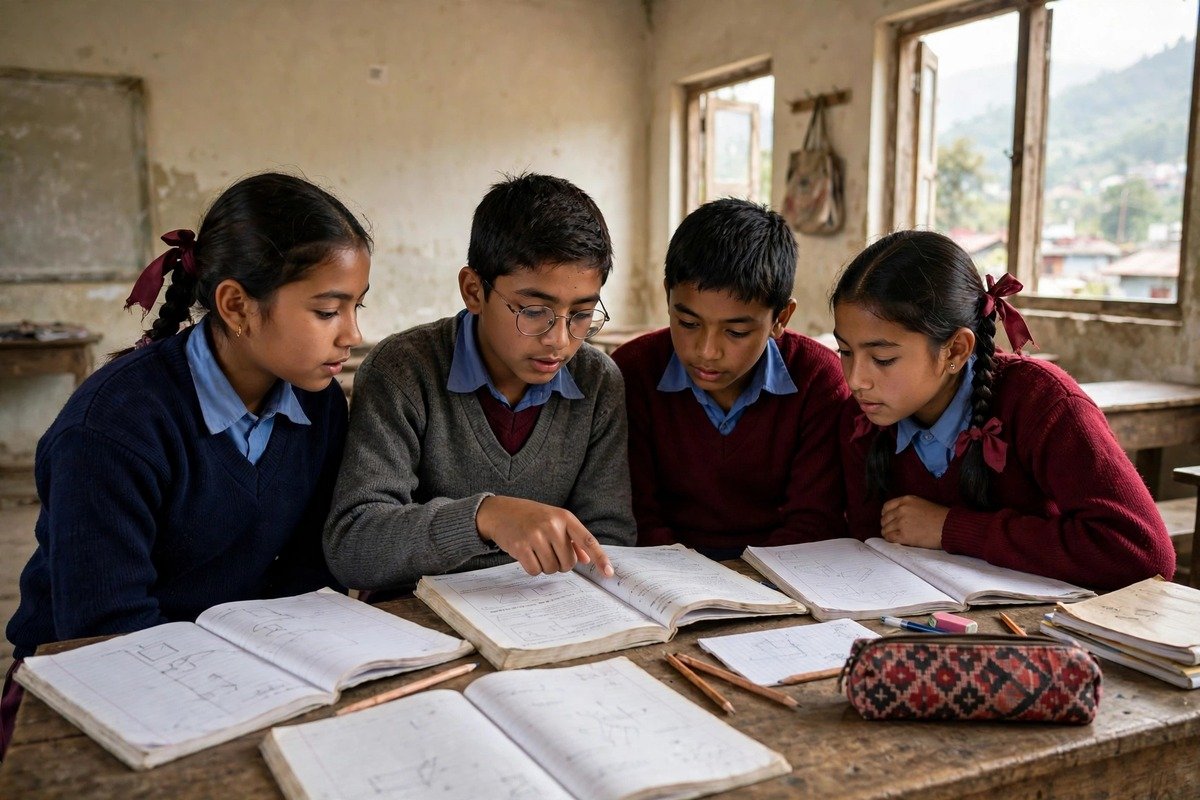
Most SEE advice is about studying harder. The more useful advice is about studying in a way that matches how the exam actually works. Because theory and internal marks are graded separately, the internal assessment is not a formality — practical files, projects, and class work are a quarter of the marks in most subjects, and neglecting them is one of the easiest ways to end up with an NG. Finish internal work early, while there is still time to fix it.
Second, past papers are the closest thing to a map of the exam. The SEE follows a published curriculum, and the paper pattern repeats more than students expect. Working through the last three years of papers under timed conditions — 8:00 to 11:00, the same hours as the real exam — does more for confidence than re-reading notes.
Third, the subjects that cause most NG grades are the ones students avoid. In practice that usually means Mathematics and Science. A weak subject does not improve by being ignored; an hour a day on the weakest subject, with a teacher or a classmate who understands it, beats a week of cramming in the subject you already like.
Finally, the exam is important but it is not the whole of a life. A third of students get an NG in at least one subject every year, and the system now gives them a second chance within a month. The students who recover fastest are the ones who treat the result as information — which subjects need work — rather than as a judgment. That is the point of having the SEE exam Nepal explained in plain language: once you know the rules, the result stops being a mystery and becomes a plan. If the result is not what you hoped, talk to your school the same week: the grade increment exam, the retake, and the technical routes are all easier to arrange early.
Frequently Asked Questions
Q: What is the full form of SEE in Nepal?
A: SEE stands for Secondary Education Examination. It is the national board exam at the end of Grade 10, run by the National Examination Board. It replaced the SLC in 2016.
Q: What GPA do you need to pass the SEE?
A: There is no single overall GPA you must clear. Each subject needs at least a D grade — 35 percent, or a grade point of 1.6 — on its own, in both the theory paper and the internal assessment. A subject below that is marked NG, and NEB issues no GPA until every subject is graded. That per-subject rule is the heart of the SEE exam Nepal explained grading system.
Q: What happens if I get NG in the SEE?
A: If you have NG in one or two subjects, and at least a D in the rest, you can sit the grade increment exam about a month after results, in only the NG subjects. If you have NG in three or more subjects, you cannot sit it; the routes are to repeat the SEE next year as a partial candidate, join a CTEVT programme, or continue through open schooling.
Q: When is the next SEE exam?
A: The next SEE, for the academic year 2083, is expected in the spring of 2027. The routine had not been published at the time of writing; the routine for the 2082 exam was released in January 2026. Check neb.gov.np for the official notice.
Q: How can I check my SEE result?
A: On the NEB’s official websites, see.gov.np and neb.gov.np, or by SMS and IVR, including dialing 1600 on Nepal Telecom. You need your symbol number from your admit card. The printed gradesheet from your school is the official record.
Q: Can I join Class 11 with an NG?
A: No — not in a regular stream. All subjects must be graded before you can enrol in Class 11. Clear the NG first through the grade increment exam or a retake, and talk to your school as soon as the result is out.
Sources: National Examination Board (NEB), see.gov.np and neb.gov.np; NEB Letter Grading Directive 2078 (as amended), via Curriculum Development Centre; SEE 2082 results reported by The Kathmandu Post, edusanjal and CollegeNP (11–13 May 2026); SEE 2081 results reported by The Rising Nepal and The Kathmandu Post (27–28 June 2025); NEB grade increment exam notice reported by NepalKhabar (12 May 2026). For related reading, see our piece on why so many young Nepalis leave to study and work abroad and whether Nepali education delivers real learning. The National Examination Board’s official site is neb.gov.np.