

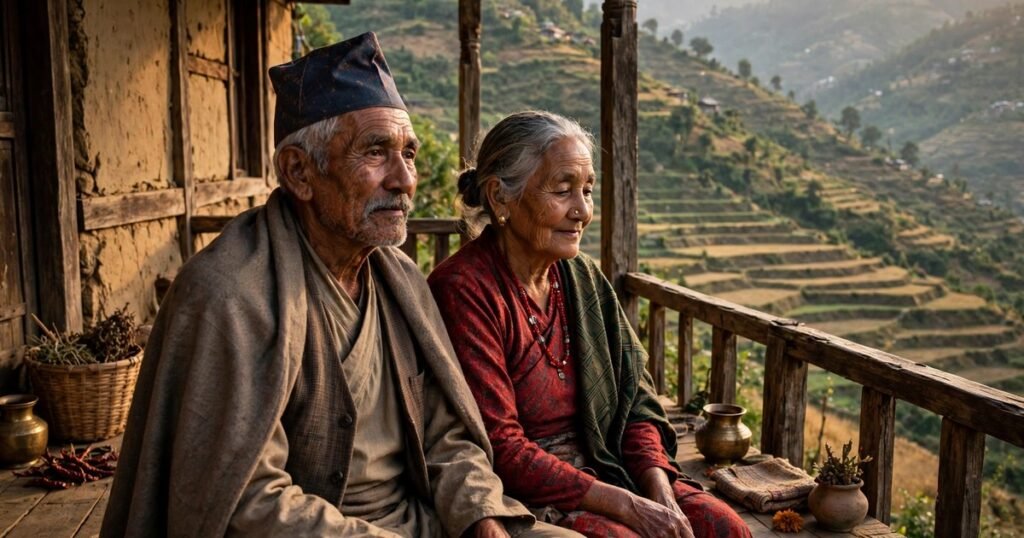
Nepal pension system explained in one sentence: Nepal does not have one pension. It has five different ways of paying people when they stop working, and which one applies to you depends on where you worked, when you were hired, and how old you are.
That is why the subject confuses so many families. A retired teacher gets a monthly pension from the state budget. A factory worker gets a monthly pension from the Social Security Fund. A bank clerk gets a single lump sum from the Employees Provident Fund. And a farmer who never held a formal job gets Rs 4,000 a month from the government — no contributions required. All four are “pensions” in everyday speech, but they run on different laws, different money, and different rules.
This guide puts the whole system on one page. It covers the five routes, who qualifies for each, how much each one pays, and what is changing — because the old system is being wound down for new hires, and the new one is still taking shape.
Table of Contents
- Nepal Pension System Explained: Five Ways Nepal Pays Its Retirees
- Nepal Pension System Explained: The Civil Service Pension — the Old Monthly Promise
- Nepal Pension System Explained: The Social Security Fund — the New Contributory Pension
- Nepal Pension System Explained: The Employees Provident Fund — a Lump Sum, Not a Pension
- Nepal Pension System Explained: The Citizen Investment Trust — Voluntary Top-Up Saving
- Nepal Pension System Explained: The Old-Age Allowance — Rs 4,000 a Month for Everyone Over 70
- Nepal Pension System Explained: What It Costs the Country — and Why It Is Changing
- Nepal Pension System Explained: How to Check What You Will Get
- Frequently Asked Questions
- Sources
Table of Contents
Nepal Pension System Explained: Five Ways Nepal Pays Its Retirees
Nepal pension system explained at a glance looks like this. The first three routes are tied to a job. The fourth is voluntary. The fifth is for everyone.
| Route | Who it covers | What you get | When it starts |
|---|---|---|---|
| Civil service pension | Government employees, teachers, security forces hired before the contributory switch | Monthly pension for life | Retirement, normally at 58 |
| Social Security Fund (SSF) | Formal-sector workers, and civil servants hired from mid-July 2025 | Monthly pension for life | Age 60, after 15 years of contributions |
| Employees Provident Fund (EPF) | Government and eligible private-sector employees | One lump sum | Retirement, normally at 58 |
| Citizen Investment Trust (CIT) | Anyone who saves voluntarily | Monthly pension or lump sum | Age 60, after 15 years |
| Old-age allowance | Every Nepali citizen | Rs 4,000 a month | Age 70 (age 60 for Dalit citizens and Karnali residents, at Rs 2,660) |
Two things are worth noticing before the detail. First, the routes overlap: a civil servant typically has both a pension and an EPF lump sum, and a private-sector worker typically has both SSF and EPF. Second, the system is mid-transition. The old pension, paid straight from the state budget, is closed to new civil servants. The contributory system, where workers and employers pay in during working life, is replacing it.
Nepal Pension System Explained: The Civil Service Pension — the Old Monthly Promise
Nepal pension system explained through its oldest route starts with the civil service pension. It is a defined-benefit pension: the government promises a monthly payment for life, and pays it directly from the national budget. The employee contributes nothing towards it.
The formula is simple. Take the years of service, multiply by the last basic salary, and divide by 50:
Monthly pension = (years of service × last basic salary) ÷ 50
The result is capped at 100% of the basic salary and floored at 50% of it. A civil servant who retires after 30 years on a basic salary of Rs 60,000 a month would therefore get (30 × 60,000) ÷ 50 = Rs 36,000 a month — 60% of the final basic salary. Someone who serves 25 years gets exactly half their final basic salary, which is the floor. Someone who serves the full career gets the whole basic salary, which is the cap.
Eligibility depends on the service. Civil servants and public school teachers qualify after 20 years of service. Nepal Army personnel qualify after 16 years — the shortest period of any service. Nepal Police personnel qualify after 18 to 20 years, depending on rank. The normal retirement age for civil servants is 58, though a bill now before Parliament proposes raising it to 60 in stages.
The pension does not stop at death. When a pensioner dies, the spouse continues to receive the pension — the family pension — which is one reason the liability keeps growing long after the employee has left service. Pensions are also revised when serving employees’ salaries rise, because the pension is tied to the salary scale, not frozen at the retirement date.
This is the route that covers the people most Nepalis picture when they hear the word “pension”: retired teachers, retired soldiers, retired police officers, retired civil servants. According to the Pension Management Office, there were around 300,000 such pensioners in 2024, and about 18,000 government employees retire every year. The bill is large and growing — more on that below.
Nepal Pension System Explained: The Social Security Fund — the New Contributory Pension
Nepal pension system explained through its newest route is a very different idea. The Social Security Fund (SSF) is a contribution-based scheme under the Contribution Based Social Security Act 2074 (2017). Instead of the state paying the pension from tax revenue, workers and employers pay in every month during working life, and the fund pays the pension after retirement.
The contribution is 31% of basic salary: the employee pays 11% and the employer pays 20%. Most of that money — 28.33% of basic salary — goes to old-age protection. The rest covers medical treatment, accidents and disability, and support for dependent family members. The scheme was launched in November 2018, and by mid-October 2026 the Fund reported 3,243,701 contributors and total collections of Rs 129.64 billion.
The pension rules are strict, and the two conditions catch people out. You must be 60 years old, and you must have contributed for at least 180 months — 15 years. Both conditions must be met. If you reach 60 with fewer than 15 years of contributions, you do not lose the money, but you get it as a lump sum instead of a monthly pension.
If you do qualify, the monthly pension is calculated from your accumulated pension-fund balance plus the investment returns it has earned, divided by 160. The pension is then paid every month for life, and the amount is reviewed periodically on the basis of actuarial assessment.
The SSF is the future of Nepal’s pension system, in two senses. First, it is mandatory for formal private-sector workers, so it is the pension most young private-sector employees will actually receive. Second, it is now the scheme for new civil servants too. From mid-July 2025, the start of fiscal year 2082/83, the Ministry of Finance instructed ministries to enrol newly appointed civil servants in the contribution-based system instead of the old pension-and-gratuity model. The contributory framework itself was created by the Retirement Fund Act 2075 (2018); the July 2025 circular is what put it into effect for new government hires. Anyone already in pensionable service keeps the old pension.
For the full detail on the SSF — the four schemes, the exact splits, and how to check your own balance — see our guide to the Nepal social security fund.
Nepal Pension System Explained: The Employees Provident Fund — a Lump Sum, Not a Pension
Nepal pension system explained honestly has to include a scheme that is not a pension at all. The Employees Provident Fund (EPF), or Karmachari Sanchaya Kosh, is a provident fund: a savings pot, not a monthly payment. It is also Nepal’s oldest retirement institution, established under the Employees Provident Fund Act 2019 BS (1962). Its roots go back further, to the Sainik Drabya Kosh (Army Provident Fund) of 1934.
The rules are simple. The employee contributes 10% of basic salary every month, and the employer adds another 10% — a total of 20% of basic salary going into the worker’s account. The fund invests the money and declares an annual return for contributors. For fiscal year 2082/83, contributors received 5.25% in total — 4.25% interest plus an additional 1% allocation at year-end. Around 600,000 employees, in government and the private sector, hold EPF accounts.
When the worker retires — normally at 58 — the whole accumulated amount is paid out as a single lump sum. That is the key difference from a pension: the money arrives once, and it is then the retiree’s job to make it last. The EPF also offers contributor loans, including for housing and education, which is one reason many workers value it while they are still in service.
Most formal-sector workers have both an EPF account and either a civil service pension or SSF membership. The lump sum and the monthly pension are designed to work together: the pension covers the monthly bills, and the lump sum covers the big one-off costs of retirement.
Nepal Pension System Explained: The Citizen Investment Trust — Voluntary Top-Up Saving
Nepal pension system explained for people outside formal employment has a fourth route: the Citizen Investment Trust (CIT), or Nagarik Lagani Kosh. Unlike the EPF and the SSF, the CIT is voluntary. Anyone can contribute, including self-employed people and workers whose employer offers no retirement scheme.
The CIT runs several savings and pension schemes. Its pension scheme works on the same logic as the SSF: contribute regularly, and after 15 or more years you can draw a monthly pension from age 60, or take the accumulated amount as a lump sum instead. The CIT is a government-owned institution and is itself listed on NEPSE.
The main reason people use the CIT is tax. Contributions to approved retirement funds — the EPF, the SSF and the CIT — reduce taxable income, subject to a combined cap with the provident fund contribution. For a worker in the 20%, 30% or 36% income tax slab, that deduction is worth real money every year, on top of whatever the savings earn.
The CIT is not a substitute for the other schemes. It is a top-up layer: useful for someone who wants to save more than the mandatory schemes take, or for someone with no employer-linked scheme at all.
Nepal Pension System Explained: The Old-Age Allowance — Rs 4,000 a Month for Everyone Over 70
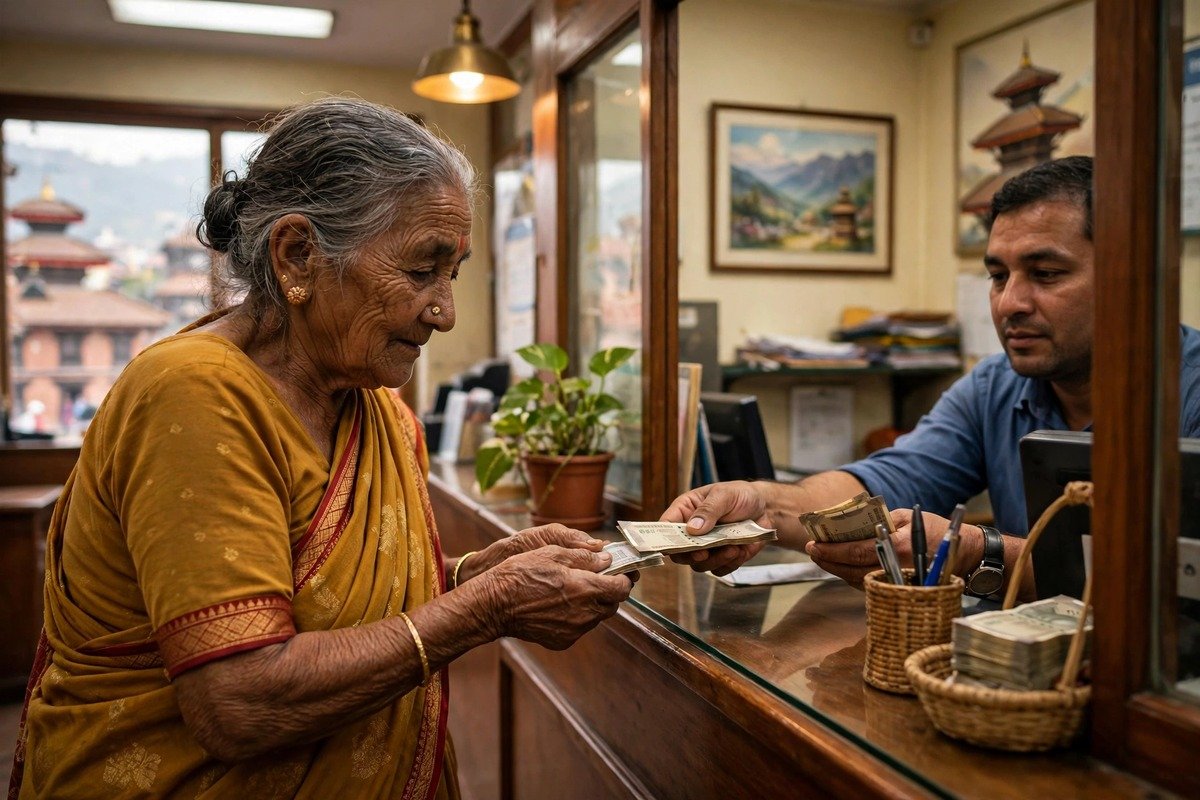
Nepal pension system explained without the old-age allowance would miss the route that reaches the most people. The senior citizen’s allowance, often called the bridha bhatta, is a social pension: it is paid from tax revenue, it requires no contributions, and it goes to every Nepali citizen who reaches the qualifying age.
The headline rate is Rs 4,000 a month for anyone aged 70 or over. Dalit citizens anywhere in Nepal, and residents of the former Karnali-zone districts, qualify earlier — at 60 — but at the lower rate of Rs 2,660 a month. The allowance is paid every quarter, so a recipient aged 70 or over receives Rs 12,000 every three months. The budget for fiscal year 2083/84 puts about Rs 120 billion into social security and targets about 3.7 million allowance recipients.
The age has moved more than once, and the history matters because it explains who is on the rolls today. The allowance was first introduced in fiscal year 1994/95 by the then finance minister Bharat Mohan Adhikari, at Rs 100 a month for people aged 75 and over. The age was lowered to 68 in fiscal year 2079/80, then raised back to 70 for new applicants from fiscal year 2082/83, on the recommendation of the High-Level Economic Reform Commission. People who were already receiving it at 68 or 69 kept it, so there are still recipients in their late sixties on the rolls under the old rule.
The allowance is administered by the Department of National ID and Civil Registration through local governments — the ward office is where you apply and where you renew. The government is also making a national identity card mandatory for receiving it. Because this allowance is a large subject of its own, we cover it in depth separately; the short version is that it is the one part of Nepal’s pension system that asks nothing of you except your age and your citizenship.
Nepal Pension System Explained: What It Costs the Country — and Why It Is Changing
Nepal pension system explained in money terms is a story of a bill that keeps growing faster than the budget. The Pension Management Office’s liability rose from Rs 37 billion in fiscal year 2016/17 to around Rs 75 billion in fiscal year 2022/23. For fiscal year 2023/24, the office said it needed Rs 77 billion against a budget allocation of Rs 52 billion — and had to ask the Finance Ministry for more. By 2025, reporting put the annual pension bill at close to Rs 100 billion.
Three forces push the bill up. First, the number of pensioners rises by roughly 15,000 to 18,000 a year. Second, pensions are tied to the salary scale, so every pay rise for serving employees raises the pension bill too. Third, the family pension means payments continue to spouses after the pensioner dies.
That is why the government has been moving new entrants onto the contributory system, where the cost is shared between workers, employers and the fund’s investment returns instead of falling entirely on the budget. And it is why the Federal Civil Service Bill 2083, registered in Parliament on 1 October 2026 and still awaiting consideration, proposes two further changes: raising the civil service retirement age from 58 to 60 in stages, and capping the service counted towards a pension at 30 years. Both are proposals, not law, and both are being contested by civil servants — hundreds have resigned in recent months, in part to lock in benefits under the current rules before any change takes effect.
The direction of travel is clear, even while the details are still being argued: the old promise — a pension paid in full from the budget — is being kept for those who already have it, and replaced by a contributory system for everyone who joins from now on.
Nepal Pension System Explained: How to Check What You Will Get
Nepal pension system explained is only useful if you can check your own position. The steps depend on which route you are on:
- Civil service pension: the Pension Management Office handles pension payments for retired government employees. If you are still in service, your service record — held by the Department of National Personnel Records — is what your pension will be calculated from. Check that your service years are recorded correctly well before retirement.
- Social Security Fund: log in to the SSF portal at https://ssf.gov.np/ to see your contributions, your balance, and your pension eligibility. If your employer has missed deposits, the contribution months do not count — and 180 months is a hard threshold.
- Employees Provident Fund: the EPF issues annual statements showing your balance and the interest credited. You can also check through your employer’s HR, which holds the deduction records.
- Old-age allowance: apply at your ward office with your citizenship certificate. Renewal is annual, at the ward, and the payment goes to your bank account every quarter.
The single most common mistake is assuming the money is automatic. In every route, the record is what matters: the service record, the contribution record, or the ward registration. Check it while you still have time to fix it.
Frequently Asked Questions
What is the pension system in Nepal?
Nepal pension system explained in brief: five routes pay people when they stop working — the civil service pension for government employees, the Social Security Fund pension for formal-sector workers, a lump sum from the Employees Provident Fund, voluntary saving through the Citizen Investment Trust, and the Rs 4,000-a-month old-age allowance for every citizen over 70.
Who gets a pension in Nepal?
Government employees, teachers and security personnel hired before the contributory switch get a monthly pension after 20 years of service (16 for the Army, 18 to 20 for the police). Formal private-sector workers get an SSF pension after 15 years of contributions and reaching age 60. Every citizen gets the old-age allowance at 70, or at 60 for Dalit citizens and Karnali residents at the lower rate.
How is the civil service pension calculated?
Monthly pension = (years of service × last basic salary) ÷ 50, with a floor of 50% and a cap of 100% of the basic salary. A civil servant retiring after 30 years on a basic salary of Rs 60,000 a month gets Rs 36,000 a month.
What is the difference between the EPF and the SSF?
The EPF is a provident fund: 10% from the employee plus 10% from the employer, paid out as one lump sum at retirement. The SSF is a social security scheme: 31% of basic salary in total (11% employee, 20% employer), paying a monthly pension from age 60 after 15 years of contributions, plus medical, accident and family cover.
How much is the old-age allowance in Nepal?
Rs 4,000 a month for citizens aged 70 and over, paid every quarter as Rs 12,000. Dalit citizens and residents of the former Karnali-zone districts qualify at 60, at Rs 2,660 a month. The age was raised back to 70 for new applicants from fiscal year 2082/83; people already receiving it at 68 or 69 kept it.
Will new civil servants still get a pension?
No, not the old pension. From mid-July 2025, newly appointed civil servants are enrolled in the contribution-based social security system instead of the pension-and-gratuity model. Existing employees keep the old pension. A bill before Parliament also proposes raising the retirement age from 58 to 60 and capping pensionable service at 30 years, but neither change is law yet.
Sources: Contribution Based Social Security Act 2074 (2017) and Social Security Fund figures reported by My Republica, 13 November 2026 (3,243,701 contributors; Rs 129.64 billion collected as of mid-October 2026); Retirement Fund Act 2075 (2018); Ministry of Finance circular on the contribution-based system for new civil servants, reported by My Republica, 5 July 2025; Employees Provident Fund Act 2019 BS (1962); EPF return for FY 2082/83 (5.25%) as reported by the Fund; Pension Management Office figures reported by The Kathmandu Post (2023, 2024): around 300,000 pensioners; pension liability Rs 37 billion in FY 2016/17 rising to around Rs 75 billion in FY 2022/23; Rs 77 billion needed in FY 2023/24 against Rs 52 billion allocated; Department of National ID and Civil Registration allowance rate table (October 2026): Rs 4,000 at 70; Rs 2,660 at 60 for Dalit citizens and former Karnali-zone residents; FY 2083/84 budget about Rs 120 billion for social security, about 3.7 million recipients; Federal Civil Service Bill 2083, registered in Parliament 1 October 2026 (retirement age 58 to 60 in stages; 30-year cap on pensionable service proposed)