

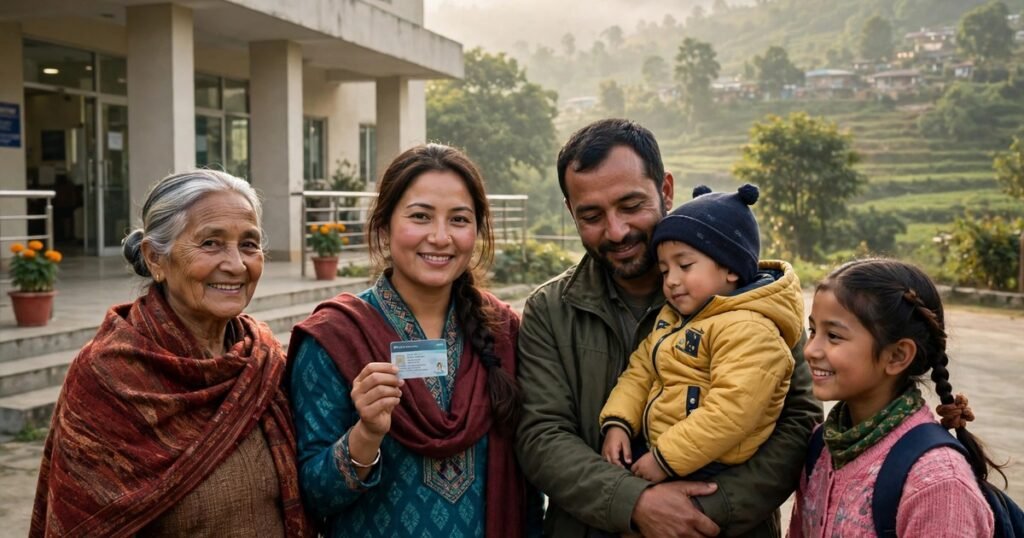
Nepal health insurance explained in one line: for Rs 3,500 a year, a family of up to five gets up to Rs 1 lakh of treatment at government-listed hospitals — but a 2026 rule change now caps ordinary outpatient care at Rs 25,000, so it pays to know exactly what the scheme does and does not cover before you need it.
A hospital bill is one of the fastest ways a Nepali family falls into debt. A single admission can wipe out months of savings, and for daily-wage households it can mean borrowing at high interest or selling assets. Nepal’s answer to that risk is the National Health Insurance Programme (NHIP), a government-run scheme that has enrolled nearly 10 million people since it began.
It is far from perfect — the board that runs it is under severe financial strain, and some hospitals have paused services over unpaid bills — but for millions of families it is still the cheapest protection available against medical costs. This Nepal health insurance explained guide covers what it costs, what it covers, who gets it free, and how to actually use it.
Table of Contents
- Nepal health insurance explained: what the scheme is
- Nepal health insurance explained: what Rs 3,500 buys
- Nepal health insurance explained: who gets it free
- Nepal health insurance explained: how to enrol and use it
- Nepal health insurance explained: the 2026 outpatient cap
- Nepal health insurance explained: the funding problem behind the headlines
- Is it worth joining?
- Frequently asked questions
Table of Contents
Nepal health insurance explained: what the scheme is
Nepal’s health insurance scheme is a social health insurance programme run by the government, not a private insurance product. It is governed by the Health Insurance Act, 2074 (2017) and the Health Insurance Regulations, 2075 (2019), and managed by the Health Insurance Board (HIB), an autonomous government body.
The idea is simple risk-pooling: many families pay a small annual premium into one fund, and the fund pays the hospital bills of the families who fall sick. The law says every Nepali citizen must enrol, although in practice enrolment is voluntary — there is no penalty for not joining, and that is one reason coverage is still far from universal.
The programme began as a pilot in mid-2015 in three districts — Baglung, Kailali and Ilam — and has since expanded to all 77 districts and all 750 local levels. According to a report released by the Health Insurance Board in April 2026, nearly 9.8 million people have enrolled since the launch, but only about 60 percent of them are currently active members.
The renewal rate has fallen to around 50 percent, a warning sign the board itself acknowledges. That gap between enrolment and active membership is the first thing this Nepal health insurance explained guide wants readers to understand: signing up is easy, staying covered takes a yearly renewal.
The scheme is different from the contributory Social Security Fund, which covers formal-sector workers through payroll contributions. Health insurance is family-based and open to everyone: farmers, daily-wage workers, shopkeepers, students and salaried employees alike. If you want the comparison, our explainer on how Nepal’s Social Security Fund works covers the other scheme. For more explainers like this one, see the Hamro Niti homepage.
Nepal health insurance explained: what Rs 3,500 buys
The premium and the benefit ceiling are fixed by the board and apply to the whole family as one unit. The family, not the individual, is the unit of enrolment.
| Family size | Annual premium | Annual coverage ceiling |
|---|---|---|
| Up to 5 members | Rs 3,500 | Rs 100,000 |
| Each additional member | + Rs 700 | + Rs 20,000 |
| 10 members (maximum) | Rs 7,000 | Rs 200,000 |
Three things about that table matter in practice. First, the Rs 1 lakh ceiling is shared across the whole family, not per person. One serious illness in one member can use up the family’s entire cover for the year, leaving everyone else uninsured until renewal. Second, the ceiling resets every year when the premium is renewed — unused cover does not carry over. Third, there is a one-month waiting period after enrolment before coverage activates, so you cannot join on the day you fall sick and claim the same week.
Within the ceiling, the scheme covers consultations, diagnostic tests, medicines on the board’s list (1,289 items), surgeries and hospital stays at empanelled facilities — public hospitals, community hospitals and private hospitals that have signed up with the board. What it does not cover is care outside the empanelled network, treatment abroad, and services beyond the annual ceiling. Once the ceiling is exhausted, the family pays the rest itself.
Knowing the ceiling is shared, not per person, is the single most useful fact in this Nepal health insurance explained guide — it changes how a family plans a hospital visit.
For eight serious illnesses — cancer, heart disease, kidney disease, head and spinal injury, sickle cell anaemia, Parkinson’s disease and Alzheimer’s disease — there is an extra top-up of up to Rs 1 lakh, taking total cover to Rs 2 lakh per person per year for those conditions. This top-up is given on medical recommendation with authorisation from the local level.

Nepal health insurance explained: who gets it free
The government pays the premium for the groups least able to pay it. If you belong to one of these groups, this Nepal health insurance explained benefit costs you nothing at the point of enrolment — the state pays the premium on your behalf:
- Ultra-poor households in 26 districts, identified through the government’s poverty identification process.
- Senior citizens aged 70 and above — the government pays their premium, and a senior citizen in the household also adds a Rs 1 lakh top-up to the family’s ceiling.
- Family members of people living with HIV, people with disabilities, people suffering from leprosy, and patients with multi-drug resistant tuberculosis.
- Female community health volunteers (FCHVs) and their families get a 50 percent discount on the annual premium.
For everyone else, the premium is the same flat Rs 3,500 regardless of age or health. There is no medical test to join and no higher premium for older members — the flat rate is deliberate, so that poor and sick families are not priced out. The trade-off is that healthy young families effectively subsidise sicker ones, which is how all insurance works, but it is also why the fund struggles when mostly sick people enrol and healthy people stay away.
Nepal health insurance explained: how to enrol and use it
Enrolling is straightforward, and since August 2026 it can be done online. Here is the process:
- Register. Enrol through the Health Insurance Board’s online portal at eportal.hib.gov.np, or through the board’s enrolment assistant in your local level, who registers households in their service area. You will need citizenship documents for family members.
- Pay the premium. Rs 3,500 for a family of up to five, plus Rs 700 per additional member. Payment can be made online or through the enrolment assistant.
- Wait one month. Coverage activates after a one-month waiting period. Keep the receipt and your insurance card safe.
- Use an empanelled facility. Start at your designated first service point — usually the nearest empanelled health post or hospital — and get referred upward for specialist or hospital care. Carry your insurance card to every visit.
- Renew every year. The cover lasts one year. Renew before it expires, or the family loses coverage and the waiting period applies again.
If something goes wrong — a hospital refuses service, a claim is disputed, or enrolment is stuck — the board’s toll-free line is 16600111224. Keep bills and prescriptions even when the insurance pays, because the board reimburses the hospital, not the patient, and disputes are settled on the hospital’s records.
Most complaints this Nepal health insurance explained research turned up came from skipping the referral step or letting cover lapse, not from the scheme itself.
One practical warning: check before you travel for treatment that the hospital you are going to is still accepting insured patients. Several large hospitals, including Tribhuvan University Teaching Hospital, have at various points paused insured services because the board had not reimbursed them. A phone call before the journey saves a wasted trip.
Nepal health insurance explained: the 2026 outpatient cap
The biggest change to the scheme in 2026 concerns ordinary outpatient care — the check-ups, follow-ups and prescriptions that make up most people’s use of the scheme.
On 8 January 2026, the Health Insurance Board decided to cap outpatient (OPD) services at Rs 25,000 per family per year — Rs 5,000 per member, with Rs 5,000 added for each extra member beyond five. The decision took effect on 13 February 2026. Previously, a family could use its full Rs 1 lakh ceiling on any mix of outpatient, inpatient and emergency care.
Inpatient and emergency care are unaffected: a hospitalised patient can still use the remaining Rs 75,000 of the family’s annual ceiling, and the Rs 2 lakh cover for the eight serious illnesses is unchanged. But for families whose main use of the scheme is regular OPD visits and medicines for chronic conditions, the practical cover is now a quarter of what it was.
The board says the cap is a short-term measure to keep the scheme running while its finances recover, and that it follows an expert panel’s recommendation. Critics, including health experts quoted in the national press, say it contradicts the promise of the programme and risks pushing renewal rates — already around 50 percent — lower still.
Either way, it is the rule in force now, and anyone renewing should plan around it: budget for routine medicines and check-ups yourself, and treat the insurance as protection against the big, hospitalising bill. That distinction — hospital protection first, routine care second — is the key takeaway of this Nepal health insurance explained update.
Nepal health insurance explained: the funding problem behind the headlines
The OPD cap did not come out of nowhere. The board’s finances have been deteriorating for years, because the money coming in has not kept pace with the claims going out.
The average premium collected is about Rs 3,800 per family, while the average benefits drawn are about Rs 8,250 — the fund pays out more than twice what it collects per family. In the first four months of the current fiscal year, the board settled claims worth Rs 4.409 billion, according to government data reported in November 2026.
By May 2026, the board owed hospitals around Rs 18 billion for services already provided, with roughly Rs 20 million in new liabilities accruing each day. A board report in April 2026 projected a funding shortfall of Rs 25.26 billion for the coming fiscal year.
That gap is why hospitals have pushed back. In May 2026, private hospitals halted outpatient services under the scheme, and several major public hospitals and medical colleges had already stopped insured services over unpaid reimbursements. The board had sought Rs 7 billion from the Ministry of Finance in October 2025 after its liabilities crossed Rs 11 billion, and received Rs 1 billion.
The government has not abandoned the programme — the Prime Minister has publicly said the scheme cannot stop despite the funding crunch — and the board has introduced reforms alongside the OPD cap, including the one-month waiting period and co-payment mechanisms to discourage unnecessary use. Whether those reforms close the gap will decide whether the scheme survives in its current form.
For members, the honest position is this: the cover is real and it pays real bills, but it is under strain, and the terms can change at short notice. Understanding the funding gap matters for readers of this Nepal health insurance explained article because it explains why the rules keep changing — so check the board’s notices before renewing.
Is it worth joining?
For most families, yes — with eyes open. On the evidence in this Nepal health insurance explained review, Rs 3,500 is roughly the cost of one private hospital admission’s first day, and it buys up to Rs 1 lakh of cover against the bill that would otherwise force borrowing. The maths is strongest for families with elderly members, young children, or anyone with a chronic condition: they are the most likely to use the cover, and the premium is flat regardless of risk.
It is weakest for healthy young families who rarely visit a hospital — they may pay for years without claiming — but that is the nature of insurance, and the year you need it is the year it pays for itself many times over.
Three rules make it work better. Renew on time, every year, so the waiting period never bites. Use the first service point and the referral chain rather than walking straight into a tertiary hospital, or the claim can be refused. And keep the OPD cap in mind: treat the scheme as hospital-bill protection first and routine-care support second, and keep a small separate budget for regular medicines.
Health insurance will not fix Nepal’s health system on its own. But until the system changes, Rs 3,500 a year is the cheapest available shield against the medical bill that pushes a family into debt — and that, for most households, is reason enough to be in it.
Frequently asked questions
How much does health insurance cost in Nepal?
Under the Nepal health insurance explained rates, a family of up to five pays Rs 3,500 per year, plus Rs 700 for each additional member, up to a maximum of Rs 7,000 for a family of ten. The government pays the premium for ultra-poor households, senior citizens aged 70 and above, and several other vulnerable groups.
What is the coverage limit of Nepal’s health insurance?
Nepal health insurance explained in numbers: a family of up to five gets up to Rs 100,000 of treatment per year, rising by Rs 20,000 per extra member to a maximum of Rs 200,000. Since February 2026, outpatient care is capped at Rs 25,000 per family per year; inpatient and emergency care can still use the full ceiling. Eight serious illnesses get an extra Rs 1 lakh top-up.
Who gets free health insurance in Nepal?
Nepal health insurance explained for free cover: the government pays the full premium for ultra-poor households in 26 districts, people aged 70 and above, family members of people living with HIV, people with disabilities, leprosy patients, and multi-drug resistant tuberculosis patients. Female community health volunteers’ families get a 50 percent discount.
How do I enrol in Nepal’s health insurance scheme?
Nepal health insurance explained, enrolment in brief: register online at eportal.hib.gov.np or through the Health Insurance Board’s enrolment assistant in your local level, pay the annual premium, and wait one month for coverage to activate. Renew every year before expiry.
Does Nepal’s health insurance cover private hospitals?
Yes — Nepal health insurance explained for hospitals: private hospitals empanelled with the Health Insurance Board are covered. But some private hospitals paused outpatient services under the scheme in 2026 over unpaid reimbursements, so confirm before travelling that the hospital is currently accepting insured patients.
What changed in Nepal’s health insurance in 2026?
Nepal health insurance explained, 2026 changes: from 13 February 2026, outpatient services are capped at Rs 25,000 per family per year. Inpatient, emergency and serious-illness cover are unchanged. Online enrolment and renewal also began in August 2026, and the board introduced a one-month waiting period and co-payment rules.
Sources
- Health Insurance Act, 2074 (2017) and Health Insurance Regulations, 2075 (2019); Health Insurance Board (hib.gov.np).
- Health Insurance Board report, April 2026, via The Himalayan Times — 9.8 million enrolled since launch, ~60% active; projected Rs 25.26 billion shortfall.
- My Republica, 3 February 2026 — OPD capped at Rs 25,000 per family from 13 February 2026; eight serious illnesses unchanged.
- The Kathmandu Post, 2 February 2026 and 27 May 2026 — OPD cap details; private hospitals halt OPD services; board owes hospitals ~Rs 18 billion.
- The Himalayan Times, 3 February 2026 — board clarification: OPD Rs 25,000 per family, +Rs 5,000 per extra member; total cover unchanged.
- My Republica, November 2026 — Rs 4.409 billion in claims settled in the first four months of FY 2083/84; 5.304 million active members (~20% of population) as of mid-July 2026.
- Online Khabar / The Himalayan Times, 4 October 2026 — 732,752 enrolled in Sudurpaschim; programme launched as pilot in 2015 in Baglung, Kailali and Ilam.
- eNewsPolar, 15 August 2026 — online enrolment and renewal via eportal.hib.gov.np launched; ~5.97 million enrolled.
- Digital Solution Nepal, updated 6 November 2026 — premium/ceiling table, 10-member maximum, critical-illness top-up, e-portal check.