

“World order now means, in effect, the establishment of compatible priorities,” argued Henry Kissinger. Foreign policy is, in a simpler version, not just a state’s choice of whom to befriend or confront; it is a strategic calculation shaped by various factors such as national interests, geopolitical constraints, and others. For decades, Nepal has demonstrated such complexity: positioned between two major powers, India and China, Nepal has historically operated within an order that highlights asymmetry, with constraints somehow placed on its strategic autonomy. Rather than being simply “stuck” between two giants, Nepal has had to navigate a balance in which maintaining equal relations with both neighbours is essential to its economic and strategic interests.
Two Giants
Successive governments in Nepal have taken a pragmatic and cautious approach, focusing on bilateral engagement with both India and China while avoiding confrontation. Additionally, every policy with a foreign state has both positive and negative impacts. Nepal’s position as a buffer state has created significant economic and developmental opportunities, but it has also resulted in structural dependence. China, for example, is Nepal’s second-largest trade partner and the largest source of foreign direct investment. Nepal imports machinery, electronics, construction materials, textiles, footwear, fertilizers, and pharmaceuticals from China, and exports agricultural products, tea, coffee, yarchhagumba, rudrakshya, etc., resulting in a persistent trade deficit. Nepal also has duty-free and quota-free access to the Chinese market for over 8,000 Nepali products.
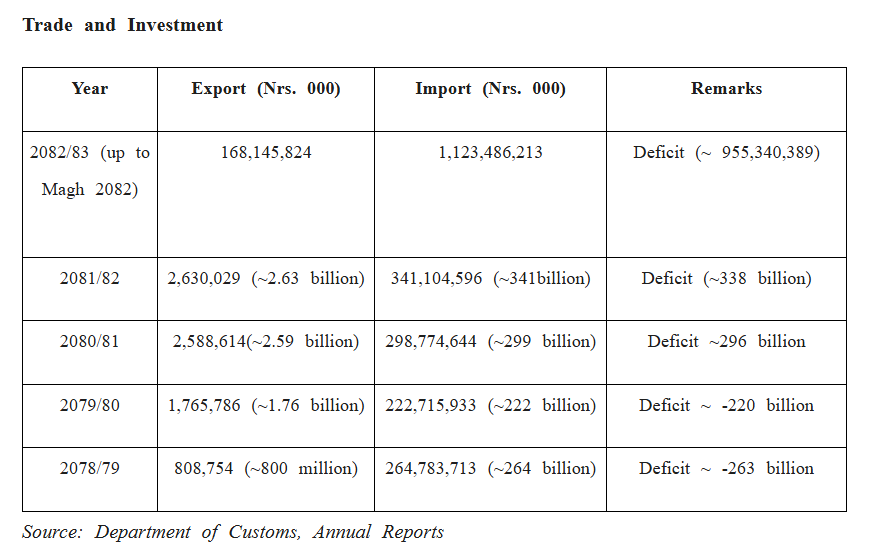
Fig 1. China-Nepal Trade and Investment (MOFA 2026)
This relationship, however, extends beyond economics. China considers Nepal a strategic ally due to its proximity to the Tibet Autonomous Region and Beijing’s security sensitivities concerning Tibet. Furthermore, history demonstrates the geopolitical consequences of this proximity. During the Cold War, scholars argue that the United States supported Tibetan resistance forces operating from Nepal, particularly in Mustang, where the CIA provided training and logistical assistance to Tibetan guerrillas. Nepal’s contemporary foreign policy towards China must therefore be understood not only through trade and development, but also through the circumstantial considerations of sovereignty, security, and regional power competition.
On the other hand, India remains Nepal’s largest trading partner and source of foreign investment, while also providing critical transit access for Nepal’s trade with third-party countries. Trade with India accounts for approximately two-thirds of Nepal’s external merchandise trade, while bilateral service trade accounts for roughly one-third of Nepal’s total services trade. India also accounts for roughly one-third of Nepal’s foreign direct investment and almost all of its petroleum imports. The economic relationship is thus not only significant, but also structurally asymmetric, with Nepal’s geography making India essential to its trade, energy security, and overall economic connectivity.
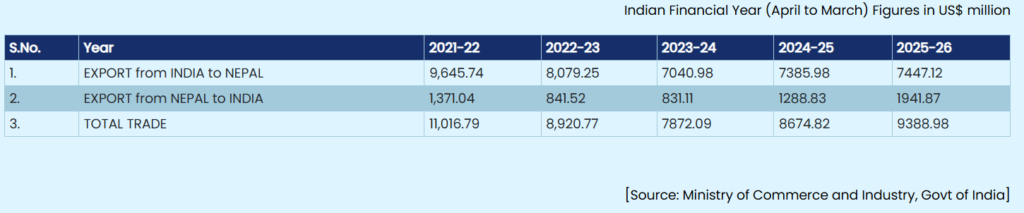
Fig 2. India-Nepal Trade and Investment
However, on the negative side, interdependence exists in a more complicated political relationship. Once characterised by a traditionally close and often described “special relationship,” Nepal–India ties have increasingly been accompanied by questions of sovereignty, perceived Indian influence, and public anti-India sentiment. These tensions became particularly visible during K.P. Sharma Oli’s tenure, especially following the 2015 blockade and subsequent territorial disputes. Oli’s governments emphasized national sovereignty and sought to diversify Nepal’s external economic and strategic options, including closer ties with China. This shift did not eliminate Nepal’s reliance on India; rather, it demonstrated Kathmandu’s efforts to increase strategic autonomy within an asymmetric relationship. The emergence of slogans and social media campaigns like #BackOffIndia and #GoBackIndia demonstrates how bilateral tensions have spread beyond diplomatic circles and into Nepal’s domestic political discourse. Thus, Nepal-India relations are a paradox: deep economic and socio-cultural interdependence coexists with growing political sensitivities and occasional strategic mistrust.
Four Leaders, Four Approaches:
Now, the major concern arises on how Nepali leaders are being persuaded to support sides. Those sides will ideologically support those countries’ policies and have a mutual understanding where leverage goes to the other side. This statement is supported by the actions of the so-called prominent leaders: Oli, Dahal, Deuba, who were former Prime minister that shaped the foreign policy. Before that, we must understand that these sole leaders were not working towards the same purposes but sometimes consequently together; in the form of a coalition. These actions are carefully interpreted in such terms: frequent visits, diplomatic meetings, outcomes, and their implementation
Starting with Oli’s tenure, his China policy was frequently interpreted as a departure from Nepal’s traditional dependence on India. The visit of 2025 to China attracted considerable attention because it resulted in agreements towards development under the Belt Inititaive road framework (BRI). Moreover, this visit was more in the limelight because it followed his visit to India and occurred amid strained Nepal-India relations following the 2015-16 border blockade. Although some scholars interpreted that the engagement with China was to align Nepal with Beijing, others viewed it as an assertion of Nepal’s sovereignty and an attempt to diversify its strategic options. However, Oli did not simply abandon India: he visited New Delhi in February 2016 with the same purpose of maintaining good relations; amid the blockade. Thus, the stance on where KP Oli’s leadership inclines towards a certain giant is ambiguous and is left for interpretation.
Secondly, Dahal presents a more complex case where his motive does not show any asymmetrical inclination. His political movement emerged from a Maoist ideological tradition influenced by communist thought; his foreign policy demonstrated considerable pragmatism. In 2008, during his first tenure as Prime Minister, Dahal chose China as his first foreign destination and attended the Beijing Olympics, departing from the conventional India-first approach. Yet his political history also intersects deeply with India through the Maoist insurgency and subsequent peace process. His trajectory therefore challenges simplistic classifications as either pro-India or pro-China.
Lastly, Sher Bahadur Deuba, meanwhile, has generally maintained stronger engagement with India and Western partners while continuing Nepal’s broader policy of maintaining relations with China. His repeated high-level engagement with New Delhi demonstrates the importance of India within Nepal’s foreign policy. His 2022 visit to India, including a controversial visit to the BJP headquarters, reinforced the political dimension of bilateral relations while generating domestic debate over diplomatic optics. Deuba’s approach can therefore be characterised as pragmatic engagement; following the Congress ideology, balancing traditional ties with India against Nepal’s broader strategic interests.
Current State:
Now, on today’s date, whether the Gen Z revolution was influenced by or carried out by any foreign nation will be buried in history. This is not the first time a revolution was influenced, whether during the Maoist insurgency or especially during the abolition of the monarchy. Again, such influencing facts and figures will never be public, but assumptions will be made accordingly. Now, the aftermath of the Gen Z revolution has seen the rise of the Rastriya Swantra party, which has dominated other mainstream political parties that ruled authoritatively, ignoring people’s needs. With a change in political regime, the main question arises on whether the Nepalese will expect the same change in institutional order and action. This is institutional action in terms of foreign policy. There have to be differences between Oli’s cabinet’s foreign policy and Deuba’s, and the same with Balen’s. But can the Nepalese expect a massive change? A change in whether Nepal will either appeal or show statesmanship?
The Rastriya Swatantra Party (RSP) entered government promising to transform Nepal from a “buffer state” into a “vibrant bridge” between India and China, with an emphasis on balanced diplomacy and economic cooperation. Yet the early months of the Balen government have been marked less by international travel than by diplomatic restraint. The unresolved Lipulekh dispute, including the India-China understanding concerning the route through territory claimed by Nepal, has further complicated Kathmandu’s relations with both neighbours.
Balen’s approach has at times prioritized sovereign signaling over traditional diplomatic engagement. His reported refusal to meet with India’s Foreign Secretary Vikram Misri contributed to the postponement of Misri’s planned visit to Nepal, and Balen initially avoided one-on-one meetings with foreign ambassadors. At the same time, RSP Chair Rabi Lamichhane pursued a parallel channel of party-level diplomacy during his June visit to India, highlighting the difference between the government’s official posture and the ruling party’s external engagement. However, the policy appears to be entering a new phase. India formally invited Balen for an official visit in July, while on August 10 he held separate meetings with the Indian and Chinese ambassadors in Kathmandu; the first such direct engagements after months of restraint. This suggests that Balen’s foreign policy may not represent isolation, but an attempt to renegotiate Nepal’s diplomatic posture. Whether this becomes genuine strategic autonomy or merely diplomatic inexperience remains an open question.
In comparison to previous leaders, Shah’s foreign-policy style appears to be more focused on direct action and selective engagement rather than frequent international visits and prolonged diplomatic engagements. His earlier reluctance to meet one-on-one with foreign envoys marked a significant departure from traditional diplomatic practice, tho his August 2026 meetings with the Indian and Chinese ambassadors indicate a recent shift in this approach. Balen’s emphasis on sovereignty and reciprocity can strengthen Nepal’s bargaining position and project greater strategic autonomy. However, diplomacy also depends on sustained dialogue, international visibility, and personal engagement. Excessive restraint can reduce Nepal’s diplomatic leverage rather than strengthen it. His emerging approach should therefore be viewed as a 50-50 trade-off between assertiveness and diplomatic engagement, with its success, therefore, depending on whether symbolic sovereignty translates into tangible national interests.
Bibliography:
(Sources are in ascending order)
- Nepal’s struggle for autonomy in the shadow of giants
https://www.thinkchina.sg/politics/nepals-struggle-autonomy-shadow-giants
- Nepal-China Relations
https://mofa.gov.np/content/1450/nepal-china-relations
- Beijing’s Nepal anxiety: The American factor
https://english.nepalnews.com/s/long-reads/beijings-nepal-anxiety-the-american-factor
- Nepal caught between Washington’s cause and China’s red line
- Nepal-India Relations
https://www.indembkathmandu.gov.in/commerce-wing-brief
- The Power of Social Media Sites: A Case of #BackOffIndia
- Oli’s landmark China visit
- Oli’s visit; indian perspective
https://www.icwa.in/show_content.php?lang=1&level=3&ls_id=12148&lid=7407
- Prachanda Breaks the Cycle
- Prachanda’s status quo
- Deuba’s visit to India
- RSP’s 2026 election manifesto
https://rspnepal.org/manifesto
- Rabi Lamichhane’s visit to India
- Balen Shah meeting indian and Chinese ambassadors