NK
Nabina Karki
Mar 22, 2026 • 4 min read
Ever wondered why vehicles are cheaper just across the border in India, yet significantly more expensive in Nepal?
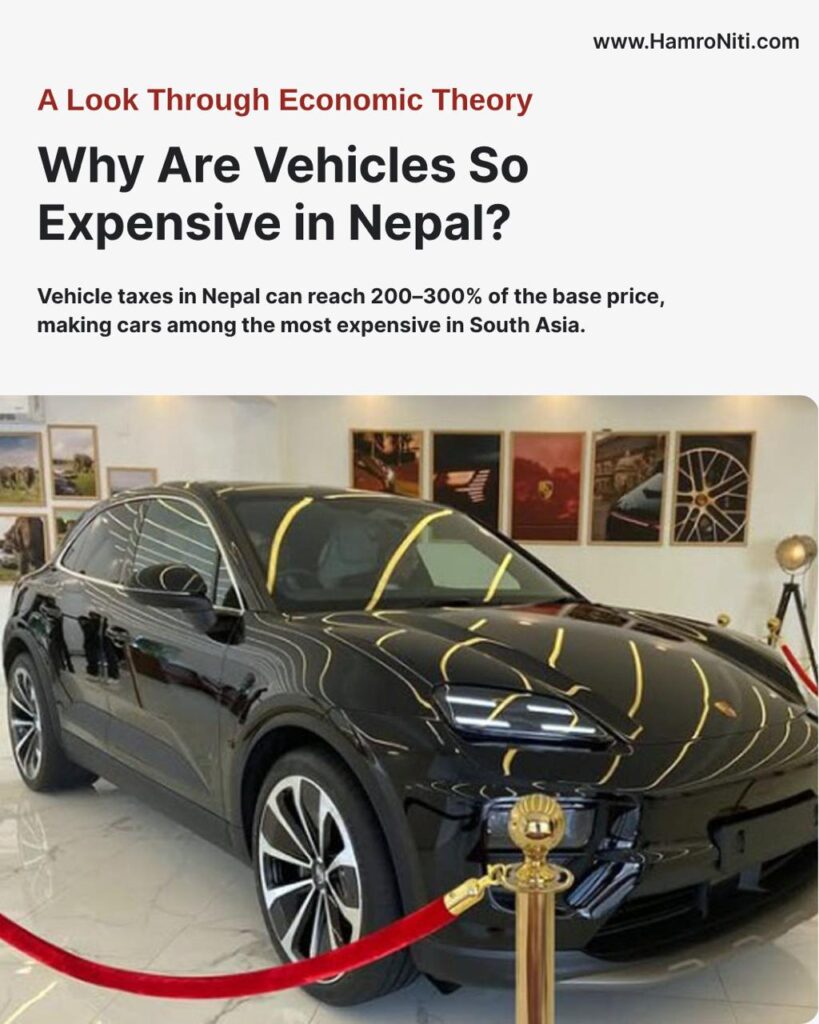
The primary reason lies in taxation. The Nepalese government categorizes private vehicles as luxury goods and imposes multiple layers of taxes on imports—excise duty, customs duty, value-added tax (VAT), registration costs, and road infrastructure tax. As a result, the total tax burden on internal combustion engine (ICE) vehicles can be nearly three times higher than in India. Additional factors such as Nepal’s difficult geography and intermediary costs further increase prices. However, electric vehicles (EVs) face comparatively lower tax rates, reflecting a policy shift toward sustainability.
From an economic perspective, high taxes directly influence price and demand. According to the Law of Demand, when the price of a good decreases, the quantity demanded increases. If Nepal were to reduce taxes on vehicles, the price of vehicles would fall, making them more accessible to a larger portion of the population, particularly middle income households. This would likely result in a significant increase in vehicle ownership.
However, increased vehicle consumption also creates negative externalities. Higher numbers of vehicles can lead to greater air pollution, increased traffic congestion, and environmental degradation. These social costs must be considered when evaluating tax policy.
Economic theory also explains how increased vehicle ownership affects related markets. The work of Alfred Marshall and John Hicks highlights the relationship between complementary goods. As more vehicles are purchased, the demand for complementary goods such as petrol increases. This can lead to higher fuel prices and increased overall expenditure for consumers.
Tax reduction can also influence domestic industries. Nepal has a small but developing automobile assembly sector. If imported vehicles become significantly cheaper due to lower taxes, domestic producers may find it difficult to compete. On the other hand, businesses involved in importing and selling vehicles may benefit from increased demand and higher sales volumes.
One of the primary purposes of taxation is to generate government revenue. Reducing taxes raises an important question of whether revenue will increase or decrease. This can be understood through the Laffer Curve. The Laffer Curve suggests that there is an optimal tax rate that maximizes revenue. At very high tax rates, consumers are discouraged from purchasing goods, which can reduce overall tax revenue.
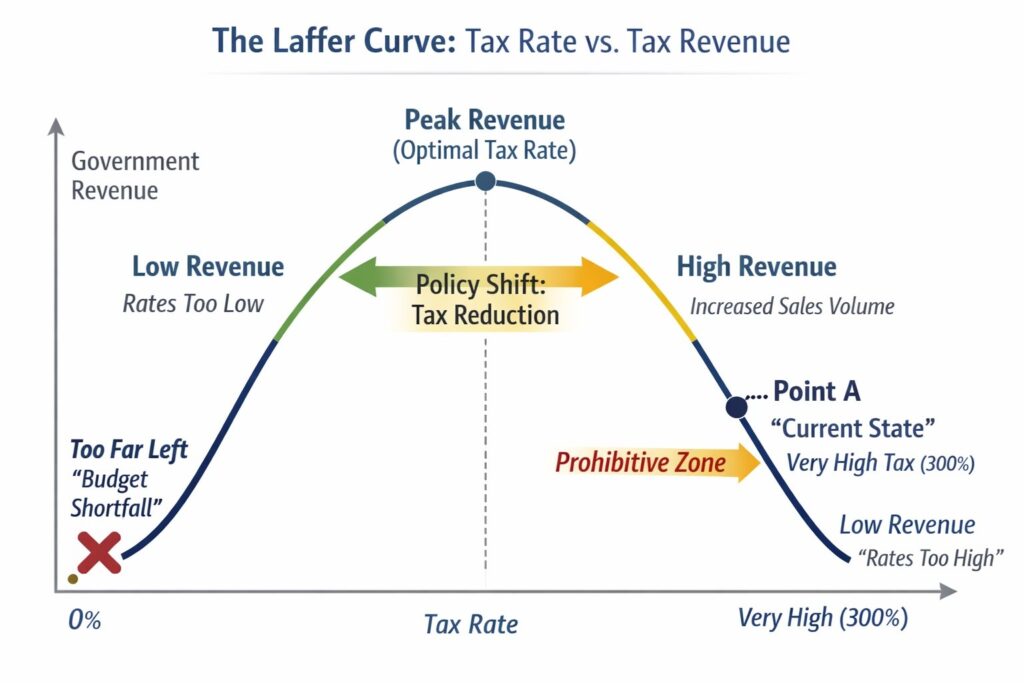
Nepal appears to be positioned at a relatively high tax rate on vehicle imports. If taxes are moderately reduced, the country may move closer to the optimal point on the curve. In such a case, increased demand for vehicles could offset the lower tax rate, leading to higher overall revenue. More individuals would be able to afford vehicles, expanding the taxable base.
However, if taxes are reduced too much, government revenue may decline, potentially creating a budget deficit. A relevant example can be seen in 2022, when Nepal imposed a ban on the import of luxury goods. This policy led to a significant drop in revenue collection, as noted by officials from the Ministry of Finance.
The effects of tax reduction also extend to the external sector of the economy. Nepal is heavily dependent on imports, particularly from India. An increase in vehicle demand would lead to higher imports of vehicles and petroleum products. This would increase the demand for foreign currency, placing pressure on foreign exchange reserves and potentially worsening the balance of payments.
In conclusion, reducing taxes on vehicles in Nepal would have wide ranging economic effects. It could increase accessibility and demand, influence complementary markets, affect domestic industries, and alter government revenue. At the same time, it may create environmental and external sector challenges. A balanced approach to tax policy is therefore essential. Policymakers must carefully consider these trade offs to achieve sustainable economic outcomes while maintaining fiscal stability.