

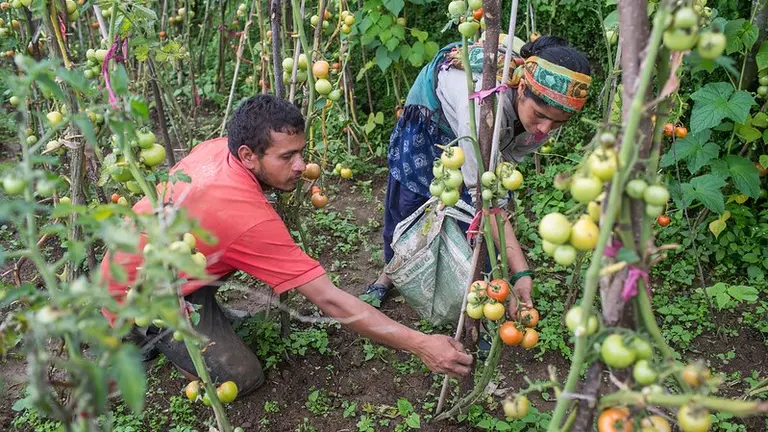
For Nepal’s smallholder farmers, just growing a healthy crop doesn’t guarantee money or a
profitable season. Between all the costs that they’ve to endure between farm and the market;
storage, transportation, unstable prices easily influenced by different factors and limited access
to the buyers can readily reduce the value of their harvest for the season.
Growing crops requires a hefty amount of time. It requires investment in seeds, ploughing of
land, crop protection, and labor. Yet the moment harvesting begins, they must face another issue,
a time-sensitive challenge. Farmers must hurriedly sell their crops before its quality declines, and
the price plummets due to it.
Today I took an exmaple of tomatoes. Tomatoes are a useful case for examining this post-harvest
loss happening in Nepal, because they’re highly perishable and vulnerable to different antics
during handling and transportation. Some case studies in Nepal have also measured both physical
and economic losses at different stages portraying the different stages of crop-value chain.
Although not everyone’s findings represent the whole crop market of Nepal, tomatoes clearly
demonstrate how perishability, weak infrastructure and the limited market options that smallhand
farmers have, can reduce farmer’s earnings.
A recent study done in 2017 about Nepal’s tomato value chain found that nearly one-quarter of
the harvested crop entering the market was lost before reaching to the consumers’ household.
And further one-fifth was sold at the redundant prices because of quality damage. Therefore,
post-harvest loss is not correlated to produce but also to the field or market. It also includes the
gradual loss of quality that causes depreciation of price and ultimately, the income of the
farmers.
Does loss always mean wastage?
The Food and Agriculture Organization describes this post-harvest loss due to measurable
reduction of quantity and quality pf the produce. It discusses that farmers can experience at least
three related forms of loss.
Physical loss occurs when goods are damaged, precisely tomatoes because that’s what we’re
discussing today. They can also be termed spoiled or discarded. Quality loss occurs when the
tomatoes remain edible but receive much lower price due to their deformity and because they
were overripening or stale. Lastly, economic loss occurs when the harvest is sold, but the cost
recieved doesn’t fully cover production and marketing costs.
This distinction of losses matters because despite various aspects, it indicates how a farmer can
sell his entire harvest but still suffer losses. If quality decrease lowers the selling price, or
transportation and production cost consume most of the income, the absence of visible waste
does not indicate a profitable season for the farmer.
Where does the value disappear?
The loss can begin immediately after harvesting. Tomatoes that are picked during excessive heat
may lose freshness before even reaching the market. Also, rough handling by the farmer,
unsuitable packaging exposes the prodcue to many vulnerabilities during transportation.
A study was conducted involving 60 tomato producers within the valley in three distinct cities;
Kathmandu, Bhaktapur, and Lalitpur. This study had estimated a 10% loss between harvesting
and marketing. Most losses were accounted majorly due to the transportation costs, followed by
harvesting, packaging, and storage. The traditional methods for farming and inadequate
knowledge of harvesting, storage, packaging, and transportation as contributing factors.
The limited storage also reduces the farmers’ options. To get a good price for their harvest, they
must preserve the freshness, and on the other hand, they also cannot wait for the prices to rise.
Transportation to the market after immediate harvest could provide access to more buyers, but
fuel, loading charges, labor costs and the risk that the produce may remain unsold eliminates the
apparent advantage.
Nepal consists of small hand farmers, and their production is of small scale. These farmers have
small production volumes which make independent transportation expensive. They cann sell
through the nearby collector, or simply a middleman, but that leaves little room for them to
negotiate as after the harvest. It’s their goods that keep decreasing the price, giving upper hand to
the collectors. Research on the Nepalese food-crop market indicates how perishability weakens
the producers’ market power because delaying the sale increases the risk of depreciation.
Therefore, perishability is both, storage and bargain problem.
What exactly is the farmers’ income?
The Kalimati Fruits and Vegetable Market Developemtn Committe publishes daily minimum,
maximum, and average wholesale prices of the goods within the valley. This information
provides useful information regarding the conditions of the market, but they do not show how
much a farmer retains. This creates an asymmetry of information between producers and buyers.
The farmers’ return is better understood as the difference in selling income and the production
and marketing costs.
Let us consider and illustrative example. If a farmer sells 500 kilograms of tomatoes at Rs. 30
per kilogram, the gross income will be Rs. 15,000. If the transportation, packaging, and
marketing expense totals Rs. 13,000, the farmer earns only Rs. 2,000. Also, if there are some
tomatoes of lower grade, this price would be reduced much further.
These are the illustrated figures rather than the average estimated costs in Nepal. Nevertheless,
they still show how the highest quoted price is not the price earned by farmers. Distance,
transportation expenses, product quality, and the quantity accepted by the buyer all affect the
final return gained by farmer.
What can be done?
Timely price information can tend to reduce uncertainty, but the information alone cannot
overturn the fate of agriculture in this country. It cannot provide storage, transportation, or
bargaining power. A higher price in a distant market can only be useful when a farmer can reach
that place affodably. Just the predicted price increases the offer a bit, but the tomatoes cannot
remain fresh till then.
Market information should therefore answer practical questions rather than digital information. I
do not try to demean access to information, but it alone cannot result in greater change. It should
asnwer: When was the price updated? Is it a wholesale price or a farm-gate price? What quality
does the buyer require? What will the overall transportation cost be? Is the buyer reliable?
Reducing post-harvest losses also requires some action beyond information. Farmers can protect
the produce and its quality through careful harvesting, shade, sorting and suitable packaging.
Instead of acting independently, all small hand farmers can collectively form a larger group. The
farmer group can combine produce, share the transportation costs and negotiate using larger
volumes and an upper hand in the bargaining power. Public institutions or local co-operatives
can facilitate the farmers with collection centres, storage facilities, training and transparent
market reporting.
A successful agricultural season should not be measured only by how much is harvested. It
should also be measured by how much produce reaches the consumer, how much calue is
preserved, and how much income remains with the farmer.
Sources:
- Bhatta et al. (2017), “Volume and value of postharvest losses: The case of tomatoes
in Nepal”, British Food Journal. - Tiwari et al. (2020), “Post-harvest practices and loss assessment in tomato in
Kathmandu, Nepal”, Journal of Agriculture and Natural Resources. - FAO, “Agricultural engineering in development: Post-harvest losses”.
- Kopp and Salecker (2022), “Perishability and market power in Nepalese food crop
production”, Journal of Agricultural Economics - Kalimati Fruits and Vegetable Market Development Committee, daily wholesale
price information.