RD
Rohan Dhungel
Mar 25, 2026 • 6 min read
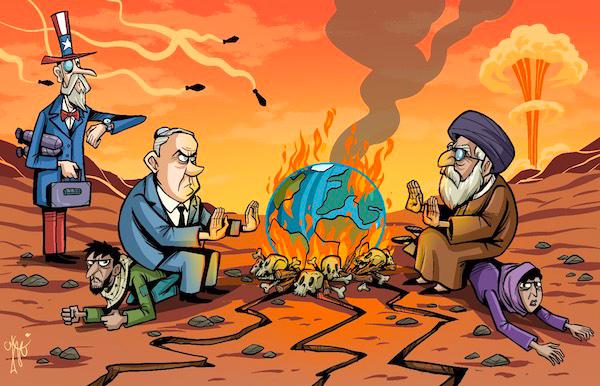
On February 28th, 2026, the US and Israel launched a surprise attack on Iran on numerous sites that killed the Supreme leader Ali Khamenei. The strikes have hit 18 hospitals that killed 11 people and a primary school that killed 170 people, most of them being schoolgirls. On the same day, Iran retaliated by targeting US military bases but drone strikes were done in densely populated areas as well. Till March 24th, over 1500 people have been killed in Iran, over 1000 in Lebanon and over 100 in all other nations.
In recent months,tension between Washington and Tehran grew to a military conflict, however, it was not always the case. Before the 1979 Islamic revolution, Iran was an ally of the US under the Imperial rule of the Shah. In 1953, the CIA and M16 backed a coup d’etat to overthrow Iran’s democratically elected prime minister who had nationalised the Anglo-Persian Oil Company. The coup installed Mohammad Reza Pahlavi as an absolute monarch and the nationalization of the oil company was reserved. Imperial Iran was firm against communism which enabled the US to set up monitoring stations to spy on the USSR. According to the New Internationalist, between 1970 and 1978, Iran bought $20 billion worth of arms, ammunition and other military merchandise from the US, making Iran one of the biggest buyers of American weapons before the revolution.
The people saw the Shah as a puppet of the US who was aggressively westernizing Iran destroying its traditional heritage. Among the working class people, his “White Revolution” was deeply unpopular as it displaced rural communities and only benefitted the urban elites. In December of 1978, 17 million people marched across the country demanding the removal of the Shah and the return of Khamenei and in January of 1979, the Shah fled the nation. In the same year Iran was declared an Islamic Republic. This shift in administration amplified the Iranian people’s hatred for the west and by inclusion, the US. This set Iran on a path that led to a conflict between Tehran and Washington.
Iran had a nuclear program before the revolution but it slowed down. After Saddam Hussain’s use of deadly chemical weapons during the Iran-Iraq war in 1980, Iranian leaders were convinced that a nuclear program was necessary. By the 2000s, the West grew alarmed and sanctions were imposed. In 2015 Iran signed the JCPOA agreement and agreed to dismantle much of its nuclear program in exchange for sanction relief. The same year, Washington backed away from the deal under the Trump administration and re-imposed sanctions on Iran. After that Iran started aggressively stockpiling and enriching Uranium. By late 2024, Iran could produce enough weapon grade materials for a nuclear bomb in roughly a week.
On October 7, 2023 Iran played a vital role in supporting Hamas’s massacre, followed by a direct Iranian attack on Israel in April and October 2024. Behind the scene, Oman was mediating a discussion and was about to reach a breakthrough. Oman’s foreign minister had announced that Iran agreed to never stockpile enriched uranium and accept full IAEA verification. But just a day later, Israel and the US launched strikes aiming to destroy Iran’s nuclear facilities and instill a regime change. US Secretary of State Marco Rubio and Israeli Defense Minister Israel Katz both say that the strike was pre-emptive aiming to destroy the imminent threat of Iran.
The strike on February 28th, 2026 affected many people living and working across different nations in the middle east. According to EBSCO research, over 1.72 million Nepali workers are spread across 13 countries in the middle east. A 29 year old Nepali security guard Dibas Shrestha was killed by debris from a drone strike in UAE. Amrit Jha, while working aboard a vessel in the Strait of Hormuz, was detained by Iranian armed forces. Several airports in the middle east are closed which has caused 22 bodies of Nepali workers who died of natural causes to be stranded. Nepali workers as well as their families are living in fear not knowing when their sons or daughters will come home.
Migrant workers in the Gulf countries are already exploited and this war just makes it very difficult to leave. The employers control the worker’s right to leave the country and change jobs. This system of employment is known as the Kafala system, where the residency and employment status of a migrant worker is tied to a specific employer. For domestic workers, this system is designed for exploitation.
After the strikes on Iran on February 28th, Iran effectively choked traffic, allowing only 21 ships in over a 100 days. The blockade by Iran is a restricted one, allowing only friendly or neutral nations. After the blockade, energy Brent crude peaked at $126 per barrel; QatarEnergy, which is responsible for 20% of the global supply of LNG, has now shut down its production and export facilities. Asia has taken the biggest hit on its crude oil and LNG supply as 90% of LNG and 80% of oil products, which flow through the strait of Hormuz are designated for Asia. China accounts for the largest crude flow and India comes at second place with 37.7% and 14.7% respectively. An 80% decline is seen in the flow of crude oil and oil products.
Aside from crude oil and oil products, a third of global fertilizer supply is also stranded, including 35% of traded Urea and 30% of traded Ammonia. Qatar is the world’s largest helium exporter, accounting for a third of Helium supply which has also been stranded. Low supply of helium directly affects the supply of semiconductors, semiconductor manufacturers use helium to cool silicon wafers during fabrication and to create a stable vacuum environment. Aluminium, petrochemicals and sulfur also face risk of disruption.
Urea now costs Rs130 per kg in the open market but state-owned suppliers in Nepal are selling at Rs14 per kg. In the global market, the price of Urea jumped to $700 per tonne. Nepal’s annual fertilizer demands sit around 8,00,000 tonnes, of which 5,00,000 tonnes are imported. Nepal depends almost entirely on the supply from the strait for Hormuz for fertilisers, even before the crisis Nepal had a pre-existing shortage of 3,00,000 tonnes. Urea prices have jumped about 40% in recent weeks and further price spikes cannot be ruled out. Nepal has signed a contract for 90,000 tonnes of Urea but officials are unsure whether it will be honoured given the current crisis. Nepal currently holds 1,37,000 metric tons of fertilizer in stock with additional 46,000 metric tons in Kolkata port awaiting transport. So, Nepal is not in immediate crisis but further disruption brings an uncertain future.
The war happening in the middle east is not just a distant war but one that hits close to home. If the war continues for a long period, the economic effects could be detrimental, however, Nepal buys oil products from India which has gained permission to buy oil from Russia. Alternative routes are being used to deliver but these are not perfect solutions. A crisis like this shows how dependent we are on the geo-politics of the world.