PR
Pramila Rai
Mar 26, 2026 • 4 min read
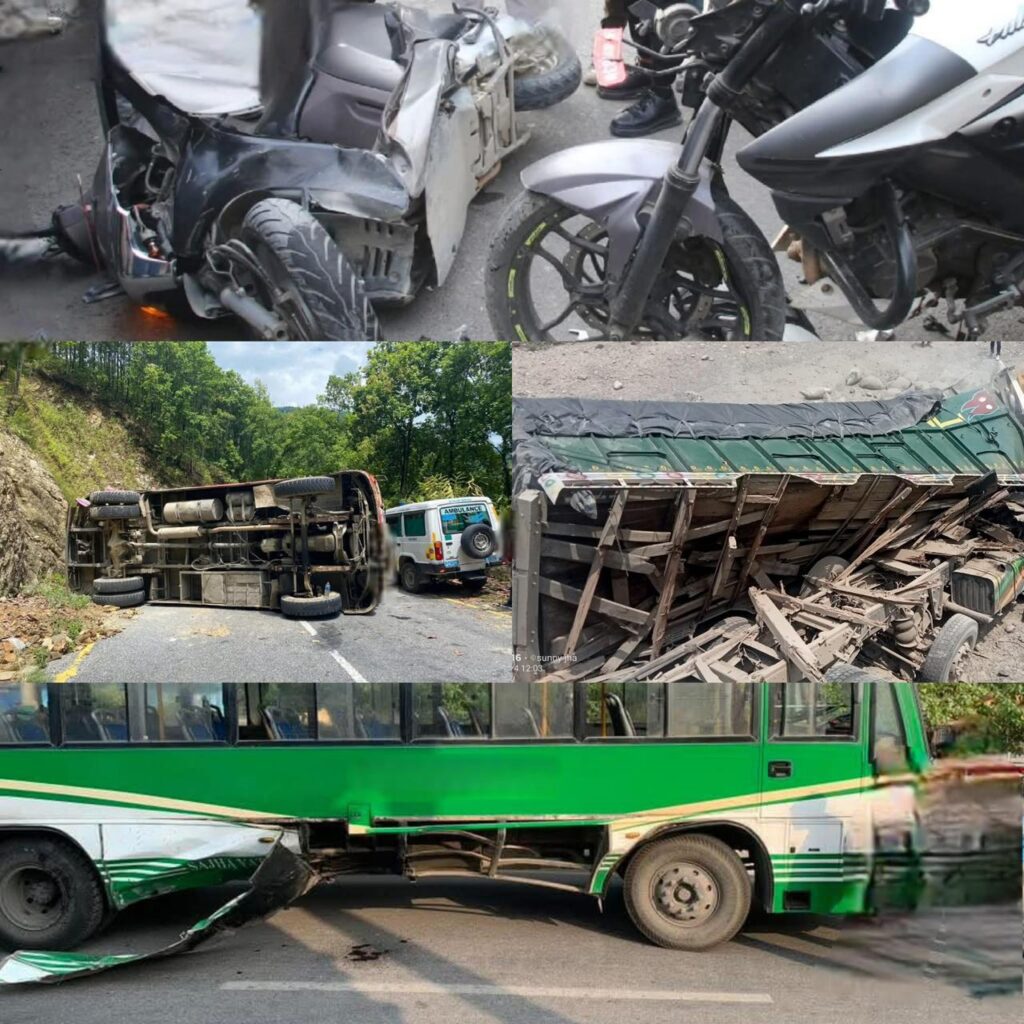
Every 24 minutes, someone dies in a road crash in Nepal. This striking statistic, drawn from recent official data, underscores the severity of road safety in Nepal. According to a Nepal Police report, there are approximately 75 road accidents every day, resulting in about seven deaths daily. Road accidents are a leading cause of death and disability among youths. In 2025, 28,692 accidents killed 2,549 people.
Road accidents in Nepal stem from overspeeding (40% of crashes), poor road infrastructure, weak law enforcement, and risky driver behavior. The impact of traffic accidents extends beyond immediate suffering, affecting families’ finances, workforce productivity, and the national economy. Every year, thousands of people are killed or seriously injured in road accidents. Despite introduced policies and action plans, overall improvement in road safety has been slow.
Road safety concerns every traveler, especially since road transport is the most accessible and economically feasible way to travel for most Nepalis. Pedestrians are the most vulnerable group.
To guide countries in improving road safety, the World Health Organization (WHO) has proposed a framework built around five pillars: road safety management, safer roads and mobility, safer vehicles, safer road users, and post-crash response. These pillars enable comparison of Nepal with international best practices and highlight where the country falls short. In road safety management, Nepal has developed action plans (2013–2020 and 2021–2030 drafts). For safer roads and mobility, Nepal has designed roads, but challenges persist due to geographic differences. Nepal’s driver licensing system is poor for safer road users. In the post-crash response, Nepal faces delays due to resource gaps.
Nepal’s primary framework is the Motor Vehicles and Transport Management Act 1993. This act defines motor vehicles, classifies them, and sets out a basic structure for registration and licensing. It also specifies speed limits and penalties and includes provisions for technical and mechanical inspection of vehicles. These inspections ensure that vehicles are in sound, structurally safe condition and within acceptable pollution limits. Through vehicle regulation, this law aims to reduce accidents caused by mechanical failure. Additional motor vehicle acts cover traffic laws on speed limits and penalties, helmets, seatbelts, and road safety awareness.
On the infrastructure side, the government has gradually invested in road safety improvements such as road widening, blacktopping, and installation of guardrails and reflective signs. These measures aim to reduce accidents on mountainous and high-risk routes. However, roads in rural areas remain poorly maintained.
In practice, coordination among federal, provincial, and local levels has gaps in implementation and accountability. Data tracking is poor. Twenty percent of Nepal’s highways are high-risk, and vehicle inspections for safety are irregular.
Despite existing laws, plans, and infrastructure development, systemic weaknesses undermine road safety in Nepal. Speed limit and seatbelt rules are poorly enforced. The Nepal Road Safety Action Plan (2021–2030) exists but lacks enforcement. Nepal has no operational National Road Safety Council (NRSC), the 1993 Motor Vehicle Act is under-resourced, and oversight is fragmented across infrastructure, vehicles, and enforcement.
Nepal should enforce the 2021–2030 action plan through an operational National Road Safety Council. It should invest in pedestrian-friendly road designs like crossings and sidewalks, plus broader infrastructure development. It should also train more officers and strengthen vehicle inspections for safety and pollution.
In conclusion, road accidents in Nepal are a serious and growing problem that demands a coherent, evidence-based policy response. While Nepal has developed a basic legal and policy framework centered on the Motor Vehicles and Transport Management Act and aligned with international road safety pillars, the country faces serious challenges in enforcement, coordination, data quality, and driver behavior. By addressing these weaknesses and strengthening institutions, laws, infrastructure, and public awareness, Nepal can move closer to its goal of halving road accidents by 2030 and making roads safer for all users.