Jhapa-5 Election Overview: Candidate Profiles and Comparative Analysis
Constituency Context: Jhapa-5, Jhapa District
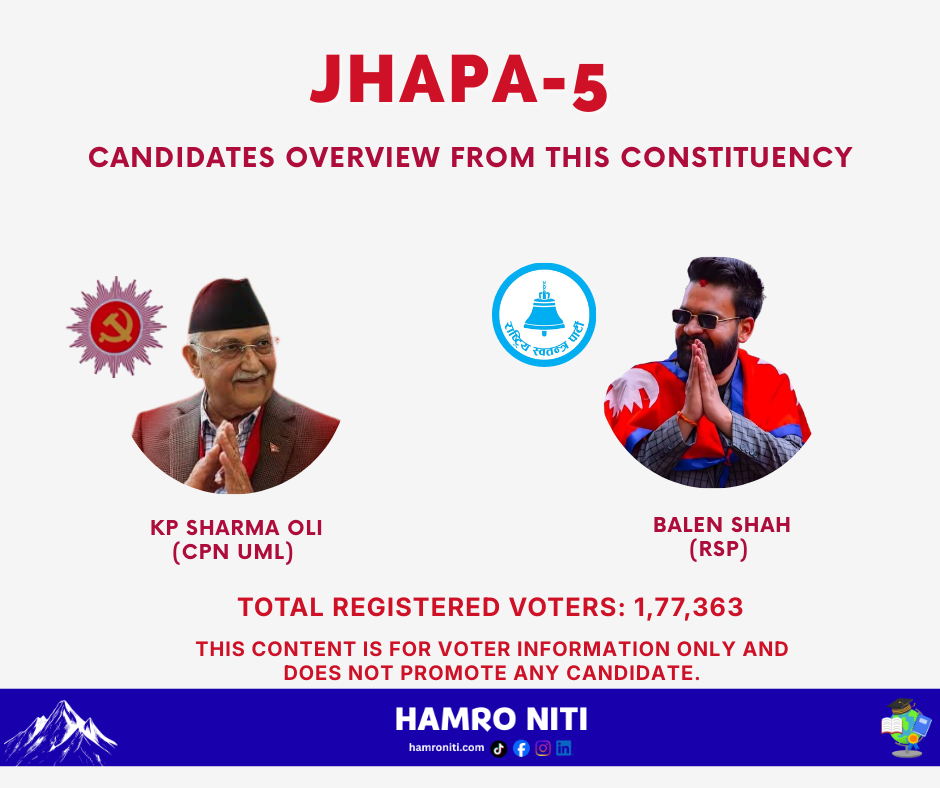
Jhapa-5 is one of the key electoral constituencies in eastern Nepal, drawing national attention due to the presence of high-profile political figures. In the upcoming general election, the constituency has 24 total candidates, with the primary public focus on the contest between Khadga Prasad (K.P.) Sharma Oli and Balendra Shah.
Disclaimer: This content is strictly for voter information and civic education. It does not promote or oppose any candidate or political party.
Candidate Profiles
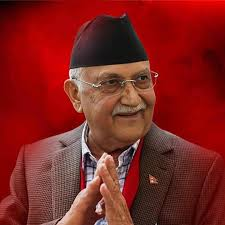
Candidate 1: Khadga Prasad (K.P.) Sharma Oli
Basic Information
Full Name: Khadga Prasad Sharma Oli
Age: 73 (Born 22 February 1952)
Birthplace: Iwa, Terathum, Koshi Province
Party: Communist Party of Nepal (Unified Marxist–Leninist) | नेकपा एमाले
Party Founded: 6 January 1991
Education:
School Leaving Certificate (SLC), Adarsha Secondary School, Jhapa (1970)
Honorary Doctorates (4):
Kangnam University, South Korea (2019)
United Nations University for Peace, Costa Rica (2018)
Govind Ballabh Pant University of Agriculture and Technology, India (2018)
Greenford International University, USA (2010) – controversial/Not Sure
Public Identity: Widely known for serving as Prime Minister of Nepal four times within a decade (2072, 2074, 2078, 2082 BS).
Political Background
K.P. Sharma Oli
Years in Politics: Approximately 56 years
Political Involvement: Active since mid-1960s as a student activist
Major Roles:
Political activist and communist party member since 1970
Imprisoned for 14 years (1973–1987) during the Panchayat era
Central Committee Member, CPN-UML (from 1987 onwards)
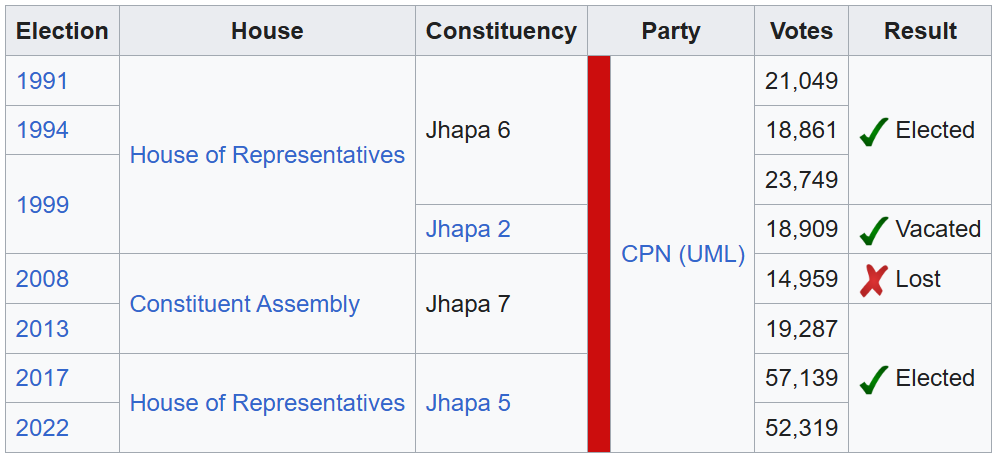
Member of House of Representatives (1991, 1994, 1999)
Minister for Home Affairs (1994–1995)
Deputy Prime Minister and Minister for Foreign Affairs (2006–2007)
Constituent Assembly Member (2013)
Chairman of CPN-UML (from 2014, currently in third term as of 2025)
Prime Minister of Nepal (2015–2016, 2018–2021, 2021, 2024–2025)
Party Affiliation: Communist Party member since 1970; founding member of CPN-UML
First-Time Candidate: No
Election History
K.P. Sharma Oli
Last Election Contested: House of Representatives, Jhapa-5 (2022 General Election)
Votes Received: 52,319
Result: Won with a landslide victory with a margin of 28,576 votes over the nearest rival, Khagendra Adhikari of Nepali Congress, who received 23,743 votes.
Key Promises
K.P. Sharma Oli
Prioritize nationalism and national interests as the top agenda, ensuring no surrender or compromises on sovereignty.
Promote nation-building through improving transport infrastructure and healthcare access. Rejecting foreign and outer interference and instability in the nation, consistently framing his political campaign in 2026 as ‘builders vs destroyers’
Kickstarting energy infrastructure developments, including supplying domestic natural gas via pipelines to every household through the Dailekh Gas Extraction project, promises distribution within months if re-elected.
Past Performance
KP Sharma Oli
Major Achievements: During the tenure of the Prime Minister of Nepal
Poverty reduction (~900,000 lifted pre-COVID), social security expansion, Dailekh gas discovery
China transit/BRI agreements, cross-border projects (railways, transmission lines).
Failed Projects:
Melamchi Drinking Water Supply Project: Long-delayed mega project (initiated pre-Oli but heavily promised under his government)
Sunkoshi-Marin Diversion Multipurpose Project: Significant cost escalations from initial estimates despite early tunnel breakthrough
Delays in national pride projects like Upper Tamakoshi Hydropower, Budhi Gandaki Hydropower, and more.
Strengths and Limitations
K.P. Sharma Oli
Strengths:
Extensive experience in politics (over 50+ years in politics)
Known for bold nationalism (Kalapani-Lipulekh Map enforcement, pro-China stance for balance)
Weaknesses:
Accused of large corruption scandals, cronyism, and heavy-handed tactics (social media ban in 2025, multiple parliament dissolutions)
Frequently changing coalition governments caused repeated government changes, resulting in delays of national projects.
Has not acknowledged the Gen-Z protests; repeatedly framed the movement as a ‘pre-planned’ movement by external elements.
Oli’s stance has been defensive instead of acknowledging the movement’s anti-corruption and youth demands as drivers of change in the nation.
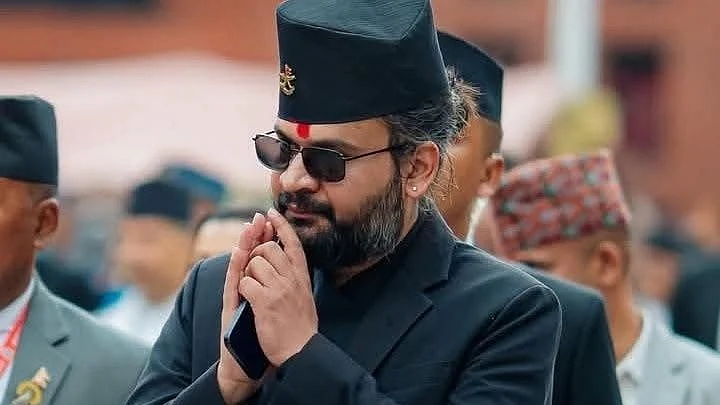
Candidate 2: Balendra Shah
Basic Information
Full Name: Balendra Shah
Age: 35 (Born 27 April 1990)
Birthplace: Naradevi, Kathmandu, Bagmati Province
Party: Rastriya Swatantra Party (RSP) | राष्ट्रिय स्वतन्त्र पार्टी
Education:
MTech in Structural Engineering, Visvesvaraya Technological University (VTU), Karnataka, India
BE in Civil Engineering, Himalayan WhiteHouse International College
10+2 (SLC), V.S. Niketan Higher Secondary School
Public Identity Best known as the first independent candidate elected Mayor of Kathmandu Metropolitan City in 2022, symbolizing a shift in traditional leadership patterns.
Political Background
Balendra Shah
Years in Politics: 4 years
Political Entry: Entered mainstream politics in 2022
Major Roles:
Mayor of Kathmandu Metropolitan City (May 30, 2022 – January 18, 2026)
First independent mayor of Kathmandu
Parliamentary Party Leader, Rastriya Swatantra Party (since late 2025)
Party Affiliation: Independent until joining RSP in December 2025
First-Time General Election Candidate: Yes
Election History
Balendra Shah
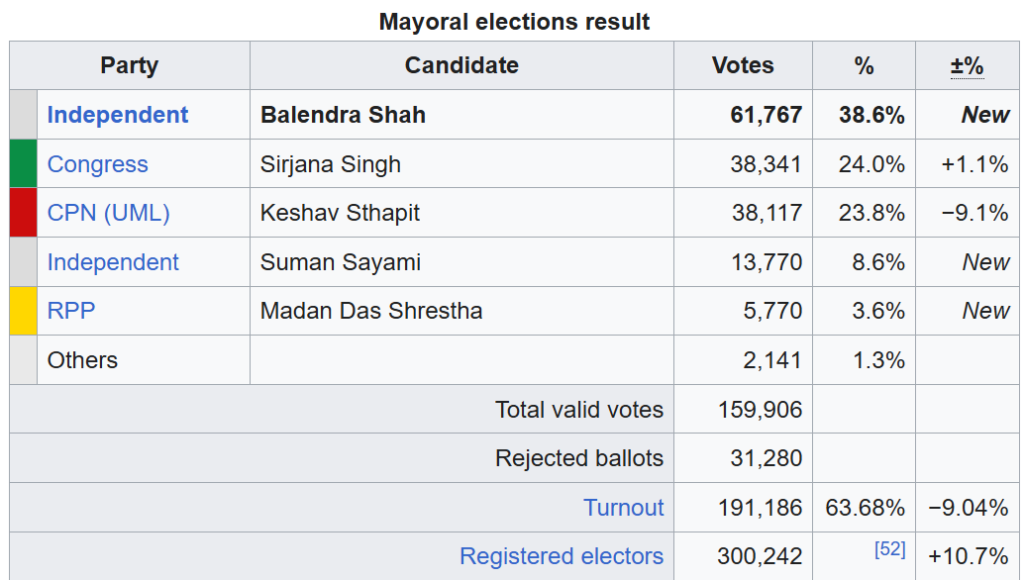
Last Election Area: Mayor of Kathmandu Metropolitan City (2022 local elections, held on May 13, 2022).
Votes received: 61,767 votes (approx 38.6% of total votes cast)
Result: Won by defeating Nepali Congress candidate Srijana Singh with 38,341 votes and CPN-UML candidate Keshav Sthapit with 38,117 votes, by a margin of over 23,000.
First-ever independent candidate contesting for the Mayor of Kathmandu Metropolitan City.
Key Promises
Balendra Shah
Strengthening federalism by improving coordination between provincial and local governmental structures, ensuring effective government and anti-corruption measures, and addressing Gen-Z movement demands.
Institutionalizing Gen-Z agendas, especially accountability and transparency, replacing the old-system corruption.
Building a manifesto based on voters’ input and needs for practical reforms; major focus on health, education, infrastructure, trade via consolidated public suggestions
Major Achievements:
Reclaimed public land (200+ ropanis), widened footpaths/roads, streetlights, Tukucha river restoration, waste management improvements, working as the Mayor of KMC.
Scholarships (30,000+ students), 32 urban health centers, Book-Free Friday, digital tax collection, and heritage preservation.
Efforts in promoting transparency through live council meetings, anti-enroachment efforts, and major traffic reforms.
Failed Projects:
Waste management technological revolution promised major changes, but the composting system didn’t start and materialize in waste management; the waste incineration plan dropped.
Larger promised reforms like major public transport development, pollution control, and vehicle wheel washing for dust were never implemented.
Strengths:
Seen as an honest, energetic, and young entrant into politics, becoming the Mayor of Kathmandu at 31 in 2022.
Focuses on “new vs old” change in governance, and direct public engagement
Rising popularity among the youth, strong social media presence, tolerance for criticism, and acknowledgement of youth demands.
Weaknesses:
Worked as the Mayor of Kathmandu for approx 4 years, before resigning mid-term in January 2026 for the general elections.
Aggresive initiations like demolitions and crackdowns in squatter areas and street vendors, which were heavily criticized, unfinished long-term projects and initiatives (public transport and waste management reforms)
Offensive social media posts and stances regarding neighbouring countries and political parties (‘indian slaves’, using profanity ‘f**k’, criticizing the USA, India, China, and Nepalese Parties)
Communication gaps with traditional media (interviews) and engagement with the public post-resignation
To provide the best experiences, we use technologies like cookies to store and/or access device information. Consenting to these technologies will allow us to process data such as browsing behavior or unique IDs on this site. Not consenting or withdrawing consent, may adversely affect certain features and functions.
Functional
Always active
The technical storage or access is strictly necessary for the legitimate purpose of enabling the use of a specific service explicitly requested by the subscriber or user, or for the sole purpose of carrying out the transmission of a communication over an electronic communications network.
Preferences
The technical storage or access is necessary for the legitimate purpose of storing preferences that are not requested by the subscriber or user.
Statistics
The technical storage or access that is used exclusively for statistical purposes.The technical storage or access that is used exclusively for anonymous statistical purposes. Without a subpoena, voluntary compliance on the part of your Internet Service Provider, or additional records from a third party, information stored or retrieved for this purpose alone cannot usually be used to identify you.
Marketing
The technical storage or access is required to create user profiles to send advertising, or to track the user on a website or across several websites for similar marketing purposes.