

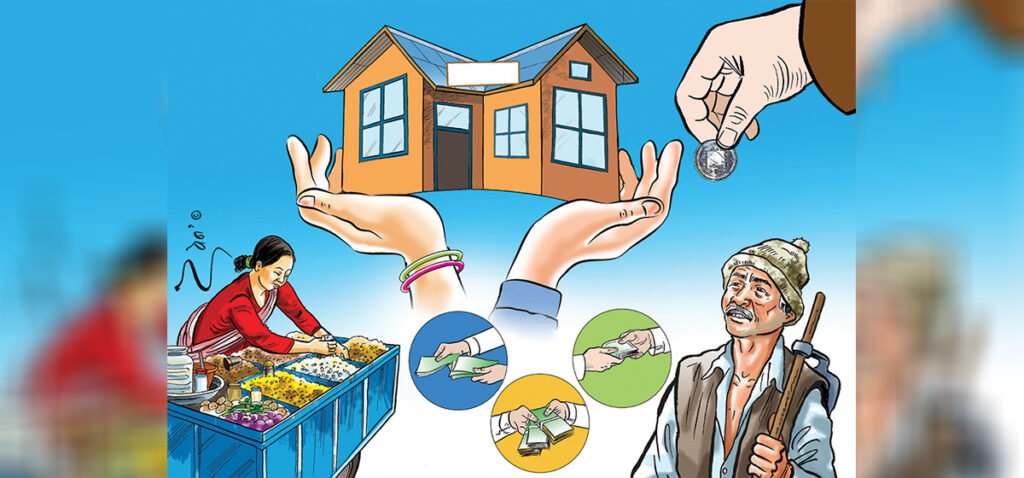
According to the Greek philosopher; Plutarch, “An imbalance between rich and poor is the oldest and most fatal ailment of all republics.” This observation remains relevant in today’s postmodern society, where economic inequality is one of the most concerning social and political issues. This reflects growing concern about the unequal distribution of income and wealth among social classes. Although economic growth can raise overall living standards, the benefits are not always distributed equally. Factors such as rising GDP, increased remittances, and progress in poverty reduction have helped Nepal’s economic development, but significant income and wealth disparities persist.
Additionally, Nepal’s economic transformation has been significant, showing signs of massive improvement. Its GDP increased from approximately US$2.85 billion in 1986 to US$45.49 billion in 2025, reflecting optimistic and stable economic expansion. The tourism sector has contributed to this growth by generating employment, foreign exchange, and economic activity. However, GDP growth alone does not necessarily demonstrate that wealth is being distributed evenly. Economic opportunities remain concentrated in particular sectors and geographical areas, while many households continue to depend on low-productivity employment and subsistence activities. One of the major factors influencing household income and poverty in Nepal has been shown to be remittances. Financial remittances increased from approximately US$2.54 billion in 2010/11 to US$8.79 billion in 2018/19. The expansion of foreign employment has provided millions of households with an additional source of income and has contributed to reducing poverty. At the same time, Nepal’s dependence on migration highlights a structural weakness in the domestic economy. For many households, migration is not simply an opportunity for higher income but a response to the limited availability of decent and adequately paid employment within Nepal.
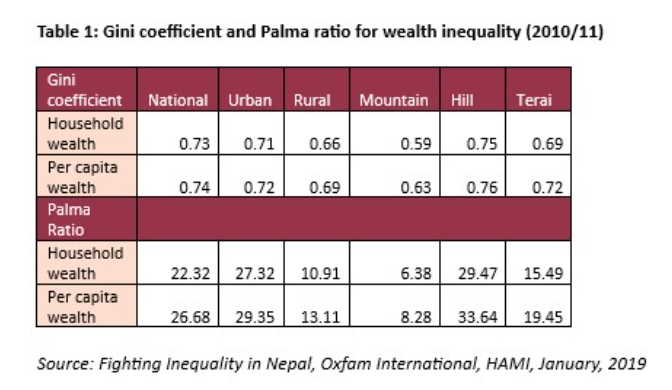
Now, Nepal has experienced significant economic growth and poverty reduction, but the benefits of this progress have not been evenly distributed throughout the population. Income and wealth inequality continue to be significant structural challenges, especially given the unequal distribution of economic opportunities across geographical, social, and economic groups. According to the data provided, Nepal’s inverted Gini Index was 58.5 in 2019, indicating that income distribution remains far from perfect equality. The conventional Gini coefficient measures inequality on a scale, with higher values indicating greater inequality; however, the World Economics dataset used here reverses the scale, with 100 representing perfect equality and 0 representing extreme inequality.
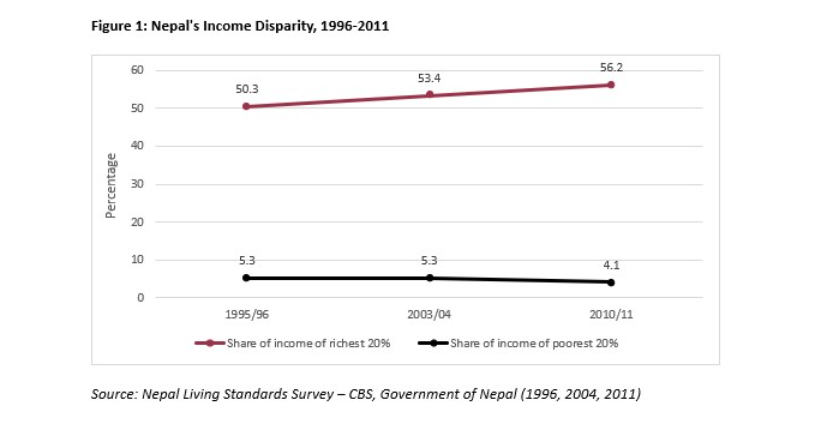
Similarly, Nepal’s income distribution data backs the argument of the “rich get richer, while the poor fall behind” phenomenon. Between 1995/96 and 2010/11, the share of national income received by the richest 20% increased from 50.3% to 56.2%, while the share received by the poorest 20% declined from 5.3% to just 4.1%. This means that, despite economic growth, its benefits were distributed increasingly unevenly: by 2010/11, the richest fifth of Nepal’s population received more than thirteen times the income share of the poorest fifth (56.2% compared with 4.1%). Such unequal distribution can exacerbate poverty and limit social mobility by giving poorer households fewer resources to invest in education, healthcare, skills, and productive assets, making it more difficult to escape poverty. Thus, the data indicate that Nepal’s problem is not simply the presence of poverty, but also the unequal distribution of economic gains, which can lead to wealth becoming increasingly concentrated at the top.
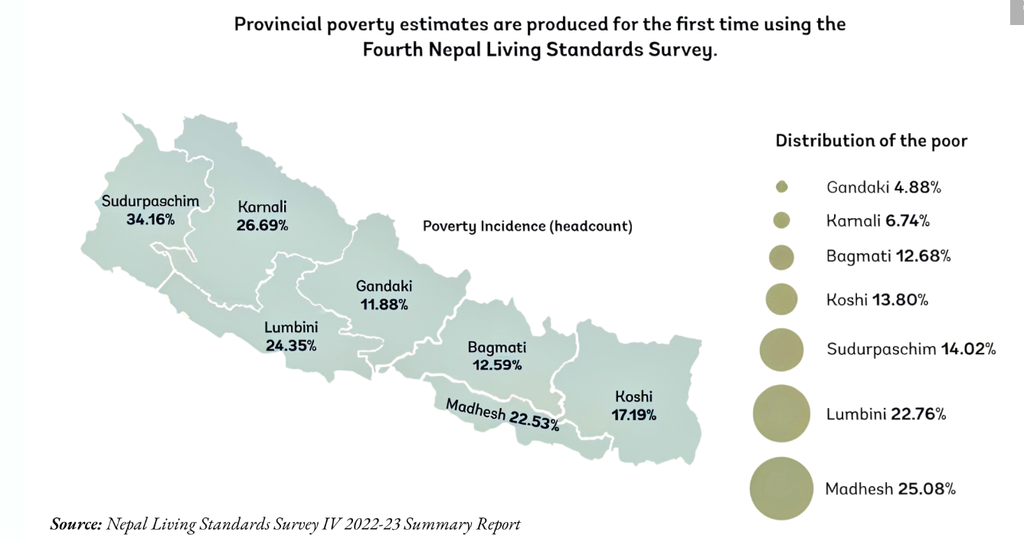
On the other hand, if we look from the perspective of ‘poverty’; The 2022/23 Nepal Living Standards Survey reveals another dimension of the “rich get richer, poor fall behind” pattern: poverty is heavily concentrated in particular regions of Nepal. Nationally, 20.27% of the population lived below the poverty line, but the incidence varied dramatically across provinces– from 11.88% in Gandaki and 12.59% in Bagmati to 26.69% in Karnali and 34.16% in Sudurpaschim. More importantly, the distribution of the poor shows that Madhesh alone contains 25.08% of Nepal’s poor population, followed by Lumbini at 22.76%, meaning these two provinces together account for almost half of the country’s poor despite not having the highest poverty rates individually. This indicates that poverty is not evenly distributed across Nepal; geographical location is closely associated with economic disadvantage. The contrast becomes even sharper when rural areas are considered– for example, 40.21% of the rural population in Sudurpaschim is below the poverty line. Therefore, while some regions benefit from greater economic opportunities and development, disadvantaged regions remain trapped in higher levels of poverty, suggesting that inequality can reproduce itself geographically. In this sense, the “poor fall behind” not necessarily because their incomes are falling absolutely, but because their access to opportunities and economic advancement remains significantly weaker than that of more prosperous regions.
In conclusion, Nepal’s inequality is not just a quixotic of economic growth, but of how economic opportunities and resources are distributed. Circumstances such as political instability, corruption, and weak institutions can prevent the benefits of development from reaching those who need them most, allowing existing economic disparities to deepen. Therefore, good governance is central to breaking the cycle of “the rich getting richer while the poor fall behind.” Stronger institutions, greater transparency, accountability, and effective implementation of public policies can ensure that economic growth translates into broader opportunities and more equitable development. Without addressing these governance failures, poverty reduction may remain uneven, and inequality may continue to reproduce itself across generations.