


Nepal social security allowance explained simply: it is a monthly cash payment from the government to Nepalis who are old, widowed, disabled, or from a community on the verge of disappearing — no contributions, no premiums, and no prior employment needed. If you are a Nepali citizen aged 70 or over, the state pays you Rs 4,000 a month, every month, for life.
It is one of the oldest schemes of its kind in South Asia. It began in the fiscal year 1994/95 at just Rs 100 a month, and it now reaches about 3.7 million people at a cost of roughly Rs 120 billion a year — about one rupee in every eighteen the government spends. Yet the rules are still widely misunderstood: the age is not 60 for everyone, the rate is not the same for every group, and the payment does not arrive automatically. This Nepal social security allowance explained guide sets out the facts in plain language: who qualifies, how much each group gets, how to apply, how the money is paid, and where the system is under strain.
Table of Contents
- Nepal Social Security Allowance Explained: The Rates in 2083/84
- Nepal Social Security Allowance Explained: Who Qualifies
- Nepal Social Security Allowance Explained: How to Apply and Renew
- Nepal Social Security Allowance Explained: How the Money Reaches You
- Nepal Social Security Allowance Explained: A Short History
- Nepal Social Security Allowance Explained: What It Costs the Country
- Nepal Social Security Allowance Explained: The Problems and the Debate
- Frequently Asked Questions
Table of Contents
Nepal Social Security Allowance Explained: The Rates in 2083/84
The Department of National ID and Civil Registration (DONIDCR) publishes the official rate table. These are the rates in force in the fiscal year 2083/84, as listed on the department’s table in October 2026:
| Who qualifies | Monthly allowance |
|---|---|
| Senior citizen, aged 70 and over | Rs 4,000 |
| Dalit senior citizen, aged 60 and over | Rs 2,660 |
| Senior citizen of the former Karnali-zone districts, aged 60 and over | Rs 2,660 |
| Single woman (unmarried, divorced or separated), aged 60 and over | Rs 2,660 |
| Widow, any age | Rs 2,660 |
| Fully disabled, red (Class A) disability card | Rs 3,990 |
| Severely disabled, blue (Class B) disability card | Rs 2,128 |
| Member of an endangered ethnic group | Rs 3,990 |
| Child nutrition grant, under-5 children in designated districts and Dalit families | Rs 532 |
Three things in that table catch most people out. First, the age is 70 for the general senior citizen’s allowance, not 60. The age of 60 applies only to Dalit citizens anywhere in Nepal and to residents of the former Karnali-zone districts, and it comes with the lower rate of Rs 2,660. Second, a widow qualifies at any age — there is no minimum age for widows — while an unmarried, divorced or separated woman must be 60. Third, the disability rates depend on the colour of the disability identity card: the red card (Class A, full disability) pays Rs 3,990, while the blue card (Class B, severe disability) pays Rs 2,128.
The budget for 2083/84, presented on 29 May 2026, did not change any of these rates or ages. It did make one change that affects the last row of the table: it doubled the nutrition grant for Dalit children to Rs 1,000 a month, with Rs 3 billion set aside for it. The department’s published rate table still shows Rs 532, so families should check with their ward office which rate is actually being paid in their area before counting on the higher figure.
For scale, the Rs 4,000 monthly payment is about a quarter of Nepal’s per-capita GDP, according to HelpAge International’s pension database — and roughly 96 percent of the World Bank’s poverty line. That is the Nepal social security allowance explained in one number: meaningful, but not enough to live on.
Nepal Social Security Allowance Explained: Who Qualifies
The legal basis is the Social Security Act, 2075 (2018), which gives effect to the right to social security in Article 43 of the Constitution of Nepal 2015. Section 3 of the Act lists the citizens entitled to an allowance: senior citizens, indigent citizens, incapacitated and helpless persons, helpless single women, citizens with disabilities, children, and citizens unable to take care of themselves. In practice, the Nepal social security allowance explained here is administered under eight categories.
The conditions are straightforward, but each category has its own proof. The applicant must be a Nepali citizen, registered at the ward of their permanent residence. That matters for families whose elderly parents split the year between Nepal and abroad: the allowance is a domestic-residence benefit, and registration, renewal and a Nepali bank account are all tied to the ward where the person permanently lives.
Senior citizens qualify at 70, or at 60 for Dalit citizens and residents of the former Karnali-zone districts. The proof is the citizenship certificate, which shows the date of birth. Single women qualify at 60 if they are unmarried, divorced or judicially separated; widows qualify at any age on the death of their husband, and need his death certificate. People with disabilities qualify on the basis of the disability identity card issued by their local level — red for full disability, blue for severe disability. Members of endangered communities qualify if they belong to one of the communities listed in the Schedule to the Act, the tribes on the verge of extinction. The child nutrition grant goes to children under five in the designated districts and to Dalit children, and needs the child’s birth-registration certificate and a parent’s citizenship.
One rule in the Nepal social security allowance explained system applies across all categories: a person can receive an allowance under only one category. A 72-year-old who also holds a red disability card does not get both payments; the local level registers them under one category. That is why the ward office’s classification matters — it decides which single rate a person is paid.
This allowance is also different from the contributory Social Security Fund, which is a separate scheme for workers who pay in through their employer. Related reading: Nepal’s Social Security Fund, Explained: How It Works covers the contribution-based scheme, while Nepal’s Pension System, Explained: Who Gets What When Work Ends shows where the old-age allowance fits among the five ways retirees are paid.
Nepal Social Security Allowance Explained: How to Apply and Renew
There is no online application for the Nepal social security allowance explained in this guide. The whole process runs through the ward office of the applicant’s permanent address, and the steps are the same in all 753 local levels.
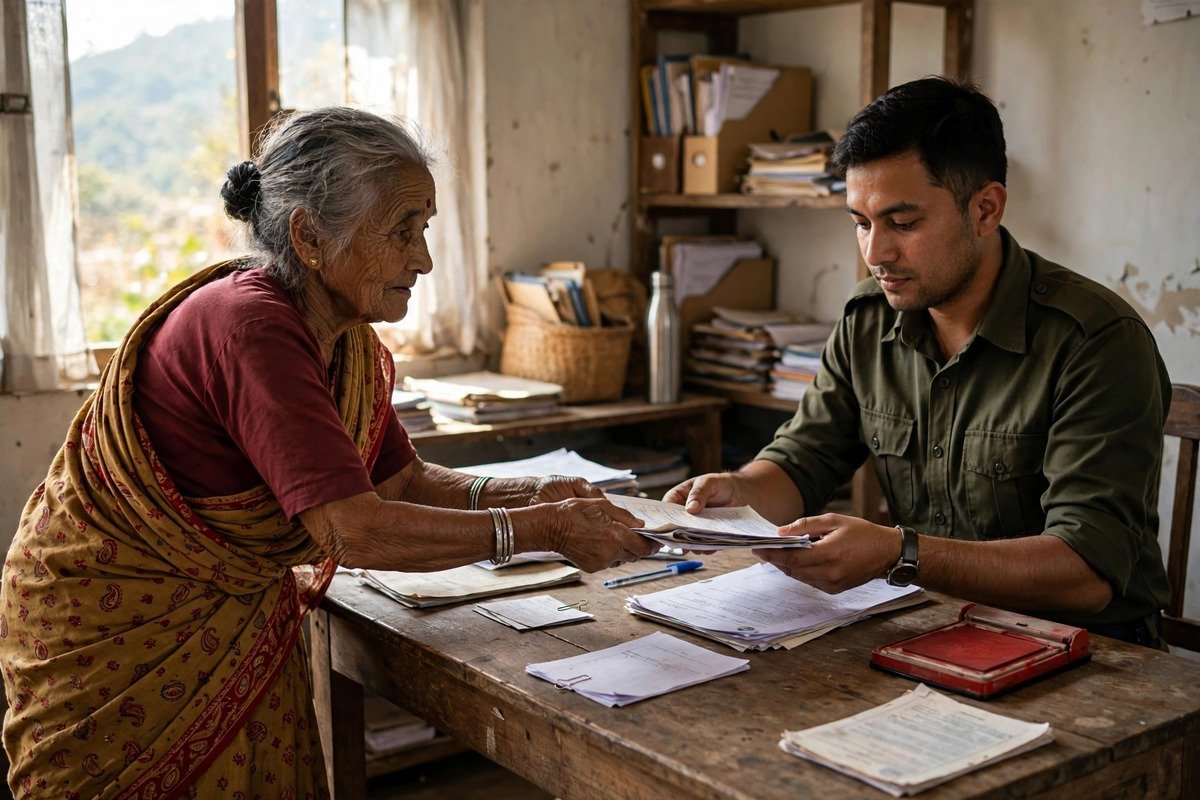
First, go to the ward office with the documents for your category: the citizenship certificate for a senior citizen, the citizenship certificate plus the husband’s death certificate for a widow, the disability identity card for a person with a disability, or the child’s birth-registration certificate for the child nutrition grant. A bank account in the applicant’s name is also needed, because the payment is made by bank transfer. The ward provides the application form, and the local level is required to decide on an application within seven days.
If the application is approved, the local level issues a social security identity card to the person entitled to the allowance. That card, together with the national identity card, is what the system now uses to keep the rolls clean. Since 14 January 2025, a national identity card has been mandatory for receiving the allowance. The requirement was first announced for 16 July 2024 and then revised, but it is now in force — and the department credits it with cutting duplicate payments and saving the state nearly Rs 5 billion a year.
The Nepal social security allowance explained in this guide is not a one-time registration. Beneficiaries must renew every year at the ward, by the end of Asoj (mid-October), under the Social Security Allowance Distribution Procedure, 2082 (2025). This is the step most often missed: a payment that stops is usually a renewal that was not done, a bank account that changed, or a national ID that was never linked. Anyone whose payment has stopped should go to the ward office first and check the renewal and the bank details, before assuming the allowance has been cancelled.
People who are financially secure can also give the allowance up voluntarily. The 2083/84 budget introduced a campaign with the slogan “Sakne lai todau, nasakne lai jodau” — those who can, let go; those who cannot, join — asking better-off citizens to forgo the benefit so the money reaches those who need it most. It is a request, not a rule: nobody is forced to give it up.
Nepal Social Security Allowance Explained: How the Money Reaches You
The Nepal social security allowance explained payment rhythm is simple: the allowance is counted monthly but paid every quarter. A senior citizen aged 70 or over therefore receives Rs 12,000 every three months; a widow receives Rs 7,980. The switch from four-monthly to quarterly payments was made in the fiscal year 2078/79, at the same time as the last general rate rise.
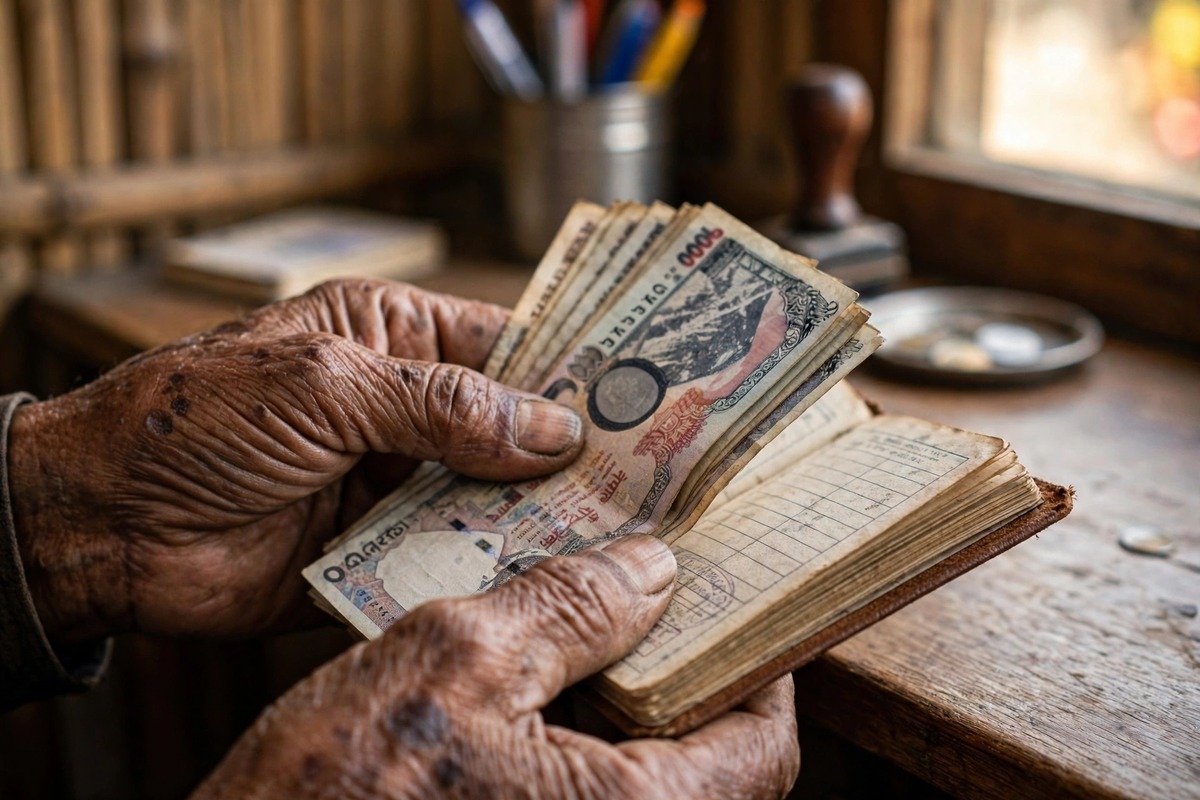
The money is paid by bank transfer into the beneficiary’s account, through the local level. All 753 local levels now pay this way rather than handing out cash at the ward office — a shift backed by the World Bank’s civil-registration project, which also supports the national ID system behind the allowance rolls. The change ended the old practice of queuing at the ward for cash, but it also means a beneficiary without a working bank account, or whose account details do not match the ward’s records, will not be paid until the details are fixed.
The quarterly rhythm of the Nepal social security allowance explained above is worth planning around. Because the payment covers three months at once, a missed renewal or a bank problem can mean three months without income before it is noticed. Families who help an elderly relative should check that the quarterly payment has actually arrived, rather than assuming the registration alone is enough.
Nepal Social Security Allowance Explained: A Short History
The allowance began in the fiscal year 1994/95, when the then finance minister Bharat Mohan Adhikari introduced it at Rs 100 a month for people aged 75 and over. It was the first universal cash transfer of its kind in Nepal, and it set a pattern that every government since has followed: each finance minister has expanded it, raised it, or lowered the qualifying age, and each change has been politically popular.
The age and the rate have moved several times. That movement is part of what makes the Nepal social security allowance explained here confusing for applicants, so the timeline is worth setting out plainly. The qualifying age came down from 75 over the years, and the rate rose in steps to Rs 4,000 in the fiscal year 2078/79, when the government raised all social-security allowances by about a third. In the fiscal year 2079/80 the age was lowered to 68. Then, on the recommendation of the High-Level Economic Reform Commission, the age was raised back to 70 for new applicants from the fiscal year 2082/83 — a change the commission said would save roughly Rs 10 billion a year. The 2083/84 budget kept the age at 70 and the rate at Rs 4,000.
The legal footing came later than the scheme itself. The Constitution of 2015 made social security a fundamental right in Article 43, and the Social Security Act, 2075 (2018) — authenticated on 18 September 2018 — turned that right into the categories, procedures and identity cards the system uses today. The Act also gave the department the job of running the scheme through the local levels, which is why the ward office, not a central ministry, is where citizens actually meet the system.
Nepal Social Security Allowance Explained: What It Costs the Country
The fiscal year 2083/84 budget puts about Rs 120 billion into social security and targets about 3.7 million allowance recipients, of whom about 1.63 million are in the 70-plus senior row. That is roughly 5.6 percent of the total budget of Rs 2,124 billion — a larger share than the entire health insurance programme, which was allocated Rs 15 billion in the same budget.
The cost of the Nepal social security allowance explained in this article has grown nearly elevenfold over the past decade, and that growth is now the central argument about the scheme. The High-Level Economic Reform Commission recommended not increasing the allowances for the next five years, and after that increasing them only once every two years, in line with inflation. The 2083/84 budget followed that advice: no rate rise, and a voluntary campaign asking those who can afford it to give the benefit up.
The counter-argument is about coverage, not cost. The 16th Development Plan (fiscal years 2024/25 to 2028/29) aims to extend social protection to the informal sector, with a goal of reaching 60 percent of the population by 2028. The child nutrition grant illustrates the gap: it still runs in only 25 districts, and the commission has recommended expanding it to all districts but limiting it to poor households, identified through poverty-identification cards. For supporters of the scheme, the allowance is the one part of the welfare state that already reaches almost every village; for its critics, it is a universal payment in a country that can no longer afford to pay everyone the same.
Nepal Social Security Allowance Explained: The Problems and the Debate
The most argued question in the Nepal social security allowance explained debate is whether the allowance should be universal or targeted. It is paid to every citizen who reaches the qualifying age, regardless of income — a retired civil servant drawing a pension and a landless labourer receive the same Rs 4,000. Supporters say universality is the point: it avoids the errors and the humiliation of means-testing, and it reaches people the state would otherwise miss. Critics say the same money could pay more to the poorest if the better-off were excluded, and point to the voluntary give-up campaign as an admission that the current design is hard to sustain.
Fraud and duplication were the second problem the Nepal social security allowance explained system had to solve, and the national ID requirement is the government’s answer. The department says making the national ID mandatory has cut duplicate payments and saved nearly Rs 5 billion a year. The trade-off is access: an elderly person in a remote ward who has not yet received a national ID card can find their payment blocked by a document they cannot easily obtain.
The third problem is the age itself, which has moved twice in four years — down to 68, then back up to 70. Each change moves thousands of people on or off the rolls, and each one is announced in a budget speech rather than through a stable rule. A 69-year-old who qualified under the old age limit and a 69-year-old who does not qualify under the new one are in the same position in every way except the year they were born, and the difference is worth Rs 48,000 a year.
Finally, there is the delivery. The quarterly bank payment works well where banks and ward offices function smoothly, and badly where they do not. Renewal by the end of Asoj is a single annual deadline for more than three and a half million people, and the ward offices that must process it are the same offices that handle birth registration, citizenship recommendations and every other local service. When a payment stops, the fix is almost always at the ward — which is also where the queue is longest.
None of this changes the basic fact that the allowance is, for millions of Nepalis, the only cash the state reliably sends them. The debate is not about whether it should exist — no major party proposes abolishing it — but about who should get it, how much it should be, and how long a universal payment of this size can be afforded. That is a debate worth having with the numbers in front of you, which is what this Nepal social security allowance explained guide has tried to provide.
Frequently Asked Questions
How much is the social security allowance in Nepal?
The headline rate is Rs 4,000 a month for senior citizens aged 70 and over. Dalit senior citizens aged 60 and over, senior citizens of the former Karnali-zone districts aged 60 and over, single women aged 60 and over, and widows of any age receive Rs 2,660 a month. Fully disabled people with a red card receive Rs 3,990, severely disabled people with a blue card receive Rs 2,128, members of endangered ethnic groups receive Rs 3,990, and the child nutrition grant is Rs 532 a month.
At what age can I get the senior citizen allowance?
At 70 for most citizens, and at 60 for Dalit citizens anywhere in Nepal and for residents of the former Karnali-zone districts. The age was lowered to 68 in the fiscal year 2079/80 and raised back to 70 from the fiscal year 2082/83.
How do I apply for the social security allowance?
Apply at the ward office of your permanent address, with your citizenship certificate and the documents for your category — for example, a death certificate for a widow, or a disability identity card for a person with a disability. You will also need a bank account in your name and a national identity card. The local level must decide within seven days.
When is the allowance paid?
The Nepal social security allowance explained payment arrives every quarter, by bank transfer. A senior citizen aged 70 or over receives Rs 12,000 every three months. The payment is made through the local level, so a changed bank account or a missed renewal can delay it.
Do I need a national identity card to receive the allowance?
Yes. A national identity card has been mandatory for receiving the allowance since 14 January 2025. The department says the requirement has cut duplicate payments and saved nearly Rs 5 billion a year.
Can I receive two allowances at the same time?
No. A person can receive an allowance under only one category, even if they qualify under two — for example, a senior citizen who also holds a disability card is registered under one category only.
What should I do if my allowance payment stops?
Go to your ward office first. The most common reasons are a missed annual renewal, which must be done by the end of Asoj (mid-October), or bank account details that no longer match the ward’s records. The ward can check both.