

When discrimination takes place against the minority related to caste, it deprives society of its diversity and development as well. The United Nations recognises descent-based discrimination as incompatible with fundamental human rights and international human rights standards. As someone curious about various fields, ranging from international conflicts, politics, and development to human rights, I find myself constantly drawn to questions about how societies function and what shapes them. Recently, I picked up Annihilation of Caste by Dr. B. R. Ambedkar, a book that introduced me to a different perspective on social hierarchy, inherited privilege, and systemic discrimination. Reading it exposed me to concepts with historical and social structures that I had not previously explored in depth. What particularly caught my attention was how a system rooted in historical and religious traditions could become so deeply embedded in everyday social relations, whether it is India, Nepal, or any nation in the world.
This prompted me to look beyond India’s borders and examine Nepalese society. How did the caste hierarchy develop in Nepal? How was it institutionalised under Jung Bahadur Rana? More importantly, despite decades of political transformation, constitutional reforms, and legal protections, does the Chaturvarna system, or the broader caste hierarchy associated with it, continue to shape modern Nepali society?
First, we need to understand that Chaturvarna and the caste system are related but not identical. The Chaturvarna system comes from the Sanskrit words Chatur (four) and Varna (social classification) and traditionally divides Hindu society into four hierarchical groups: Brahmins (priests and scholars), Kshatriyas (rulers and warriors), Vaishyas (merchants and traders), and Shudras (labourers and service providers). These groups were historically associated with religious duties and social obligations; this classification gradually became intertwined with hereditary caste identities, occupational restrictions, and social discrimination. Although the Chaturvarna system and the broader caste system are not identical, both have helped shape social hierarchies across South Asia, including Nepal.
One of the most prominent critics of this social structure was Dr. B. R. Ambedkar, an Indian jurist, economist, and social reformer. In his influential 1936 work, Annihilation of Caste, Ambedkar challenged the legitimacy of caste-based hierarchy, arguing that caste was not merely a division of labour but a division of labourers. He believed that the system institutionalised inequality by determining an individual’s social position through birth rather than ability or individual achievement. His arguments remain relevant to understanding Nepalese society, where caste-based identities and inherited social privileges continue to influence social relationships.
Nepali society has historically been characterised by social hierarchies, where an individual’s status has often been associated with caste, family background, occupation, education and land ownership. These differences have influenced how individuals interact, the degree of respect they receive, and their position within society. Among these factors, the Hindu Varna system has played a particularly significant role in shaping traditional social stratification. It divides society into four broad categories: Brahmins, Kshatriyas, Vaishyas, and Shudras, traditionally associated with different social and occupational responsibilities. Over time, these classifications became intertwined with hereditary caste identities, commonly referred to through one’s thar, reinforcing distinctions based on birth and perceived social status.
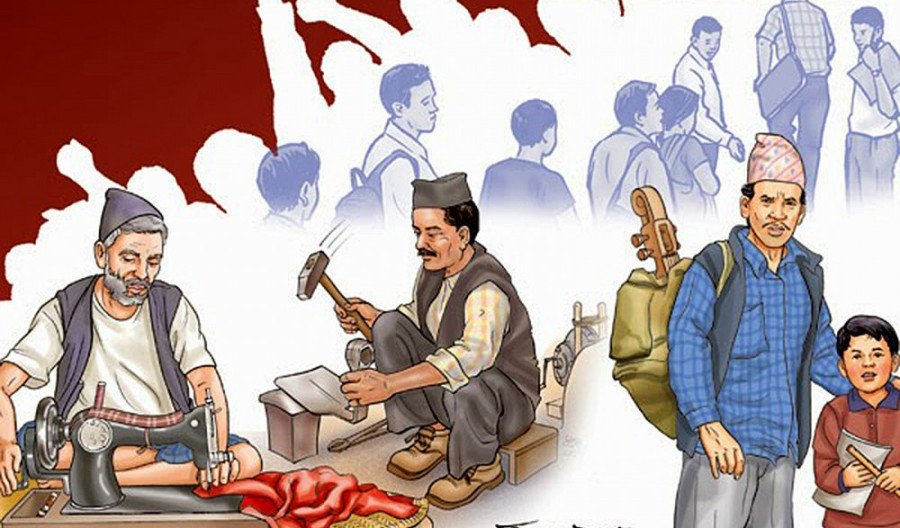
Such hierarchies also influenced ideas of purity and impurity, with certain occupations, particularly those involving sanitation and leatherwork, historically associated with communities placed at the bottom of the social hierarchy. Although Nepal legally abolished caste-based discrimination through the 1963 Muluki Ain, the formal abolition of these practices did not necessarily dismantle their social foundations. Caste continues to influence marriage, social acceptance, religious practices, and access to opportunities in certain communities. Nevertheless, urbanisation, education, migration, and generational change have contributed to weakening some traditional boundaries, particularly in urban centres such as Kathmandu. Yet, the persistence of caste-based exclusion demonstrates that social transformation and legal reform have not eliminated the hierarchies inherited from Nepal’s past.
In Nepal, caste hierarchy was established as a particularly institutionalised system during the Rana regime. A significant turning point was the introduction of the Muluki Ain of 1854 by Prime Minister Jung Bahadur Rana. Rather than creating caste divisions from nothing, the code formalised existing social hierarchies into a state-recognised legal framework. It classified communities into hierarchical categories, including Tagadhari (sacred-thread wearers), Matwali (alcohol-drinking groups), and communities categorised as water-acceptable or untouchable. These classifications determined social status and, in various circumstances, legal treatment and punishments. Consequently, caste discrimination was not simply a social practice; it was reinforced through the authority of the state. The Muluki Ain remained a central legal framework until its replacement in 1963.
Modern Nepali society is increasingly characterised by diversity, social mobility and changing perceptions of identity. Urbanisation, education, globalisation, migration, and technological advancement have gradually transformed traditional social relationships and challenged inherited hierarchies. Unlike the conventional social order, where an individual’s identity and position were often associated with caste, occupation and family background, contemporary Nepal is witnessing greater interaction across caste, ethnic, religious and cultural boundaries. The constitutional framework of 2015 A.D. further reflects this transition by recognising equality under Article 18, prohibiting untouchability under Article 24 and protecting Dalit rights under Article 40. Nevertheless, describing Nepal as entirely postmodern would be premature, as traditional values and social structures continue to coexist with modern ideas and practices. Rather, Nepal is experiencing a gradual transition in which tradition, modernity, and emerging social identities intersect, creating a society that is increasingly diverse while still negotiating the legacy of its historical hierarchies.
Now, in Nepal, caste continues to influence several dimensions of everyday life. Marriage remains an important example, as inter-caste relationships can still encounter family opposition, social exclusion, and, in extreme circumstances, violence. Similarly, Dalit communities continue to experience barriers in accessing equal opportunities, social acceptance, and representation. Discrimination can also take place in religious spaces, residential arrangements, employment and community interactions. Although urbanisation, education, migration and economic mobility have weakened certain traditional boundaries, they have not entirely eradicated inherited social prejudices.
Understanding Nepal’s caste hierarchy requires looking beyond historical classifications and examining how social structures have evolved. From the traditional Chaturvarna framework to the legal institutionalisation of caste under Jung Bahadur Rana to modern Nepal, this history offers an important perspective on the relationship between society, culture, and equality. The purpose of exploring this subject is not to criticise any particular caste, religious belief, community, or cultural tradition, nor to undermine the historical significance of Nepal’s social diversity. Rather, it is to understand how certain inherited structures have influenced social relationships and how their consequences continue to be experienced by different communities.