

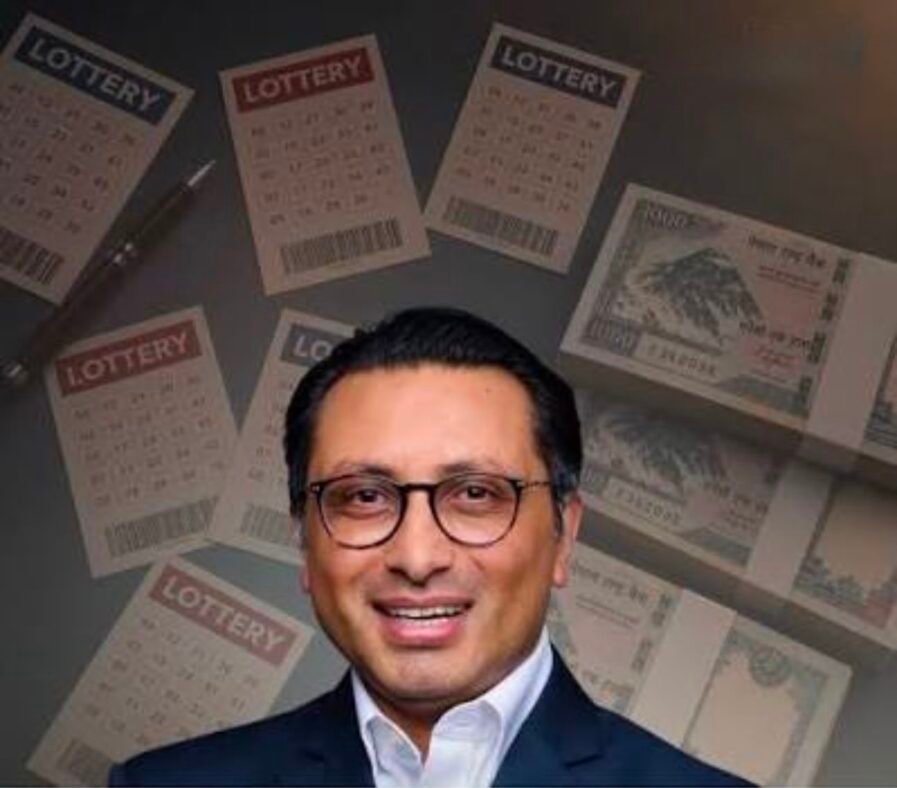
Rewarding the citizens for doing something that they are legally obliged to do, anyways, generally paints the overall picture of “Tax compliance” in Nepal. Formally started from countries like Taiwan, Eastern Europe and many other Asian nations, the tradition to make Nepalese citizens responsible and act as tax compliance inspectors is not a new concept.
The Taxpayer Incentive Gift/Reward Programme(bill lottery) was initiated by Minister Wagley of the Ministry of Finance for FY 2083/84 (2026/27) Budget in coordination with the Inland Revenue Department of Nepal starting from Shrawan 2083. Under the incentive, consumers making eligible personal expenses of more than 100 NPR are eligible to receive the price worth upto 1 million rupees. Here, two monthly winners will each receive 1 million rupees every month and a consumer will receive Rs.133,034 every day. More than a lottery opportunity, there is a bigger standpoint of making consumers/ citizens more responsible on topics of tax and tax compliance and with a big lottery in hand the government has made the citizens act as responsible tax inspectors. The real question is not about whether people win the lottery, but whether the program enables the government to collect more additional tax revenue than the cost of running it.
WHY IS THE REWARD POLICY IMPORTANT?
Every business makes a sale, but large numbers of vendors or business houses try to hide it from the formal taxing records and when the transactions are not visible formally, then the government loses its potential tax revenue and the income or economy as a whole becomes harder to monitor. To minimize the tendency, the government’s new incentive program is targeted to make consumers demand their invoices themselves in order to win large prizes instead of relying completely on tax officers. The Inland Revenue Department(IRD) explicitly says that the programme is intended to improve consumer’s habits regarding tax compliance and make transactions more transparent. In that sense the lottery is just an instrument to make people do what they are intended to do and the real policy is better tax compliance.
CREATING A TRACEABLE ECONOMIC MODEL:
The incentive programme has definitely changed the “tax game” of Nepal. Traditionally, the government had to persuade the businesses to issue the invoices in order to formalize the tax report. But the enforcement agency and officials had a hard time to monitor business related activity of small business vendors like stationeries, restaurants and food stalls, instead the government plan makes the consumers act as tax compliance officers and ask for invoices and bills for every single purchase they make.
This programme would limit businesses to conceal its sales, more specifically called “कर छल्ने” as every genuine invoice would record a genuine transaction making the concealment much harder. The programme could also indirectly facilitate the increase in digital payments as manual invoices would be slightly lengthy whereas digital payments and transactions are more formal methods of transactions.
Along with the facilitation, it would also result in formalisation of monetary material. Every transaction has a history when recorded carefully. A formally recorded data or transaction data can not only be useful for tax compliance but, furthermore, it can be a great financial plug for understanding of economic activity, business turnover and consumption patterns. Such data and facts can be very important for the Ministry along with other finance official institutes for budget formation, priority categorization, developing financial models whenever it is necessary and forming solutions contrary to the problem enlisted from the figures.
THE ANALYSIS ON FISCAL VIABILITY OF THE PROGRAMME:
Along with the uphills of the program, comes the bigger question: How much additional tax revenue will the country actually generate?
The government operation costs include surveillance monitors, different prizes with the largest being 1 million rupees, administrative costs, verification costs, publicity costs, and many more miscellaneous costs. The programme cannot be determined successful on the basis of number of participants but instead the test should be fiscal. The government’s additional tax revenue must exceed the total expenditure of the government on the program this fiscal year. For example, the government spends 60 million on surveillance and operation but only generates 40 million on additional tax revenue, the policy could be considered financially unviable and unsuccessful.
More than the number of participants in the program, the net additional tax revenue through the program should be considered an important factor for the timely success of this program.
Also, the programme can be considered one initiative under the tax reform program or method. The programme can improve the behaviour of customers for asking vat bills and invoices in small restaurants and stores, which somehow helps in better tax compliance but cannot really be considered as a substitute for strong tax administration. Our country still needs better auditing, strong tax reform institutions, risk based investigation and reliable digital tax administration for better transparency.
Will the programme create a permanent dependency on incentive or make people habitual with such tasks?
Here, the government is already paying their nationals for doing things that they are responsible to do in order to facilitate a better economy and tax culture. The consumers should ask for invoices and bills as the law requires them to do so rather than in greed of awards and prizes.
The programme could, therefore, generate two different outcomes:
The first, that the people become habitual to such rituals with or without prizes and normalize asking for bills that they are obliged to do by the law.
The second scenario would be that the people participate until and unless any sort of incentives are present. Once the programme ends, the behaviour automatically disappears. But here is an important distinction, IRD as well as the Ministry’s official has repeatedly mentioned that the programme’s main objective is better tax compliance and strong tax reformation rather than becoming a permanent feature of the tax system. According to the department, Nepal’s economy could only support such programs for a maximum of 2-3 fiscal years making the citizens habitual about tax compliance. The real success of the programme would only be achieved if, after participating for some time, people develop a habit of demanding bills when there is no possibility of winning the prize as well.
Also, for a country like Nepal, where the economy remains unusually vulnerable, the next step only should be taken considering the outcome of previous results. For example, tracking the records of FY 83/84, if the record mentions strong trend in people demanding bills, the incentive might not be necessary but if the trend falls down after the programme disappears, then the programme can only be considered a temporary participation rather than a strong culture of tax compliance within the people. Such records or trends must be carefully studied by the related ones and decisions regarding next installments must be taken considerably.
QUESTIONS REGARDING EQUALITY:
The lottery’s format is non-dynamic, which basically puts those who consume more on advantage. A person who makes 5 purchases with genuine invoices is more prone to win the bumper prize than the ones with one purchase per day. This format explicitly puts large business vendors or large consumers who make numerous payments every single day at advantage. Consequently, the programme does not distribute its potential benefits equally across society. Contrary to the branding of the programme, every single individual has a low chance to win the big prize. In my opinion, the branding is solid to put every consumer in the belief that they might win, regardless of chances being just around 0.5 percent.
Instead, to make the programme favourable for every single citizen, the government needs to place a cap on entries per individual, and provide small guaranteed rewards for low frequency consumers for consistent compliance. The programme should focus and reward ones with habitual tax compliance rather than placing ones who consume more at advantage. This would make the programme more inclusive while still encouraging people to develop a consistent habit of demanding genuine bills and follow the trend simultaneously.
PAST VS PRESENT VIEWPOINT ON WHAT ACTUALLY HAS CHANGED:
“Previous Installations by the government for better compliance”
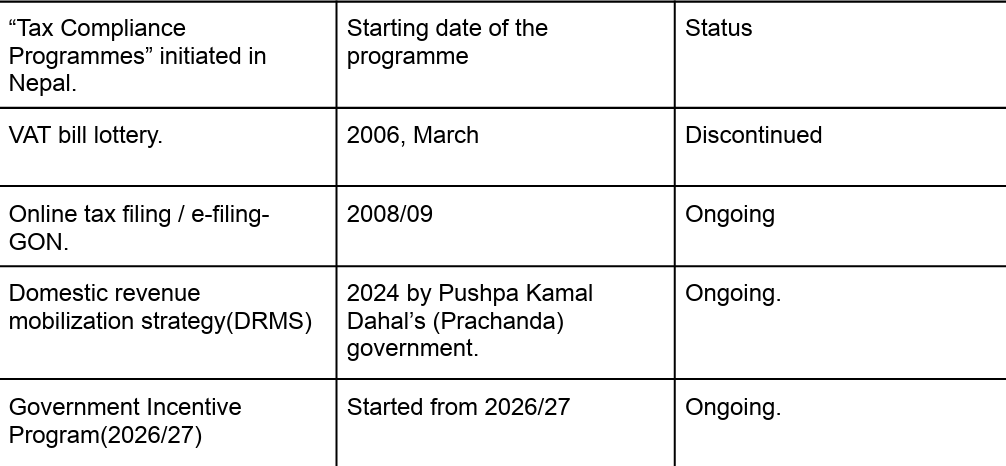
Previous Governments led by Oli, Deuba as well as Dahal had had such reformation acts which are still ongoing but none of the programmes were able to register a change in behaviour of consumers. The IRD reports that, for the Online Tax Filling programme, the numbers began with 15% of participation during the time of starting but later reached 87% till 2018, this data tells us that only the medium of tax payment was changed rather than the behaviour of people. People who wanted to conceal their sales, still did with the presence of a digitalized system as there was no strong verification system to monitor their reports and sales to be true or fake. Such concealment, if not occurred, would lead to several developmental activities like infrastructure, road, health and education. Another program started by Dahal’s cabinet was Domestic revenue mobilization strategy, which had a lot of ambitious targets, of which one being to raise Nepal’s tax-to-GDP ratio from about 16.3% in FY2023/24 to 20.9% by FY2028/29. But the actual loophole was never the ambitions, but the gap between the design of the policy or model and the actual capacity of Nepal’s economy. It became one of the strategies that only promised better growth rather than a permanent change in behaviour of consumer and additional revenue generation.
One thing that the present government needs to take in consideration, regarding the programme, is creating a permanent and lasting impact on people’s behavior rather than generating additional revenue in a short period of time. The programme paints an inappropriate image of Nepal in the global market, where citizens are paid to perform a civic duty. This might raise questions on our global standing and about Nepal’s institutional maturity. The programme, in future, could escalate more, where people start demanding rewards and prizes for performing their other duties like voting, which they are obliged to do and the trend can shift from “doing your duty” to “doing only when rewarded”.
The initiators should take an important warning from the previous initiatives, as the problem here is the behaviour rather than the non-dynamic system. The end goal, here, is building a system or a culture where people don’t need to be rewarded for performing a simple national duty.