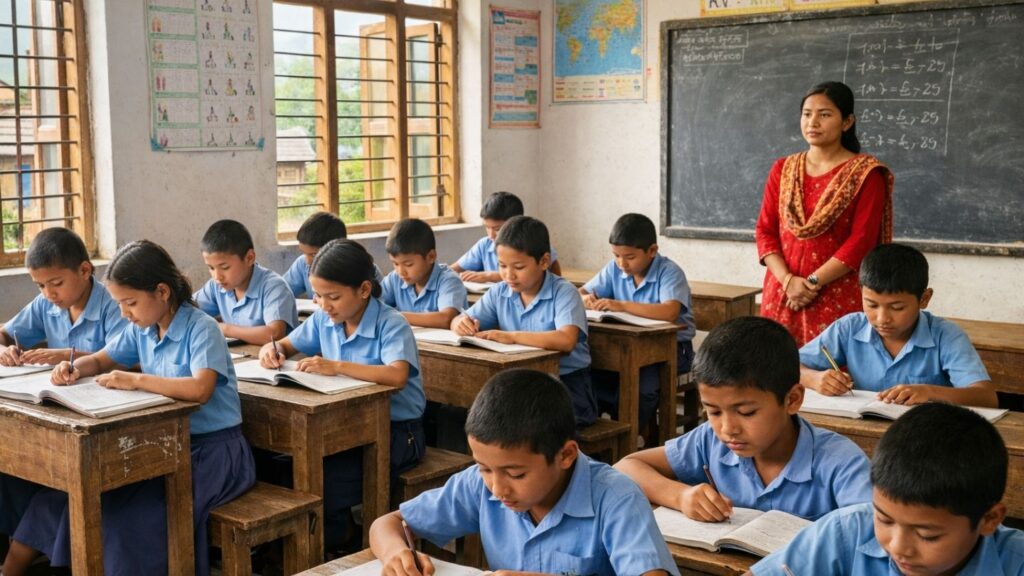
Saksham Rupakheti, ThinkNiti
I am on a gap year after high school, and I refuse to study in Nepal. Before you dismiss this as privilege or unpatriotic, understand: I don’t want to leave because I want to leave because staying means accepting mediocrity as destiny.
Former Prime Minister KP Sharma Oli claimed Nepali students choose foreign universities “by will, not necessity.” This is a comfortable lie. Last year, 112,593 students received government permission to study abroad. Fewer than 1,000 attended top-ranked universities.
The remaining 111,593 aren’t chasing Ivy League dreams—they’re fleeing a system that has abandoned them, packing their entire lives into suitcases because survival, not ambition, demands it.
Ask the right questions: Why do parents sacrifice decades of savings not for elite education, but for basic opportunity? Why do students choose debt in foreign countries over “free” education at home? Why do education consultancies occupy Kathmandu’s most expensive real estate while government schools lack benches?
The answer isn’t student choice. It’s a system failure. And this election, we must vote like our futures depend on it, because they do.
Nepal Education Crisis Explained: Why Students Are Leaving
The Trust Deficit in Nepali Education
When 112,593 Nepali students received government permission to study abroad in FY 2023/24, nearly half the country’s entire university enrollment, they weren’t chasing prestige. They were fleeing dysfunction. Surveys reveal the core problems: outdated curricula focused on rote memorization rather than problem-solving, chronic faculty shortages driven by political appointments over merit, campuses closed for union strikes more often than exams, and infrastructure so weak that science students lack functioning laboratories. A telling statistic: 65% of study-abroad aspirants cite “better academic facilities” as their primary reason, but the deeper issue is trust. Nepali employers themselves view local degrees skeptically, placing even high-scoring MBA graduates in entry-level roles because they know what the credential represents.
When your own universities cannot vouch for their graduates, when political parties control student unions and hiring decisions, when classrooms teach students to “crack tests, not solve real-world problems,” education becomes a charade. Students aren’t abandoning Nepal because foreign universities are slightly better. They’re leaving because staying means accepting a degree the market doesn’t respect, taught by faculty hired through connections rather than competence, in institutions that close for political rallies more than they open for research. This isn’t brain drain. It’s a rational escape from institutional collapse.
While India sends over 1 million students abroad annually, its 0.07% per capita rate suggests most return with skills. Nepal’s 0.37% rate is the highest among comparable nations. We’re losing proportionally five times more educated youth than India, nearly double Vietnam (0.20%), and six times more than the Philippines (0.06%).
China, despite 1.41 billion people, maintains just 0.03% outflow because domestic universities now rival Western institutions. Bangladesh (0.05%) leveraged its garment industry into upward mobility. Their students return as entrepreneurs. Sri Lanka (0.15%), despite economic collapse, maintains stronger public universities. Even Pakistan (0.06%), facing political instability, invested in engineering schools that retain talent.
The pattern is clear. Countries investing in domestic education see lower outflow. Those that neglect it watch their brightest queue at consultancies. Our 110,000 annual departures from the 30 million population means every extended family has someone abroad. When nearly 2 out of every 1,000 Nepalis leave annually (19% of tertiary-age cohort), we’re not experiencing brain drain. We’re witnessing structural collapse of faith in national institutions.
South Korea transformed from aid recipient to developed nation in one generation by making education the national obsession. If they could do it, why can’t we?
South Korea’s Education Miracle and the Lesson for Nepal
A Policy Blueprint Nepal Ignores
South Korea’s transformation from $158 GDP per capita in 1960 to $33,000 by 2023 wasn’t luck. It was political will. Post-Korean War leaders made education the national obsession. They standardized a 6-3-3-4 schooling system, enforced compulsory middle school by 1985, and used lottery-based school assignments to eliminate inequality. When private tutoring threatened equity, they regulated it while maintaining universal access. By 2023, 71% of young Koreans held tertiary degrees, the OECD’s highest rate.
The lesson isn’t just policy. It’s leadership. Park Chung-hee, despite authoritarian flaws, treated education as infrastructure, not charity. He built 20,000 classrooms by 1967 because he understood that factories need educated workers. Singapore followed the same playbook, spending 4.5% of GDP on merit-based streaming systems, achieving 100% secondary enrollment and $82,000 GDP per capita. Taiwan focused on vocational training post-1960, creating the semiconductor talent pool that now powers global tech.
Nepal spends 4.2% of GDP on education, below UNESCO’s 6% standard, yet no major party has released a comprehensive education manifesto this election. South Korea proved education delivers 10-15% ROI in development. Their leaders chose textbooks over rhetoric. Ours choose highways over human capital. The question isn’t whether Nepal can replicate Korea’s miracle. It’s whether our politicians have the courage to try.
Before you vote, look at your younger sibling studying for SLC. Look at your nephew who dreams of engineering but whose school lacks lab equipment. Ask yourself: what do they actually need?
They need universities where politics stays outside. They need education as public service, not private business. They need research funding so students don’t flee Nepal to run experiments. They need startup culture as normalized as ragging is in medical colleges, as common as alcohol seems in engineering hostels.
Right now, entrepreneurship is a hobby. Research is a luxury. Education is a transaction. Politics controls every hiring decision.
Bring one question to rallies: “What is your education plan, and how will you fund it?” Don’t accept “we prioritize youth.” Demand specifics. Will you increase spending to 6%? Remove political appointments? Fund research? Build labs? When?
Post their answers. Vote for plans, not slogans.
South Korea’s leaders chose textbooks over rhetoric. If we demand it, ours can too.
Your vote decides whether your siblings build futures here or pack them in suitcases.
Let’s vanish the sentence “नेपालमा हल्लेर काम छैन |”
Reference:
 risingnepaldaily.com
The Exodus Of Nepali Students
In 2023/2024 alone, 112,593 people were awarded a No Objection Certificate (NOC)—a formal permit required by Nepali students to study abroad, granted by the Ministry of Education, Science and Technology. The total number of students enrolled in universities in Nepal over six years (four years for a bachelor’s degree and two years for a master’s degree) is 633,053, according to the University Grants Commission, Nepal. A simple calculation reveals a stark truth: nearly half of our students are leaving the country to study abroad.
myrepublica.nagariknetwork.com
339,000 individuals obtain NOC in four years – myRepublica – The New York Times Partner, Latest news of Nepal in English, Latest News Articles | Republica
KATHMANDU, Jan 1: The number of Nepali students going abroad has increased. A few decades ago, only children from affluent families went abroad for higher education, but in recent years, students from ordinary families have also started pursuing the same goal abroad.
myrepublica.nagariknetwork.com
339,000 individuals obtain NOC in four years – myRepublica – The New York Times Partner, Latest news of Nepal in English, Latest News Articles | Republica
Ghimire said, “Although not all students who obtain NOCs go abroad, the trend of students wanting to go abroad is still increasing. What is surprising is that students are going abroad to study subjects that are available in Nepal, which is concerning.”
researchgate.net
(PDF) Unraveling the Challenges: Understanding the Factors Behind the Struggles of Nepali Universities
Nepal’s higher education system is facing tremendous challenges despite its initial progress from 1971 to 1986, which is often termed the golden period. Political conflicts and increasing interference have eroded the quality of education, and universities have become battlegrounds for political agendas. The curricula are outdated and fail to align with global market demands, thus limiting the competitiveness of graduates. Many institutions lack basic
risingnepaldaily.com
The Exodus Of Nepali Students
My first doubts arose months before I even set foot in a classroom. After my high school exams, a friend told me he had joined an entrance exam preparation institute and asked me to join too. I believed entrance exams were meant to test the skills I had developed in high school, so joining a coaching centre felt unnecessary. Still, I kept in touch to see what the institute’s classes were like. To my surprise, most lectures there focused on note-taking and memorising for exams—no analysis, deeper understanding, or appreciation of the subject matter. And yet, students from these institutes scored highest on the entrance exams.
nepalitimes.com
Nepal’s hard working students overseas | Nepali Times
“The fact that our education is still very much rote learning with curriculum not relevant to our context means we are producing graduates without actual skills required to meet challenges. Moreover, our education doesn’t even guarantee them jobs,” says educationist Narottam
risingnepaldaily.com
The Exodus Of Nepali Students
formalities for external marks. This is the reality: in Nepal, doctors, engineers, lawyers, bankers, and teachers are trained to excel at examinations—not to master their professions. They are taught to crack tests, not to solve real-world problems. When these top scorers enter the workforce, they often struggle. Government employees, too, emerge from this same
nepjol.info
This article explores the key challenges facing Nepalese higher education, including outdated curricula, inadequate infrastructure, limited research opportunities, and a lack of faculty development. The absence of a Federal Education Act has resulted
researchgate.net
(PDF) Unraveling the Challenges: Understanding the Factors Behind the Struggles of Nepali Universities
curricula are outdated and fail to align with global market demands, thus limiting the competitiveness of graduates. Many institutions lack basic
theannapurnaexpress.com
Higher education abroad: A trend among students
Research opportunities and infrastructure
researchgate.net
(PDF) Unraveling the Challenges: Understanding the Factors Behind the Struggles of Nepali Universities
Faculty shortages, political involvement, and brain drain make the situation worse, leaving students without proper guidance. Corruption and nepotism in hiring practices undermine meritocracy, creating inefficiencies and reducing academic standards. Furthermore, the neglect of research and innovation contributes to intellectual stagnation, prompting students to seek better
english.lokaantar.com
Declining number of students in Nepal’s colleges| Lokaantar
Political instability: Political instability and rampant corruption have direct impact on employment opportunities. Widespread corruption hinders quality graduates entering better jobs.
english.lokaantar.com
Declining number of students in Nepal’s colleges| Lokaantar
economic factors, political instability and relevance of courses.
theannapurnaexpress.com
Higher education abroad: A trend among students
One of the primary factors driving this interest in studying abroad is the perceived higher quality of education offered by renowned international institutions. Many students believe that attending colleges overseas would provide them with a more comprehensive and globally recognized education, preparing them for the competitive global job market. According to research conducted by the Ministry of Education, approximately 65 percent of students seeking higher education abroad cite improved academic facilities and resources as their main motivation.
nepalitimes.com
Nepal’s hard working students overseas | Nepali Times
visa was a one-way ticket out of Nepal. Indeed, the push-factors are strong: erratic and low quality instruction in colleges, and the lack of job prospects.
theannapurnaexpress.com
Higher education abroad: A trend among students
Visa policies and job opportunities
theannapurnaexpress.com
Higher education abroad: A trend among students
Specialized courses and opportunities
nepjol.info
that the two biggest push factors in Nepal are the dearth of work prospects and the country’s inadequate educational system. Nonetheless, the possibility for exposure to other cultures, the availability of scholarships, and the modern educational standards are the pull factors. According to the report, migration decisions are influenced by both push and pull forces, reflecting the intricate relationship
nepalitimes.com
Nepal’s hard working students overseas | Nepali Times
Although some of the money students spend on fees and living costs are from what they earn from part-time jobs, much of it is funded by families in Nepal who sell their land or borrow money to send their children away.
myrepublica.nagariknetwork.com
339,000 individuals obtain NOC in four years – myRepublica – The New York Times Partner, Latest news of Nepal in English, Latest News Articles | Republica
management, IT, medical sciences, humanities, law, nursing, and engineering. Now, the state should investigate how many of those who went abroad for studies found opportunities, how many returned to Nepal, and how many stayed abroad. In the past, only affluent individuals used to go abroad for higher studies, but now even people from weaker families are selling their property to seek opportunities abroad. It is important to investigate whether they found
theannapurnaexpress.com
Higher education abroad: A trend among students
Global exposure and cultural diversity
english.nepalpress.com
The Quest for New Horizons: Understanding Why Nepali Youths Seek Opportunities Abroad – Nepal Press
Social factors play a crucial role in Nepali youths’ decisions to go abroad. There is a prevailing social perception that acquiring an international education or gaining employment in foreign countries enhances an individual’s social status and prestige. Additionally, the influence of peer networks, family expectations, and societal pressure to succeed contribute to the allure of going abroad among Nepali youths.
english.lokaantar.com
Declining number of students in Nepal’s colleges| Lokaantar
Employment and career prospects: Many students perceive that obtaining a degree from a foreign institution can enhance their employment and career prospects, both domestically and internationally. They believe that degrees from reputable universities abroad carry prestige and are more recognized and valued by potential employers. The exposure to international networks and industry connections during their studies can also increase their chances of securing job opportunities.
nepalitimes.com
Nepal’s hard working students overseas | Nepali Times
Another push factor, especially for young Nepali women is that by going abroad they can escape family pressure for an arranged marriage. Nepali youth are also frustrated with Nepal’s politics and leadership, and
english.lokaantar.com
Declining number of students in Nepal’s colleges| Lokaantar
Quality of education: One of the key reasons behind the inclination to study abroad is the perception that foreign educational institutions offer a higher quality of education. Many students and their parents believe that international universities provide a more advanced curriculum, cutting-edge research facilities, and a more practical and industry-oriented approach to learning. The pursuit of quality education is seen as a pathway to gaining a competitive edge in the global job market.
risingnepaldaily.com
The Exodus Of Nepali Students
merely as a way to secure social and familial approval—not as a path to knowledge or critical thinking. Yet employers care about skills, not grades. High-scoring MBA graduates are often placed in entry-level roles because employers know what a Nepali degree is worth practically. This gap between marks and skills shows why mark sheets lose all value in the workplace. Colleges should shift focus from grades to genuine skill development—changing how students, teachers, and parents see education.
english.lokaantar.com
Declining number of students in Nepal’s colleges| Lokaantar
Rudra Pandey, a Nepali software engineer and educationist, has recently tweeted ‘Colleges of Nepal are going empty. But our policy makers seem dumb. Nobody is even speaking about higher education and its problems.’
researchgate.net
(PDF) Unraveling the Challenges: Understanding the Factors Behind the Struggles of Nepali Universities
Nepal’s higher education system is facing tremendous challenges despite its initial progress from 1971 to 1986, which is often termed the golden period. Political conflicts and increasing interference have eroded the quality of education, and universities have become battlegrounds for political agendas. The curricula are outdated and fail to align with global market demands, thus limiting the competitiveness of graduates. Many institutions lack basic infrastructure such as libraries, labs, and playgrounds, especially outside Kathmandu, and private colleges are more concerned with profits than quality. Faculty shortages, political involvement, and brain drain make the situation worse, leaving students without proper guidance. Corruption and nepotism in
nepjol.info
Drawing from Nepal’s historical evolution of higher education and comparative insights from other developing nations, the discussion underscores the