

Introduction to Global Factions and Their Positions
Global South geopolitics shapes the current international order. In the ever-transitioning geopolitical landscape, the world is divided into three major factions: the Global West, the Global East, and the Global South. Many Western states once held colonial empires, and the Industrial Revolution began in parts of Western Europe, contributing to the region’s long-standing economic and technological dominance.
As a result, the Global West comprises most of the world’s developed and wealthiest countries. However, in this article, the Global West refers specifically to states that are close allies of the United States.
For centuries, the Global West has exercised hegemony over the international order. The Global East, primarily led by China and Russia, challenges this dominance and seeks to reshape the existing global hierarchy. The Eastern bloc promotes political and economic models that rival Western liberalism, including state-led governance and variants of communism.
The Global South, however, is not formally aligned with any bloc and consequently holds the potential to influence long-term global stability within Global South geopolitics. Some of the most notable states within the Global South are the six so-called “swing states”: India, Saudi Arabia, Indonesia, Brazil, South Africa, and Turkey. These nations wield considerable influence within their respective regions and possess the leverage necessary to shape major geopolitical contests and the Global South’s standing in the world.
Most countries in this group experienced colonial rule and continue to navigate the challenges of development.
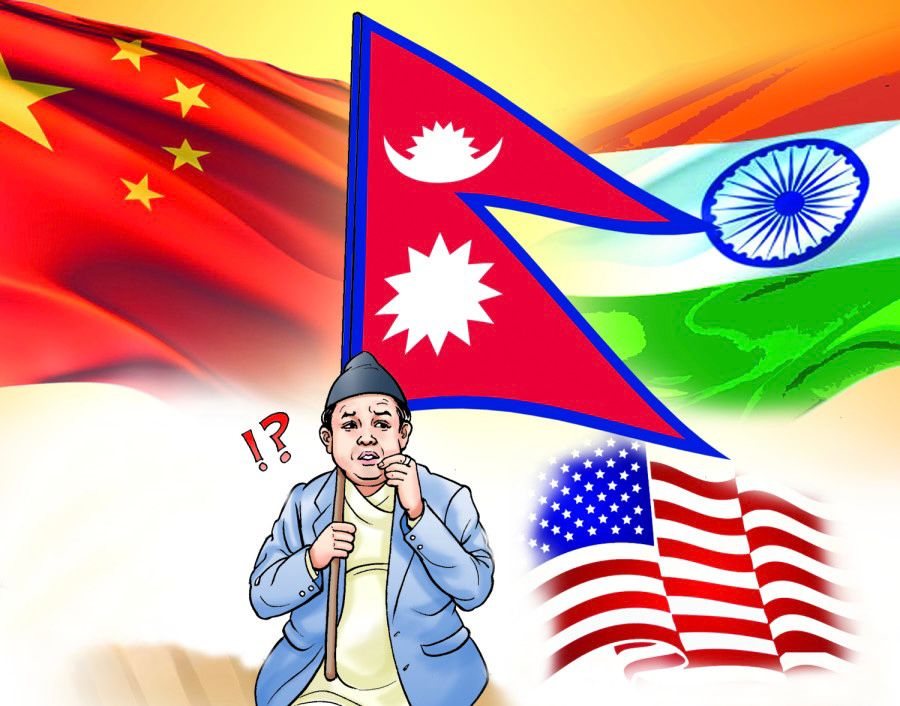
Within the Global South, Nepal occupies a unique position in Global South geopolitics. As a landlocked state situated between two great powers, Nepal has historically functioned as a buffer between India and China, dating back to the era of British India. In modern times, Nepal projects itself as a non-aligned buffer state, a posture that grants it strategic significance in South Asia.
Both India and China compete for influence in Nepal, seeking a neighbor that is politically and strategically aligned with their interests.
An unstable Nepal could potentially harbor elements hostile to Chinese interests, complicating Beijing’s efforts to maintain stability in the Tibetan Autonomous Region (TAR). As a result, China views Nepal as a strategic neighbor in the context of Global South geopolitics, with historical ties spanning centuries, including periods when Nepal functioned as a tributary state.
For India, a hostile Nepal would represent not merely a diplomatic inconvenience but a strategic risk. An adversarial Nepal could tilt toward China, expanding Beijing’s influence in the Himalayas and exacerbating India’s security concerns, particularly amid ongoing Sino-Indian border disputes.
Economic and Military Trends Across the Blocs
There is a growing divergence between the United States and the European Union that directly affects Global South geopolitics. Once an unquestioned ally of Washington, the EU has adopted a more cautious approach in recent years, particularly amid speculation surrounding a potential second Trump term. During his first term, President Trump pressured NATO members to increase defense spending to at least 2 percent of GDP, arguing that European states were not contributing their fair share to collective security. Brussels, however, has criticized this approach for treating long-standing strategic alliances as transactional arrangements rather than partnerships rooted in shared values.
Due to decades of security guarantees provided by the US and NATO, many European states have been able to allocate substantial resources to social programs such as universal healthcare, unemployment benefits, and free education. Increasing defense spending risks placing pressure on these welfare systems. On February 24, 2025, the US voted alongside Russia not to condemn Moscow’s aggression against Ukraine. This decision, combined with Washington’s increasingly transactional diplomacy, has accelerated a strategic reassessment within the European Union.
Consequently, Brussels is reevaluating its reliance on the US and increasingly viewing China as a necessary, if cautious, economic partner.
Meanwhile, the Global East has intensified efforts to reshape the Western-led global order within Global South geopolitics. One of the most significant dimensions of this challenge is the growing push for “de-dollarization.” According to IDN Financials, between 2020 and 2024, BRICS nations purchased over 50 percent of the world’s newly acquired gold, reducing their exposure to dollar-denominated assets.
These economic initiatives are accompanied by rapid militarization, particularly in China, which now possesses the world’s second-largest defense budget and continues to narrow the gap with the United States. Russia, meanwhile, has reduced energy exports to Europe while increasing supply to Asia, contributing to energy insecurity in the West.
At the same time, South-South trade and economic cooperation are expanding as a core feature of Global South geopolitics. Southern nations are diversifying away from Western markets and institutions. According to Asia Times, African countries are increasingly exporting to China, India, and ASEAN member states, while turning to institutions such as the BRICS Development Bank and China’s Asian Infrastructure Investment Bank instead of the IMF or World Bank.
Nepal benefits from this shift not because it leads South-South trade, but because markets and trade channels once dominated by the West are gradually reorienting toward the Global South. This transition creates new opportunities for Nepal’s hydropower, agricultural products, handicrafts, and niche exports.
Challenges and Inconsistencies in Nepal’s Foreign Policy
Nepal lacks a clear and definite foreign policy within Global South geopolitics. Nepal’s current foreign policy emphasizes sovereignty, non-alignment, and maintaining balanced relations with neighbors India and China. Guided by the UN Charter and Panchsheel (Five Principles of Peaceful Coexistence), it aims for economic prosperity through diversification, enhanced connectivity, labor diplomacy, and active participation in multilateral bodies like SAARC. While formally Nepal does claim that it is not aligned to any powers, whether it be Washington or Moscow, New Delhi or Beijing, it is clear to everyone that Nepal has a major dependency on India.
According to the Indian Embassy, Kathmandu‘s Commerce Wing Brief, India accounts for 63 percent of all trades, nearly all of petrol, 35 percent of foreign investment and is the transit for all third country trade. By contrast, Nepal constitutes a negligible share of India’s trade, underscoring the structural imbalance between the two economies.
It must be acknowledged that in the event of a regional contingency, due to being constrained by economic, geographic and security imperatives, Nepal will find itself being aligned with Indian interests.
After the earthquake of 2015, a “hedging” strategy was being anchored in the national political landscape, it is a balancing act where the nation does not lean on either China or India due to fear of provoking the other. By contrast, Nepal and India have a “Roti-Beti” relationship and the 32,000 Nepali soldiers serving in India’s army are proof of a “Special Relationship” that is deeper than any written policy.
Nepal lacks participation and initiation on major international forums and issues. For a nation that anchors itself via participation in the international stage it remains absent from many key forums like UN Youth Delegate Programme, World Economic Forum, OECD Youth Policy Dialogue, Youth20, UNESCO Youth Forums, International Youth Climate Negotiators.
Nepal has talented youths but without a proper system to support or nurture them and expose them to international platforms, their potential will remain untapped.
Nepal has shown its commitment to multilateral institutions via participation in peacekeeping operations. While Nepal does gain recognition from its contributions, it does not translate to tangible influence on international decisions. It should be noted that Nepal’s foreign policy suffers from inconsistency. At times Nepal adheres to strict non-alignment and independence on the international stage, while at other moments, Nepal sides with its major neighbor, India. This inconsistency creates confusion among foreign partners and limits Nepal’s ability to negotiate or assert its interests effectively. For example, its official commitment to global initiatives such as climate action or multilateral diplomacy is often overshadowed by reactive stances in regional disputes.
This inconsistent messaging in the long run, weakens the state’s strategic identity and diminishes its impact on the global stage.
Conclusion and Recommendations for the Future
The upcoming years will be crucial for determining long-term peace and stability of the world and for Global South geopolitics. The rivalry between US and China sets the framework for geopolitics, but those are not the only forces at play. Unlike the East, the South is not united by the threat of the West but by the shared desire of development, autonomy and freedom.
With organizations like BRICS, the developing nations oppose the hegemony of the West but also with forums like Non-Aligned Movement (NAM), these states are not aligned to the cause of the East either. As the foreign minister of India, Subrahmanyam Jaishankar stated, “we are simply standing on our own ground.” This growing confidence intensifies competition between Western powers, Russia and China to win the South’s support.
In turn, this trend may grant the most skilled actors in the Southern states greater flexibility and room to maneuver in pursuing their policy priorities.