

Table of Contents
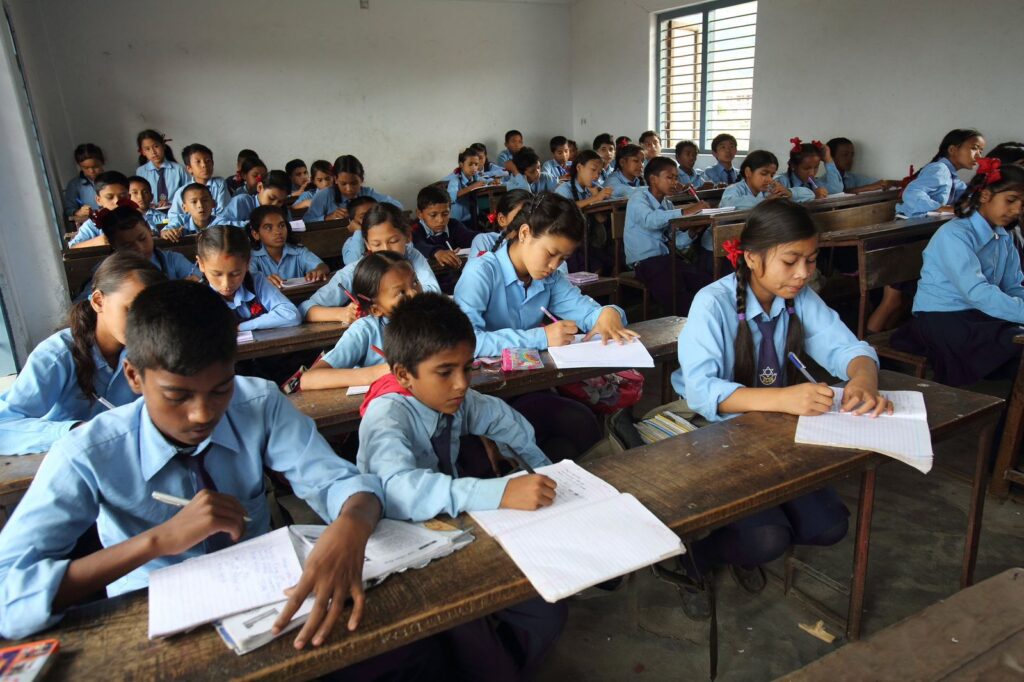
A student in Nepal can repeat a book chapter word for word, but is unable to make sense of the basic realities of the life they live. Millions of students in Nepal go to schools and universities every year, and while we have expanded access and improved enrolment over the past two decades, we still lack a strong educational infrastructure. The quality of educational content has not kept its pace. There is a widening gap between attendance and actual learning. According to ASER Nepal 2022, only about one-third of Grade 5 students can read a Grade 2-level text, and less than 30% can solve basic arithmetic. These numbers show that years of schooling are not translating into meaningful learning. Nepal ranks 112th out of 141 countries in the Global Knowledge Index 2024 and 16th out of 24 countries with a medium level of human development, indicating that our educational content has not kept pace with the growing number of classrooms. Despite these gaps, Nepal allocates only around 10–11% of its national budget to education, well below the international recommendation of 15–20% (UNESCO). This underinvestment reflects why quality has not kept pace with access.
What is the Purpose of Education?
Education’s core is the empowerment of individuals to think, understand, and act purposefully in their lives and community. It goes beyond memorising facts; it builds the ability to question and the capacity to apply knowledge to real‑life problems. By fostering curiosity, education helps people shape their own futures while contributing positively to society.
When curricula focus only on rote recall ‘students to memorize definitions instead of questioning ideas’ and ‘repeat outdated lessons’, learners may pass exams but struggle to apply what they have learned in everyday classrooms. True education therefore, balances theory with practice, encouraging learners to connect concepts to their lived experiences and to develop the confidence needed to pursue meaningful, productive lives. Countries that have shifted from rote learning to competency-based education, such as Finland and Singapore, show that when curricula encourage inquiry, creativity, and application, learning outcomes rise significantly. Nepal’s system, however, remains stuck in memorization only.
The Historical Problem
The Ranas introduced the first English‑medium education system, but it was exclusively for the elite. Education was highly restrictive, the majority of the population was barred from schooling as a deliberate strategy to keep people ignorant and easier to manipulate. The establishment of Durbar High School (1854) marked the beginning of modern education in Nepal, yet the Rana regime continued to oppose mass education, maintaining a system that extended only to a few privileged.
After the fall of the Rana regime in 1951, Nepal entered a politically unstable period. Multiple political parties emerged, each competing for influence and power in the newly opened democratic system. As a result of that, in 1960, educational institutions in Nepal became a battleground between the state and political actors. The Panchayat regime understood that controlling schools meant controlling ideas, and gradually moved to dominate school management committees.
The government introduced the National Education System Plan (NESP) in 1971, which was introduced under the claim of producing “skilled manpower,” but its deeper purpose was ideological. By centralising curricula, by reshaping what students learned, who taught them, and how schools were run. Through NESP, education became a tool of political engineering. The Panchayat government used the education system to authorise its rules and shape loyal, depoliticised citizens.
By the time democracy was restored in 1990, Nepal had expanded school access but inherited an education system shaped more by political agendas than by learning needs. This legacy still shapes the content, quality, and purpose of Nepali education today. After 1990, political parties continued to influence school governance through partisan teachers’ unions, frequent changes in education policy, and politicized appointments. These issues prevented stable long-term reform and kept the curriculum outdated.
What is happening?
Nepal’s classrooms remain trapped in an outdated model of learning. Our curriculum still asks students to memorise definitions instead of questioning ideas, and to repeat outdated syllabus, leaving students with certificates but without the necessary real world skills or critical thinking ability they need in real life.
Nepal’s curriculum is conceptually built with the aim of skill development and student-centred learning. A World Bank report notes that more than 40% of Nepali teachers have not received adequate in-service training, and many rural schools lack functional science labs or libraries. This makes it nearly impossible for student-centered learning to happen in practice. This gap has produced alarming consequences. There are multiple instances that reveal how deeply Nepal’s education system has failed its students. One striking example is a fabricated letter attributed to Abraham Lincoln in the Grade 10 Nepali textbook. The piece, titled “What will my son have to learn?”, has been officially confirmed as fake by the Abraham Lincoln Presidential Library. It was dated 1882, seventeen years after Lincoln’s assassination, which makes the error unmistakable.
In a 2024 column for The Kathmandu Post, writer Deepak Thapa documented the widespread grammatical, factual, and structural errors found across Nepali school textbooks, including those used in expensive private schools. Physics books describe natural phenomena in outdated language. Chemistry books offer instructions written in broken English. Even basic textbooks on logic start with sentences that defy grammar. Students are often taught through materials that fail even the most basic standards of clarity and correctness.
Consequences
This result is a generation that passes exams but often struggles to apply knowledge. When students grow up reading poorly written textbooks, they inevitably struggle with writing, communication, and critical thinking later in life. This directly affects Nepal’s workforce: employers frequently report that graduates lack problem-solving abilities, digital skills, and basic communication competencies, contributing to high underemployment and dependence on foreign labour markets. We see the consequences reflected across public life, in the quality of policies drafted, the speeches delivered by elected representatives, and the shallow level of language used in political debates. The disconnect between the academic qualifications many leaders and influential figures possess and their limited ability to implement ideas effectively is not accidental. It stems from an education system built on rote learning rather than inquiry, and from a political culture that has long rewarded connections and loyalty over competence and intellectual rigour.
For instance, the “Sajha Prakashan case” refers to major corruption and scandals involving its former General Manager and Chairman, Dolindra Prasad Sharma, which involved allegations of massive fraud in textbook printing, unjustified hiring, misappropriation of funds and illegal appointments. What makes the case troubling is not only the scale of the alleged corruption, but the fact that it took place within an institution entrusted with developing, printing, and distributing textbooks for millions of Nepali students. When the very agencies responsible for educational materials are compromised, the damage extends far beyond financial loss; it affects what children learn, how they learn, and whether they can trust the systems meant to educate them.
These are the people and structures we have put in charge of our curriculum, our textbooks, and ultimately, our children’s future. Unless we take a stance and begin rebuilding the system, the very foundation of our nation and the force that shapes young minds, we cannot hope for meaningful progress.To rebuild the system, Nepal must strengthen textbook quality checks, invest in teacher training, modernize curriculum to focus on competencies rather than content recall, and establish an independent education regulatory body free from political interference. Only then can we cultivate a generation that understands not just what is written in textbooks, but the world they live in and the world they must help change.