

This article explores the economic hopes, infrastructure hurdles, and environmental risks behind Nepal’s permit-free peaks policy.
While Nepal government hiked Everest’s climbing fee from $11,000 to $15,000 in January 2025, with the new rates going into effect on September 1, 2025, the government also simultaneously waived permit fees on 97 remote peaks in Karnali and Sudurpaschim, raising a bigger question: what is the real aim of this policy, and what could it mean for tourism, and the future of Nepal’s least-visited regions under the Nepal Free Climbing Peaks Policy?
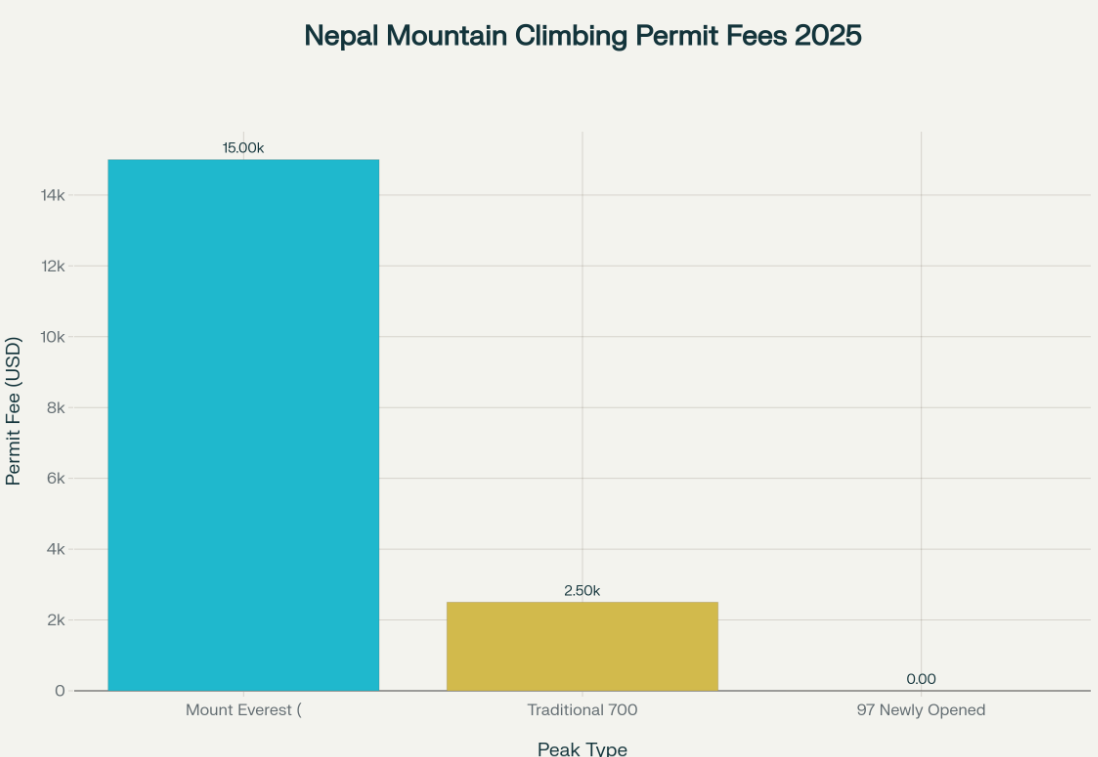
Comparison of mountain climbing permit fees in Nepal showing the stark difference between premium Everest permits and the newly waived fees for 97 remote peaks
The Nepal Free Climbing Peaks Policy: What’s Happening?
On July 17, 2025, Nepal’s cabinet approved a historic move. For the next two years, climbers will not pay any government permit fees to attempt 97 peaks, with 77 in Karnali province and 20 in Sudurpaschim province. These mountains, ranging from 5,870 to 7,132 meters, lie scattered across the remote and rugged far west of Nepal.
With famous summits like Api at 7,132 meters, Saipal at 7,030 meters, and Api West at 7,076 meters included, the decision marks Nepal’s most ambitious attempt yet to decentralize adventure tourism. Under the Nepal Free Climbing Peaks Policy, the government aims to spread economic benefits to regions that have long remained outside the mainstream mountaineering economy.
The policy was announced by Tourism Minister Badri Prasad Pandey, with crucial support from the Nepal Mountaineering Association and the Department of Tourism. Speaking after the decision, Dr. Narayan Prasad Regmi, Director General of the Department of Tourism, emphasized how most of these scenic mountains remain almost untouched due to poor accessibility and lack of infrastructure.
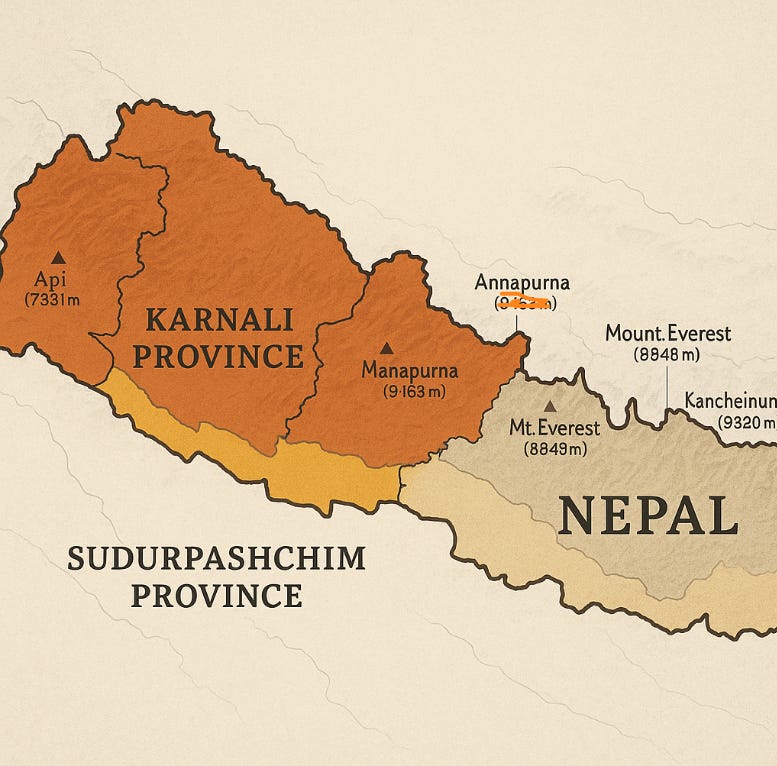
Map of Nepal highlighting the western provinces where 97 permit-free peaks are located.
Why Now? The Economic Logic Behind the Nepal Free Climbing Peaks Policy
For decades, mountaineering in Nepal has revolved around Everest and a handful of other famous peaks in the east. In 2024, Everest alone generated 77 percent of all climbing permit revenue, about Rs 790 million. By contrast, the far west attracted only 68 climbers in the past two years combined, generating just Rs 1.4 million.
By removing permit fees for these 97 peaks, the Nepal Free Climbing Peaks Policy aims to redirect global climbers toward the unexplored mountains of Karnali and Sudurpaschim. The policy is as much about redistribution as tourism. These provinces are among Nepal’s poorest, facing high outmigration, unemployment, and weak local economies.
If even a fraction of guiding jobs, homestay income, and trekking-related spending shifts westward, mountaineering could become a tool for local empowerment rather than remaining concentrated around Everest.
The Reality on the Ground Under the Nepal Free Climbing Peaks Policy
Free permits do not mean free climbing. Karnali is Nepal’s largest province but also its poorest, with the lowest road density in the country. The Karnali Highway, under construction for 26 years, remains largely unpaved. Reaching many peaks still requires days of walking from the nearest road or airstrip.
Lodges are scarce, rescue posts are almost nonexistent, and communication remains unreliable. The provincial government has allocated Rs 33.72 billion for roads, water, and transport infrastructure and plans to connect all district headquarters and 19 local centers. However, progress has been slow.
For climbers, logistics, guides, and transport remain costly. For local communities, the Nepal Free Climbing Peaks Policy offers new income opportunities, but without training and institutional support, tourism can also strain already limited services. Unless these gaps are addressed, opening so-called virgin peaks may remain symbolic rather than transformative.
Policy Trade-offs: Environment and Equity
Every major tourism policy comes with risks. On Everest, climbers generate an estimated 4.6 tons of waste daily during peak season. Karnali’s mountains, more ecologically fragile and less prepared, could face similar consequences without proper waste management systems.
Equity is another concern. A previous permit fee waiver between 2008 and 2018 attracted limited climbers, and much of the profit flowed to Kathmandu-based operators rather than local households. Without certified local guides, homestays, and cooperatives, communities risk being bypassed again, left to manage waste and accidents while others reap the benefits of the Nepal Free Climbing Peaks Policy.
What Will Make the Nepal Free Climbing Peaks Policy Work
Fee waivers are only the starting point. For this policy to succeed, four elements are essential:
Infrastructure: Improved roads, communication towers, and rescue posts modeled after regions like Manang or Pheriche.
Community Ownership: Training local residents as guides, porters, and homestay operators to keep income within the region.
Environmental Safeguards: Waste deposit systems and community-led monitoring to avoid repeating Everest’s environmental mistakes.
Promotion: Digital marketing campaigns and partnerships with international climbing federations to attract climbers to the far west.
The Bottom Line on the Nepal Free Climbing Peaks Policy
This policy is less about free climbs and more about whether Nepal can turn tourism into a shared opportunity for its most remote regions.
Over the next two years, the test is simple. Can smart policy redirect climbers from Everest to Karnali, and can fragile mountain communities convert that interest into long-term progress?
The Nepal government is betting that the Nepal Free Climbing Peaks Policy will succeed. But as always in the Himalayas, the mountains will be the final judge.